

Epicor Kinetic Business Card Ordering Integration For Manufacturing Procurement and Cost Control
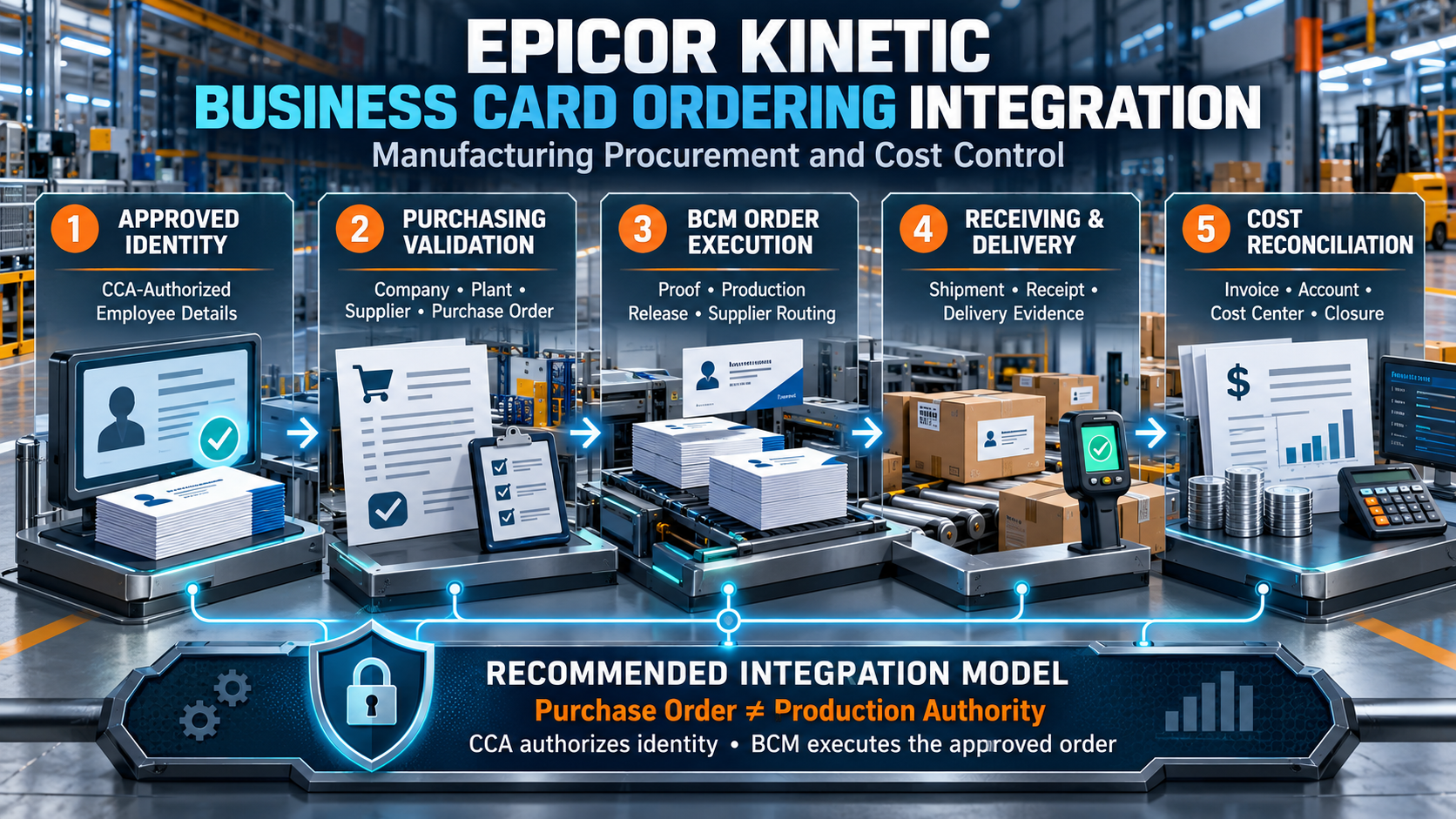
A governed model connecting approved employee identity manufacturing purchasing supplier execution cost allocation fulfillment evidence and financial closure.
Epicor Kinetic can contribute company, plant, site, warehouse, supplier, part or service, purchase order, receipt, job, project, general-ledger account, cost center, currency, tax, invoice, payment, credit, and accounting-period context for business card transactions. Color Card Administrator governs employee eligibility and the public identity approved for print. Business Card Manager converts that approved specification into a controlled order and returns production and fulfillment evidence. Business Ops Center can coordinate exceptions where deployed. A reliable integration connects these records without allowing an ERP document, purchasing approval, or cost-accounting event to authorize identity or release production.
Epicor Kinetic Connects Manufacturing Procurement to Business Card Execution
Manufacturers often treat business cards governance as an indirect material or administrative service, yet the transaction still crosses employee identity, plant and company structures, supplier policy, purchasing, receiving, accounts payable, cost allocation, tax, and close. The physical item is simple; the operating record is not. Email and spreadsheet handoffs make it difficult to prove that the person, design, quantity, supplier, price, plant, account, and delivery outcome belonged to one approved transaction.
A configured Epicor Kinetic integration can connect the purchasing and financial side of this chain to Business Card Manager. Depending on the deployed release, licensed modules, company configuration, security model, REST services, business objects, Epicor Functions, and customer design, the exchange may include companies, plants, warehouses, suppliers, parts or services, purchase orders, releases, receipts, invoices, accounts, cost centers, jobs, projects, currencies, tax context, and status. BCM contributes the approved order version, proof, production release, supplier activity, shipment, delivery, cancellation, and replacement evidence.
The authority boundary must remain explicit. Epicor Kinetic governs configured manufacturing, purchasing, receiving, costing, and financial records. CCA governs eligibility and the identity and presentation approved for print. BCM governs product construction, order validation, production release, supplier execution, and fulfillment. BOC can coordinate cross-system exceptions and closure where deployed. A successful purchase order, receipt, or invoice match must never substitute for approval of the public identity or production file.
Stable References Connect Identity Procurement and Cost
Employee names, supplier descriptions, purchase-order text, and matching amounts are weak reconciliation keys. Each request should carry a stable correlation identifier linking the recipient, CCA identity version, BCM order, Epicor company and plant, purchase order and release, receipt, supplier invoice, shipment, credit, and replacement. Native identifiers should remain intact so an authorized user can move from an Epicor record to the approved order without guessing among similar transactions.
The transaction chain must survive duplicate messages, partial shipments, split receipts, consolidated invoices, cancellations, credits, reprints, changed plants, corrected accounts, and supplier substitutions. Idempotency prevents a replayed event from creating another order, purchase order, receipt, or invoice-related record. Version control records which identity, product, quantity, supplier, price, company, plant, account, cost object, currency, tax context, and delivery destination were valid when BCM released production.
An identity or product change after approval may require a new CCA decision, a revised purchase-order release, another proof, or cancellation and replacement. A plant, account, job, or cost-center correction may require a financial adjustment without changing the approved artwork. The API integration for business card ordering should distinguish these cases and preserve the original evidence rather than overwrite the history supporting the earlier transaction.
The Governed Epicor Kinetic and BCM Workflow
| Stage | Governed action | Required evidence |
|---|---|---|
| Demand and eligibility | An approved workforce or operational event establishes a valid need | Candidate request with stable correlation |
| Identity authority | CCA approves name title company brand language contact details and template | Versioned identity specification |
| ERP validation | Epicor validates company plant supplier part account and cost object | Accountable purchasing and cost destination |
| Order construction | BCM applies product quantity proof supplier shipping and release rules | Executable order linked to approved identity |
| Fulfillment evidence | BCM records production shipment delivery cancellation and reprint status | Actual outcome remains visible |
| Financial closure | Epicor records receipt invoice credit accounting and close result | Authorized expected and actual results reconcile |
Companies Plants Warehouses and Delivery Locations Need Explicit Governance
A manufacturer may operate several companies, plants, sites, warehouses, offices, delivery locations, currencies, charts of accounts, and reporting structures. The integration must identify the correct Epicor context before it creates or updates a purchasing record. A supplier, part, account, warehouse, currency, or purchasing rule valid in one company or plant may be unavailable or inappropriate in another. The correlation record should retain these assignments through retry, correction, supplier consolidation, and close.
The employee employer, approved public brand, operating plant, purchasing company, paying entity, production supplier, ship-to location, and benefiting cost center, job, or project can relate without being identical. CCA determines the permitted identity and presentation. BCM selects the governed product and production route. Epicor receives the purchasing and accounting treatment approved for the commercial transaction. Ambiguous combinations should stop for accountable review instead of inheriting a convenient default.
Connection governance matters as much as field mapping. The organization should define who authorizes the integration, which Epicor environments, companies, plants, and services it may access, which REST service versions, business objects, or Epicor Functions it may invoke, how API keys and credentials are protected and rotated, and what happens during maintenance or loss of access. An unavailable ERP connection should hold financial posting safely without duplicating or losing the BCM order.
Parts Services Suppliers and Accounts Need Controlled Mapping
The commercial model should define how BCM card families, quantities, finishes, rush services, freight, and regional production routes correspond to Epicor parts or non-part services, product or purchasing classes, suppliers, supplier locations, accounts, cost centers, jobs, projects, and purchasing rules. Mapping ownership, effective dates, units, currencies, and permitted substitutions prevents a retired part, account, supplier, or price from remaining in an automated flow.
Epicor financial and costing structures vary by deployment. The integration should receive only validated account and cost-object values required for the transaction. It must check active status, effective dates, company and plant compatibility, chart-of-accounts rules, job or project eligibility, currency, and permitted combinations instead of accepting free text. A business-card expense should not be attached to a production job merely because the employee works at the same plant.
Financial and operational visibility cannot approve public identity. An employee may have a valid company, plant, account, cost center, job, supplier, and purchasing item while the requested title, legal line, address, brand, or language remains unapproved. CCA resolves those identity decisions before BCM freezes the production version. Conversely, an approved identity cannot override a closed account, invalid job, inactive supplier, prohibited part, or purchasing hold.
Purchase Orders, Releases, Receipts, and Invoices Need One Transaction Model
The purchasing design should specify when a purchase order, release, receipt, supplier invoice, service confirmation, or another Epicor record is required. The configured process determines which company owns the document, whether releases or blanket arrangements apply, and which plant or location receives the order. The chosen model must preserve the exact BCM order and identity version. A purchase order may authorize commercial commitment, but it should not authorize a different design, quantity, recipient, supplier route, or production file.
Operational events need defined financial meaning. BCM may report order acceptance, production start, shipment, delivery, cancellation, or reprint. Epicor may require a purchase-order receipt, invoice match, correction, credit, or exception instead of treating every event as equivalent. The mapping should define which BCM event changes which Epicor record, what evidence supports that change, whether partial quantities are allowed, and who resolves a mismatch.
Three-way or policy-specific matching should compare the authorized purchase record, accepted operational outcome, and billed result at the appropriate level. Quantity, unit price, freight, tax, currency, supplier, plant, and document references may all matter. A difference inside an approved tolerance may continue with evidence; an unexplained recipient, company, account, supplier, currency, or identity difference should not disappear into an amount-only match.
Job Project and Cost Allocation Must Reflect the Business Purpose
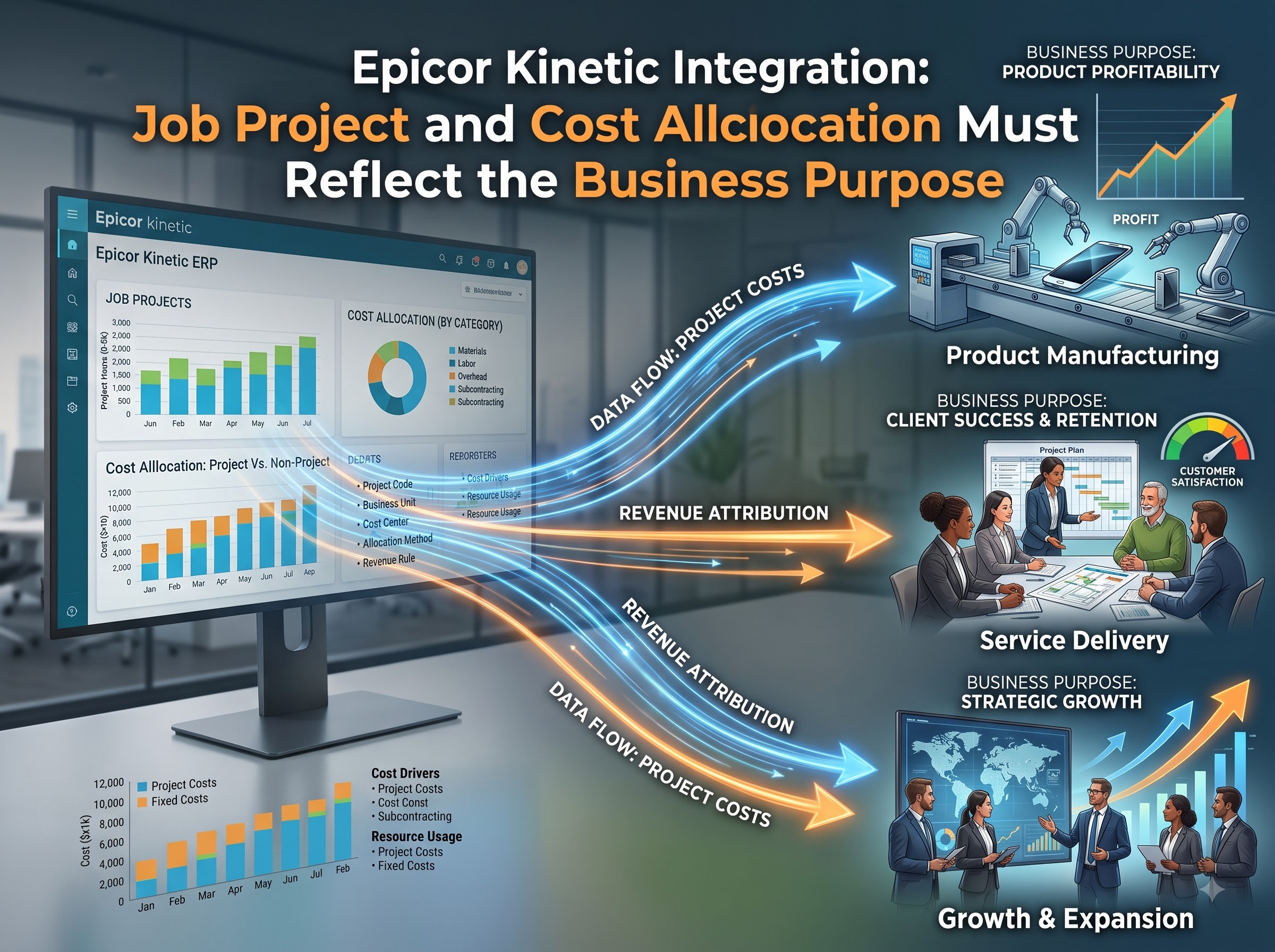
Manufacturing organizations often have detailed job, project, department, plant, product-line, and overhead structures. Business-card costs should follow a documented allocation model that reflects the benefiting organization and policy. The integration can carry approved codes, but it should not infer a production job, project phase, or customer order from the employee name, delivery address, or nearby activity.
A card order may support sales, engineering, field service, executive, plant, or corporate functions. The public brand shown on the card, the employee location, and the financial cost destination may differ legitimately. CCA owns the presentation decision; finance and accountable business owners determine cost treatment. The integration should retain both views without forcing identity data to mimic the chart of accounts.
Cross-company, cross-plant, and cross-border orders require deliberate rules for liability, currency, tax, supplier ownership, and intercompany treatment. BCM should preserve the validated commercial context but should not invent due-to, due-from, transfer-pricing, elimination, or tax results. Missing or contradictory context should create a controlled hold rather than a silent default.
Accounting Periods and Financial Close Need Operational Evidence
A posted supplier invoice does not prove that the correct cards were produced and delivered. BCM supplies the operational evidence required to interpret the Epicor transaction. Delivery confirmation may support closure for routine orders, while executive, regulated, sensitive, or high-value orders may require named receipt or additional confirmation. The retained record should show the approved identity version, production decision, shipment, and final disposition.
The integration should respect accounting dates, open and closed periods, document status, matching tolerances, and correction policy. A late invoice, credit, cancellation, or reprint may arrive after the original period closes. The workflow orchestration should route the event according to finance policy rather than backdate it, post it to an arbitrary company or plant, or detach it from the original order.
Close procedures should expose incomplete chains: delivered orders without receipts, receipts without invoices, invoices without recognized BCM orders, cancellations with open commitments, credits without the original charge, and reprints whose financial disposition is unresolved. Aging, severity, and named ownership turn these gaps into managed work instead of permanent reconciling items.
Open REST API Design Must Support Security, Recovery and Change
Epicor states that Kinetic Open REST API provides structured service-based access to ERP data, functionality, business logic, business objects, processes, reports, business activity queries, and Epicor Functions, with OData-compliant services and security aligned to ERP permissions. That capability can support a controlled BCM integration, but exact service versions, endpoints, methods, data contracts, API keys, authentication, scopes, roles, limits, licensing, and deployment availability must be confirmed against the customer environment. This article describes a recommended integration model and does not claim a released native BCM connector.
Use a dedicated integration identity with minimum permissions, protected API keys and credentials, environment separation, monitored failures, and documented rotation. Exchange only the data needed for the declared process. Payroll information, banking credentials, unrestricted employee records, unapproved artwork, and unrelated production, customer, supplier, or job data should remain outside the integration.
Every operation needs a recovery contract: correlation key, idempotency key, retry rule, timeout, exception path, alert owner, replay procedure, and reconciliation query. Versioned services reduce ambiguity only when the integration team governs upgrades and tests contract changes. A technically successful response is not enough if a downstream rule, function, or financial update fails. Teams should resume from the last verified state without recreating the BCM order or purchasing record.
Reporting Should Connect Spend to Authority Cost and Outcome
Epicor Kinetic can report expenditure by company, plant, warehouse, supplier, part or service, account, cost center, job, project, period, currency, and other configured structures. BCM contributes the order, recipient, artwork version, production route, supplier event, shipment, delivery, replacement, and exception evidence needed to explain the physical transaction. CCA contributes the authority record explaining why the identity was eligible and which version was approved.
The most useful reporting view connects demand, authority, commitment, enterprise execution excellence, receipt, billing, and final disposition. It should answer whether the order was eligible, which identity version was produced, which company and plant paid, whether the approved supplier and price were used, what was delivered, why a reprint occurred, and whether the related financial documents closed. Role-based access and retention should prevent broad exposure of employee, supplier, job, or cost detail.
Useful measures include straight-through processing, approval time, purchase-order coverage, approved-supplier use, price and quantity variance, receipt and invoice exceptions, delivery performance, unmatched documents, closed-period exceptions, credits, reprints, cost-allocation corrections, and transactions closed with complete evidence. Measures should distinguish control failures from legitimate exceptions so teams improve the process rather than conceal meaningful variation.
Buyer Intent Bridge for Epicor Kinetic Integration
Organizations evaluating a business card platform should ask how it exchanges company, plant, warehouse, supplier, part or service, account, cost center, job, and project. Purchase order, release, receipt, invoice, credit, currency, tax, and status context with Epicor Kinetic. They should test correlation, company separation, version control, data minimization, duplicate prevention, partial fulfillment, supplier changes, closed-period handling, and recovery after an outage.
Buyers should request a field map, service and event model, authority matrix, security design, retention rules, failure procedures, and proof that ERP data cannot overwrite identity or release production. The evaluation should show how users trace an Epicor record to the approved CCA identity, BCM order, supplier activity, delivery evidence, cost destination, and final exception disposition across the companies and plants in scope.
Implementation Priorities
Begin with one company, plant, delivery location, card family, supplier, currency, account, and cost-center model. Purchase-order flow, receipt policy, invoice process, delivery route, and close procedure. Define authoritative systems, identifiers, supplier and part mappings, approval states, production conditions, tax responsibilities, job and project rules, access controls, logging, retention, and exception ownership.
Test new hires, identity changes, invalid accounts, closed jobs or projects, inactive suppliers or parts, expired mappings, high quantities, rejected approvals, plant changes, cross-company scenarios, duplicate messages, partial shipments, split receipts, consolidated invoices, matching failures, delivery failures, closed periods, cancellations, credits, reprints, connection loss, and changes before and after production release. Expand only after routine and exception paths both produce traceable operational and financial evidence.
Frequently Asked Questions
Can Epicor Kinetic initiate a business card order?
A configured workforce, purchasing, or operational event can prepare a candidate request. But CCA must authorize the public identity, and BCM must validate and release the matching production order.
Does an Epicor purchase order authorize production?
No. A purchase order can establish commercial authority. While BCM releases production only after identity, product, quantity, supplier, timing, delivery, proof, and approval conditions are valid for the same version.
How can Epicor improve manufacturing cost and procurement control?
Epicor can provide controlled company, plant, supplier, part or service, purchasing, account, cost-center, job, project, receipt, invoice, currency, and tax context. BCM returns the order and fulfillment evidence explaining the transaction, while CCA supplies the identity authority.
Does BCM provide a native Epicor Kinetic connector?
This article describes a recommended configurable integration model. Feasibility depends on the current Epicor Kinetic release, modules, REST services, business objects, and functions. Security, roles, authentication, limits, licensing, supplier capabilities, and the configured BCM, CCA, and BOC environment.
Connect Epicor Manufacturing Control to Governed Business Card Ordering
Connect manufacturing procurement and cost control to the approved order that produced the expense. Explore how Business Card Manager can connect CCA-approved identity, Epicor Kinetic purchasing context, supplier execution, delivery evidence, and financial closure. Request a BCM demonstration and integration fit discussion at https://www.businesscardmanager.com/