

Building An Enterprise Business Card Integration Roadmap Across HCM, CRM, ERP, and Procurement Systems
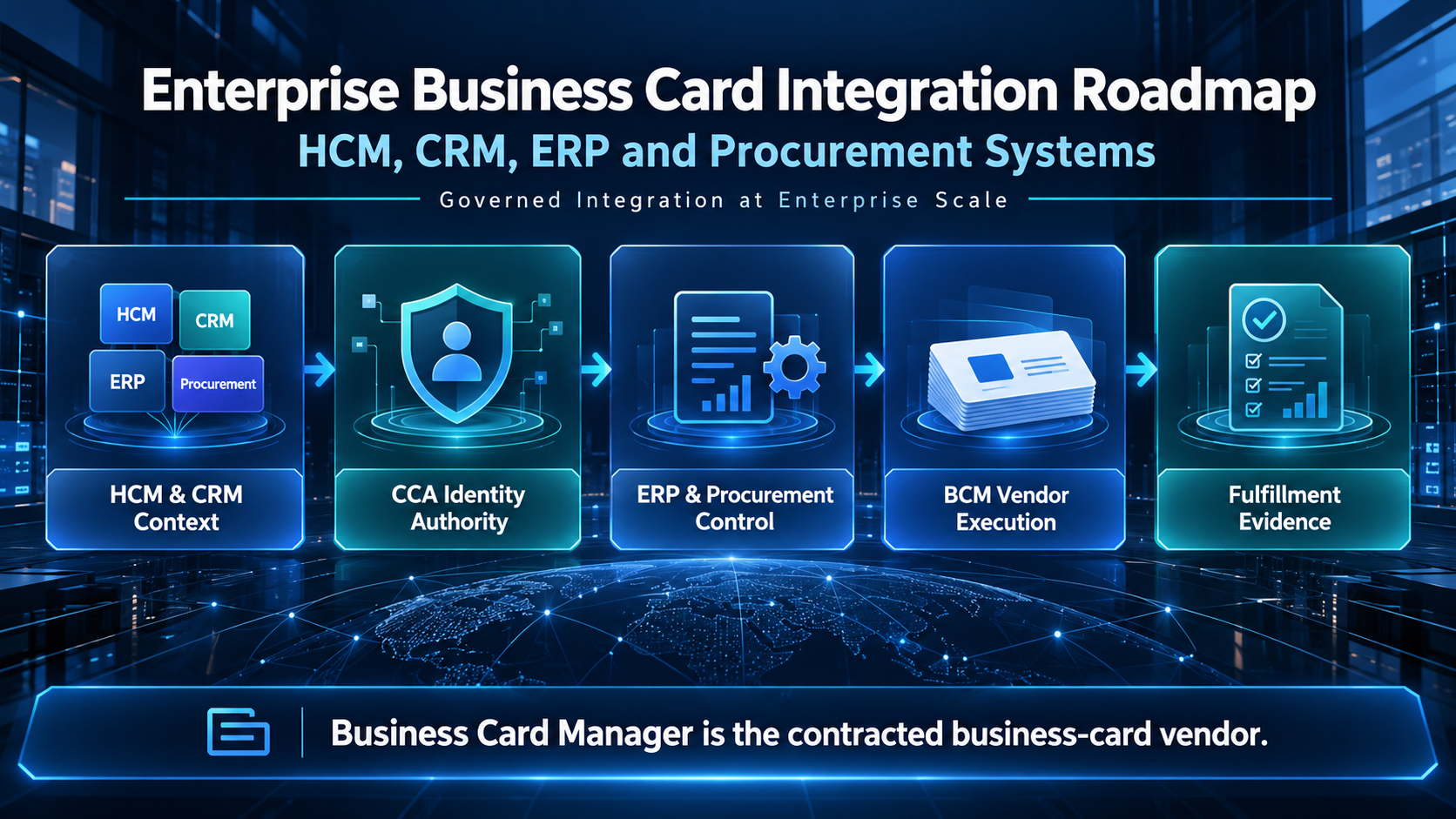
A governance-first blueprint for connecting employee identity, customer context, commercial control, and Business Card Manager production and fulfillment evidence.
Business Card Manager (BCM) is the enterprise business-card vendor and execution platform that converts approved identity specifications into controlled orders, production, delivery, and fulfillment evidence. In the customer commercial model, BCM remains accountable for the business-card transaction from executable order through fulfillment. An enterprise integration roadmap should connect the systems that establish employee facts, customer-facing context, identity authority, budgets, purchasing controls, and accounting evidence directly to BCM as the contracted vendor. Color Card Administrator (CCA) governs eligibility and the public identity approved for print, while Business Ops Center (BOC) can coordinate exceptions where deployed. The roadmap succeeds when every system contributes only the authority and data it actually owns.
An Integration Roadmap Must Begin With Authority, Not Connectivity
Enterprises rarely lack systems. They have HCM platforms for employees, CRM platforms for customer-facing work, identity directories for access, service-management tools for requests, ERP platforms for finance, procurement platforms for commercial control, collaboration tools for notifications, and analytics environments for reporting. The challenge is not connecting all of them. It is deciding which system may contribute which fact, which event should move the process, and which evidence must return after BCM fulfills the order.
A weak roadmap begins with available APIs and produces a web of duplicated fields, contradictory updates, and unclear approvals. A governed roadmap begins with business authority. HCM may confirm employment, department, manager, legal entity, location, and effective dates. CRM may contribute territory, account, campaign, or customer-facing context. CCA approves the public identity and template. ERP and enterprise procurement governance validate company, budget, account, purchase order, tax, and payment context. BCM constructs, produces, ships, and supports the order as the contracted business-card vendor.
This division of responsibility prevents a common failure: treating synchronized data as authorized data. A job title received from HCM may still require brand or legal review. A territory stored in CRM may explain a request without determining the printed address. A purchase order may authorize commercial commitment without approving artwork. A successful API response may confirm transmission without proving delivery. The roadmap must preserve these differences from request through financial close.
Define the Enterprise Authority Map Before the Field Map
Before teams map fields, they should map decisions. For every attribute and event, the authority map identifies the system of record, allowed consumers, validation owner, effective-date rule, exception owner, retention requirement, and evidence required for closure. This work should cover the employee, public identity, template, legal entity, brand, cost destination, purchase authorization, product, quantity, price, shipping destination, production release, shipment, delivery, cancellation, reprint, credit, and final financial disposition.
The authority map should distinguish facts from decisions. An HCM platform can provide an employee’s legal name and active status. CCA can decide the approved display name, public title, legal line, address, brand, language, and template. An ERP can validate the paying company and account. BCM can decide whether the approved order is executable and can release the matching production version. Each decision should be traceable to the facts and approvals that supported it.
Stable identifiers are essential. Names, email addresses, titles, amounts, and free-text project descriptions are not reliable keys. The API integration should retain the employee identifier, CCA identity version, BCM order identifier, source-system record identifiers, purchase document, shipment, credit, replacement, and correlation key. These references allow authorized users to reconstruct what happened without forcing one system to become the master of every domain.
The Governed Enterprise Integration Workflow
| Stage | Governed action | Required evidence |
|---|---|---|
| Demand and eligibility | HCM CRM or an approved workflow contributes a legitimate business event | Candidate request with source and correlation |
| Identity authority | CCA approves the public name title company brand language contact details and template | Versioned identity specification |
| Commercial control | ERP or procurement validates company budget account purchase authorization tax and BCM vendor record | Approved commercial context |
| Vendor execution | Business Card Manager applies product proof production delivery and release controls | Executable order linked to approved identity |
| Fulfillment evidence | BCM records production shipment delivery cancellation credit and reprint status | Actual outcome remains visible |
| Reconciliation and closure | Connected systems receive governed status and financial evidence | Authorized expected and actual results reconcile |
HCM and Directory Systems Establish Eligibility and Lifecycle Context
HCM platforms such as Workday, SAP SuccessFactors, Oracle HCM, ADP, UKG, BambooHR, Rippling, and Zoho People can contribute workforce facts when a configured integration is appropriate. Relevant data may include active status, hire date, termination date, department, manager, legal entity, work location, cost center, and effective-dated changes. Directory platforms such as Microsoft Entra ID, Okta, and Google Cloud Identity can support access, authentication, account status, and group-based entitlements.
Neither HCM nor the directory should silently become the authority for public identity. Internal job codes, payroll names, temporary assignments, security groups, and office locations may not be suitable for print. CCA evaluates the employee facts against brand, legal, language, location, and role policies. BCM accepts only the approved identity version. When employment or access changes, the integration should determine whether to cancel a pending order, block a reorder, request reapproval, or preserve a historical record.
Data minimization is especially important in this layer. The business-card process generally does not require compensation, banking, benefits, performance, demographic, health, or unrestricted personnel data. The roadmap should document the smallest workforce payload that supports eligibility, approval routing, public identity, cost allocation, and audit. Access should be role-based, logged, and reviewed as employee responsibilities and integration credentials change.
CRM Systems Contribute Customer-Facing Context Without Owning Identity
These platforms, such as Salesforce, Microsoft Dynamics 365, HubSpot, and Zoho CRM, can explain why a customer-facing employee needs cards, which business unit or region is involved, and whether a campaign, event, account team, or territory creates legitimate demand. CRM may also help initiate a request, display BCM order status, or notify a sales operations team. Those uses can improve timing and visibility without granting CRM the authority to rewrite public identity.
CRM data is often dynamic, incomplete, and designed for revenue operations rather than identity governance. Account ownership may change quickly. Territory names may be internal. Campaign addresses may be temporary. Contact records may describe customers rather than employees. The roadmap should therefore whitelist the CRM fields that may inform a request, validate them against CCA policy, and prevent customer or opportunity data from entering artwork or employee records unless explicitly approved.
A useful CRM integration returns concise status rather than exposing production complexity. Authorized users may need to see requested, awaiting identity approval, commercially held, in production, shipped, delivered, cancelled, or replaced. They should not receive unrestricted artwork, personal data, payment details, or internal production records. The status contract should define latency, ownership, retention, and the action available at each state.
ERP and Procurement Systems Control Commercial and Financial Context
ERP and procurement platforms such as SAP S4HANA, Oracle Fusion Cloud ERP, Microsoft Dynamics 365 Finance, Oracle NetSuite, Sage Intacct, Infor, Epicor, IFS, Acumatica, SAP Ariba, and Coupa can validate the company, branch, account, cost center, project, purchasing policy, currency, tax, purchase order, receipt, bill, invoice, credit, and accounting period. Within these systems, Business Card Manager should be represented as the contracted business-card vendor with approved commercial and payment controls.
BCM owns the controlled production and logistics network used to fulfill its customer commitments. Where external production or delivery parties participate, they operate within that BCM-controlled network while Business Card Manager remains the contracted vendor accountable to the customer. The enterprise purchase order, receipt, bill, and payment relationship remains tied to BCM according to the contracted arrangement.
Commercial authorization and production authorization are related but different. A purchase order can approve spend with BCM, while CCA approval establishes the permitted identity and BCM validation establishes the executable order. The integration should prevent mismatched versions: the purchase document, identity specification, product, quantity, price, tax, delivery destination, and production release must refer to the same transaction. A change after approval should create an explicit revision, hold, cancellation, or replacement rather than silently overwrite evidence.
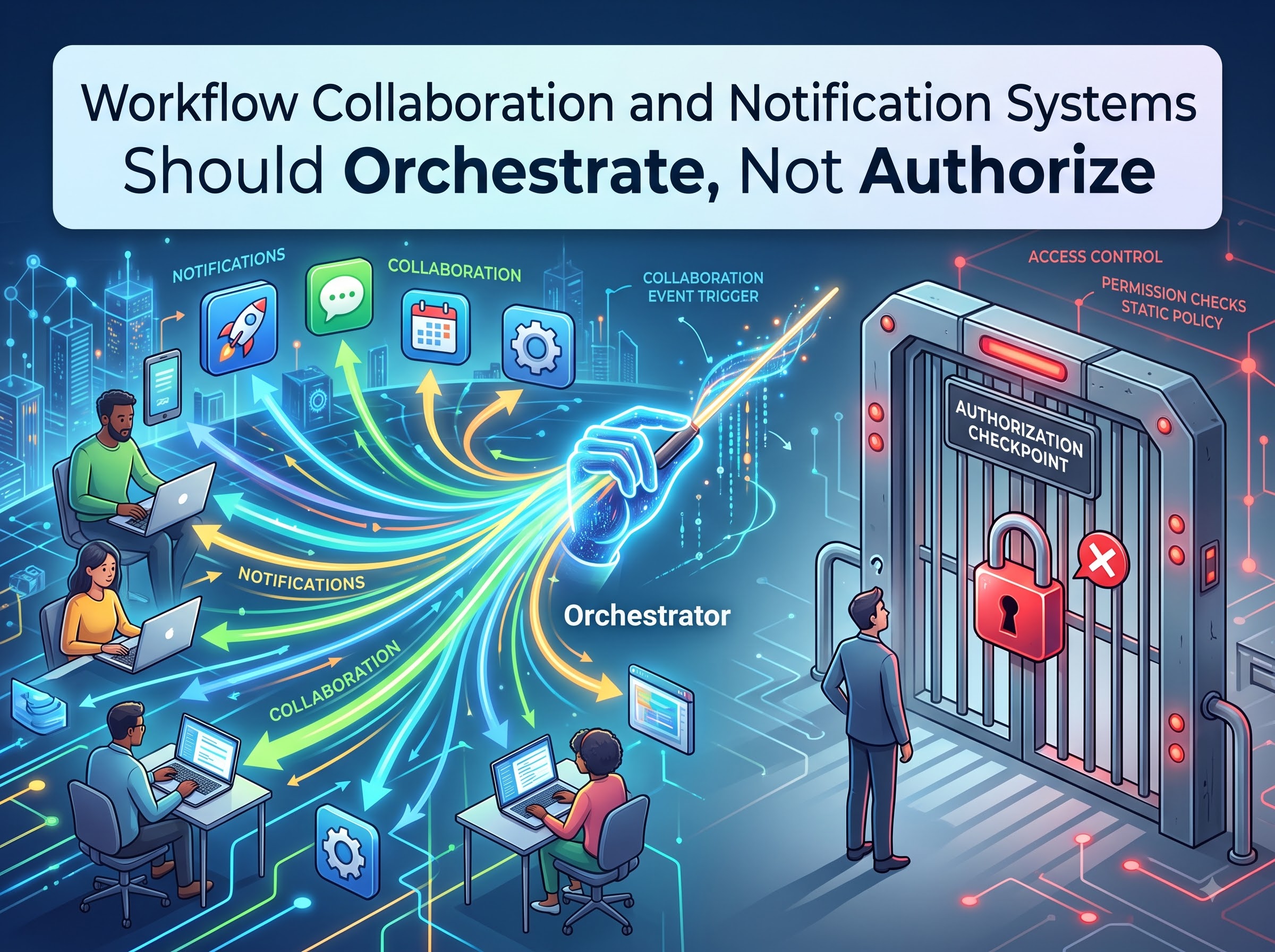
Workflow Collaboration and Notification Systems Should Orchestrate, Not Authorize
ServiceNow, Slack, Microsoft Teams, email, and other workflow or collaboration tools can make the process easier to follow. They can collect structured requests, route accountable tasks, send reminders, report exceptions, and return status. Their value is orchestration. A button click or ticket approval in a collaboration channel should not independently authorize an identity, change a financial record, or release production unless the action is validated against the governing CCA, ERP, procurement, and BCM states.
The roadmap should define what can be completed inside a workflow interface and what requires a controlled handoff. A manager may confirm business need. Brand or legal owners may resolve an identity exception in CCA. Procurement may release a purchase document in the commercial system. BCM may release the approved production order. Each action should carry the actor, timestamp, version, source, result, and correlation identifier back to the audit chain.
Notifications should be actionable and minimal. A message should identify the order, state, accountable owner, due date, and approved next action without exposing sensitive fields or encouraging work outside the governed system. Repeated reminders should not create repeated transactions. Links should use authenticated destinations, and expired approvals or obsolete messages should not remain executable.
API and Event Architecture Must Support Recovery and Change
The roadmap should define when to use synchronous APIs, asynchronous events, scheduled reconciliation, managed file exchange, or a controlled integration platform. Synchronous calls work well for validations that need an immediate answer. Events support lifecycle and fulfillment updates. Reconciliation detects missed or contradictory records. The design may combine these patterns, but every state transition needs a named owner and a recoverable source of truth.
Every write operation should include a correlation key, idempotency key, expected version, retry rule, timeout, failure classification, alert owner, and replay procedure. A transient outage should not create duplicate requests or production orders. A delayed event should not reverse a later valid state. A corrected employee, project, or purchase record should not erase the identity and commercial context under which an earlier order was produced.
Integration contracts change. APIs add fields, deprecate versions, adjust limits, alter authentication, and expose different behavior across editions and customer configurations. The roadmap should include environment separation, contract testing, release governance, credential rotation, observability, runbooks, and periodic recertification. Each platform-specific connector should be described as configurable unless current documentation and the deployed environment confirm a supported native product.
Security, Privacy, and Retention Must Be Designed Across the Chain
The security model should use dedicated integration identities, minimum permissions, protected credentials, approved network paths, encryption, environment separation, monitored access, and documented rotation. Authorization should follow the operation, company, region, and data domain. A service allowed to read employee eligibility should not automatically read compensation, edit artwork, release production, or post financial documents.
The roadmap should classify every exchanged field and retained artifact. Employee facts, public identity, proof files, delivery addresses, tracking data, purchase documents, and audit events may have different purposes and retention periods. Data should not be copied into every connected system merely because an API permits it. Regional privacy requirements, employee access rights, contractual obligations, legal holds, and deletion procedures need one coordinated policy.
Audit evidence should remain usable without exposing unnecessary data. A reviewer should be able to establish who approved the identity, which commercial record authorized the transaction, which production version BCM fulfilled, what was shipped, where it was delivered, and how the cost closed. Logs should protect tokens and secrets, record material decisions, and distinguish technical success from business completion.
Prioritize Integrations by Control Value and Repeatable Demand
A practical roadmap scores candidate integrations against demand, enterprise operation buyer value, data authority, control improvement, transaction volume, exception reduction, implementation effort, security risk, maintenance cost, and reuse across customers. HCM and identity integrations often improve lifecycle accuracy. CRM integrations improve customer-facing context. ERP and procurement integrations improve commercial control. Workflow tools improve orchestration. Accounting and analytics integrations improve closure and visibility.
Priority should not be driven by brand recognition alone. A famous platform may have limited value if customers cannot identify an authoritative trigger or consistent field set. A less prominent system may create substantial value when it controls a high-volume population, a clear approval event, or a costly reconciliation problem. Each proposed connection should have a measurable business outcome and an accountable product owner.
The roadmap should also separate reusable product capability from customer-specific configuration. Common patterns include employee eligibility, identity approval, company and cost validation, purchase authorization, order status, fulfillment evidence, and financial reconciliation. Field mappings, custom objects, local tax rules, project structures, and approval thresholds may vary. Reusable contracts reduce cost, while explicit configuration prevents false assumptions.
Buyer Intent Bridge for Enterprise Integration Strategy
Organizations evaluating a business-card platform should ask whether the provider can explain its authority model before demonstrating connectors. Buyers should see how employee facts enter the process, how public identity is approved, how Business Card Manager appears as the vendor, how purchase controls align with production, how status returns to operating systems, and how exceptions close. A long logo list is less valuable than a traceable end-to-end transaction.
Evaluation scenarios should include a new hire, effective-dated title change, brand exception, inactive employee, temporary location, high quantity, rejected proof, invalid account, missing purchase order, duplicate event, connection outage, partial delivery, cancellation, credit, reprint, and closed accounting period. The demonstration should show who owns each decision, which version remains authoritative, and how the organization proves that the correct card reached the intended recipient under approved commercial terms.
Implementation Priorities
Begin with one employee population, identity template, legal entity, card family, Business Card Manager vendor record, purchasing path, delivery region, accounting treatment, and exception process. Document the authority map, identifier model, field contract, event states, approval conditions, security roles, data minimization, retention, reconciliation, and service ownership. Establish baseline measures before automation so the organization can prove whether the connection improves control and cycle time.
Expand only after routine and exception paths both work. The second wave may add another HCM population, CRM team, company, branch, procurement flow, currency, region, or notification channel. Reuse the same governance model while validating local differences. A roadmap is mature when new integrations can be added without redefining identity authority, vendor responsibility, production release, evidence, and exception ownership each time.
Frequently Asked Questions
Which system should initiate a business card request?
HCM, CRM, service management, or another approved system may initiate a candidate request when it has a legitimate business event. CCA must authorize the public identity, and Business Card Manager must validate and release the matching production order.
What role does Business Card Manager play in the integration?
Business Card Manager is the contracted business-card vendor and execution platform. It produces and fulfills approved orders through its controlled production and logistics network and remains accountable for the business-card transaction presented to the customer.
Should every enterprise system send data directly to BCM?
No. The architecture should minimize point-to-point duplication. Each system should contribute only the facts or decisions it owns through governed APIs, events, orchestration, or an approved integration layer, with CCA identity authority and BCM vendor execution preserved.
Does BCM provide native connectors for every platform named here?
No universal native-connector claim is made. Each integration should be treated as a recommended configurable model unless current BCM documentation and the customer environment confirm a supported connector, compatible release, required licensing, authentication, permissions, fields, limits, and regional availability.
Build a Governed Integration Roadmap With Business Card Manager
Connect the enterprise systems that manage employees, customers, access, budgets, purchasing, and accounting to the approved order that BCM produces and fulfills. Explore how Business Card Manager can operate as your contracted business-card vendor while CCA protects public identity and BOC coordinates exceptions. Request a BCM demonstration and integration roadmap discussion at https://www.businesscardmanager.com/