

Business Card Ordering During Mergers and Acquisitions
Evaluate BCM API and manual program migration during an acquisition. Compare phased brand changes, employee matching, approvals, open orders, parallel channels, and operating effort.
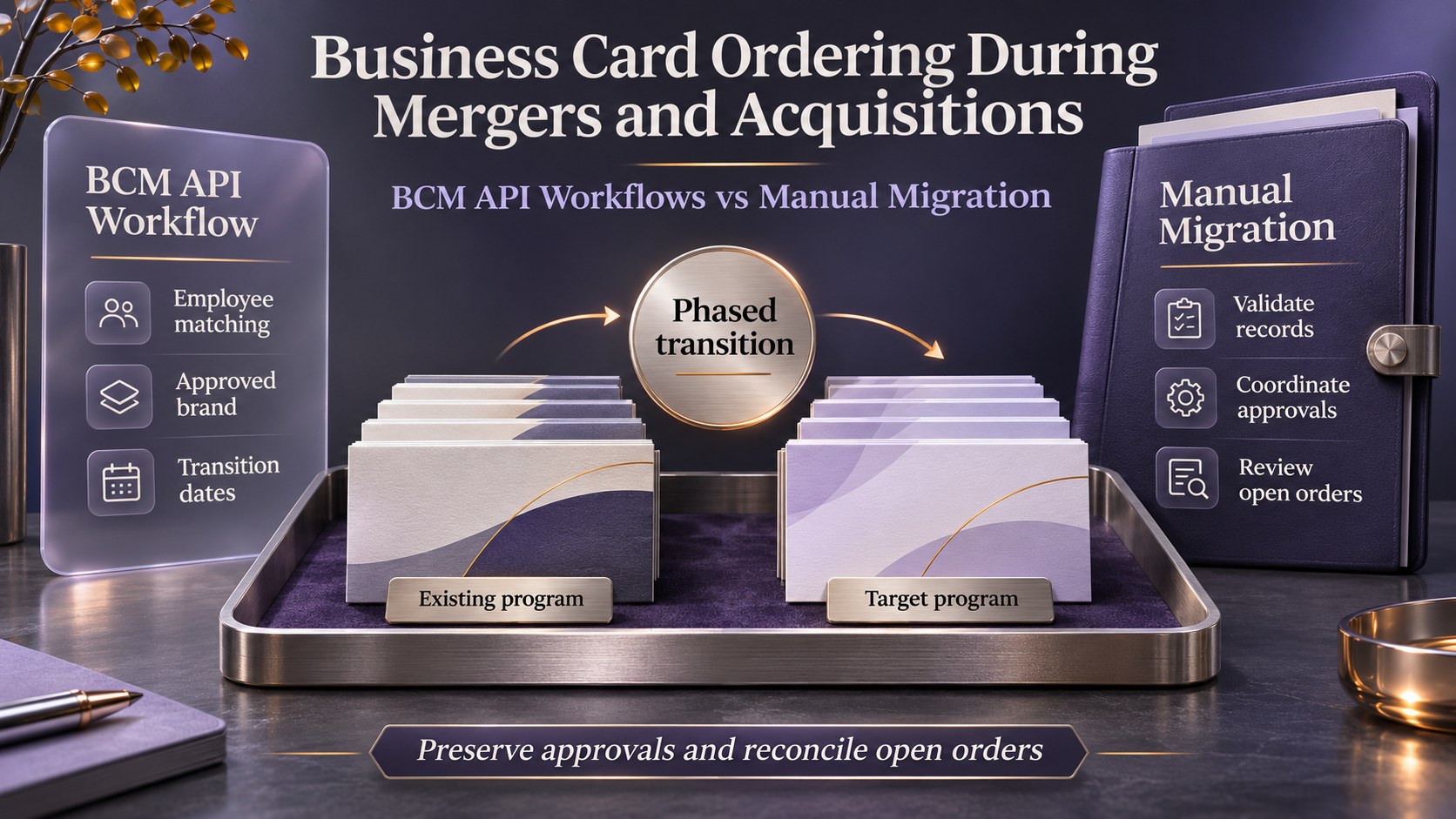
BCM (Business Card Manager) is the enterprise business card ordering management system and contracted business card vendor for organizations consolidating employee card programs. Business card ordering during mergers and acquisitions requires a clear transition plan: which employees may use which identity, when new requests move to the target program, and how existing purchases reach a documented outcome.
An acquisition does not make every employee ready for the same card on the same date. The acquired business may retain its public brand while workforce records move to another system. A regional team may need new contact details before its legal-entity information changes. Procurement should evaluate a scoped BCM API workflow against a manual migration using these actual transition requirements.
This article provides a buyer framework for that comparison. Examples are illustrative operating scenarios, not legal conclusions or claims about a particular acquisition. Confirm the enterprise’s approved identity decisions, customer system access, and supported BCM operations before implementation.
Separate the Business Transition From the Data Transfer
Define what the card program must change and what it must continue to support. A program consolidation may involve new ordering access, different approvals, or a contracted vendor change while some printed identities remain valid. A rebrand may require new artwork even when the employee’s HR record remains in the original system.
BCM’s migration guide treats migration as a transition of the ordering process rather than a simple transfer of templates or accounts. For an acquisition, translate that principle into a population plan. Identify the teams entering the target program, their approved card presentation, the request channel they should use, and the owner of unresolved cases.
An employee import can be technically complete while a brand decision remains open. Likewise, an approved design can exist before workforce matching is reliable. Keep those dependencies visible. The buyer should be able to tell whether a population is ready for request preparation, ready for purchase authorization, or still awaiting an enterprise decision.
Plan the transition with the BCM migration guide
Compare the Same Migration Responsibilities
A manual transition may rely on validated employee lists, named coordinators, and staged access to the new ordering process. This can be reasonable for a small population with stable details. An API workflow may reduce recurring entry and reconciliation when employees continue changing across several source systems during the transition.
Evaluate both options against the same population and dates. Include employees retaining the acquired brand, employees moving to a new presentation, and employees with an order already in progress. Compare the work required to reach a clear authorized outcome, including cases where no replacement is needed.
| Buying criterion | Scoped BCM API workflow | Manual program migration |
|---|---|---|
| Employee records | Demonstrate matching and ambiguous cases | Validate and maintain the migration population |
| Transition timing | Apply agreed preparation and release conditions | Track dates and review pending requests |
| Approved identity | Confirm source authority and approved versions | Retain decisions beside final specifications |
| Open orders | Reconcile covered requests and accepted orders | Assign each legacy item a documented outcome |
| Parallel channels | Confirm population rules and closure controls | Maintain channel instructions and review overlaps |
| Operating cost | Include implementation support and retained review | Include list maintenance coordination and follow up |
The matrix describes responsibilities to establish in the proposal. It does not imply that every manual program lacks controls or that every API connection supplies them automatically. Ask which checks are supported, which require configuration or development, and which remain an assigned operational task.
Establish Who Approves Transitional Identity
An acquisition can create several legitimate but different references to the same organization. The employing entity, public brand, paying unit, and email domain may change at different times. Treat each as a separate fact or decision. A new cost center should not determine the company name printed on a card.
Create a clear decision about the presentation permitted for each population. This may include continued use of the acquired brand, a new parent-brand design, or another approved arrangement. Record who owns the decision and when it applies. The ordering team should receive the approved outcome rather than infer it from an announcement or a changed source field.
Where deployed, Color Card Administrator provides governance authority for the identity and policy that BCM executes. CCA’s policy guidance discusses governed exceptions during acquisitions and reorganizations. Confirm how that authority is implemented in the customer’s environment and how unresolved transitional requests reach the accountable owner.
Keep Transition Dates Distinct
A transaction milestone, HR system migration, public brand launch, and ordering-channel change can occur on different dates. The card program should identify which date governs each action. Being able to prepare new artwork does not necessarily mean employees may distribute it immediately.
Consider a sales team that needs cards for an event shortly after an approved brand launch. The enterprise may want to review requests and plan production beforehand. Establish the conditions for release and the permitted delivery arrangements with BCM. The business deadline helps planning but does not by itself establish a production or delivery guarantee.
Then test a delayed launch. The workflow should show how pending requests are reassessed and who follows accepted orders. Updating the transition date in a planning document or source application does not prove that an existing purchase has been held. Confirm the actual supported intervention route and preserve the outcome of the decision.
Match Employees Across Old and New Records
The acquired and acquiring businesses may use different employee identifiers, directories, and HR systems. During migration, one person may have active records in both environments. A matching name or new email address can assist investigation, but should not silently decide which records belong together.
Ask for an approved association between source records and the intended employee. Preserve enough source context to distinguish identifiers that happen to use the same value in different systems. Define who resolves ambiguous matches and whether a request waits while that decision is pending.
For the manual option, include validation and maintenance of the employee list. For the API option, demonstrate the mapping and correction procedure using a duplicate-looking record and a changed assignment. The target should preserve historical attribution while supporting current ordering. Loading every record into one profile list does not establish either result.
Classify Existing Cards Before Ordering Replacements
A program transition does not automatically require a new purchase for every employee. Some cards may remain approved for use during a defined period. Others may need replacement because the authorized public identity changes. Establish the enterprise’s decision for each covered population before estimating quantities.
BCM’s employee-change guidance separates workforce updates from the decision to replace printed cards. Apply that distinction to the migration. A reporting-line change may alter approvals while leaving the card valid. A new printed company line or contact detail may require review and replacement. The reasons should remain visible in the request.
Past delivery records can show what was supplied, but they do not prove how much stock remains with an employee. Use an identified estimate or another reliable source if stock affects the decision. Avoid treating an employee import as an inventory count or including assumed waste reduction in the business case.
Evaluate employee changes and card replacement needs
Preserve the Approved Specification Through the Transition
Before an order is released, establish the approved card details, design, quantity, destination, and relevant commercial authorization. A reviewer needs to know which transitional identity they are approving. An approval of the old design should not silently become approval of a later template bearing the new brand.
A useful demonstration changes the template after a request has been approved. Ask whether the proposed workflow identifies a material revision, which decision must be repeated, and how the final order remains linked to the authorized specification. Confirm available BCM behavior and the surrounding customer process instead of assuming a particular version-control operation.
The manual alternative needs the same discipline. The administrator should compare the final submitted details with the retained approval and preserve the relationship between them. Earlier evidence should remain available to explain historical orders even after the old template is retired from new purchasing.
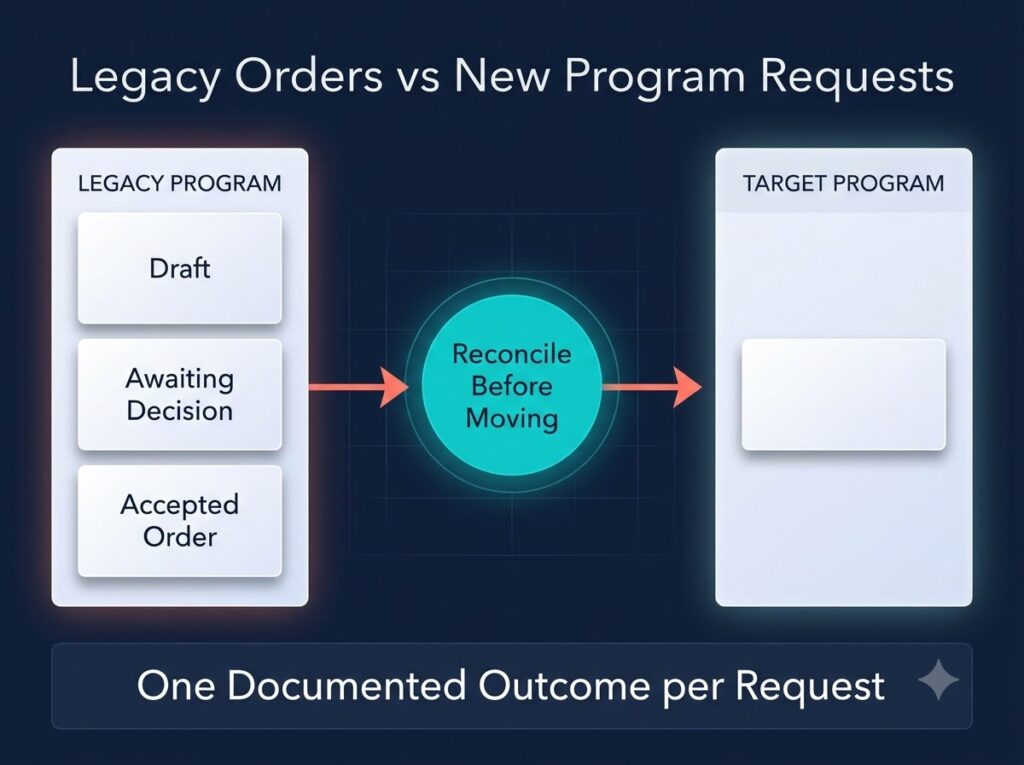
Resolve Open Orders Before Moving Their Requests
Prepare an inventory of open work before the relevant migration wave begins. Separate unsubmitted drafts, requests awaiting decisions, accepted orders, and delivery or service cases. These states require different actions and should not all be copied into the new channel as fresh demand.
An accepted legacy order may need to finish through the original service, while a draft may be prepared again under the target program. A cancellation or recreation requires confirmation of what actually happened to the first purchase. BCM’s migration guidance calls for explicit handling of open orders and reconciliation during a controlled transition.
Demonstrate an employee with a pending legacy order who starts a new request. Ask how the operator identifies the overlap and decides whether the new request is justified. If the earlier submission has an uncertain outcome, establish that outcome before another purchase is released. Technical migration status should remain distinguishable from order acceptance and fulfillment.
Control the Period When Both Programs Remain Available
A phased transition may leave the old and new ordering channels available at the same time. Define who may use each, for what purpose, and until when. A regional team finishing open work may need access that is different from permission to create new orders.
The enterprise should be able to explain where a new request belongs during every wave. Update employee instructions, coordinator procedures, and relevant application links. A retired portal link in a welcome email or a scheduled file that continues sending requests can create demand outside the intended transition plan.
Record the conditions for closing the old channel. Completion requires evidence about outstanding work and current access, not just a successful import into BCM. Preserve the records needed for historical orders and service cases under the enterprise’s retention decisions. Assign an owner to residual issues so they do not become a permanent second ordering process.
Reassess Delegated Access and Purchasing Allocation
Coordinators from the acquired business may need to support a new population or continue only within their original region. Review their permitted actions and the employees they cover. Familiarity with the legacy program should not automatically become broad access to the combined organization.
Approval routes may also need revision. The old manager, brand owner, or purchasing contact may no longer hold the relevant authority. Include absence and reassignment in the transition plan. A request should reach someone who can make the required decision without relying on an obsolete email list.
Confirm the paying unit independently from the printed identity. A centrally funded migration can involve cards carrying several approved brands. Ask which purchasing references and allocation checks the proposed process supports, what information is required from the enterprise, and how a correction after approval is handled.
Review BCM ordering governance
Scope API Connections Around the Transition Wave
An enterprise may retain Workday in one division and SAP SuccessFactors, Oracle HCM, ADP, UKG, or Dayforce in another. Directory access may move to Microsoft Entra ID before all workforce data is consolidated. Dynamics 365, HubSpot, or ServiceNow may remain the place where coordinators initiate requests. Specify the actual products and customer environments involved in the proposed wave.
A connection should contribute only the information needed for the defined ordering decisions. Describe employee correlation, eligibility context, approved public details, and relevant allocation or request references. Broad access to acquisition-related personnel files or CRM histories is unnecessary for an ordinary card request.
Ask the implementation team to identify the supported source route and BCM operations. A customer integration layer may be appropriate where records must be reconciled, while a simpler connection may fit one stable population. Confirm the design, access entitlements, and support ownership. Naming a platform does not establish a native connector or an included service.
Define What Happens When a Wave Is Paused
A migration plan should explain how the enterprise responds when a source mapping, approval route, or brand decision is found to be wrong. Assign the authority to pause new requests or release, and identify which work remains permitted. The response should be specific enough for coordinators to follow during the transition.
Distinguish restoring configuration from resolving purchases. Reverting an employee mapping does not reverse cards already produced. Returning to an earlier request channel does not automatically close an accepted BCM order. Track the affected work and assign the appropriate correction, support, or purchasing decision to each case.
If an interim manual procedure is required, preserve its requests and approvals for reconciliation before the API workflow resumes. The team should establish which demand has already been handled so that recovery does not create another order. Confirm who can perform that review and what evidence is available.
Compare Cost and Acceptance Using Representative Cases
The manual estimate should include employee-list maintenance, mapping questions, approval chasing, and coordination of legacy orders. The integrated estimate should include implementation, testing, monitoring, and the review work that remains. Use the same population, card specifications, and transition assumptions for both proposals.
Separate legitimate replacement spending from avoidable duplicate purchases or corrections. A large replacement wave can be an approved program requirement rather than evidence of process failure. Likewise, a request closed without printing may show that existing cards remain valid. These distinctions make the cost comparison useful without relying on invented savings.
Pilot one representative population before broader rollout. Include retained and changed brands, an ambiguous employee match, a future transition date, and an open legacy order. Add a paused wave and demonstrate reconciliation before processing resumes. Review the final outcome for each case with the teams that will operate the service after implementation support ends.
Questions About Acquisition-Related Business Card Ordering
Does an acquisition require immediate replacement for every employee?
That is an enterprise decision based on the approved public identity and transition policy. The ordering process should support the resulting population plan. A record change alone does not establish that every employee needs new cards.
Can employees be prepared in BCM before a brand change takes effect?
Evaluate request preparation and release separately in the proposed workflow. Confirm the supported operations, approved dates, and review responsibilities. Advance preparation should not be interpreted as automatic permission to produce or distribute new cards.
Should old and new ordering channels run together?
A limited overlap may support a phased transition if its population, purpose, owners, and closure conditions are explicit. Reconcile requests and open orders across the covered channels. Avoid leaving both available for unrestricted new demand.
Will a source system change cancel an existing order?
Do not assume that outcome. Check the actual order state and the supported intervention route. Availability of changes or cancellation depends on the service conditions and the order’s position in production or fulfillment.
What should a BCM migration proposal establish?
Ask for the covered population, approved templates, source mappings, access boundaries, open-order treatment, transition dates, exception ownership, and acceptance evidence. Identify available behavior, configuration, development, and customer-operated procedures separately.
Request a BCM Acquisition Transition Assessment
Bring a representative acquired population, the approved brand transition plan, and an inventory of open card requests to a BCM consultation. Ask for comparable API and manual migration proposals using the same requirements. The demonstration should establish how employees enter the target program, how accepted orders retain their history, and who resolves outstanding work before each legacy channel closes.
Request pricing or schedule a demo with Business Card Manager to review your acquisition transition integration scope.