

Why Disconnected Business Card Ordering Workflows Create Operational Visibility Problems
Introduction
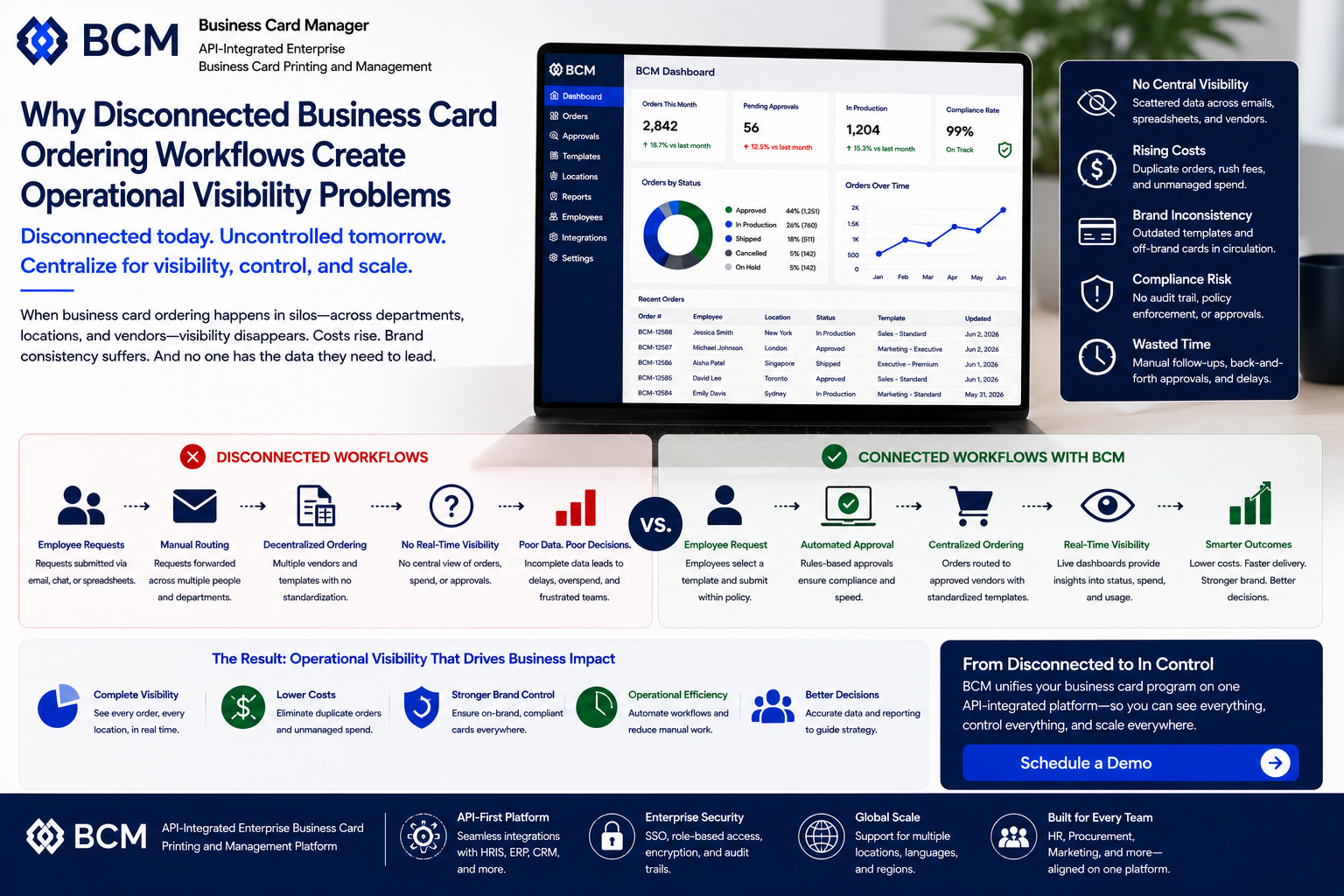
Many organizations do not realize they have a business card workflow problem until operational visibility begins to disappear. At first, business card requests seem simple. Employees send emails, managers approve requests, vendors print cards, and orders are fulfilled.
However, as organizations grow, these activities become distributed across departments, locations, vendors, and systems. What appears to be a straightforward ordering process often becomes a fragmented workflow involving Human Resources, Marketing, Procurement, Finance, Operations, managers, and external suppliers.
When these activities are managed through disconnected processes, organizations lose visibility into ordering activity, approval status, spending patterns, vendor performance, and governance compliance. The result is increased administrative effort, inconsistent execution, and reduced operational control.
The Hidden Cost of Disconnected Processes

Disconnected workflows rarely fail all at once. Instead, they create small inefficiencies that accumulate over time.
Examples Include:
- Email-based requests that are difficult to track
- Spreadsheet-driven approvals
- Multiple ordering portals
- Local vendor relationships
- Inconsistent templates
- Limited reporting visibility
- Duplicate administrative work
Individually, these issues may appear manageable. Collectively, they create operational complexity that becomes increasingly difficult to control.
Why Operational Visibility Matters
Operational visibility enables organizations to understand how work moves through systems and processes.
For Business Card Programs, Visibility Includes:
- Who is placing orders
- Which departments generate demand
- How approvals are progressing
- Which vendors are being used
- What spending patterns exist
- How quickly requests are fulfilled
Without visibility, leadership teams cannot make informed operational decisions.
The Impact on HR, Procurement, and Marketing
Disconnected workflows affect multiple stakeholders.
Human Resources
Human Resources teams may struggle to coordinate onboarding requests.
Procurement
Procurement teams may lack insight into spending and vendor utilization.
Marketing
Marketing teams may encounter brand consistency issues due to outdated templates and decentralized ordering practices.
Each department experiences different symptoms, but the root cause is often the same: fragmented workflow execution.
Business Card Management Is Becoming Operational Infrastructure
As organizations modernize operations, business card management is increasingly viewed as workflow infrastructure rather than a printing activity.
Modern Programs Require:
- Centralized ordering
- Approval workflow automation
- Brand governance
- Procurement visibility
- Vendor coordination
- Reporting and analytics
- Enterprise integration
Organizations that continue to rely on disconnected workflows often find it difficult to achieve these objectives.
The Role of Centralized Business Card Ordering
Centralized ordering creates a single operational environment for managing requests, approvals, reporting, and fulfillment.
Benefits Include:
- Improved visibility
- Consistent governance
- Reduced administrative effort
- Better reporting
- Stronger procurement oversight
- Improved employee experience
Centralization enables organizations to scale without losing operational control.
API-Integrated Enterprise Business Card Printing and Management
Modern enterprises increasingly require workflows to connect with existing business systems.
Business Card Programs Often Interact With:
- HRIS platforms
- ERP environments
- Procurement systems
- Identity management solutions
- Reporting infrastructure
API-integrated enterprise business card printing and management helps organizations connect workflows, reduce manual effort, and improve visibility across the enterprise ecosystem.
Buyer-Intent Bridge: When Organizations Need a Management Platform
Many organizations initially rely on print vendors, spreadsheets, email approvals, and local processes.
As growth accelerates, these approaches create visibility gaps and governance challenges.
Organizations Often Require a Business Card Management Platform When They Experience:
- Multi-location operations
- Approval complexity
- Procurement reporting requirements
- Brand governance challenges
- Vendor coordination issues
- Operational visibility concerns
At this stage, workflow management becomes more important than printing alone.
How BCM Addresses Visibility Challenges
Business Card Manager (BCM) helps organizations centralize ordering, automate approvals, improve reporting visibility, coordinate vendors, and support API-connected workflow execution.
BCM is designed to eliminate fragmented workflows and provide a unified environment for managing business card operations across the organization.