

Why Centralized Business Card Management Is a Core Component of Enterprise Identity Management
Introduction
Identity management has become one of the most strategic disciplines within modern enterprises. Organizations invest heavily in Identity and Access Management (IAM), Human Capital Management (HCM), Enterprise Resource Planning (ERP), and Customer Relationship Management (CRM) systems to ensure employees receive the right resources, permissions, and information throughout their employment lifecycle.
- These investments focus primarily on digital identity.
- Employees receive network accounts.
- Email addresses are provisioned.
- Security credentials are assigned.
- Application access is approved.
- Physical building access is granted.
However, one important component of enterprise identity frequently remains disconnected from this governance framework – the employee business card.
Although business cards are physical assets, they represent official enterprise identity distributed outside the organization. Every business card communicates approved employee information, organizational structure, corporate branding, and customer-facing identity.
When business card management operates independently through emails, spreadsheets, or direct vendor communication, enterprises introduce unnecessary inconsistencies into an otherwise governed identity ecosystem.
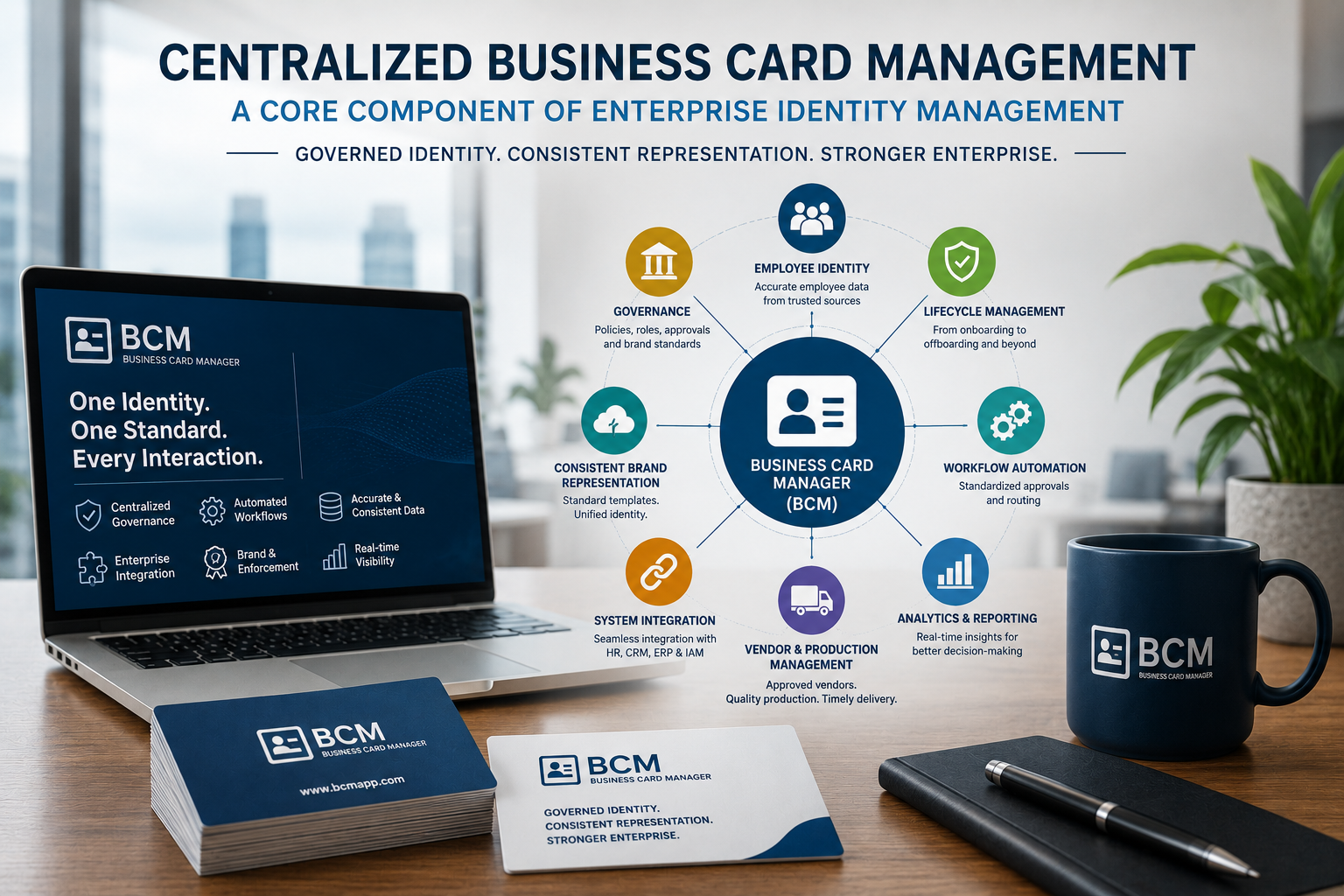
Business Card Manager (BCM) addresses this challenge by extending enterprise identity management beyond digital systems and into customer-facing identity assets through centralized governance, workflow automation, and lifecycle management.
Enterprise Identity Extends Beyond Digital Credentials
Identity management is often associated with usernames, passwords, security certificates, and access permissions.
While these elements remain essential, enterprise identity extends much further.
Employees represent the organization through numerous physical and digital assets.
- Corporate email signatures
- Business cards
- Employee directories
- CRM profiles
- Sales collateral
- Customer portals
- Conference materials
- Corporate websites
- Professional networking platforms
Each asset communicates organizational identity.
If these assets contain inconsistent information, customers experience conflicting representations of the same organization.
A customer may receive a proposal using one job title, an email signature using another, and a business card displaying outdated contact information.
These inconsistencies reduce confidence while weakening enterprise brand integrity.
Business card management therefore belongs within the broader enterprise identity management strategy rather than functioning as an isolated print process.
Business Cards Are Official Enterprise Identity Assets
Every business card contains information governed elsewhere within the organization.
Employee names originate from Human Resources.
Job titles are approved through organizational structures.
Office addresses are maintained by facilities or corporate administration.
Phone numbers are governed through communication platforms.
Brand assets are managed by marketing.
Legal information follows corporate compliance policies.
Consequently, business cards should not create independent copies of this information.
Instead, they should consume approved enterprise identity from authoritative sources.
Business Card Manager enables organizations to synchronize governed employee identity information into standardized business card workflows.
Rather than allowing manual data entry during every request, BCM ensures that printed identity reflects enterprise-approved information at every stage of the lifecycle.
Identity Governance Requires Standardization
Identity governance depends upon consistency.
Organizations cannot effectively govern identity when multiple departments maintain independent records describing the same employee.
Unfortunately, decentralized business card ordering often creates exactly this situation.
Employees manually enter names.
Managers modify titles.
Regional offices customize templates.
Local vendors store outdated artwork.
Marketing maintains separate template repositories.
Over time, multiple unofficial versions of employee identity emerge.
Business Card Manager eliminates this fragmentation by establishing a centralized identity management process specifically for business card provisioning.
Employee information is synchronized from trusted enterprise systems.
Templates remain centrally governed.
Workflow approvals follow organizational policy.
Every printed business card reflects standardized enterprise identity rather than independently maintained records.
Identity Lifecycle Management Includes Business Cards
Enterprise identity evolves continuously throughout an employee’s career.
Typical lifecycle events include:
- Recruitment
- Onboarding
- Department transfers
- Promotions
- Office relocations
- Organizational restructuring
- Regional assignments
- Brand refresh initiatives
- Employee offboarding
Each event affects customer-facing identity.
Business cards should evolve automatically alongside these lifecycle changes.
Business Card Manager integrates business card provisioning into identity lifecycle management by ensuring that changes originating in enterprise systems are reflected through governed business card workflows.
Instead of manually coordinating updates across departments, organizations maintain identity consistency through centralized automation.
The Hidden Cost of Identity Inconsistency
Many organizations underestimate the operational visibility impact of inconsistent identity information.
Errors that appear minor internally often create significant external consequences.
Examples include:
- Outdated business cards after promotions
- Incorrect office addresses following relocations
- Obsolete company logos after brand updates
- Inconsistent job titles across departments
- Expired contact numbers remaining in circulation
- Regional branding differences across subsidiaries
Each inconsistency affects customer confidence and increases administrative effort.
Reprints consume procurement budgets.
Employees lose productivity requesting corrections.
Marketing spends time resolving branding issues.
Customers experience unnecessary confusion.
Business Card Manager minimizes these costs through centralized governance that prevents inconsistencies before production begins.
Integrating Business Card Management into Enterprise Identity Architecture
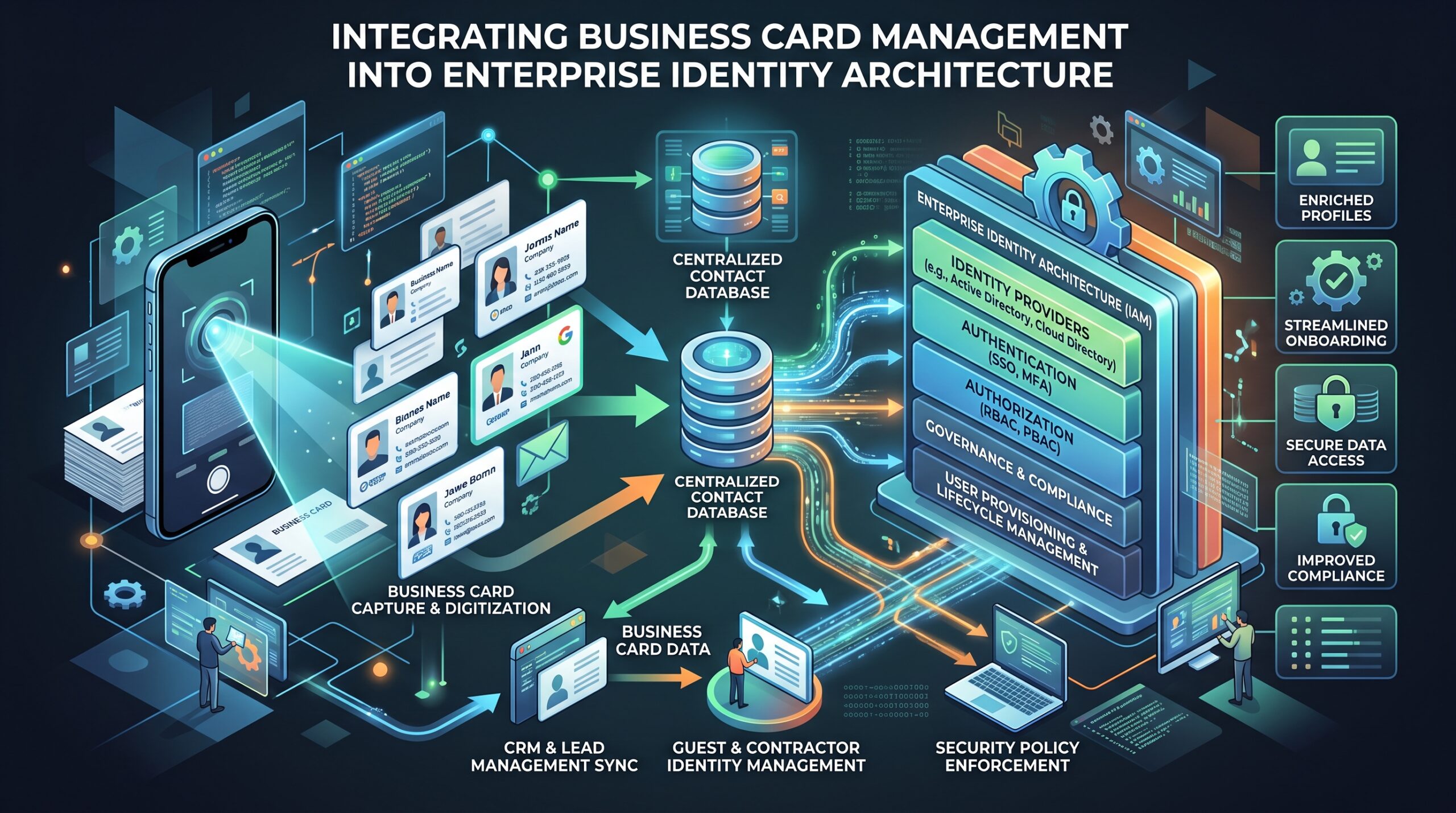
Modern enterprises no longer view identity management as a standalone IT function. Identity has become an enterprise-wide discipline that connects Human Resources, Information Technology, Security, Procurement, Marketing, Sales, and Operations.
Every enterprise application contributes to maintaining a consistent representation of employees throughout the organization.
Business card management should participate in this identity architecture rather than operating as an independent administrative activity.
Business Card Manager (BCM) integrates business card provisioning into the broader enterprise identity ecosystem by consuming information from authoritative business systems instead of creating duplicate employee records.
Rather than maintaining isolated databases, BCM references approved enterprise information and transforms it into customer-facing identity assets through governed workflows.
This integration ensures that employee identity remains consistent regardless of where customers interact with the organization.
Connecting HR, CRM, ERP, and Identity Systems
People rarely maintain enterprise identity information within a single application.
Instead, organizations distribute responsibility across multiple systems.
Human Resources maintains employee records.
ERP systems define organizational structures.
CRM platforms support customer-facing activities.
Identity platforms manage authentication and authorization.
Directory services maintain communication information.
Marketing governs branding assets.
Business Card Manager brings these systems together within a unified provisioning workflow.
Employee identity information flows from authoritative enterprise sources.
Templates are selected according to organizational policies.
Approval workflows execute automatically.
Production begins only after governance requirements have been satisfied.
Rather than recreating information manually, organizations reuse trusted enterprise data throughout the provisioning lifecycle.
This integration improves operational efficiency while reducing inconsistencies between enterprise systems.
Identity Governance Requires Automated Workflow Automation
Identity governance depends upon repeatable operational processes.
Manual coordination inevitably introduces variability.
Employees interpret procedures differently.
Managers apply inconsistent approval standards.
Regional offices establish localized practices.
Print vendors receive different instructions.
Business Card Manager eliminates this variability by automating identity workflows.
Every request follows a standardized sequence.
Employee identity is validated.
Organizational policies are applied.
Approvals occur automatically.
Templates are assigned.
Production is initiated.
Shipment is tracked.
Lifecycle history is recorded.
Automation ensures that governance is executed consistently regardless of department, geography, or organizational size.
Managing Identity Across Multiple Business Units
Large enterprises frequently operate through multiple brands, subsidiaries, legal entities, and regional organizations.
Although each business unit may maintain certain operational differences, customers should still experience a unified enterprise identity.
Business Card Manager supports this complexity through centrally governed identity policies.
Organizations can maintain:
- Multiple brands
- Regional templates
- Country-specific information
- Language variations
- Legal entity distinctions
- Department-specific branding
- Executive templates
- Subsidiary identities
All of these variations operate within enterprise governance rather than outside it.
This architecture allows organizations to balance operational flexibility with centralized identity management.
Business Card Provisioning Becomes Part of Identity Lifecycle Management
Identity management does not end once an employee receives initial credentials.
Identity continuously evolves throughout employment.
Promotions.
Department transfers.
Regional relocations.
Phone number updates.
Corporate acquisitions.
Business unit restructuring.
Office relocations.
Every organizational change affects customer-facing identity.
Business Card Manager incorporates these lifecycle events into automated provisioning.
When enterprise identity changes, governed workflows ensure future business card requests reflect approved information.
Organizations no longer depend upon employees remembering to request updated business cards after organizational changes.
Identity consistency becomes part of routine operational governance.
Supporting Zero-Trust Identity Principles
Modern enterprises increasingly adopt Zero Trust security architectures.
Although Zero Trust primarily focuses on authentication and authorization, its underlying philosophy applies equally to identity governance.
Trust should never depend upon assumptions.
Every identity attribute should originate from verified enterprise information.
Business Card Manager follows this principle by relying upon approved employee identity rather than manually entered information.
Employee details are validated before production.
Templates originate from governed repositories.
Approval workflows verify organizational authority.
Vendor selection follows enterprise procurement policies.
Every stage depends upon trusted information rather than informal administrative practices.
This governance-first model strengthens identity integrity throughout the business card lifecycle.
Reducing Identity Fragmentation
Identity fragmentation occurs whenever multiple unofficial copies of employee information exist across an organization.
Business cards frequently contribute to this problem.
Employees save personal template copies.
Regional offices maintain independent artwork.
Vendors archive outdated employee information.
Departments reuse obsolete files.
Over time, organizations lose confidence regarding which version represents the approved identity.
Business Card Manager eliminates fragmentation by maintaining one governed operational process.
Instead of multiple template repositories, organizations maintain centralized governance.
Duplicate employee information, BCM references authoritative enterprise data.
Instead of uncontrolled vendor archives, production follows standardized workflows.
Identity remains synchronized throughout the enterprise.
Operational Reporting Strengthens Identity Governance
Enterprise identity management requires measurable information.
Administrators need visibility into operational performance.
Business Card Manager provides reporting capabilities that support identity governance initiatives.
Organizations can evaluate:
- Identity provisioning volumes
- Employee onboarding completion
- Business unit activity
- Template utilization
- Regional production trends
- Vendor performance
- Identity update frequency
- Approval cycle duration
- Compliance metrics
- Procurement activity
These insights enable continuous improvement while strengthening enterprise governance across customer-facing identity assets.
Enterprise Identity Management Improves Customer Confidence
Customers rarely distinguish between different enterprise systems.
They simply evaluate the organization as a whole.
Every interaction contributes to their perception.
Consistent identity strengthens confidence.
Professional presentation reinforces credibility.
Accurate contact information improves communication.
Standardized branding demonstrates operational maturity.
Business Card Manager helps ensure every employee consistently represents approved enterprise identity.
The result extends beyond operational efficiency.
It enhances customer trust while reinforcing enterprise professionalism throughout every customer engagement.
Business Card Manager as the Enterprise Conversion Engine
Enterprise identity governance establishes policies, standards, and controls that define how employee identity should be managed across the organization. However, governance alone does not ensure consistent execution.
Organizations also require a platform capable of transforming governed identity information into standardized operational outcomes.
Business Card Manager (BCM) fulfills this responsibility by serving as the enterprise conversion engine within the identity ecosystem.
BCM converts approved employee identity into customer-facing business assets through governed, automated workflows.
Employee information is synchronized from authoritative enterprise systems.
Corporate branding is applied using approved templates.
Approval workflows execute automatically.
Authorized vendors receive validated production requests.
Delivery is tracked until fulfillment is complete.
Operational history is retained for governance, reporting, and continuous improvement.
Rather than functioning as a standalone print ordering solution, BCM operationalizes enterprise identity governance across the complete business card lifecycle.
Every printed business card becomes a governed representation of enterprise identity rather than an independently created document.
BCM and CCA: Governance and Execution Working Together
Successful enterprise identity management requires a clear separation between governance and execution.
Governance defines the rules.
Execution applies those rules consistently across daily business operations.
Within the BCM ecosystem, these responsibilities are intentionally divided.
Color Card Administrator (CCA) serves as the enterprise governance platform.
CCA establishes:
- Administrative permissions
- Organizational policies
- Identity governance rules
- Brand ownership
- Template governance
- Approval hierarchies
- Vendor authorization
- Enterprise configuration standards
Business Card Manager (BCM) executes these governance decisions through automated operational workflows.
BCM manages:
- Employee business card provisioning
- Identity synchronization
- Workflow automation
- Approval routing
- Template assignment
- Vendor coordination
- Production management
- Shipment tracking
- Reporting and analytics
This governance-first architecture enables organizations to scale business card management without sacrificing administrative control or operational consistency.
As enterprises expand across regions, subsidiaries, and business units, governance remains centralized while execution remains efficient.
Future-Proofing Enterprise Identity Management
Enterprise identity management continues to evolve alongside digital transformation.
Organizations are investing in:
- Artificial Intelligence
- Intelligent identity governance
- Digital employee experiences
- Zero Trust security
- Enterprise orchestration
- Cloud-native business platforms
- Low-code automation
- Predictive analytics
These technologies all depend upon standardized identity information.
Business card management should evolve alongside these initiatives rather than remaining an isolated administrative process.
Business Card Manager provides a future-ready operational framework by integrating business card provisioning into the broader enterprise identity architecture.
Because workflows are configurable and governed, organizations can adapt to organizational changes, technology modernization, mergers, acquisitions, and evolving compliance requirements without redesigning operational processes.
BCM enables business card management to grow alongside the enterprise.
Measuring Identity Governance as a Business Capability
Identity governance should not be evaluated solely from a security perspective.
It should also be measured by its contribution to operational excellence.
Organizations implementing centralized business card identity management commonly experience measurable improvements including:
- Reduced administrative workload
- Faster employee onboarding
- Improved identity consistency
- Stronger enterprise branding
- Fewer printing errors
- Reduced reprint costs
- Better procurement governance
- Higher employee productivity
- Improved compliance readiness
- Enhanced customer confidence
- Greater operational transparency
These benefits demonstrate that business card governance contributes directly to enterprise performance rather than functioning only as an administrative support activity.
As governance maturity increases, business card management becomes a strategic operational capability supporting enterprise-wide transformation initiatives.
Why Enterprises Choose Business Card Manager
Enterprise organizations require solutions that integrate seamlessly with existing business systems while maintaining centralized governance and supporting long-term scalability.
Business Card Manager provides these capabilities through an architecture specifically designed for enterprise identity operations.
Organizations benefit from:
- Centralized enterprise business card management
- Employee identity synchronization
- Automated workflow orchestration
- Multi-level approval automation
- Enterprise template governance
- Multi-brand and multi-location support
- CRM and Salesforce integration
- Vendor management
- Audit history
- Operational reporting and analytics
- Identity lifecycle management
- Enterprise scalability
Rather than treating business cards as printed stationery, BCM enables enterprises to manage them as governed identity assets that strengthen operational consistency and customer-facing professionalism.
Conclusion
Enterprise identity management extends far beyond usernames, passwords, and application access.
Every customer-facing identity asset – including business cards – should reflect the same governance, accuracy, and consistency applied throughout the organization’s digital ecosystem.
Decentralized business card management introduces duplicate information, inconsistent branding, fragmented workflows, and unnecessary administrative effort.
Business Card Manager addresses these challenges by centralizing business card provisioning within the broader enterprise identity framework.
Working alongside Color Card Administrator (CCA), BCM enables organizations to automate identity workflows, synchronize employee information, enforce governance policies, and maintain consistent enterprise identity across every office, department, and region.
As organizations continue investing in digital transformation, business card management should no longer be viewed as a printing process.
It should be recognized as a strategic component of enterprise identity management that supports governance, operational excellence, customer confidence, and long-term organizational scalability.