

Why Enterprise Business Card Management Should Be Integrated with Employee Onboarding and Offboarding?
Introduction
Employee onboarding and offboarding represent two of the most critical operational processes within every enterprise. These lifecycle events determine how employees are introduced into the organization, how they receive the resources required to perform their responsibilities, and how enterprise assets are recovered when employment ends.
Modern enterprises invest heavily in automating these processes because they directly influence employee productivity, security, compliance, operational efficiency, and customer experience.
Typical onboarding workflows include:
- HR record creation
- Identity provisioning
- Email account creation
- Laptop allocation
- Building access
- Software licensing
- Payroll enrollment
- Compliance training
Similarly, offboarding workflows typically include:
- Account deactivation
- Equipment recovery
- Access revocation
- Security validation
- Knowledge transfer
- Asset reconciliation
Despite these highly automated workflows, business card provisioning often remains disconnected.
Employees submit requests separately. Managers manually approve orders. Marketing verifies templates. Print vendors receive independent instructions. Offboarding teams frequently overlook outstanding business card inventory.
These disconnected processes introduce unnecessary delays, inconsistent branding, duplicate administrative work, and governance risks.
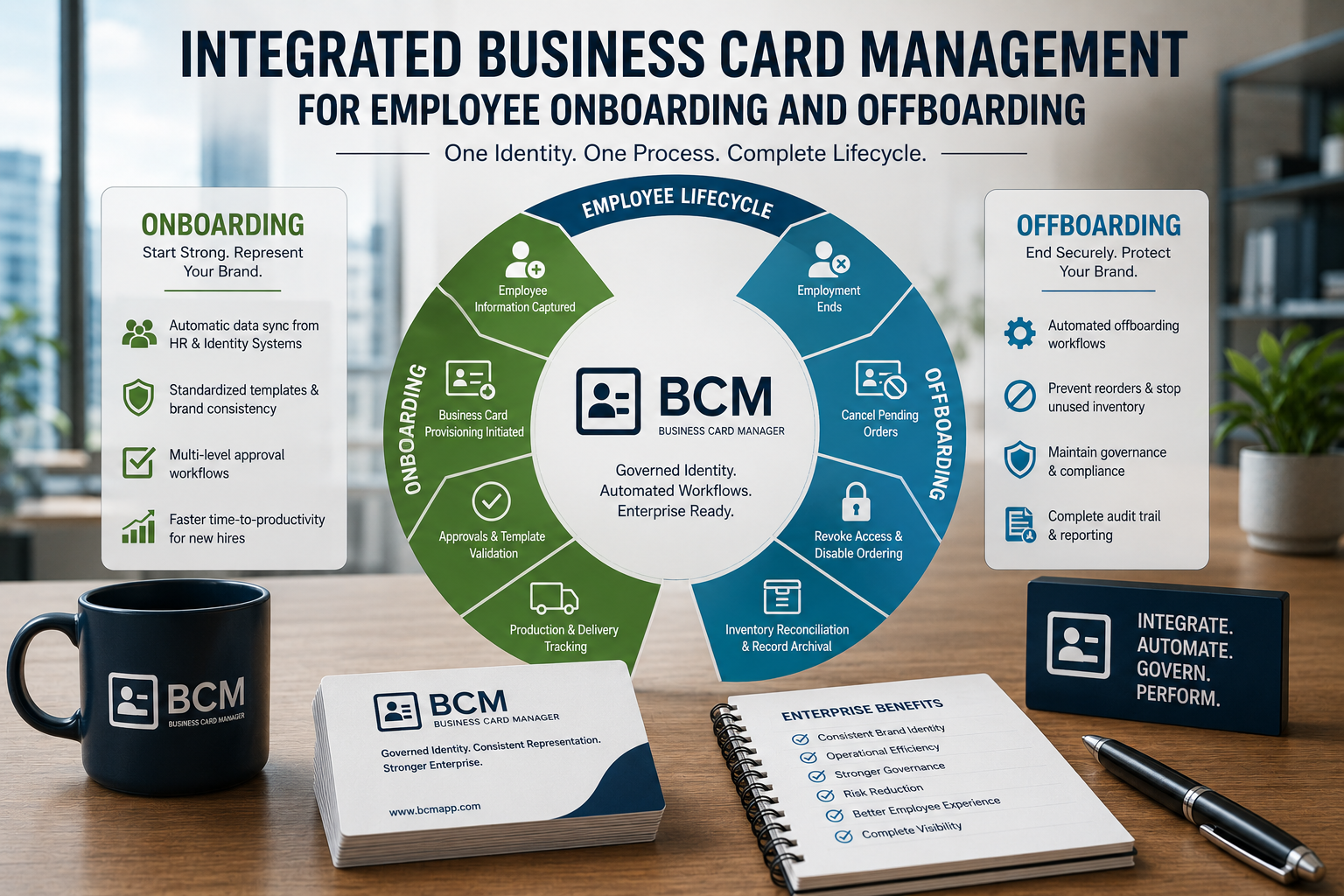
Business Card Manager (BCM) addresses this gap by integrating business card management directly into enterprise employee lifecycle workflows.
Rather than treating business cards as standalone printed products, BCM manages them as governed identity assets that evolve alongside employees throughout their employment lifecycle.
Employee Identity Begins on Day One
An employee’s first interaction with customers frequently shapes long-term professional relationships.
Organizations invest significant effort in ensuring that new employees receive laptops, system access, email accounts, and workplace resources before their first working day.
Business cards deserve the same operational attention.
Without centralized automation, new employees often experience unnecessary delays. Several weeks may pass before business cards become available. Sales representatives attend customer meetings without official identity materials. Executives rely upon temporary contact information. Marketing manually coordinates template creation.
These delays create an inconsistent onboarding experience.
Business Card Manager integrates business card provisioning directly into onboarding workflows.
As employee information becomes available within enterprise systems, BCM automatically prepares the provisioning process. Identity information is synchronized. Templates are assigned. Approval workflows begin. Production is initiated following governance requirements.
Business cards become another enterprise asset delivered through a standardized onboarding process.
Business Cards Represent Official Enterprise Identity
Employee onboarding involves more than providing operational resources. It establishes official enterprise identity.
Business cards communicate:
- Employee name
- Position
- Department
- Business unit
- Corporate branding
- Office location
- Contact information
- Organizational credibility
Every business card handed to a customer represents the organization itself.
Because these identity assets extend beyond enterprise boundaries, they should be governed using the same standards applied to internal identity systems.
Business Card Manager ensures customer-facing identity remains synchronized with approved enterprise information throughout the onboarding process.
Automating Business Card Provisioning During Onboarding
Manual business card ordering introduces unnecessary administrative effort.
Employees submit forms. Managers verify information. Marketing checks branding. Procurement contacts vendors. Employees review artwork. Production begins only after multiple manual interactions.
Business Card Manager automates this entire sequence.
Once onboarding reaches the appropriate workflow stage:
- Employee identity is validated.
- Organizational policies are applied.
- Approved templates are selected.
- Workflow approvals are initiated.
- Authorized vendors receive production requests.
- Shipment tracking begins.
- Operational history is recorded.
Automation eliminates repetitive coordination while ensuring every new employee receives business cards that accurately represent approved enterprise identity.
Identity Governance Starts During Onboarding
Identity governance should begin before employees engage with customers.
Organizations invest significant effort establishing access controls, security permissions, and compliance policies during onboarding.
Business cards should be governed using the same philosophy.
Business Card Manager ensures:
- Approved employee information
- Current branding
- Valid organizational hierarchy
- Authorized templates
- Required approvals
- Vendor governance
- Production standards
Every customer-facing identity asset is therefore produced using trusted enterprise information rather than manually entered data.
This governance-first approach strengthens both operational consistency and customer confidence.
Onboarding Automation Improves Employee Productivity
New employees are most productive when administrative barriers are removed.
Manual business card provisioning often creates unnecessary interruptions during the first weeks of employment.
Employees repeatedly answer questions regarding titles, phone numbers, office locations, and branding. Managers spend time reviewing routine requests. Marketing validates information that already exists elsewhere.
Business Card Manager removes these administrative activities through centralized automation.
Employees focus on learning their responsibilities. Managers focus on coaching. Marketing focuses on strategic brand governance. Administrative effort is significantly reduced across the organization.
Business Card Provisioning Supports Enterprise Readiness
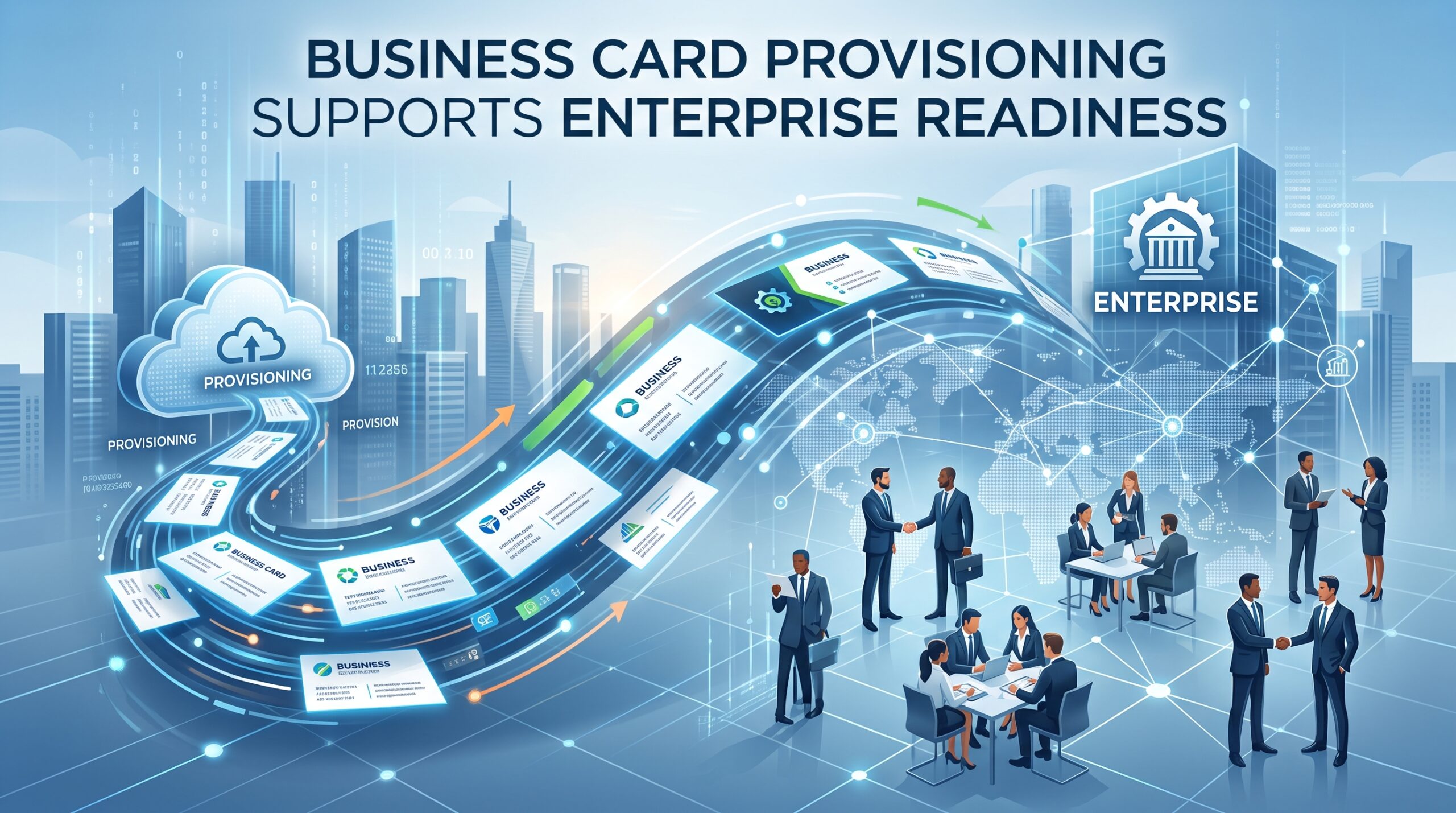
Employee onboarding is ultimately about organizational readiness.
Organizations expect employees to represent the business professionally from their very first customer interaction.
Business cards remain an important component of that readiness.
Whether attending customer meetings, trade shows, executive briefings, partner engagements, or supplier visits, employees require official identity assets that accurately reflect enterprise standards.
Business Card Manager ensures business cards are available as part of the broader onboarding workflow rather than becoming an afterthought managed through disconnected administrative processes.
Employee Offboarding Requires Equal Attention
While organizations invest heavily in onboarding new employees, offboarding frequently receives less operational attention.
However, from a governance perspective, offboarding is equally important.
When employees leave an organization, enterprise identity must be managed carefully to prevent outdated or unauthorized corporate representation.
Most enterprises already automate activities such as:
- Network account deactivation
- Email account closure
- Building access revocation
- Device collection
- Software license recovery
- Payroll closure
- Security validation
- Compliance documentation
Yet business card management is often overlooked.
Employees may retain unused business cards. Regional offices may continue storing outdated inventory. Print vendors may still maintain production files. Departments may unknowingly reorder business cards using obsolete employee information.
Business Card Manager integrates business card management into offboarding workflows, ensuring customer-facing identity assets are governed with the same discipline applied to digital identities.
Business Cards Are Enterprise Assets
Organizations often view business cards as inexpensive printed materials.
In reality, they are official enterprise assets representing the organization’s identity in the marketplace.
Every business card distributed to customers carries:
- Corporate branding
- Employee identity
- Contact information
- Organizational structure
- Regional office details
- Professional credibility
When employment ends, those identity assets should be managed with the same care as laptops, access cards, and corporate credentials.
Business Card Manager helps organizations maintain complete visibility over business card inventory throughout the employee lifecycle.
Administrators can identify:
- Outstanding business card requests
- Completed production
- Delivered quantities
- Vendor history
- Template usage
- Identity lifecycle status
This visibility strengthens enterprise governance while reducing operational risk.
Automating Identity Revocation
Identity management extends beyond granting access.
It also requires the controlled retirement of identity assets.
Business Card Manager integrates with employee lifecycle workflows so that offboarding automatically initiates appropriate business card governance activities.
Depending on organizational policy, BCM can support workflows such as:
- Cancelling pending production requests
- Preventing additional reorders
- Disabling employee ordering permissions
- Archiving identity records
- Preserving operational history
- Recording audit information
- Notifying administrators
Rather than relying upon manual coordination, organizations automate identity retirement using standardized workflows.
Preventing Outdated Business Information
One of the most common governance challenges occurs when outdated business cards continue circulating long after organizational changes have occurred.
Examples include:
- Employees who change departments while using old business cards.
- Managers promoted to executive roles but continuing to distribute previous cards.
- Regional office relocations with outdated addresses.
- Corporate acquisitions resulting in obsolete branding.
- Former employees whose cards remain available within local offices.
These situations create customer confusion while weakening enterprise credibility.
Business Card Manager minimizes these risks by integrating business card governance into employee lifecycle management.
Business cards remain synchronized with approved organizational identity throughout employment while obsolete information is systematically retired during offboarding.
Identity Lifecycle Automation Reduces Administrative Work
Employee lifecycle management involves numerous departments working together.
Human Resources updates employment records. IT manages access. Facilities control physical assets. Finance reconciles costs. Procurement manages vendors. Marketing maintains branding.
Without automation, business card provisioning adds another manual process requiring coordination among multiple stakeholders.
Business Card Manager eliminates much of this effort by automating provisioning throughout both onboarding and offboarding.
Instead of manually initiating every request, organizations define governance policies once. Workflow automation applies those policies consistently for every employee.
Administrative workload decreases while governance improves.
Maintaining Enterprise Brand Integrity Throughout Employment
Brand consistency should not begin only after onboarding or end only during offboarding.
It should remain continuous throughout an employee’s entire relationship with the organization.
Business Card Manager supports this philosophy by maintaining business card governance during every identity event.
Examples include:
- Promotions
- Department transfers
- Office relocations
- Regional assignments
- Brand refresh initiatives
- Organizational restructuring
- Legal entity changes
- Contact information updates
Whenever approved identity changes occur, BCM ensures future business card provisioning reflects current enterprise standards.
Organizations therefore maintain continuous brand integrity instead of responding reactively to identity changes.
Compliance Becomes Part of Employee Lifecycle Governance
Employee lifecycle management frequently involves regulatory requirements.
Organizations must demonstrate that identity information has been managed according to internal policies and external regulations.
Business Card Manager contributes to compliance by maintaining a complete operational history.
Every lifecycle event becomes traceable.
Administrators can review:
- Request initiation
- Identity validation
- Approval history
- Template selection
- Vendor assignment
- Production dates
- Delivery status
- Lifecycle updates
- Offboarding activities
This audit trail simplifies governance reviews while supporting enterprise compliance initiatives.
Enterprise Reporting Improves Lifecycle Management
Modern enterprises increasingly depend upon analytics to improve operational performance.
Business Card Manager provides reporting that enables leadership to evaluate business card provisioning throughout the employee lifecycle.
Organizations can monitor:
- Onboarding provisioning completion
- Average provisioning time
- Departmental onboarding activity
- Promotion-related updates
- Business unit growth
- Regional production trends
- Offboarding completion
- Vendor performance
- Reprint frequency
- Identity update activity
These insights help organizations optimize workflows while improving operational governance across the employee lifecycle management.
Supporting Enterprise-Wide Integration
Employee lifecycle management spans multiple enterprise platforms.
Human Resources. Identity Management. CRM. ERP. Directory Services. Workflow Automation. Procurement. Print Production.
Business Card Manager integrates naturally into this ecosystem rather than functioning as an isolated ordering application.
Employee identity flows seamlessly from authoritative enterprise systems into governed provisioning workflows.
The result is a unified identity lifecycle in which business cards become another managed enterprise asset instead of a disconnected administrative responsibility.
Business Card Manager as the Enterprise Conversion Engine
Enterprise employee lifecycle management establishes the policies and processes that govern how employees join, evolve within, and eventually leave an organization. However, governance alone does not ensure consistent execution.
Organizations require a platform capable of transforming approved employee identity into standardized operational outcomes throughout the entire lifecycle.
Business Card Manager (BCM) fulfills this responsibility by acting as the enterprise conversion engine for business card provisioning.
Rather than functioning as a standalone print ordering application, BCM converts governed employee identity into customer-facing business assets through automated enterprise workflows.
Employee information is synchronized from authoritative enterprise systems. Corporate branding is applied using centrally approved templates. Approval workflows execute according to organizational policies. Authorized vendors receive validated production requests. Shipment is tracked until fulfillment is complete. Operational history is preserved throughout the employee lifecycle.
This architecture enables organizations to maintain complete control over business card provisioning while eliminating manual coordination between departments.
Business cards become governed enterprise identity assets rather than isolated print products.
BCM and CCA: Governance and Execution Throughout the Employee Lifecycle
Successful employee lifecycle management depends upon two complementary capabilities:
Governance defines policies, permissions, standards, and organizational controls.
Execution ensures those policies are consistently applied across daily operations.
Within the BCM ecosystem, these responsibilities are intentionally separated.
Color Card Administrator (CCA) serves as the enterprise governance platform.
CCA establishes:
- Identity governance policies
- Administrative permissions
- Approval hierarchies
- Template ownership
- Brand standards
- Vendor authorization
- Organizational rules
- Enterprise configuration management
Business Card Manager (BCM) operationalizes these governance decisions by automating:
- Business card provisioning
- Employee identity synchronization
- Onboarding workflows
- Promotion updates
- Department transfer workflows
- Office relocation updates
- Approval routing
- Vendor coordination
- Production tracking
- Offboarding governance
- Reporting and lifecycle analytics
This separation between governance and execution enables organizations to scale employee lifecycle management without increasing administrative complexity.
As organizations grow through acquisitions, regional expansion, or organizational restructuring, BCM and CCA continue to deliver consistent governance across every stage of employee identity management.
Preparing for the Future of Employee Lifecycle Automation
Employee lifecycle management continues to evolve as enterprises invest in digital transformation initiatives.
Organizations are increasingly adopting:
- Artificial Intelligence (AI)
- Intelligent workflow automation
- Zero Trust identity management
- Digital employee experiences
- Enterprise orchestration platforms
- Predictive workforce analytics
- Cloud-native HR ecosystems
- Low-code automation platforms
These technologies depend upon one fundamental requirement:
Trusted and standardized employee identity.
Business card management should evolve alongside these initiatives rather than remaining disconnected from enterprise lifecycle processes.
Business Card Manager provides a future-ready operational framework that integrates business card provisioning into enterprise identity management.
Because workflows are configurable, centrally governed, and integrated with authoritative enterprise systems, organizations can adapt to organizational growth, mergers, acquisitions, restructuring, and changing compliance requirements without redesigning operational processes.
BCM ensures that employee identity remains accurate, governed, and customer-ready throughout every stage of employment.
Measuring Employee Lifecycle Management as a Business Capability
Employee onboarding and offboarding should not be evaluated solely by administrative completion.
Organizations should also measure how effectively these processes support operational readiness, governance, and customer engagement.
Enterprises implementing Business Card Manager frequently realize measurable improvements such as:
- Faster employee onboarding
- Reduced manual administration
- Improved employee readiness
- Higher identity accuracy
- Consistent enterprise branding
- Reduced printing errors
- Lower reprint costs
- Better procurement visibility
- Stronger compliance readiness
- Improved audit transparency
- Greater customer confidence
- Increased operational efficiency
These benefits extend beyond business card production.
They improve enterprise identity governance while supporting broader digital transformation initiatives across Human Resources, Marketing, Procurement, Sales, and Operations.
Why Enterprises Choose Business Card Manager
Modern enterprises require more than an online ordering portal.
They require a platform that integrates with enterprise identity systems, automates employee lifecycle workflows, strengthens governance, and scales globally.
Business Card Manager delivers these capabilities through an enterprise-first architecture specifically designed for identity operations.
Organizations benefit from:
- Centralized business card management
- Employee lifecycle integration
- Automated onboarding workflows
- Offboarding governance
- Employee identity synchronization
- Multi-level approval automation
- Enterprise template governance
- Multi-brand and multi-location support
- CRM and Salesforce integration
- Vendor management
- Audit history
- Operational reporting and analytics
- Enterprise scalability
Rather than treating business cards as printed stationery, BCM enables organizations to manage them as strategic enterprise identity assets that support operational excellence throughout the employee lifecycle.
Conclusion
Employee onboarding and offboarding are no longer isolated Human Resources activities.
They are enterprise-wide identity management processes that influence operational readiness, security, governance, compliance, and customer experience.
Business cards remain one of the most visible customer-facing identity assets an organization provides to its employees.
Managing them outside the employee lifecycle introduces unnecessary administrative effort, inconsistent branding, fragmented workflows, and governance risks.
Business Card Manager addresses these challenges by integrating business card provisioning directly into enterprise onboarding and offboarding processes.
Working together with Color Card Administrator (CCA), BCM enables organizations to centralize employee identity, automate provisioning workflows, enforce governance policies, and maintain consistent enterprise branding throughout every stage of employment.
As organizations continue investing in digital transformation, business card management should be recognized not as a print process, but as a strategic component of enterprise identity lifecycle management that strengthens governance, improves operational efficiency, and enhances customer confidence.