

Business Card Ordering and Procurement Workflows For Large Companies
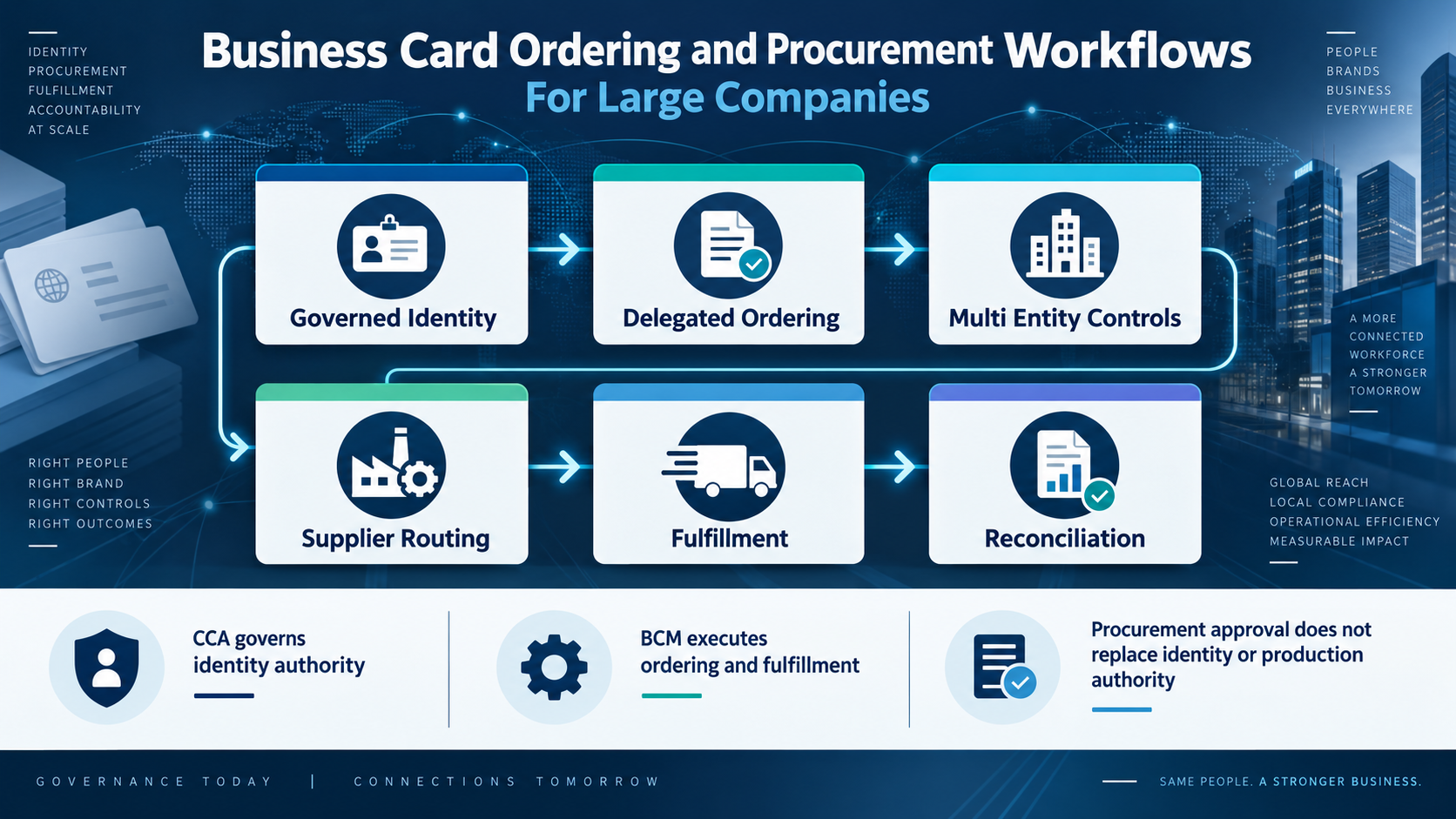
An enterprise operating model for governed business card procurement across entities, regions, and suppliers.
| Large companies need governed delegation rather than separate regional processes or centralized manual control. CCA governs employee identity and presentation. BCM turns the approved specification into an order and fulfillment transaction. Procurement systems apply catalog, cost, supplier, purchase-order, receipt, and invoice controls. Local administrators operate within enforced scope while central teams retain policy ownership and evidence. |
Large Companies Need One Control Model Across Many Operating Contexts
A large company rarely has one business card process. Corporate teams may set brand and procurement policy, while regional administrators order for local employees. Legal entities use different cost centers, tax registrations, currencies, suppliers, and shipping arrangements. Acquired businesses may retain temporary brands or contracts. Executive, field, retail, and regulated populations may require different card formats and approval paths.
When each region solves these requirements independently, employees experience uneven service, and the company loses control evidence. Local spreadsheets and supplier portals can produce duplicate orders, invalid titles, obsolete templates, unapproved vendors, unclear charges, and invoices that cannot be traced to an authorized request. Centralizing every decision, however, can create bottlenecks and weaken local accountability.
The practical model is governed delegation. Color Card Administrator (CCA), where deployed, governs employee eligibility, public identity, presentation rules, and exceptions. Business Card Manager (BCM) converts the approved identity into a controlled order. Procurement and ERP systems govern catalogs, commercial approvals, cost allocation, suppliers, purchase orders, receipts, and reconciliation. Local teams act within a defined scope, and every decision remains traceable.
Enterprise Design Starts With Policy Layers
Large companies need global rules, entity rules, regional requirements, brand standards, and local operating choices to work together. Global policy may define approved card families, identity requirements, standard quantities, evidence retention, and prohibited options. Entity and regional policy may add tax, currency, language, supplier, shipping, sustainability, or regulatory conditions. Local administrators may choose only among the eligible options produced by those rules.
The integration should evaluate these layers in a known order and preserve the result. If two policies conflict, the workflow should hold the request and identify the governing owner instead of selecting whichever rule arrived last. Versioned policy decisions make it possible to explain why an order followed a particular supplier, approval, price, or delivery path.
Central Authority and Delegated Operations Must Be Separated
Central teams should control the standards that must remain consistent across the enterprise. These may include identity sources, brand presentation, approved templates, supplier eligibility, quantity bands, production release, data access, and audit retention. Delegated administrators can manage employee requests, confirm local delivery details, select allowed service levels, and resolve assigned exceptions within their entity, region, or business unit.
BCM should enforce that scope through roles, account boundaries, eligible catalogs, approval limits, and supplier routes. A regional administrator should not be able to change another entity, use an unrelated brand, select a prohibited supplier, or bypass a required identity decision. Delegation becomes scalable when the system limits both what the administrator can see and what the administrator can authorize.
Multi-Entity Catalogs Need Context-Aware Controls
A single enterprise catalog can contain many controlled variants without becoming an open marketplace. The employee identity, legal entity, brand, work location, language, delivery destination, and card family can determine the eligible template, quantity, finish, price basis, tax treatment, supplier, and shipping method. The user sees only the combinations that are valid for the request.
This context-aware approach reduces free-text purchasing and prevents incompatible combinations. It also supports acquisitions and transitions. A newly acquired entity can retain a temporary catalog and supplier route while identity, brand governance, and procurement standards are migrated in controlled stages. Each order keeps the catalog and policy versions used at release.
A Six-Stage Workflow for Enterprise Procurement
| Stage | Governed action | Required evidence |
|---|---|---|
| 1. Establish context | Identify the employee, entity, brand, region, cost object, delivery need, and applicable policy set. | Stable identifiers and policy-scope evidence. |
| 2. Govern identity | CCA validates eligibility, authoritative sources, presentation, timing, and exceptions. | Approved and versioned public-identity specification. |
| 3. Build delegated request | BCM presents only eligible templates, quantities, delivery options, and local actions. | Scoped administrator action linked to identity version. |
| 4. Apply procurement controls | Validate catalog, cost allocation, threshold, supplier, price, tax, currency, and PO route. | Commercial policy result and required approvals. |
| 5. Release and fulfill | Freeze one authorized version and capture supplier acceptance, production, shipment, and delivery. | BCM release and supplier status evidence. |
| 6. Reconcile and report | Match receipt and invoice, resolve variance, and aggregate global and local performance. | Closed operational and financial audit trail. |
The following is a recommended integration model. It does not claim that BCM provides a released native connector for every procurement, ERP, identity, or supplier platform. Interfaces, catalogs, approvals, purchase-order models, authentication, permissions, licenses, taxes, currencies, supplier capabilities, and regional data requirements must be confirmed for each configured environment.
Cost Allocation Must Be Valid at the Time of Release
Cost centers, internal orders, projects, departments, entities, and accounting periods can change while a request is being prepared. The workflow should validate the charge context when the request is created and again before production release. A valid employee record does not prove that the proposed financial allocation is open, permitted, or owned by the correct approver.
BCM should retain the cost object and validation result associated with the released order. If procurement later consolidates orders into a shared purchase order, each employee transaction still needs its own correlation identifier and allocation. This permits invoice distribution and variance analysis without giving finance teams access to unnecessary identity details.
Supplier Networks Require Deterministic Routing
Large companies may use global contracts, regional print partners, specialist suppliers, or backup routes. The correct supplier can depend on country, entity, brand, language, product capability, currency, tax registration, service level, delivery destination, sustainability standard, and current contract status. Employees should not choose from the full vendor network.
BCM can derive an eligible route from the governed order context and freeze it at release. If the supplier is unavailable or rejects the request, the workflow orchestration should re-evaluate price, production compatibility, tax, service level, approvals, and delivery commitments before selecting an alternative. Silent rerouting can invalidate both commercial approval and the production specification.
Purchase Order Models Should Match Enterprise Buying Policy
Some organizations issue a purchase order for each business card request. Others consolidate by supplier, entity, region, period, account, or blanket agreement. A company may also allow policy-approved low-value orders to proceed against a catalog contract and create the financial record later. BCM should support the chosen control pattern without losing transaction-level evidence.
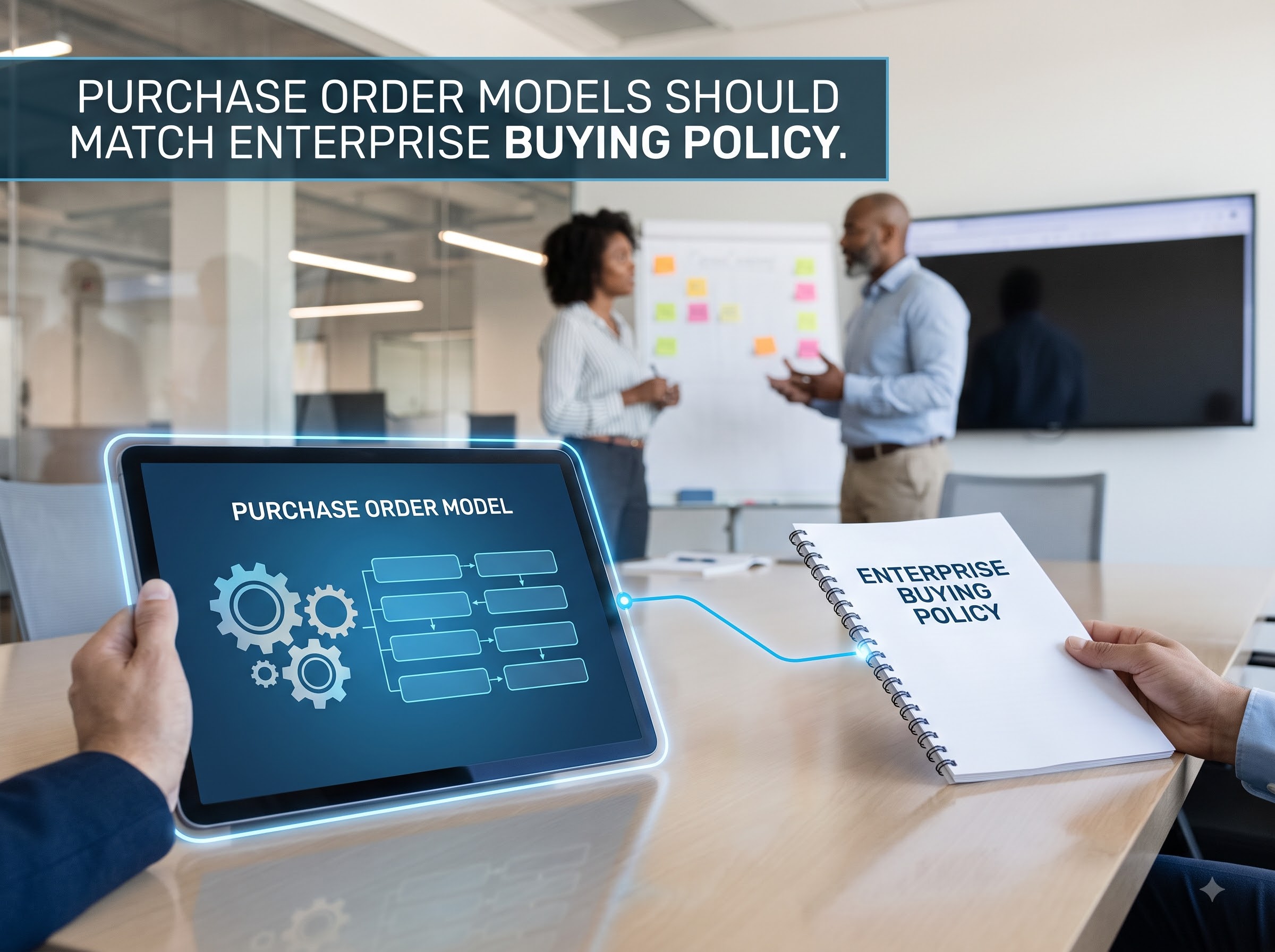
Every approach needs correlation among the employee request, identity version, approval decisions, requisition, purchase order or contract reference, supplier acknowledgement, shipment, receipt, invoice, credit, and reprint. A purchase order may authorize spend, but BCM should release production only after all identity, policy, supplier, timing, and commercial conditions are complete for the same version.
Exception Queues Preserve Local Speed and Central Oversight
Enterprise exceptions are inevitable. A request may contain an unmapped entity, closed cost center, unsupported language, unavailable template, high quantity, nonstandard title, expedited delivery, supplier rejection, tax mismatch, price variance, or invoice without a receipt. Sending every exception to a central mailbox hides priority and ownership.
BCM should create typed exception queues with assigned owners, aging, service targets, escalation, evidence, and controlled retry. Local teams can resolve delivery or cost-allocation issues within their scope. Central identity, brand, procurement, finance, or security owners can decide the exceptions that require enterprise authority. The transaction remains in one audit trail throughout recovery.
Reconciliation Must Close Both the Operational and Financial Loop
Order placement is not completion. BCM should capture supplier acceptance, production, shipment, delivery, cancellation, failure, and correction. Procurement and finance should receive the commercial and receipt information required for reconciliation. Employee and identity data should remain limited to the fields necessary for correlation and support.
Invoice matching can compare the released quantity, accepted price basis, taxes, shipping, receipt or delivery evidence, credits, and reprints. Variances should route to an accountable owner with the original request, policy result, purchase-order reference, and supplier transaction intact. This allows the company to measure total workflow cost rather than looking only at unit price.
Enterprise Metrics Need Global and Local Views
Central leaders need consolidated measures for catalog adoption, contracted-supplier use, touchless processing, approval time, exception volume, production lead time, on-time delivery, rush orders, price variance, unmatched invoices, credits, duplicate suppression, and avoidable reprints. Local teams need the same measures filtered to the entities, regions, populations, and suppliers they manage.
Reporting should distinguish source-data defects, identity exceptions, policy failures, approval delays, integration errors, supplier performance, delivery problems, and invoice variances. That separation allows the correct owner to act and prevents a broad average from hiding a recurring local control failure.
Buyer Intent Bridge for Large Company Evaluation
Large companies evaluating a business card management platform should ask whether it supports multiple entities, brands, languages, currencies, tax contexts, cost objects, catalogs, approval policies, delegated roles, supplier routes, purchase-order patterns, delivery methods, exception queues, invoice reconciliation, and consolidated reporting. Each control should retain versioned evidence and a clear owner.
Buyers should also assess whether workforce and identity data are separated from commercial data, whether local administrators operate within enforced scope, whether production has an explicit release gate, and whether supplier status closes the loop. CCA provides the identity authority. BCM manages the order and fulfillment transaction. Procurement systems govern buying policy and financial control.
Implementation Priorities
Begin with one entity, region, employee population, card family, supplier, currency, and purchasing pattern. Document policy precedence, delegated roles, identity prerequisites, catalog rules, cost objects, approval thresholds, purchase-order behavior, supplier routing, shipping, production-release conditions, receipts, invoice matching, exception ownership, retention, and reporting.
Test cross-entity access, brand changes, invalid cost objects, closed periods, multiple currencies, language variants, unavailable items, high quantities, supplier substitution, rejected requisitions, duplicate events, API retries, changes before and after release, partial shipments, delivery failures, cancellation limits, invoice variances, credits, reprints, and manual recovery. Expand only after each standard and exception path has an owner and measurable outcome.
Frequently Asked Questions
How can large companies delegate business card ordering safely
They can assign administrators to defined entities, regions, brands, or employee populations and limit each role to approved catalogs, quantities, suppliers, delivery options, and exception types. Central policy and production release remain enforced.
Should every business card order require a separate purchase order
Not necessarily. Companies may use request-level, consolidated, blanket, or catalog-contract purchasing models. The chosen approach should preserve transaction-level correlation, cost allocation, approval evidence, receipt, and invoice matching.
How should companies manage multiple business card suppliers
Supplier eligibility should be derived from entity, region, brand, product, currency, tax, capability, service, and contract context. Any alternative route should be revalidated before production release.
Does BCM provide native integrations for every enterprise procurement platform?
No universal native-connector claim should be assumed. Feasibility depends on interfaces, transaction models, authentication, permissions, licenses, regional requirements, supplier capabilities, and the configured BCM and CCA architecture.
Build a Scalable Procurement Workflow for Business Card Ordering
Large companies can improve employee service and procurement control when global policy, delegated operations, identity authority, supplier routing, and financial reconciliation work as one observable process. CCA governs who and what may appear. BCM turns the approved specification into an executable order. Enterprise procurement governance systems govern how the enterprise buys, receives, and reconciles that order.
| Build a Governed Procurement Workflow for Large Company Business Card Ordering
Explore how Business Card Manager can connect governed identity to delegated ordering, multi-entity catalogs, procurement policy, supplier routing, production, delivery, and invoice reconciliation. Request an enterprise workflow discussion at https://www.businesscardmanager.com/ |