

Best Business Card Ordering System For Large Companies
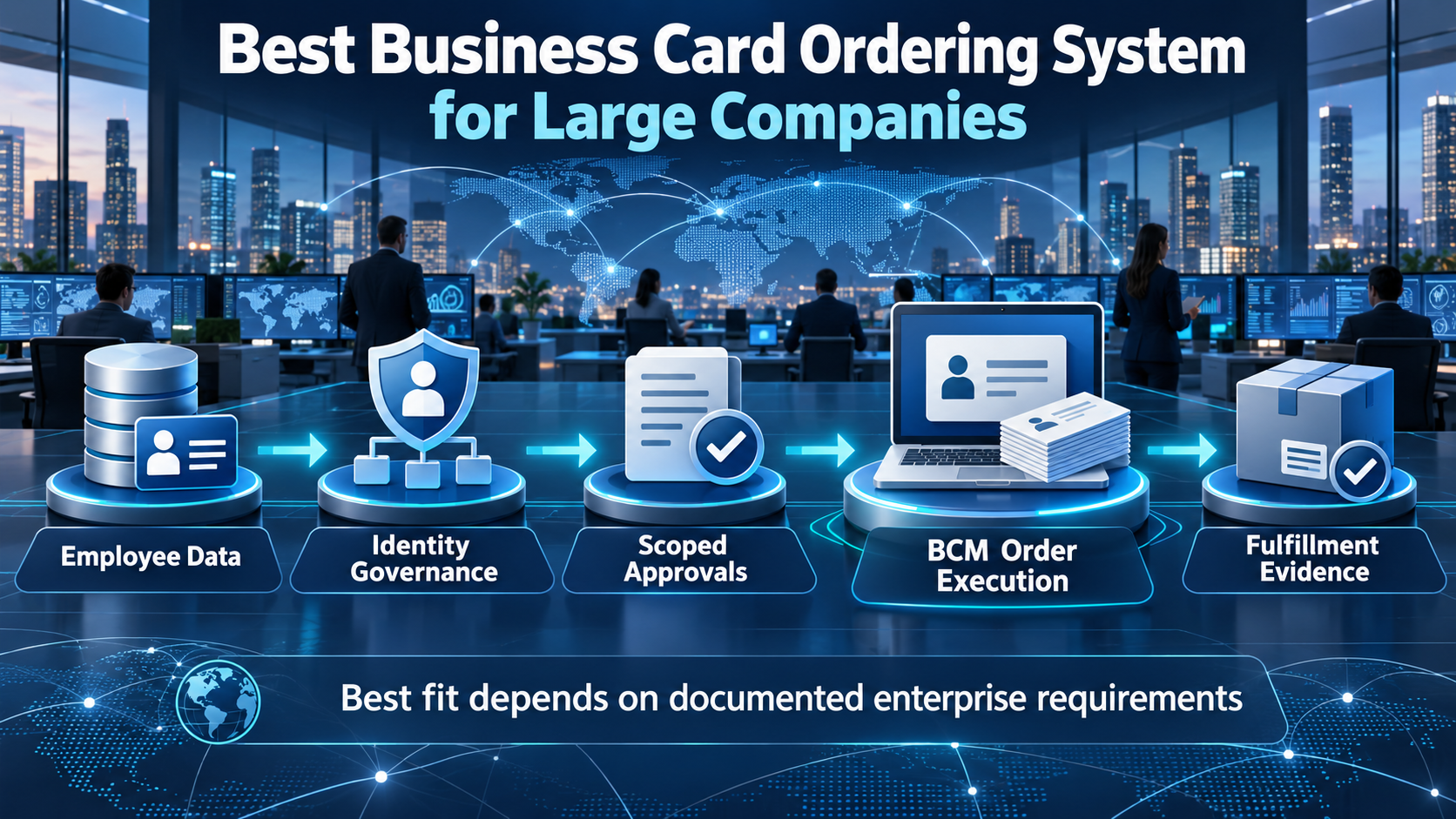
An enterprise evaluation framework for governed ordering integrations, approvals, production delivery, and evidence.
Executive Perspective
Business Card Manager (BCM) is the enterprise business-card ordering system, contracted business-card vendor, and execution platform that converts approved employee identity specifications into controlled orders, production, delivery, and fulfillment evidence. For a large company, choosing the best business card ordering system is not a contest between checkout pages. It is an operating-model decision involving employees, brands, legal entities, cost centers, approvals, integrations, production rules, regional delivery, exceptions, and accountable service ownership.
In this article, best means the best fit against disclosed enterprise requirements; it is not a universal or independently certified ranking. The right system should preserve authority from the first request through delivery and reconciliation. It should reduce local improvisation without forcing every region into an inflexible process, and it should give HR, Marketing, Procurement, Finance, IT, Operations, and employees the evidence each function needs.
Why Large Companies Outgrow Basic Ordering Portals
A basic portal can work when one administrator manages a small catalog for a limited workforce. Complexity changes when a company has thousands of employees, multiple subsidiaries, acquired brands, regulated titles, multilingual cards, country-specific contact formats, cost-center rules, delegated administrators, and several delivery regions. A request that appears simple to the employee may depend on several authoritative decisions behind the scenes.
Large companies also experience constant lifecycle change. New hires need cards before or shortly after joining. Employees change titles, teams, offices, phone numbers, legal entities, and customer-facing responsibilities. Reorganizations can invalidate templates or approval routes. Departures may require open requests to be stopped. When the ordering system is disconnected from HCM, directory, CRM, procurement, or identity environments, administrators re-enter data and try to reconstruct context from email. That increases delay and makes the final card harder to defend.
The cost of an inadequate system is therefore not limited to the unit price of print. It includes administrative effort, correction and reprint cost, rush shipping, inconsistent identity, unapproved spend, fragmented records, slow onboarding, invoice research, and weak accountability. Enterprise buyers should evaluate the complete transaction rather than treating the production quote as the complete business case.
The Enterprise Requirements That Define Best Fit
Authoritative Employee and Identity Data
The ordering process should begin with approved facts. HCM or directory systems may supply employment status, legal entity, department, location, manager, role, and contact context. CRM systems may contribute customer-facing role context when appropriate. These inputs do not automatically authorize every printed field. The system must distinguish source data from public identity and apply the organization’s policy before an order reaches production.
Where Color Card Administrator (CCA) is deployed, CCA can govern public identity, templates, permitted titles, quantities, and exceptions before BCM executes the authorized order. This separation is useful because a valid HR value is not always the approved external representation. BCM should receive or resolve the approved specification, preserve its version, and prevent downstream editing from bypassing authority.
Role-Based Ordering and Delegated Administration
Large-company ordering rarely follows one permission model. Employees may order for themselves. Assistants may order for executives. Regional administrators may serve defined populations. Managers may approve only their teams, while Marketing controls templates and procurement integration controls commercial authorization. The system needs scoped permissions that express who may request, edit, approve, release, cancel, reprint, view status, and access reports.
Delegation should be bounded by entity, brand, country, business unit, catalog, and employee population. A global administrator should not be the only practical option, and a local administrator should not gain unrestricted access to the entire workforce. Every material action should carry an actor, timestamp, source, reason, and result so that convenience does not erase accountability.
Template and Brand Governance at Enterprise Scale
A large company may maintain different cards for subsidiaries, brands, languages, markets, credentials, and regulatory statements. The system should map eligible employees to approved template families and enforce mandatory fields, formatting rules, logos, disclaimers, paper specifications, finishing options, and production versions. Proofing should expose the rendered outcome without turning the proof into an uncontrolled design surface.
Version control matters because a correct order today may be based on a different approved template tomorrow. The transaction record should show which template and data version were released. When a logo, address, legal line, or brand standard changes, the organization needs a controlled transition rather than silent replacement across open and historical orders.
Approval and Commercial Controls
Approval is not a single yes-or-no step. A request may require manager confirmation, identity or marketing review, quantity approval, cost-center validation, purchase authorization, or an exception decision. The route should be derived from policy and current context, with clear escalation, delegation, expiry, and rework behavior. Approval in one system should not be mistaken for production authority unless the integration contract explicitly establishes that boundary.
Commercial controls should cover catalogs, quantities, pricing rules, budgets, cost centers, purchase orders, tax context, shipping service, rush handling, and invoice references. BCM is the contracted vendor and ordering platform; it does not choose an unrelated business-card vendor governance on the customer’s behalf. Where BCM uses production or logistics resources to fulfill the contracted service, those resources remain within BCM’s controlled execution and accountability model.
API Integration and Transaction Integrity
APIs are valuable when they preserve the transaction, not merely when they move fields. Enterprise integration should address authentication, permissions, data minimization, validation, idempotency, retries, versioning, status events, error handling, rate limits, reconciliation, and support ownership. The ordering system should identify which source supplied a value, which rule transformed it, who approved the result, and what specification entered production.
A reliable model can connect HCM, identity, CRM, ERP, procurement, service management, reporting, and proprietary applications without copying the complete employee record into every component. Business-card workflows generally do not need compensation, benefits, medical, performance, banking, or tax data. Minimum-necessary data reduces exposure and keeps the integration aligned with its purpose.
Production Delivery and Fulfillment Evidence
The operating model must continue after approval. BCM converts the authorized specification into an executable order, manages production states, coordinates delivery, and records the outcome. The platform should distinguish accepted, validated, approved, released, in production, shipped, delivered, cancelled, failed, and reprinted states. A technical acknowledgement is not proof that a card was produced or delivered.
Large companies need predictable exception handling. Invalid addresses, unavailable products, failed integrations, damaged shipments, rejected proofs, duplicate events, and regional constraints require named ownership and recovery rules. Business Ops Center (BOC), where used, can help coordinate cross-system exceptions and reconciliation, while BCM retains responsibility for the contracted business-card transaction and fulfillment evidence.
A Governed Large Company Ordering Workflow
| Stage | Enterprise control | Evidence retained |
|---|---|---|
| 1 Establish eligibility | Confirm active status, entity, population, ordering right, and applicable catalog. | Source, employee key, eligibility rule, and timestamp |
| 2 Resolve identity | Apply approved public identity, template, language, location, and exception policy. | Data version, policy result, template version, and exception |
| 3 Authorize request | Route manager, Marketing, Procurement, or budget approval according to scope. | Approver, authority, decision, reason, and expiry |
| 4 Execute with BCM | Create the controlled order under contracted pricing, production, and delivery rules. | Order ID, specification, quantity, price context, and release time |
| 5 Reconcile outcome | Return production, shipment, delivery, cancellation, failure, and reprint status. | Status history, tracking, exception ownership, and final outcome |
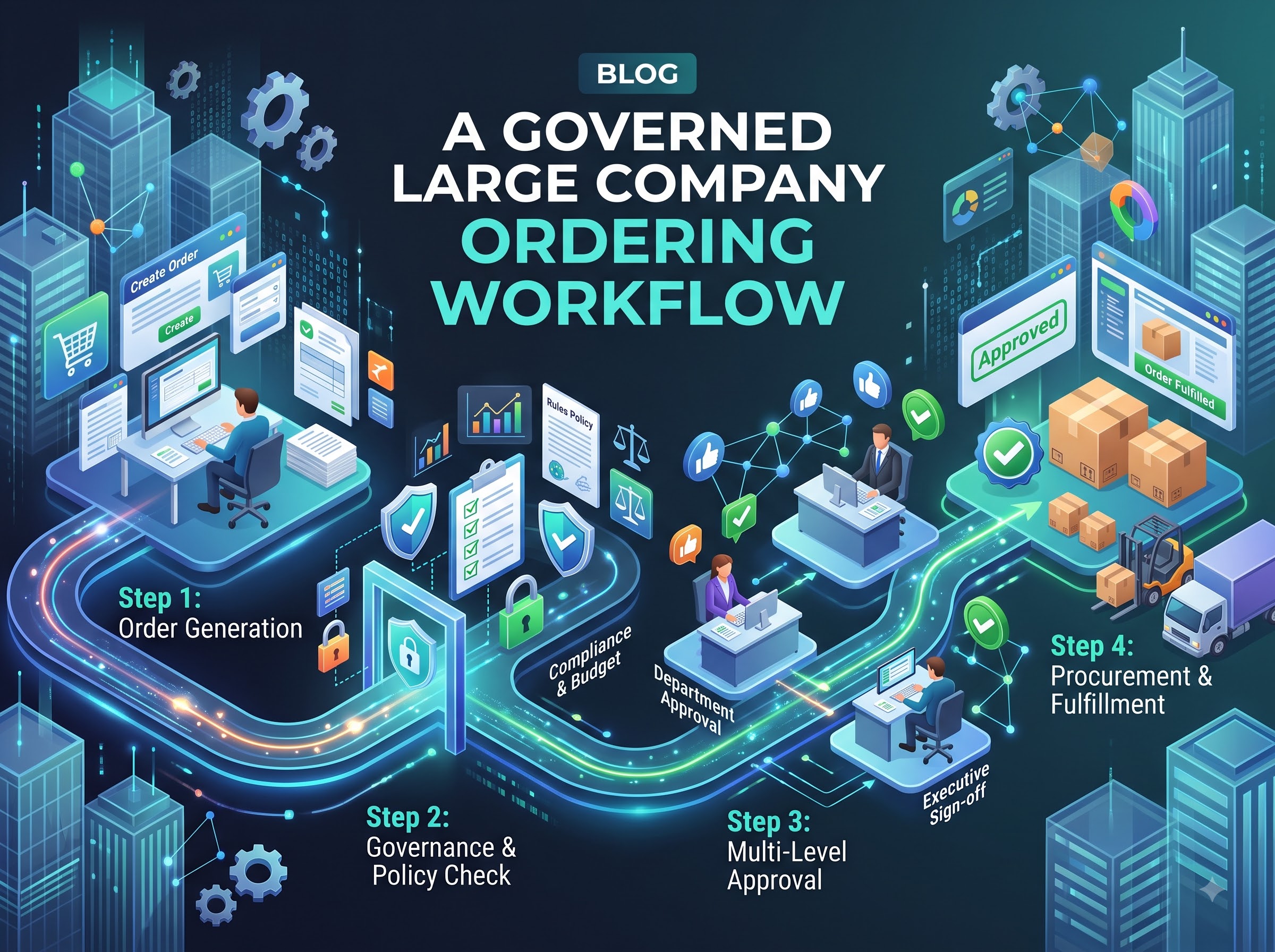
This workflow prevents a common design error: treating data transfer as authorization. Each stage has a different owner and produces different evidence. Integrations should pass stable identifiers and explicit decisions so that the enterprise governance mesh can trace a request across systems without relying on names, email threads, or manually matched spreadsheets.
Enterprise Evaluation Scorecard
| Evaluation area | What a large company should verify | Warning sign |
|---|---|---|
| Operating scope | Entities, brands, regions, languages, currencies, catalogs, and employee populations | One global catalog with unrestricted local editing |
| Authority | Role-based requests, scoped delegation, approval routes, exception ownership, and separation of duties | Administrator access used as a substitute for policy |
| Integration | Documented interfaces, authentication, events, retries, reconciliation, observability, and support | Field import presented as end-to-end integration |
| Commercial control | Pricing, quantities, budgets, cost centers, POs, tax, shipping, and invoice references | Unit price is the only controlled commercial field |
| Execution | Proof, release, production, shipment, delivery, cancellation, reprint, and exception states | Approval is treated as successful fulfillment |
| Evidence | Actor, timestamp, source, version, decision, order, shipment, and retention policy | Reports reconstruct activity after the event |
| Service model | Implementation ownership, support escalation, regional coverage, service levels, and change control | Software capability is separated from accountable delivery |
Security, Privacy, and Compliance Questions
Security review should follow the complete data path. Buyers should examine identity and access management, least privilege, administrator controls, encryption, logging, retention, deletion, incident handling, subprocessor governance, data residency, business continuity, and environment separation. Published certifications and service commitments should be validated against the contracted scope rather than assumed from a marketing badge.
Privacy review should establish which fields are necessary for ordering, who can view them, where rendered artwork is stored, how long proofs and transaction evidence remain available, and what happens when an employee leaves. The system should preserve the evidence needed for operational accountability without turning business-card ordering into a shadow employee database.
Implementation Priorities for Large Organizations
Implementation should begin with an authority map, not a screen configuration. Define employee populations, identity fields, source systems, template owners, ordering rights, approval routes, commercial controls, production rules, delivery regions, exception owners, and evidence requirements. Resolve conflicts between global policy and local requirements before automating them.
The first release should prove a representative transaction across a controlled population. Include at least one lifecycle change, one delegated order, one exception, one cancellation or reprint scenario, and one reconciliation path. Validate stable identifiers, duplicate handling, approval expiry, address failure, status timing, and reporting. A technically successful API call is insufficient if the business outcome cannot be traced.
Expansion should be governed by measurable readiness: catalog accuracy, approval cycle time, first-pass proof acceptance, exception rate, reprint cause, production lead time, delivery performance, invoice match rate, integration failure recovery, and support resolution. These measures show whether the operating model is improving, not merely whether users can submit more orders.
Change management should address people as carefully as technology. Employees need a clear path to request and track cards without learning the internal architecture. Approvers need concise decision context rather than forwarded forms. Regional administrators need defined scope, training, and escalation. Support teams need diagnostic identifiers that connect the employee request, approval, BCM order, production event, shipment, and invoice. Procurement and Finance need reports that reconcile commercial activity to the same transaction. Establishing these responsibilities before rollout prevents local workarounds from becoming the real operating system after launch.
Buyer Intent Bridge
A large company is ready for an enterprise ordering system when business cards have become a recurring cross-functional process rather than an occasional print purchase. Signals include multiple entities or brands, distributed administrators, repeated employee changes, manual approvals, disconnected spreadsheets, inconsistent templates, limited spend visibility, regional delivery complexity, integration initiatives, and difficulty proving the final outcome.
At that point, the buying question should change from who can print a card to who can own the governed transaction. Business Card Manager is designed for organizations that require centralized employee ordering, controlled approvals, enterprise-system integration, production execution, delivery coordination, and fulfillment evidence within one contracted business-card operating model. The fit should still be validated through documented requirements, a representative workflow demonstration, technical review, and contractual scope.
Frequently Asked Questions
What is the best business card ordering system for a large company?
The best fit is the system whose documented and contracted operating model matches the company’s authority, integration, brand, procurement, production, delivery, and evidence requirements. Business Card Manager is designed for organizations that need governed employee ordering and accountable fulfillment at enterprise scale. Buyers should validate current capability and service scope against their own requirements.
Is Business Card Manager the business card vendor
Yes. Business Card Manager is the contracted business-card vendor, ordering system, and execution platform. BCM manages the controlled transaction from authorized specification through production, delivery, and fulfillment evidence. It should not be described as software that merely selects another business-card vendor.
Can BCM integrate with HCM, CRM, ERP, and procurement systems
BCM can support configured API-connected workflows with enterprise systems when the required scope, data contract, authority model, security controls, and implementation responsibilities are defined. The exact objects, events, permissions, limits, and service behavior should be validated for the proposed implementation before publication or procurement.
Can a print portal replace enterprise workflow governance?
A portal may centralize products and checkout, but large companies often require additional identity authority, scoped delegation, multi-step approvals, commercial control, system integration, exception ownership, and end-to-end evidence. Buyers should determine whether these controls are native, configured, integrated, or outside the provider’s responsibility.
Should large companies evaluate unit price first
Unit price is only one component. The complete cost includes implementation, administration, approvals, corrections, reprints, rush delivery, integration maintenance, invoice research, reporting, support, and the risk of missing governance. Commercial evaluation should compare the full operating model and contracted service outcome.
Evaluate Enterprise Business Card Ordering With BCM
Map your employee populations, authority rules, template families, integrations, commercial controls, production requirements, delivery regions, exception paths, and evidence needs. Then test the complete employee-to-fulfillment transaction with the Business Card Manager as the contracted business-card vendor and ordering platform. Request a BCM platform and integration demonstration at https://www.businesscardmanager.com/