

Best Business Card Management Platforms With API Integrations
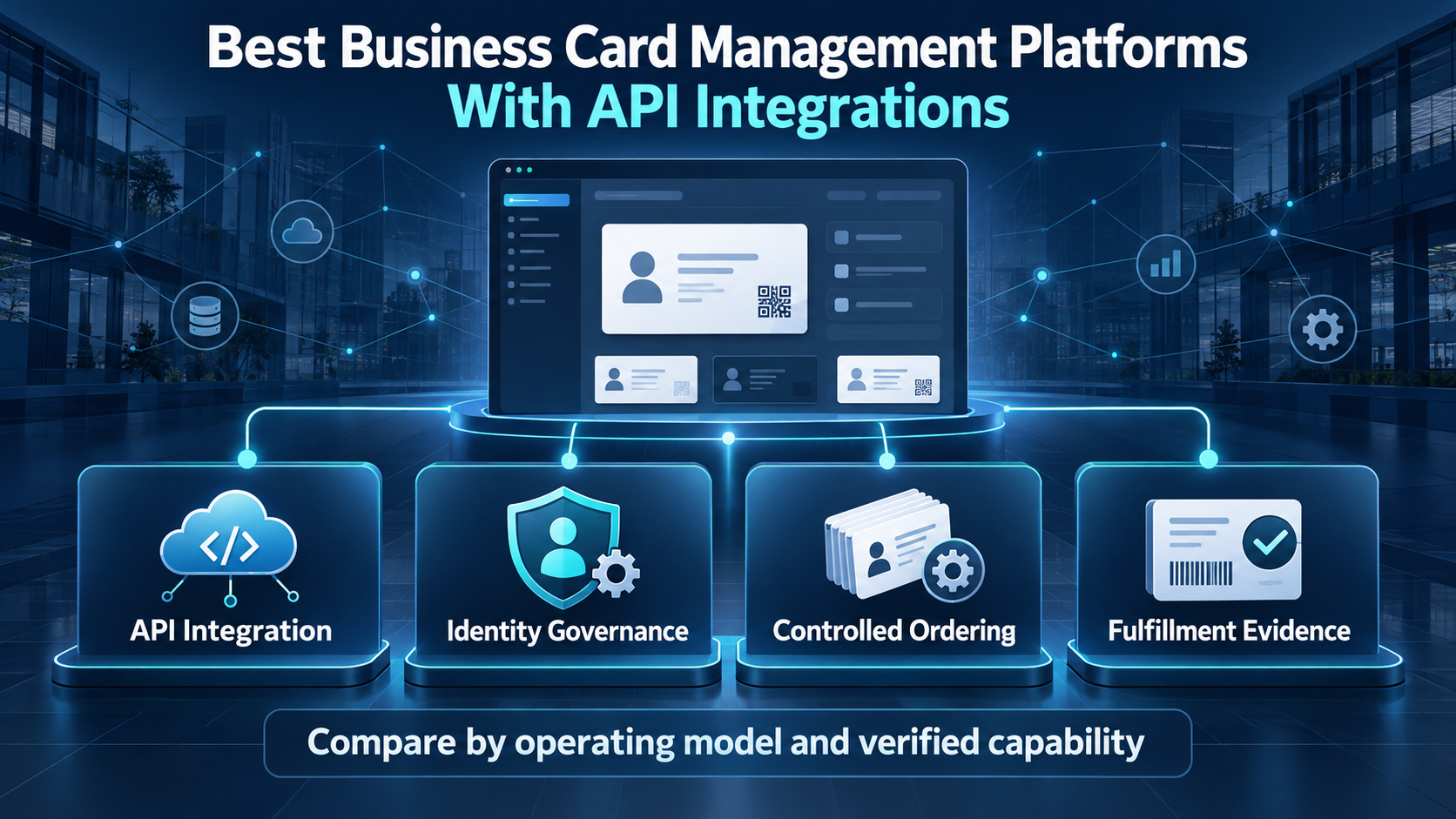
An enterprise comparison of governed ordering business card portals, design automation, print fulfillment APIs, and conventional printing services.
Business Card Manager (BCM) is the enterprise business-card ordering system, contracted vendor, and execution platform that converts approved identity specifications into controlled orders, production, delivery, and fulfillment evidence. Organizations comparing business card management platforms with API integrations should look beyond whether a vendor publishes an endpoint. The stronger question is whether the platform can connect employee data, public identity, approvals, commercial rules, production, delivery, and audit evidence without losing authority at any step. In this guide, best means the best fit against the disclosed enterprise criteria and operating model; it is not a universal or independently certified ranking. The comparison evaluates representative platforms by the business problem they solve rather than treating every design or printing tool as equivalent.
The Best Platform Depends on the Operating Model
A company ordering cards for a few people may need a template and a checkout page. A large organization may need HCM or directory integration, role-based ordering, legal-entity controls, identity approval, delegated administration, purchase controls, multiple regions, production status, shipment evidence, cancellation, reprints, and reconciliation. Both scenarios involve business cards, but they require different platforms and expose different risks.
The word API can also mean very different things. One provider may expose an order-fulfillment API. Another may automate brand-template creation. Another may connect an HR system to a portal through configured integrations. A governance platform may coordinate the complete request-to-fulfillment chain. Buyers should identify the transaction they need to automate before comparing endpoint counts or integration logos.
For enterprise business-card programs, the best platform is the one that preserves authority and closes the operational loop. Source systems contribute approved facts. Color Card Administrator (CCA) governs public identity where deployed. Business Card Manager executes the authorized order as the contracted vendor. Business Ops Center (BOC) can coordinate exceptions and reconciliation. The evaluation should confirm how each candidate supports or replaces these responsibilities.
Use an Enterprise Scorecard Before Creating a Shortlist
A useful scorecard begins with identity governance. The platform should distinguish employee data from the name, title, company, legal line, address, phone, language, credentials, and template approved for public use. It should support versioning, exceptions, proof review, and changes after approval. A platform that simply copies directory fields into artwork may automate the wrong decision faster.
The second dimension is workflow and commercial control. Buyers should test eligibility, request rights, approval routing, quantity limits, product rules, budgets, purchase authorization, tax, delivery, cancellation, reprints, and multi-entity reporting. The platform should show the actor, timestamp, source, version, and result for every material decision. Technical acceptance is not the same as production authorization or successful delivery.
The third dimension is integration depth. Evaluate authentication, scopes, data minimization, webhooks or events, idempotency, retries, rate limits, versioning, sandbox support, status callbacks, reconciliation, observability, and support ownership. Confirm whether the API handles design, ordering, fulfillment, or only one segment. Published documentation and the contracted implementation must support every capability claimed in the buying process.
Representative Platform Comparison
| Platform model | Documented strength | Best evaluated for |
|---|---|---|
| Business Card Manager | Governed ordering approvals integrations production delivery and evidence | Enterprise business-card execution |
| Brandly | Business-card portal with described HR SSO and procurement connections | Connected portal ordering |
| Gelato API | Order quote status cancellation and programmable print fulfillment | Developer-led print fulfillment |
| Canva Connect APIs | Brand templates datasets autofill and design creation | Design and brand automation |
| Marq API | Templates smart fields project creation exports and webhooks | Template-driven content automation |
| MOO and VistaPrint | Business printing design products bulk ordering and service plans | Conventional design and print purchasing |
Business Card Manager Provides Governed Enterprise Order Execution
Business Card Manager is designed for centralized business-card ordering, approvals, integration, operational visibility, and enterprise execution. BCM can receive approved employee, CRM, directory, ERP, procurement, or workflow context through configured API integrations. It turns the authorized identity and commercial context into a controlled order, manages proof and production states, and returns fulfillment evidence.
Business Card Manager is designed for organizations that need to govern recurring employee orders across teams, entities, brands, regions, and connected systems rather than manage printing alone. CCA can protect the public identity and policy decision before BCM executes. BOC can coordinate cross-system exceptions. The architecture supports a clear chain from authoritative facts to approved identity to the transaction fulfilled by BCM as the contracted vendor.
Buyers should validate the exact BCM API scope, authentication, objects, events, regional support, product catalog, commercial arrangement, service levels, and customer configuration. Integration articles describe recommended models unless current BCM documentation and the deployed environment confirm a packaged connector. The advantage is the operating model: ordering, control, and fulfillment evidence remain part of one governed business-card process.
Brandly Emphasizes a Business Card Portal and Connected Ordering
Brandly publicly presents an all-in-one business-card portal and describes connections with HR, SSO, and procurement systems. Its materials emphasize automated employee onboarding, centralized ordering, spending oversight, business cards, email signatures, and digital profiles. This can suit organizations seeking a straightforward portal with configured enterprise connections and a consolidated brand experience.
The evaluation should determine how deeply each integration is implemented. Buyers should ask whether connections are native, partner-delivered, configured, or custom; which systems and fields are supported; how identity exceptions are handled; whether events are bidirectional; and what status returns after production. A portal may be easy to adopt while still requiring external governance or reconciliation for complex entities and regions.
Brandly should be assessed against the same authority model as any other platform. HR data should not automatically become public identity. SSO confirms access, not print eligibility. Procurement context authorizes commercial activity, not artwork. The buyer must confirm how the portal separates these decisions and how its ordering, production, delivery, audit, and support responsibilities align with enterprise policy.
Gelato Offers a Developer-Oriented Print Fulfillment API
Gelato publishes order APIs that allow applications to create and retrieve orders using customer, order, and item references. Its documentation includes business-card print-file examples, product identifiers, fulfillment status, quotation, cancellation, and order-management capabilities. This makes Gelato relevant when a company or software provider already owns the upstream experience and needs programmable print fulfillment.
The API strength does not automatically make Gelato a complete employee business-card management platform. The customer may still need to build employee eligibility, identity authority, template population, proof rules, manager or brand approval, quantity policy, procurement controls, delegated administration, exception handling, and enterprise reporting. The amount of custom orchestration can be substantial.
Gelato is therefore best evaluated as a fulfillment component in a larger architecture. Buyers should confirm product availability, file validation, approval behavior, production cutoff for cancellation, shipping coverage, taxes, status granularity, error recovery, idempotency, rate limits, security, and service ownership. A powerful order API is valuable when the organization is prepared to govern everything before the order reaches it.
Canva Connect APIs Support Brand Template and Design Automation
Canva provides Connect APIs for working with designs and brand templates, including APIs that can list, retrieve, publish, and use brand templates and datasets. Autofill capabilities can create personalized designs from approved templates and input data. These capabilities are useful when the primary challenge is generating controlled, data-driven artwork inside a broader creative environment.
Canva should not be assumed to provide complete enterprise business-card ordering and fulfillment governance merely because it can automate design creation. The buyer must determine how employee eligibility, public identity approval, legal text, quantity, purchasing, production release, delivery, cancellation, and reprints are managed. A design API can be one layer in the architecture without becoming the transaction authority.

Canva is a strong candidate for organizations that already use its brand environment and need controlled creative automation. It may complement BCM by generating or governing an approved design asset that enters a separate order workflow. Before selection, confirm plan eligibility, current API availability, scopes, brand-template permissions, autofill field behavior, export formats, approval controls, rate limits, and integration ownership.
Marq Provides Template-Driven Content Automation APIs
Marq publishes APIs for brand templates, smart fields, project creation, exports, and webhooks. Its content-automation model can transform structured data into template-based documents and branded assets. This is relevant when an organization needs controlled variable-data generation and wants to embed or automate template workflows across sales, marketing, or internal systems.
As with Canva, template automation is not synonymous with end-to-end business-card management. A Marq-generated project or export still needs an authoritative employee context, public identity approval, product specification, quantity, proof decision, commercial authorization, production destination, shipment tracking, and exception process. Those responsibilities may remain with customer systems or another platform.
Marq can be evaluated as a specialized design and content layer, particularly where smart fields and template APIs match the organization’s automation requirements. Buyers should validate authentication, account and user tokens, template access, field mapping, export behavior, webhook coverage, plan entitlement, retention, and support. The architecture should prevent an exported file from being treated as an automatically approved order.
MOO and VistaPrint Represent Printing and Ordering First Models
MOO publicly offers business printing services, business plans, design support, account management, and a range of business-card products. VistaPrint offers online business-card design, customization, bulk ordering, papers, finishes, and delivery options. Both can be relevant when the principal need is accessible design and print ordering rather than a deeply integrated enterprise governance platform.
The reviewed public materials did not establish the same documented open API model found in the Gelato, Canva, or Marq developer documentation. That observation should not be interpreted as proof that no private, partner, or contracted integration exists. It means enterprise buyers should request written confirmation of API availability, supported objects, authentication, events, service levels, and implementation responsibility rather than inferring integration depth from a business-plan page.
These providers may remain appropriate for simple, occasional, or decentralized purchasing. For a large employee program, buyers should test template locking, user roles, identity validation, approvals, multi-location administration, cost allocation, catalog control, data exchange, order status, cancellation, audit evidence, and enterprise support. Print quality and product variety matter, but they do not replace workflow control.
The Platform Must Fit the Complete Integration Architecture
A mature architecture separates source facts, identity authority, ordering, fulfillment, and evidence. HCM and directory platforms can contribute employee status, role, organization, manager, and location. CRM can contribute customer-facing context. ERP and procurement can contribute company, budget, purchase authorization, tax, and accounting information. CCA governs the public identity. BCM creates and fulfills the approved transaction.
The API layer should use stable identifiers, least-privileged credentials, explicit field contracts, idempotency keys, expected versions, retries, timeouts, event handling, and reconciliation. A new hire, promotion, transfer, termination, rejected proof, duplicate request, shipment, cancellation, or reprint must be processed according to the current business state. A platform that exposes only order creation may require the customer to build most of this control externally.
The best platform also minimizes data. Business-card ordering rarely needs compensation, payroll, banking, tax, benefits, medical, performance, or detailed activity data. It should retain enough evidence to prove the identity, approval, commercial authorization, production version, shipment, and outcome without copying the complete employee record into every system. Security and privacy are architectural requirements, not optional API features.
Buyer Intent Bridge for Platform Evaluation
Enterprise buyers should ask every shortlisted provider to demonstrate the same scenarios: new hire, future-dated start, title change, transfer, brand exception, inactive user, duplicate event, high quantity, rejected proof, invalid cost code, missing purchase authorization, connection outage, partial delivery, cancellation, reprint, and terminated employee with an open order. The comparison becomes meaningful only when each provider must show who owns the decision and how evidence closes the transaction.
The evaluation should separate verified current capability from roadmap intent. Ask for API documentation, security model, permissions, sandbox access, release policy, limits, webhook or event behavior, status definitions, data residency, retention, regional coverage, accessibility, implementation services, support escalation, pricing drivers, and customer references. The best platform is the one whose contracted operating model matches the organization’s authority map and risk profile.
Implementation Priorities
Begin with the business outcome and authority map, not a vendor logo list. Define the employee population, identity fields, templates, entities, brands, products, quantities, approvals, commercial path, delivery regions, systems of record, API events, order states, exceptions, evidence, retention, and service owners. Score each candidate with documented evidence and identify which capabilities require configuration, integration, customization, or a separate platform.
Run a controlled pilot using one population, card family, identity template, entity, approval path, and delivery region. Measure data accuracy, approval time, rejected mappings, duplicate requests, proof changes, production time, on-time delivery, cancellation success, reprints, reconciliation gaps, administrator effort, and support response. Expand only after routine and exception paths are secure, recoverable, and explainable.
Frequently Asked Questions
Which platform is best for enterprise business card management?
Business Card Manager is designed for organizations that need governed employee ordering, approvals, enterprise-system integration, controlled production, delivery, and fulfillment evidence in one business-card operating model. Other platforms may be stronger for a narrower design, portal, or print-fulfillment requirement.
Does every business card platform provide an API?
No. Some providers publish order or design APIs, some offer configured integrations, and others primarily provide online ordering or commercial printing services. Buyers should verify current documentation, contracted access, supported objects, authentication, limits, events, and support before relying on an integration.
Can a design automation API replace a business card management platform?
Usually not by itself. Design automation can populate approved templates, but employee eligibility, public identity, approvals, quantity, commercial control, production release, delivery, cancellation, reprints, and audit evidence still require governed ownership.
Should price be the main platform selection criterion?
No. Unit print price is only one component. Buyers should compare implementation, integration, administration, approval effort, errors, waste, support, regional delivery, reprints, security, compliance, and the cost of building missing governance around a narrower tool.
Evaluate API Connected Business Card Management With BCM
Compare platforms against the complete employee-to-fulfillment transaction, not a list of logos or endpoints. Explore how Business Card Manager can operate as your contracted business-card vendor and ordering platform while CCA protects public identity and BOC coordinates exceptions. Request a BCM platform and integration demonstration at https://www.businesscardmanager.com/