

Business Card Ordering API vs Custom Integration: How To Evaluate BCM For Enterprise Applications
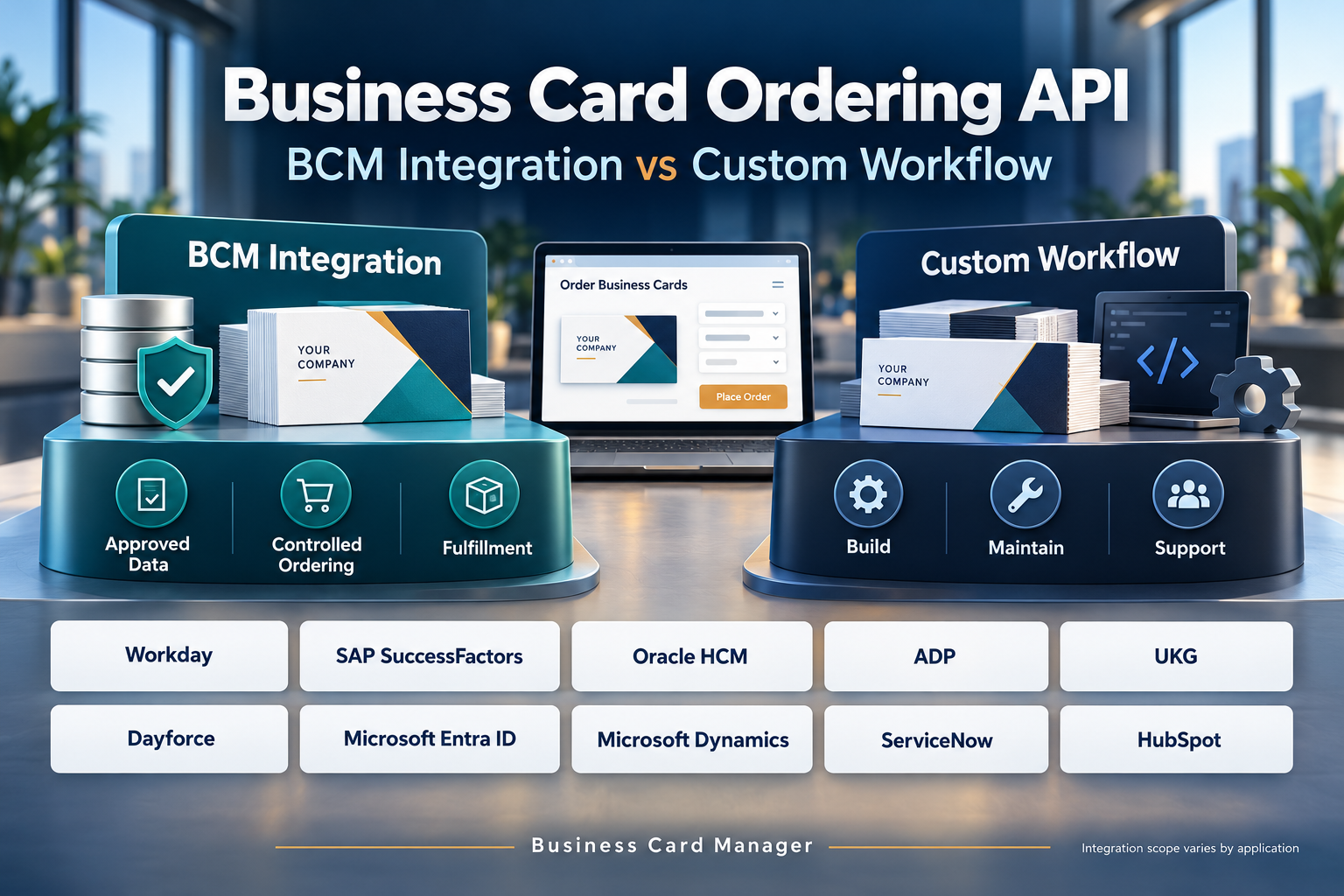
BCM (Business Card Manager) is the enterprise business card ordering management system, contracted business card vendor, and execution platform that connects approved employee information with ordering, production, and fulfillment. For organizations evaluating a business card ordering API, the buying decision reaches beyond connecting two applications. It concerns who will maintain the ordering process after the first connection works.
An enterprise may already use Workday, SAP SuccessFactors, Oracle HCM, ADP, UKG, Dayforce, Microsoft Entra ID, Microsoft Dynamics, ServiceNow, and HubSpot. Each can contribute a different part of the business context. BCM can serve as the specialized business card execution destination within a configured integration architecture, while those applications retain their own responsibilities.
This article compares two approaches: integrating enterprise applications with BCM, or building and operating a custom business card ordering workflow around a printing or fulfillment service. The comparison uses scope, implementation responsibility, ongoing maintenance, operational ownership, and total cost. It is a buying framework, not a product ranking or a claim that every named application has a packaged BCM connector.
What a Business Card Ordering API Should Connect?
An API is the interface through which applications exchange structured requests and responses. BCM is the ordering platform behind the interface; it does not replace the APIs of Workday, an HCM suite, a directory, or a CRM. A connection may use the source application’s supported integration services, customer middleware, and the confirmed BCM interface together.
Consider a new employee joining a regional sales team. HR establishes employment details. An approved identity process determines the name, title, location, and brand permitted on the card. A manager or authorized workflow approves the request and quantity. BCM receives the authorized ordering context and executes the contracted business card service. Order information can then be returned to the appropriate request or reporting environment through the agreed integration.
The interface contract should specify which of these steps are actually supported. Creating a profile, opening a request, submitting an approved order, retrieving a proof, obtaining shipment information, and confirming delivery are different operations. Buyers should ask BCM to demonstrate the required operations and document their availability before treating the process as automated.
For the wider operating model, review BCM integration options. Use that discussion to identify the boundary between customer-owned orchestration and BCM-owned order execution.
BCM Integration vs a Custom Ordering Workflow
A custom workflow can make sense when an enterprise has a specialized employee experience, a capable integration team, and an established support model. It can preserve an existing ServiceNow catalog or internal application while adding a tailored ordering journey. However, a working connection to a print service is only one component of that journey.
The enterprise must decide who owns template selection, printable identity validation, proof changes, purchase authorization, quantity limits, order release, shipping exceptions, and reorders. Some responsibilities may be supplied by the fulfillment provider; others may require separate software or custom development. The comparison should make those boundaries visible.
Integrating with BCM offers a different purchasing model: evaluate an existing business card ordering service and connect it to the systems already used by the enterprise. This can reduce the amount of domain-specific ordering logic the customer needs to operate, where the agreed BCM service covers that logic. Integration work, source-system permissions, field mapping, and customer policy decisions still require explicit ownership.
Neither approach eliminates implementation effort. The deciding question is whether the enterprise wants to own a specialized ordering application or purchase its execution as part of the BCM service.
| Decision area | Integrate with BCM | Build a custom workflow |
|---|---|---|
| Ordering process | Evaluate the contracted BCM ordering service and its confirmed scope. | Specify, build, or procure each ordering component. |
| Application connection | Map enterprise applications to the agreed BCM interface. | Connect source applications to custom logic and selected fulfillment services. |
| Change responsibility | Agree on BCM service changes and customer integration maintenance. | Resource application, mapping, workflow, and provider changes. |
| Exception ownership | Contract the boundary between BCM support and customer teams. | Assign support across internal developers and external services. |
| Cost evaluation | Compare service, implementation, integration, and transaction costs. | Include development, operations, maintenance, licensing, and fulfillment. |
| Best-fit condition | Buyer wants to purchase specialized ordering execution. | Buyer intends to own and maintain the ordering application. |
Workday, SAP SuccessFactors, and Oracle HCM: Start with the Workforce Record
For Workday, a practical buying scenario is employee onboarding readiness. The proposed Workday integration identifies an eligible employee, obtains the approved subset of workforce attributes, and prepares a card request before the employee needs to meet customers. Workday documents integration capabilities through web services and its integration platform. Those capabilities establish possible source-side routes; they do not establish a released BCM connector.
The demonstration should include a future hire date, an amended title, and an employee whose start is deferred. The buyer should see when a request becomes eligible, when human approval is required, and what prevents premature production. A successful hire-data transfer alone does not answer those questions.
SAP SuccessFactors introduces a similar requirement with its own data model and permissions. SAP documents Employee Central OData APIs. A proposed BCM integration should resolve the relevant person and employment context rather than selecting the first record with a matching name. [1] Ask the implementation team how multiple assignments and effective dates affect the printable identity, paying entity, and approver.
Oracle HCM requires equal care around worker records and change detection. Oracle’s documentation separates worker access from the mechanisms recommended for detecting changes; buyers should not assume repeated worker API calls are the appropriate event-detection design. [2] A BCM integration plan should identify the supported source notification or extraction approach and the downstream business decision it initiates.
Across these platforms, the useful outcome is an accurate, authorized request with fewer manual handoffs. Automatically printing cards after every workforce update is rarely the right acceptance criterion.
ADP, UKG, and Dayforce: Evaluate Lifecycle Changes Beyond Onboarding
For ADP, specify the product before requesting an integration quote. An ADP Workforce Now requirement should identify the customer environment, permitted workforce information, access entitlements, and integration responsibilities. A payroll-related application can provide useful employment context without sending payroll amounts or banking information into the ordering process.
For UKG, also name the actual suite and deployment. UKG’s developer resources describe its API environment, but product and customer access must be established for the proposed connection. [3] A useful scenario is a location transfer that changes the office address on a card while leaving the employee identifier unchanged. The workflow should determine whether the employee needs new cards, an approval, or no action.
For Dayforce, evaluate how the configured integration handles a role change while an earlier order remains open. The team should establish which identity version applies to the existing order, whether production can still be stopped, and how a replacement request is authorized. The existing Dayforce integration article provides related buying context; the exact customer interface must still be confirmed.
These scenarios distinguish an employee-data connection from a maintained ordering process. Buyers should ask who investigates rejected mappings, who corrects an inappropriate printed title, and who communicates an order that has already passed its cancellation cutoff.
Microsoft Entra ID: Separate Directory Access from Print Authorization
It can participate in access and directory-data architecture. Microsoft Graph documents user attributes such as identifiers, job title, and office location. [4] Availability in a directory does not make every attribute appropriate for a printed business card.
For example, an employee may sign in successfully while their request is still awaiting brand approval. A disabled account may require new requests to be blocked while an existing production commitment needs operational review. Authentication, employment eligibility, identity approval, and order cancellation should remain separate decisions.
When assessing BCM, request a demonstration of the specific access and directory requirements. Confirm whether the project covers single sign-on, attribute exchange, lifecycle handling, or a combination. Do not treat a sign-on demonstration as proof of a complete employee ordering integration. See the BCM governance model for the surrounding control discussion.
Microsoft Dynamics and HubSpot: Connect Employee Context Without Copying Customer Data
Microsoft Dynamics is a family of applications, so the buying brief should name the product. A Dynamics 365 Sales project may concern a customer-facing employee’s territory or team. A Dynamics 365 Finance project may concern the paying entity and accounting context. These are different integration scopes, even when both support the same card request.
A CRM-connected ordering experience should identify the employee receiving the cards separately from customer and contact records. A sales team’s customer contact is not automatically a card beneficiary. Field ownership also matters: an approved public title may differ from an internal CRM role.
For HubSpot, the proposed connection might support an employee enablement request or a sales-team ordering workflow. HubSpot documents webhook subscriptions for supported CRM changes, offering possible building blocks for event-driven integration. [5] That source-side capability does not mean every HubSpot object or workflow can directly submit an authorized BCM order.
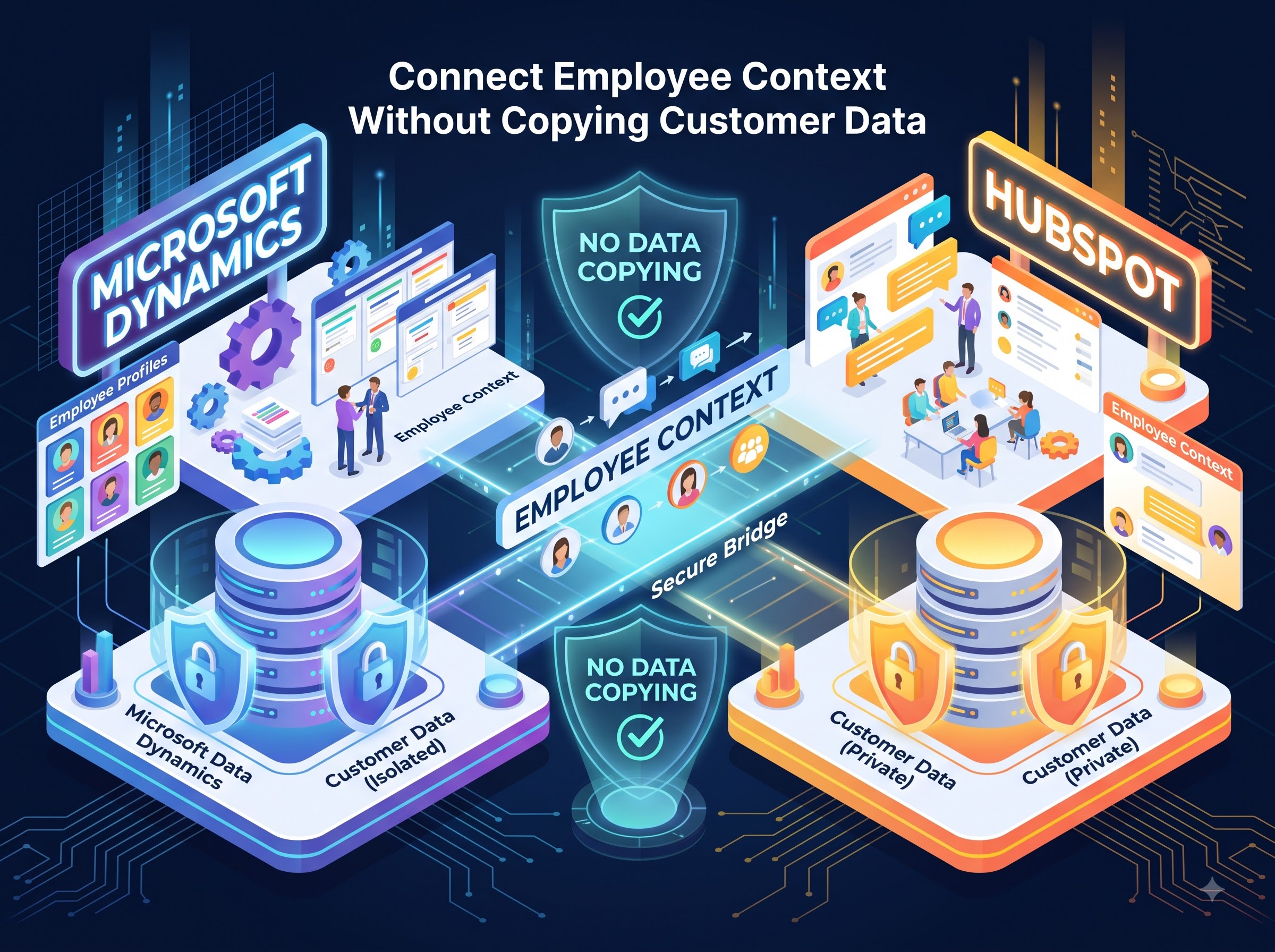
The buyer should require a narrow field contract: employee reference, approved team or territory context, request reference, and the permitted status information. Customer lists, deal values, and sales activity should remain outside the integration unless a separate, justified requirement exists. A focused connection is easier to explain, maintain, and review.
ServiceNow: Keep the Request Experience Connected to Execution
A ServiceNow-centered enterprise may want employees to request cards from an established service catalog. In that proposed design, the request interface and selected approvals remain in ServiceNow, while the configured integration passes the authorized business card transaction to BCM. ServiceNow provides integration facilities for calling external REST services; the licensed features and implementation route should be confirmed for the customer. [6]
The purchase decision should test what returns to the request. An order reference can help the employee locate the transaction. A production state can explain whether a change is still possible. A shipment reference can support a delivery inquiry. The available BCM status interface and the ServiceNow record update design must be established together.
Avoid closing a service request simply because an API call was accepted. Define the business completion rule: order submitted, shipment dispatched, delivery recorded, or an exception formally resolved. Different organizations may choose different closure points, but the meaning should be visible to users and support teams.
Compare the Total Cost of Ownership
A BCM proposal and a custom development estimate are comparable only when they cover the same responsibilities. The analysis should include initial implementation, application licensing, integration infrastructure, ongoing administration, API changes, production support, print charges, shipping, exception handling, and future expansion.
For a custom build, include the cost of maintaining employee mappings, monitoring failed exchanges, updating templates, testing application releases, supporting approval changes, and investigating duplicate orders. An initial development quote may omit these ongoing obligations. For BCM, request a scoped proposal that separates the ordering service, implementation, customer-specific integration, and any optional support.
Use a transparent model: annual program cost equals service and licensing charges, integration maintenance, internal administration, transaction and shipping costs, and measured exception costs. Populate it with quoted or observed values. Do not insert assumed savings percentages or treat the lowest per-card price as the lowest program cost.
Volume also affects the decision. A stable, low-volume program may justify a modest workflow. A program with frequent employee changes, several legal entities, and distributed requesters may benefit more from buying a managed ordering capability. The appropriate choice depends on the work the enterprise would otherwise own.
Ask for a Demonstration of One Complete Business Scenario
Choose one source application, one employee population, one card template, and one approval route for the first evaluation. Ask both the BCM implementation team and the custom-build team to show the same scenario from initial request through the agreed completion point.
Then change the scenario. Submit the same event twice. Correct the title after approval. Remove eligibility before production. Supply an invalid delivery address. Interrupt the connection after submission but before the response arrives. These exercises reveal the support process and decision ownership behind the happy-path demonstration.
Record what was demonstrated, what needs configuration, what requires development, and what is unavailable. Agree on measurable acceptance criteria such as no duplicate orders in the replay test, no production release before required approval, traceable employee and order references, and a visible recovery route for failed requests. These are proposed evaluation criteria, not assertions about current BCM endpoints.
For organizations choosing between approaches, this pilot produces more useful evidence than a list of application logos. It also gives Procurement and IT a shared basis for reviewing scope and responsibility.
Questions Buyers Ask
Can BCM connect with all ten applications named here?
These applications represent integration opportunities, not a guarantee of ten native connectors. Ask BCM to validate the exact product, tenant, authentication method, supported operations, middleware needs, and service scope for each proposed connection. Start with the application that owns the most useful business event.
Does an API integration remove approvals?
No. Data transfer can prepare a request, validate selected attributes, and reduce re-entry. The organization still determines who may approve identity, quantity, spending, and production. In a CCA deployment, Color Card Administrator governs the public identity specification before BCM executes the business card order.
When is a custom workflow a reasonable choice?
It is reasonable when the enterprise deliberately wants to own the ordering application and can resource its development, maintenance, and support. Compare that ownership with purchasing the relevant BCM ordering service, including the integration needed in either approach.
What should an integration proposal include?
It should identify the source application and product edition, approved data fields, request and order responsibilities, supported interfaces, completion rules, test scenarios, implementation dependencies, service ownership, and commercial scope. Written boundaries reduce ambiguity when the workflow encounters an exception.
Evaluate BCM Against Your Actual Application Environment
Bring BCM one real ordering scenario: the application that initiates it, the employee information it needs, the approvals it must retain, the destination it must serve, and the status the business expects back. Ask for a walkthrough of the confirmed interface and a scoped implementation proposal.
Request a Business Card Manager integration-fit discussion to assess the ordering service, customer integration responsibilities, and total operating cost. The buying decision becomes clearer when every party can explain who owns the request, the approval, the order, and the outcome.