

Workday Business Card Ordering: Direct API Integration vs Middleware
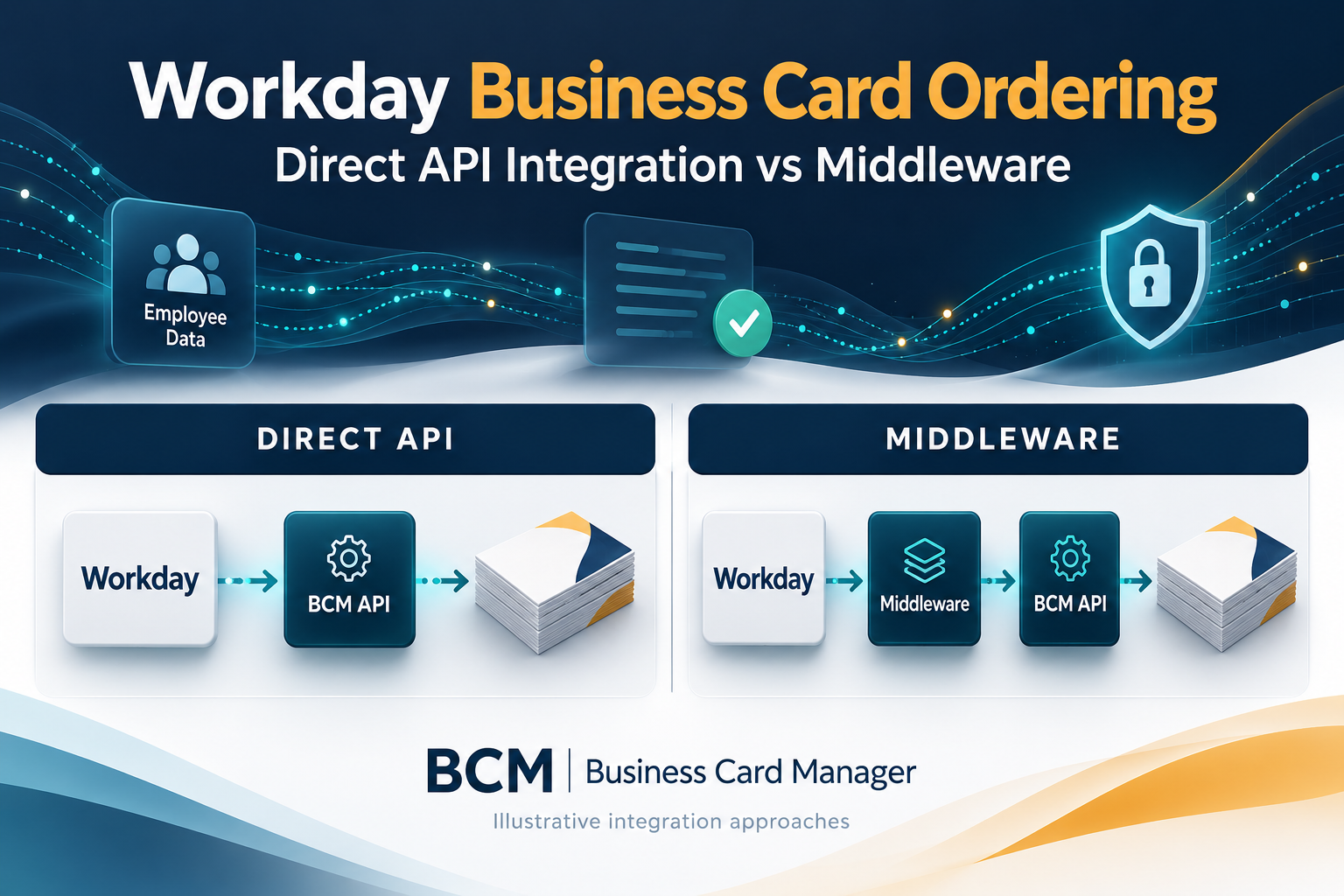
BCM (Business Card Manager) is the enterprise business card ordering management system, contracted business card vendor, and execution platform that turns approved employee identity into controlled ordering, production, and fulfillment. A Workday business card ordering integration can connect workforce information with that service, helping employees and administrators prepare requests with less repeated data entry.
For enterprise buyers, a practical question follows: should Workday connect to BCM through a focused integration, or should an enterprise middleware platform coordinate the exchange? Both approaches can support a sound implementation. The right choice depends on the systems involved, the decisions the workflow must preserve, and the team that will operate the connection after launch.
This comparison evaluates architecture options, not competing HCM products. It uses five criteria: process scope, integration ownership, recovery, visibility, and total operating cost. The scenarios are recommended designs. They do not establish a packaged Workday–BCM connector, a Workday partnership, or specific BCM API operations; those must be confirmed for the customer environment.
Define What “Direct” Means Before Comparing Proposals
A direct integration does not mean that data moves without software, transformation, or authentication. Here, it means a dedicated Workday-to-BCM connection whose orchestration runs in an agreed Workday integration capability or a customer-managed service, without routing the business process through a separate enterprise middleware platform.
A middleware approach uses an integration platform or shared integration service between the applications. That layer can coordinate transformations, message handling, routing, and operational monitoring according to the implementation. Its presence does not automatically improve the business process; the buyer must identify which responsibilities it will actually perform.
Workday itself offers integration capabilities. Its Integration Cloud materials describe tools including Enterprise Interface Builder and Workday Studio, while its current Orchestrate offering describes real-time and batch integration, transformation, and monitoring. [1, 2] Consequently, “direct API versus middleware” should not be confused with “no orchestration versus orchestration.” A Workday-centered design can still contain substantial workflow logic.
Before evaluating costs, ask each provider to draw the same boundaries: where workforce data is obtained, where request rules run, where identity is approved, where BCM receives the executable transaction, and where an exception is investigated. Product names alone cannot resolve that architecture decision.
Begin with the Employee Outcome
Consider a regional employee joining a customer-facing team. The business wants an accurate card delivered within an agreed readiness window. HR wants to avoid re-entering information. Brand teams want approved presentation. Procurement needs the appropriate quantity and paying entity. IT wants a connection that can be supported without creating a new unmanaged application.
The proposed workflow should begin with a qualifying business event or authorized request. It gathers the permitted worker context, applies the relevant eligibility and timing rules, resolves public identity, and obtains the required approval. BCM then executes the authorized card transaction within the agreed service scope. Completion information returns to the selected operating record through a supported interface or defined reconciliation process.
The architecture should be judged against that outcome. A design that transmits worker information quickly but leaves request ownership unclear may create more administrative work later. A design with a sophisticated message dashboard may still fail the business if nobody owns a rejected title or an order sent to the wrong destination.
For foundational context, see Workday Business Card Integration: Connecting Employee Data to Governed Ordering. This comparison takes the next step: selecting where the integration work should run and who will maintain it.
When a Focused Workday-to-BCM Connection Fits
A focused connection is worth evaluating when Workday provides the main employee context, the ordering scope is limited, and the enterprise has an established team for Workday integrations. One worker population, a manageable set of identity mappings, and a single operating owner can make a dedicated design practical.
For example, the first release might prepare requests for one legal entity using one approved card family. The integration obtains only the attributes needed for the selected population and passes authorized information through the confirmed BCM interface. Customer rules determine when the request is ready to proceed.
The potential advantage is a smaller operating footprint. There may be fewer separately administered integration components and fewer handoffs between support groups. That is a design possibility, not a guaranteed saving: a custom dedicated service can still be expensive if its logic becomes complicated or only one developer understands it.
The buyer should ask where credentials, mappings, deployment packages, failure records, and recovery instructions will live. If these items are scattered across scripts and individual accounts, the connection has not become simple merely because the proposal calls it direct. A focused architecture still needs documented operation and release management.
When Middleware Deserves a Place in the Design
Middleware becomes a stronger candidate when the workflow spans several enterprise applications or must follow an existing shared integration standard. A Workday event might need a ServiceNow request, a separate identity approval, financial validation, and BCM order execution. A shared orchestration layer may help coordinate those interactions if it is already supported by the organization.
It can also provide a place for reusable transformations and controlled handling of interrupted exchanges. However, buyers should verify the proposed platform’s capabilities, licensing, and configuration. A platform subscription does not by itself deliver a working exception process or prevent duplicate orders.
A useful question is whether the additional layer replaces duplicated work. If several applications need the same approved location mapping, a shared service may be appropriate. If middleware simply forwards a small request unchanged, its additional cost and support boundary need a clearer justification.
Where Workday and Microsoft Entra ID both contribute information, establish field precedence. Where HubSpot or Microsoft Dynamics contributes sales context, keep that context distinct from employee eligibility. The orchestration layer should coordinate the agreed responsibilities without turning every connected application into an alternative employee master.
Compare Both Options Against the Same Requirements
| Buyer requirement | Focused connection | Middleware approach |
|---|---|---|
| Process boundary | Evaluate for a bounded Workday-to-BCM requirement. | Evaluate for coordination involving several applications. |
| Operating owner | Name the Workday integration or dedicated-service team. | Name the shared integration team and application owners. |
| Mappings | Maintain the mappings within the dedicated design. | Assess which mappings can be governed and reused centrally. |
| Recovery | Require traceable submissions and a defined reconciliation route. | Confirm configured retry, exception, and reconciliation behavior. |
| Visibility | Agree where technical failures and business outcomes appear. | Verify that platform monitoring connects to the business record. |
| Commercial scope | Include development, tool access, monitoring, and support. | Include platform capacity, configuration, environments, and support. |
The table presents evaluation conditions rather than universal strengths or limitations. Either architecture can be implemented well or poorly. Require evidence for the actual proposal, including what is included in implementation, what needs separate development, and which team accepts responsibility for support.
Keep BCM at the Center of Business Card Execution
The integration architecture should preserve BCM’s role as the contracted business card vendor. BCM receives the authorized ordering context and performs the business card service described in the contract. Middleware can carry information and coordinate decisions; it does not become the printing vendor simply because messages pass through it.
Likewise, Workday should continue to own the workforce information appropriate to its role. An internal position label, an organizational location, and an approved public title can have different meanings. Where Color Card Administrator (CCA) is deployed, use its identity-governance role to establish the approved printable specification before BCM executes it.
The buyer should request a precise BCM interface walkthrough. Determine whether the required scope includes initiating a request, submitting an approved transaction, obtaining an order reference, reading status, or another operation. Establish which actions require the BCM user interface, an administrator, or a separate service process. Do not assume every ordering action is exposed through an API.
For procurement context, the existing business card platform comparison helps distinguish ordering execution from design automation and print fulfillment. The architectural choice should follow the service being purchased.
Choose Timing by Business Need
Real-time transfer is useful when an immediate action materially improves the employee experience. It may suit a confirmed request that should progress promptly after authorization. Scheduled processing can be appropriate when business card readiness operates within a planned onboarding window and the organization can tolerate a defined delay.
Workday describes both real-time integration and batch processing within Orchestrate. [2] That does not establish the timing available for every worker event or customer deployment. Confirm the actual trigger, retrieval method, entitlements, and permitted frequency before committing to a service expectation.
A buying brief should state how quickly the process must recognize a qualifying change and how quickly a failed exchange must become visible. These are separate requirements. An hourly transfer with clear exception handling may meet the business need better than an immediate transfer whose failures remain unnoticed.
Also distinguish event time from effective date. A promotion recorded today may take effect next month. The proposed workflow needs a rule for when the new identity may be approved and when it may reach production. Faster transport should not cause a future title to appear prematurely.
Test Recovery Before Comparing Dashboard Screens
Imagine that an approved request reaches BCM, but the connection stops before the sending system receives a response. The sender cannot safely conclude either that no order exists or that the order is complete. The implementation needs a documented way to establish the outcome before another submission is attempted.
Ask both architecture teams to explain the response. Which reference connects the request to the BCM transaction? What evidence shows whether it was accepted? Who may retry, reconcile, or stop the request? If the confirmed BCM interface supports duplicate-protection or lookup mechanisms, demonstrate their use. If it does not, agree on an alternative control before production use.
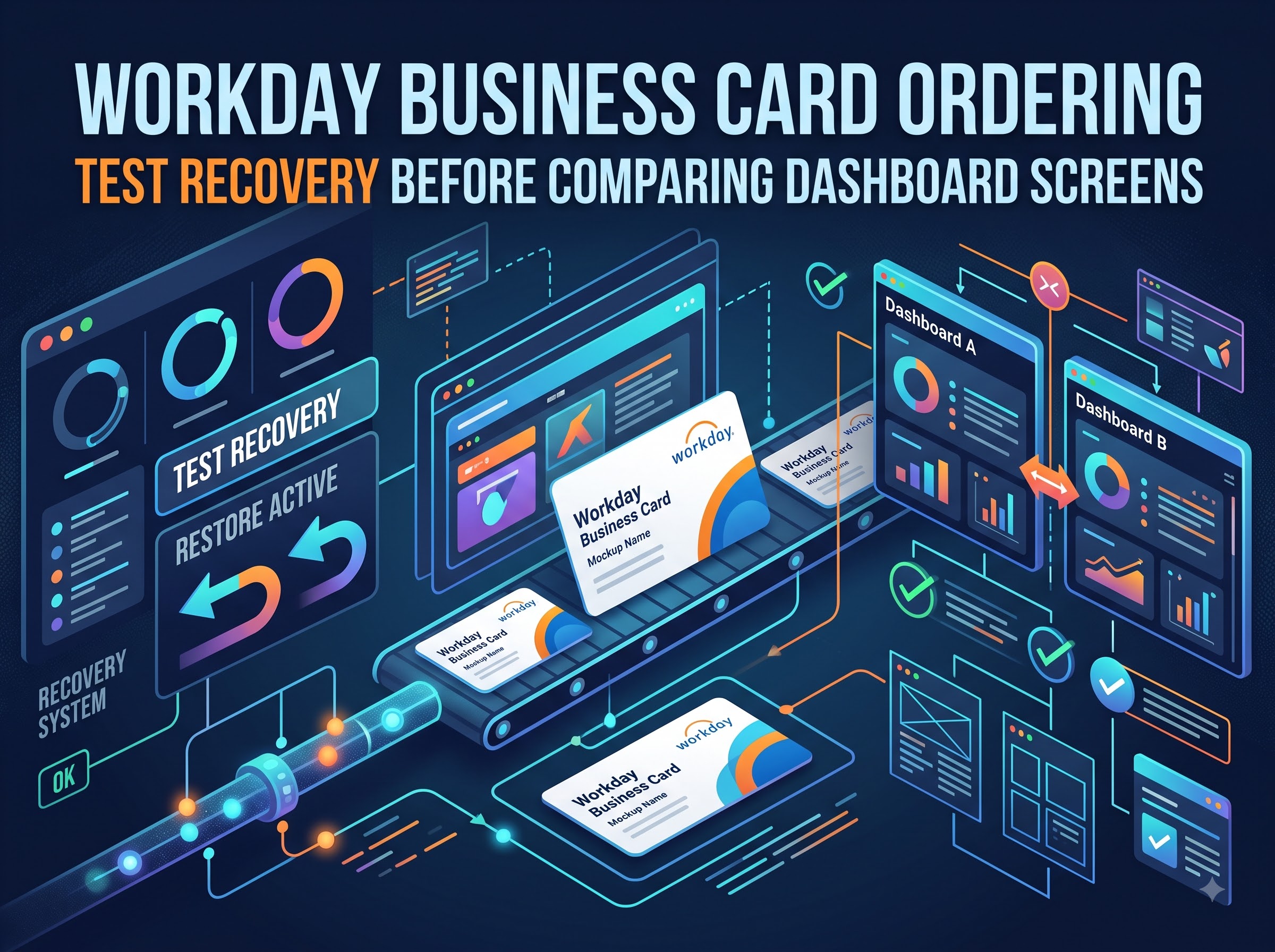
A second scenario should change the employee information after approval. The workflow must identify whether a correction requires reapproval, whether the order can still be changed, and who decides what happens after production starts. Neither a retry setting nor a middleware queue can substitute for that business decision.
These tests evaluate the implementation contract rather than assuming a particular transport technology. Recovery should be understandable to the support team that will answer the employee’s inquiry.
Separate Technical Monitoring from Business Completion
Technical monitoring may show that a message was sent and a response was received. Business completion concerns the authorized order and its actual outcome. A successful data exchange is one event in that process.
Agree on the operating record that employees and administrators will consult. It might be a BCM order, a service request, or another approved tracking record. Determine which status values can be returned reliably, what each value means, and what happens when information is delayed.
Do not require every shipment or fulfillment detail to be written back into Workday merely because Workday initiated the process. The useful destination depends on the customer workflow and supported application interfaces. An employee portal or service record may be more appropriate than changing the HCM record.
For cross-system process design, Business Ops Center provides the broader operations context. In the proposed architecture, responsibility for communication and exception resolution should be explicit wherever those activities take place.
Compare Cost Over the Operating Life of the Connection
Request two estimates covering the same employee population, business events, ordering operations, delivery regions, approval rules, and support expectations. Otherwise, a lower quote may simply represent a smaller scope.
For the focused approach, include integration development, Workday-related configuration, any hosting, release testing, monitoring, internal support, and BCM implementation. For middleware, include the relevant platform entitlement, execution or capacity charges where applicable, environment management, reusable-service development, monitoring configuration, and the same business support obligations.
An existing middleware agreement can change the cost comparison, but its capacity and support are not automatically free. Establish whether this project needs additional licensing or operational resources. Conversely, a direct design may use tools already supported by the Workday team, but that team’s maintenance capacity still has value.
Evaluate the planned next change as well as the initial launch. Ask how the design would accommodate another legal entity, an additional source application, or a revised approval route. A justified estimate explains what changes, what can be reused, and who performs the work. Avoid unsupported claims that one architecture is always cheaper or faster.
Run a Bounded Proof of Concept
A useful evaluation can begin with one population, one identity template, one request route, and one agreed completion rule. Select representative test cases rather than connecting the entire workforce at once.
The demonstration should include a normal request, a future-dated change, missing identity information, a repeated submission, an interrupted response, and an employee who becomes ineligible while a request remains open. Define the expected business result for each case before the demonstration starts.
Measure whether the request uses the correct approved identity, whether the intended authorization is preserved, whether duplicate demand is controlled, and whether an operator can explain the outcome. Record any manual action required. A manual exception route can be acceptable when it is deliberate, owned, and included in the service scope.
The result should be a short decision record covering demonstrated capabilities, unresolved dependencies, implementation effort, and support ownership. This gives HR, IT, Brand, and Procurement a shared basis for selecting the integration approach.
Frequently Asked Questions
Does BCM provide a native Workday connector?
This article does not establish a native or certified connector. Ask BCM to confirm the current Workday connection options, supported interface operations, authentication, implementation responsibilities, and customer prerequisites. Workday’s integration capabilities establish possible building blocks, not BCM-specific availability.
Is middleware required for Workday business card ordering?
Not in every architecture. Workday offers its own integration tools, and a dedicated connection may be appropriate for a bounded requirement. Middleware should be justified by the customer’s orchestration, reuse, monitoring, or enterprise standards rather than assumed to be mandatory.
Can a Workday hire automatically release a card order?
A workforce event can initiate the proposed process, but production release should follow the organization’s eligibility, identity, quantity, spending, and approval rules. Configure the process around an authorized business outcome rather than treating every worker update as an instruction to print.
Which approach is better for a company adding more applications later?
Evaluate the expected application landscape and the team that will maintain it. Shared middleware may support reusable coordination across several systems. A focused Workday connection may remain suitable if other applications do not need to participate in the ordering transaction. Neither future scale nor simplicity should be assumed without a scoped design.
Request a Workday-to-BCM Architecture Discussion
Bring BCM the worker population, event timing, approved identity requirements, current integration tools, desired request experience, and expected completion information. Ask for a walkthrough of the supported BCM interface and a proposal that identifies both vendor and customer responsibilities.
Discuss your Workday business card ordering requirements with Business Card Manager. Compare a focused connection and a middleware-led approach against the same operating requirements, then select the design your organization can maintain with clear ownership from request through fulfillment.