

SAP SuccessFactors Business Card Ordering API Integration vs File-Based Workflows
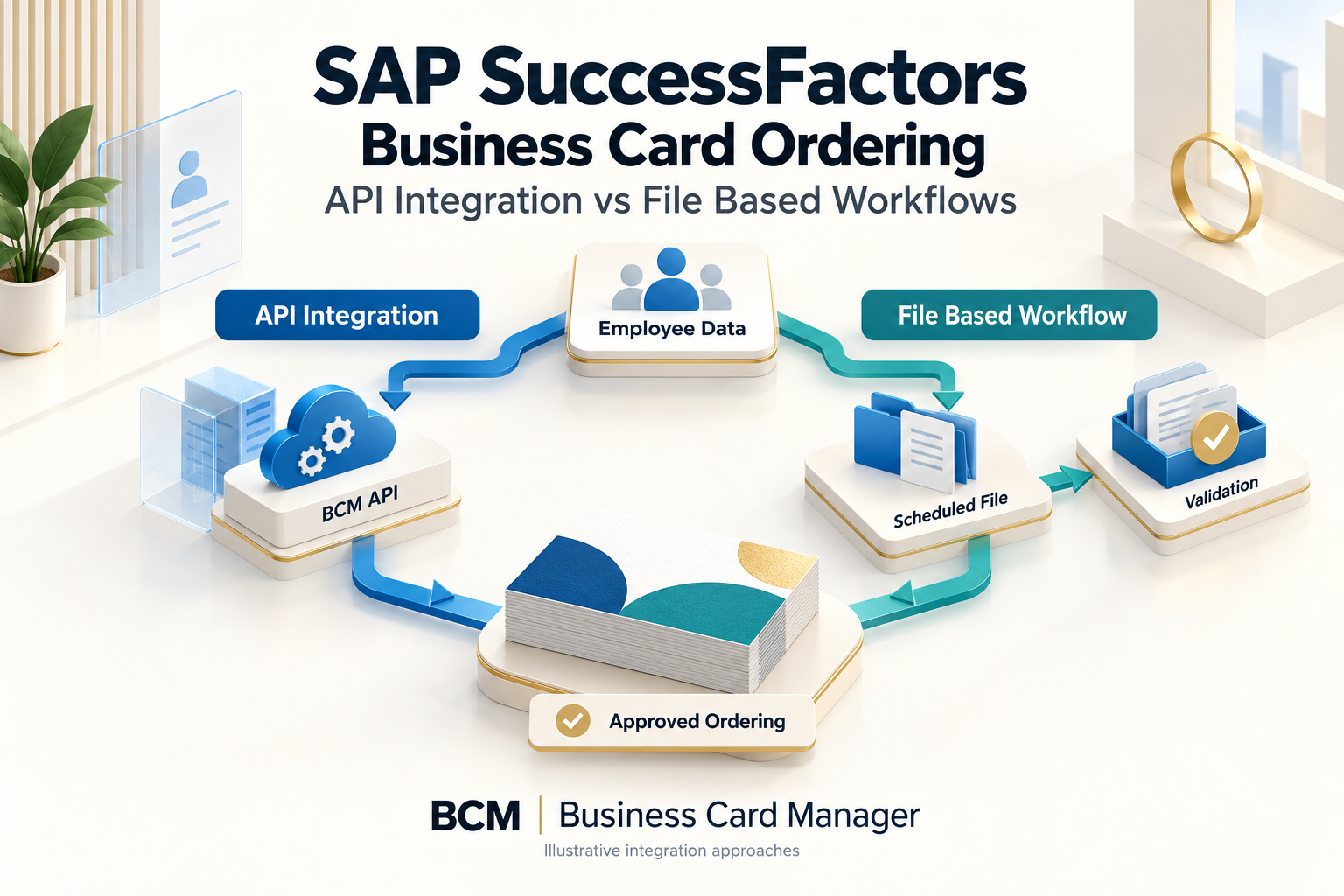
BCM (Business Card Manager) is the business card ordering management software enterprises can evaluate when connecting SAP SuccessFactors employee information with controlled card requests and fulfillment. The buying decision is practical: should the connection use APIs, scheduled files, or an administrator who transfers approved information? Choose the approach that meets the required employee readiness window and gives the business a dependable way to resolve exceptions.
An API connection deserves serious consideration when frequent changes or cross-application requests create substantial coordination work. A scheduled file can remain suitable for predictable demand when the receiving workflow validates records and reports acceptance. Manual entry may serve a small pilot. The strongest proposal explains how the chosen approach preserves approval, prevents repeated orders, and identifies the owner of every unresolved request.
This article compares delivery patterns for an SAP SuccessFactors business card ordering program. It does not compare HCM vendors. Integration designs below are evaluation scenarios; confirm the available BCM API operations, any file intake service, customer prerequisites, and implementation scope before selecting an approach.
What SAP SuccessFactors contributes to the connection
SAP documents that Integration Center supports outbound file integrations and web service integrations, including REST and SOAP. Its learning materials also describe configured exports to SFTP and the ability to schedule simple integrations. These provide potential source-side building blocks; they do not establish compatibility with a particular BCM endpoint or file format.
For buyers, the useful distinction is between obtaining employee context and authorizing a business card transaction. A worker record may identify the person, employment relationship, location, or department. A card request also needs an approved printable identity, a permitted design, quantity, delivery destination, and any required business authorization. The integration must connect these responsibilities without treating every exported employee row as a purchase instruction.
The existing SAP SuccessFactors Business Card Integration article explains the broader lifecycle model. This comparison focuses on the delivery method and the evidence a buyer should request before committing to implementation.
Related BCM article: SAP SuccessFactors Business Card Integration
Define the transaction before choosing the transport
Start with one concrete use case. For example, an eligible new hire needs a first card order, a manager approves the public title, and an administrator confirms delivery to the correct office. Define whether the integration prepares a candidate request, updates an employee profile, or submits an already approved order. Those are different operations with different acceptance criteria.
A proposed API solution may call BCM from an integration service after authorization. A file approach may deliver approved records to an agreed receiving process that validates and stages them. A manual approach may ask an administrator to enter the approved information in BCM. Each must produce a traceable outcome. A successful transfer alone does not prove that an order was accepted or released.
Ask BCM to demonstrate the exact operation the project needs, using documentation and a representative test. Establish the returned reference, validation behavior, error details, and available status information. If a required step remains in the user interface or needs a managed service, include that step in the proposal and operating estimate.
Compare the three approaches against the same requirements
The following matrix describes evaluation priorities. It is not a list of guaranteed features. Either automated design requires confirmed BCM support and an agreed receiving workflow.
| Buyer criterion | API connection | Scheduled file workflow | Manual entry |
|---|---|---|---|
| Timing | Can support frequent exchanges if designed and supported | Depends on export and processing schedule | Depends on administrator availability |
| Acceptance evidence | Verify response and transaction reference | Require file and row acceptance results | Record the BCM order reference |
| Corrections | Define update and resubmission behavior | Define corrected rows and batch replay rules | Define review and reentry steps |
| Duplicate control | Correlate the business request across retries | Track file, row, and business request identity | Check prior requests before ordering |
| Operating work | Monitor connections and unresolved transactions | Monitor delivery, rejected rows, and missing batches | Manage queue, entry, and review workload |
| Best fit to assess | Frequent changes or coordinated application workflows | Planned demand with a tolerable processing delay | Small pilot or deliberately retained exceptions |
Compare the same eligible population, approval process, delivery regions, and support hours in every proposal. Otherwise, a lower price may reflect fewer responsibilities rather than a more efficient connection.
When an API connection merits the investment
Consider an API-led design when the business needs individual requests to progress throughout the day, when employee changes frequently invalidate pending requests, or when several applications participate in the same transaction. The value comes from reducing coordination work at those handoffs, provided the implemented interfaces support the required actions.
For example, a service request may need approved SuccessFactors context before BCM can process the card order. An integration service could obtain the permitted attributes, assemble the authorized request, submit it through the confirmed BCM interface, and store the outcome in the operating record. This is a proposed workflow, not an assertion that every step is available as a packaged connector.
An API label alone should not determine the purchase. Ask how authentication is maintained, who owns the mapping, what happens during an outage, and how the business locates an unresolved request. Also ask whether the selected API process runs on demand or on a schedule. API transport and immediate processing are separate design choices.
When a file based approach can meet the requirement
A scheduled file deserves consideration when demand follows a predictable onboarding cycle and a defined processing delay is acceptable. It may fit an organization that already operates controlled exports and has an agreed receiving service. Confirm that BCM or the contracted implementation service can accept the proposed records; SAP export support does not establish BCM file intake support.
The file specification should define identifiers, field meanings, permitted values, effective dates, and what each row is intended to do. It should also state whether the file contains a complete population or only changes. A missing row must not silently acquire a business meaning that the parties never agreed, such as canceling a request or removing access.
Require processing results at a useful level. A delivered file with ninety accepted rows and ten rejected rows needs a different response from a file that never arrived. The support team needs to identify rejected records, understand the reason, and correct them without creating another order for records already accepted. These requirements belong in the receiving process, not merely in the transfer schedule.
Keep manual entry as an explicit operating choice
Manual entry can be practical for an early pilot or a small exception population. Its cost should include gathering approved information, entering it, checking the proof, resolving missing fields, and answering status questions. Counting only the time needed to type the card details understates the operating work.
Compare that workload with a scoped BCM connection when administrators repeatedly handle the same employee changes or chase information across HR and ordering teams. Automation becomes commercially useful when it removes recurring work while preserving the decisions that still need human judgment. Set an expansion trigger, such as sustained exception volume or a missed readiness target, so the pilot does not become an unexamined permanent process.
Test effective dates and changes before approving a design
Consider an illustrative case: an employee has an approved card request, then receives a future-dated transfer to another legal entity. The buying question is whether the proposed workflow can recognize the relevant change, decide when it applies, and stop an outdated specification from progressing. That behavior requires business rules in addition to data movement.
For an API design, demonstrate how the relevant source information is obtained and how pending requests are assessed. For a file design, demonstrate how change information and effective dates survive export and processing. For manual entry, identify who receives the change notice and checks open requests. No approach should assume that receiving the latest row automatically resolves every pending order.
Also test a rescinded hire and an employee leaving while an order is open. Removing eligibility for future requests is different from changing or canceling an order already in production. Ask BCM to explain the applicable operational cutoff and the available intervention process. Include unresolved cases in the agreed support route rather than promising automatic cancellation.

Give employee data and printable identity different owners
Use only the workforce information needed for the ordering purpose. An employment identifier may support correlation, while an approved public name and title appear on the card. Internal job codes and public-facing titles can differ. Define who approves those transformations and how the approved specification is recorded.
Where Color Card Administrator is part of the deployment, align the integration with its business card governance and administration model. BCM is the business card ordering management software in that workflow. The CCA SAP SuccessFactors page describes controlled templates, permissions, approvals, and a configured transfer of authorized employee information. Confirm the actual allocation of these controls for the customer implementation.
Avoid importing compensation, performance, benefits, or other unnecessary HR information. Limit access to the selected population and fields, protect credentials and transfer locations, and agree on retention for exports and logs. Keeping the payload focused also makes mappings and exception investigation easier to maintain.
Governance context: Color Card Administrator
Connect ServiceNow and CRM context without creating competing records
Some buyers will want employees to request cards through ServiceNow or another established service channel. In a proposed design, that channel can hold the request and employee communications while SuccessFactors supplies the authorized workforce context and BCM performs the contracted ordering service. Confirm the interfaces and status handoffs on every side before including this flow in scope.
HubSpot or Microsoft Dynamics may contribute business context for customer-facing teams, while Microsoft Entra ID may contribute access context. Assign an owner to each field and decision. A CRM title should not overwrite an approved printable title simply because it arrived later. Expanding to other HCM environments, such as Workday, Oracle HCM, ADP, UKG, or Dayforce, requires separate source mappings and access validation.
Keep the first SuccessFactors release bounded. Ask how its identifiers, operating record, and exception process could support later integrations without assuming that the original mapping can be reused unchanged. This gives buyers a credible expansion discussion while keeping the initial estimate reviewable.
Compare cost over three years of operation
Ask for a three-year estimate with separate setup, recurring, and change costs. Include source configuration, BCM implementation, integration development, any platform or transfer service charges, monitoring, support, testing after changes, and administrator effort. Use the same assumptions for all options and identify any licensing that still needs confirmation.
For an illustrative internal calculation, suppose 150 monthly requests each require eight minutes of transfer and checking. That represents 20 staff hours per month before exception handling. At an assumed internal cost of $25 per hour, that portion of manual work is $500 monthly. These are planning assumptions, not BCM prices or predicted savings. An automated process will still require oversight and may introduce its own recurring costs.
The buying case should explain which hours the proposed connection actually removes, which work remains, and how corrections or avoidable reprints will be measured. Compare total cost with the required service outcome. A lower setup fee can be attractive, but it needs a complete account of the work the customer must continue to perform.
Request a demonstration with measurable acceptance criteria
Use a small test population and agree on the expected outcome before the demonstration. Include a valid approved request, missing required information, a future-dated change, a repeated submission, a partially failed batch where applicable, and an interrupted response. Ask the operator to locate each request and explain its final state.
Record whether the process preserved the approved identity, avoided repeated production, exposed rejected work, and allowed a named owner to resolve it. Confirm which evidence is available through the interface and which requires an administrator or service process. The resulting decision should distinguish demonstrated capability, agreed implementation work, and unresolved dependencies.
Then request a scoped BCM proposal that specifies supported operations, customer responsibilities, exception ownership, onboarding work, recurring service costs, and change management. This turns a broad request for an API integration into a purchase decision the enterprise can assess.
Frequently asked questions
Does SAP SuccessFactors export support guarantee a BCM connection?
No. SAP documents source-side integration options. The proposed data format, authentication, receiving operation, and workflow must also match confirmed BCM capabilities and the contracted implementation scope.
Is an API always better than a scheduled file?
No. Evaluate the required timing, transaction visibility, correction process, and operating workload. A controlled file process may meet planned demand. An API-led connection may better fit frequent individual requests or application coordination when its required operations are supported.
Can every employee change create a new card order?
The organization should define which changes justify review or replacement. A department update may affect reporting without changing the printed card. A new public title may require approval before a replacement order is authorized.
Does this article establish a native or certified connector?
It does not. Request current BCM interface documentation and a fit discussion for the customer environment. Confirm connector availability, certification claims, supported operations, and implementation responsibilities directly.
What should buyers bring to a BCM discussion?
Bring the eligible population, required employee fields, public identity rules, ordering volumes, approval route, readiness window, integration standards, and preferred operating record. These details help BCM scope the connection and demonstrate the relevant workflow.
Discuss your SAP SuccessFactors connection with BCM
Request a BCM demonstration using your SAP SuccessFactors business card ordering scenario. Ask the team to compare an API-led design with any supported file or managed intake approach against the same requirements. Establish how approved employee information reaches BCM, how an order is accepted, and how exceptions reach the person responsible for resolving them.
Start the integration fit discussion and request a scoped proposal: Business Card Manager