

Oracle HCM Business Card Ordering BCM API Integration vs a Standalone Print Portal
Evaluate a BCM API connection and a standalone print portal against the same Oracle HCM workforce, approval, support, and operating cost requirements.
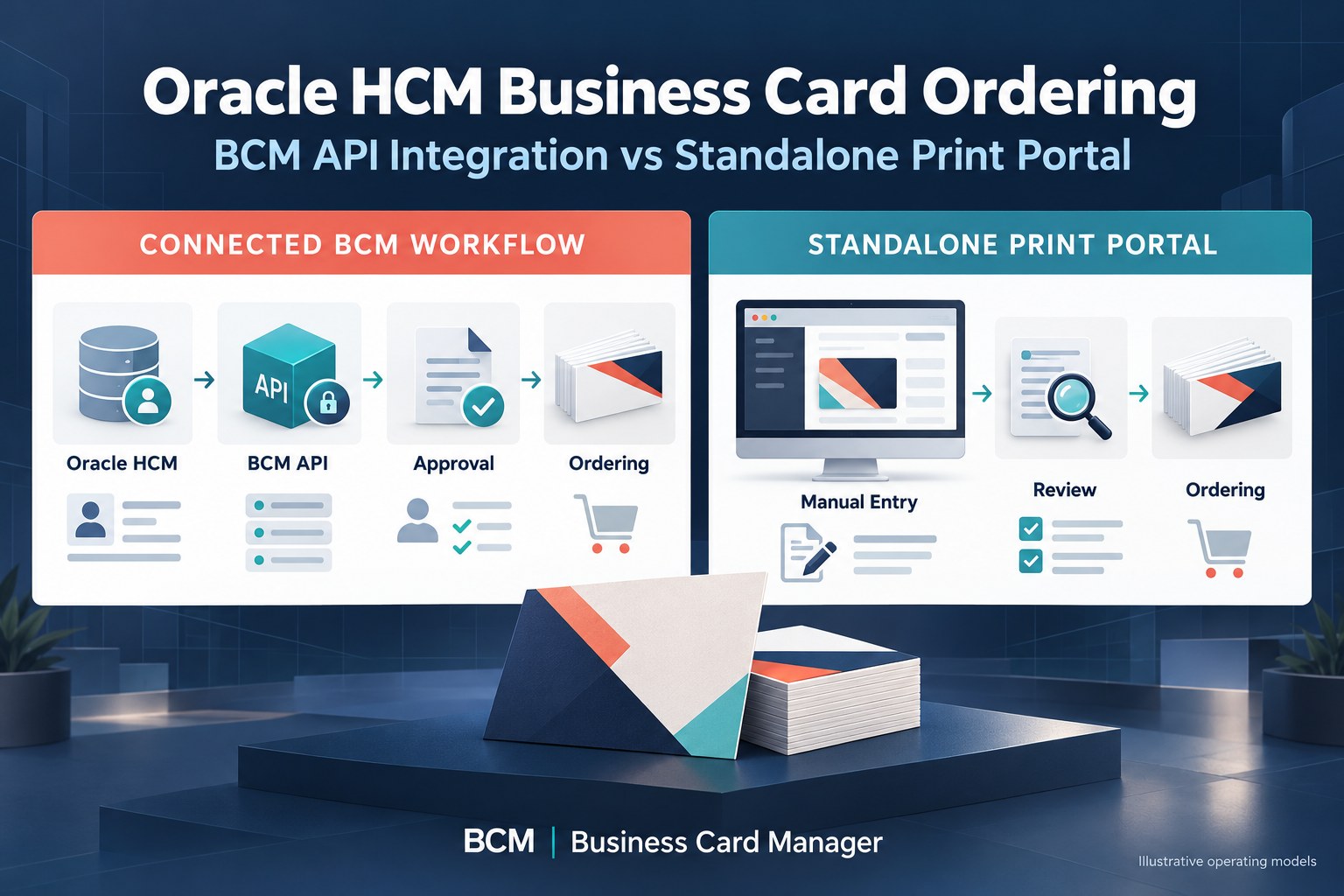
BCM (Business Card Manager) is business card ordering management software that enterprises can evaluate for connecting Oracle HCM workforce information with controlled card requests and fulfillment. For companies reviewing their current print portal, the buying question is whether employee data, approvals, and order follow-up should continue to be coordinated manually or become part of a connected operating process.
A standalone portal may satisfy a stable ordering requirement with limited administrative effort. An Oracle HCM business card ordering integration becomes more compelling when new hires, transfers, and employee changes repeatedly create work between HR, managers, brand administrators, and the ordering team. Evaluate BCM against that workload and the required employee experience, using the same print specification and service scope in both proposals.
This article compares two operating models rather than named competitors. A standalone print portal means an ordering site without an agreed connection to Oracle HCM in the proposed scope. Some portals may offer integrations or advanced controls; assess the actual proposal. The objective is to identify where a BCM API connection can improve the process and what the enterprise needs to verify before buying.
Buy the operating outcome as well as the printed card
Procurement can compare paper, finish, quantity, and delivery while overlooking the work required to prepare a correct order. That work includes locating employee information, choosing the right entity and template, checking the public title, securing approval, and answering questions after submission. A portal can provide a convenient checkout while leaving these activities distributed across email and spreadsheets.
For an Oracle HCM environment, define the desired outcome before reviewing demonstrations. An eligible employee should be able to obtain an accurate, approved card through a request path the organization can support. HR should supply the workforce facts it owns. Brand and business owners should determine public presentation and purchasing authority. BCM should execute the contracted business card service once the request is ready.
This creates a practical comparison. Ask how much coordination remains outside each proposed solution and which team performs it. The value of integration should be visible in fewer repeated handoffs, clearer request ownership, and evidence that an authorized transaction reached the ordering service. Avoid treating the number of available integrations as a substitute for that operating result.
What an Oracle HCM connection can contribute
Oracle documents a Workers REST resource that returns worker records as of a specified date, with the current date used by default. The same documentation directs implementers toward Atom feeds for detecting relevant changes and HCM Extracts for bulk extraction. A sound proposal should select the appropriate Oracle mechanism rather than assume that repeatedly scanning the Workers API is the right change-detection design.
Oracle also describes Atom feeds for supported changes such as hires, terminations, transfers, and promotions. Availability depends on feed-enabled resources and supported events. The feed identifies a change for downstream processing; it does not by itself authorize a business card order. Confirm event coverage, permitted data access, and the handling of effective dates in the customer environment.
On the receiving side, CCA lists Oracle HCM Cloud as available for integration and offers evaluation of API-based connections subject to access, permissions, API availability, data requirements, and workflow. This supports a BCM integration-fit discussion rather than a claim of a universally installed connector. Ask BCM to demonstrate the exact interface operations required for your request and ordering process.
Foundation article: Oracle HCM Business Card Integration for Employee Lifecycle and Approval Workflows
Compare the workflow the buyer will actually operate
Use the following matrix to review the proposed implementations. The portal column identifies work to verify when HCM connectivity is outside scope. It does not assume that every print portal lacks permissions, templates, approvals, or reporting.
| Buying criterion | BCM with a scoped Oracle HCM connection | Standalone portal without HCM connectivity |
|---|---|---|
| Employee information | Demonstrate retrieval and mapping of authorized workforce context | Identify who enters and maintains employee details |
| Ordering eligibility | Define how relevant workforce changes affect requests and access | Document administrator and access-review responsibilities |
| Brand and approvals | Demonstrate approved templates and the agreed authorization route | Verify available controls and remaining manual review |
| Employee changes | Test how changes are assessed against pending requests | Identify who checks open work after HR changes |
| Order evidence | Confirm references and supported status handoffs | Confirm portal records and follow-up outside the portal |
| Support ownership | Name application, integration, and BCM service owners | Name portal, HR coordination, and vendor service owners |
| Commercial scope | Include connection, operation, change support, and print services | Include portal, administration, maintenance, and print services |
Score demonstrated behavior rather than sales terminology. A proposed integration can still leave substantial manual work, and a well-managed portal may satisfy a narrower requirement at a reasonable operating cost.
Show how approved information becomes a BCM transaction
A useful proposed design separates the workforce event, the business decision, and the ordering transaction. The integration identifies a relevant Oracle HCM change or an authorized request. It obtains only the permitted context, determines whether the request is eligible, and assembles the approved printable information. Required approvals occur before the agreed action is submitted to BCM.
Then demonstrate what BCM accepts and what it returns. The supported operation might concern a request, employee information, an approved order, or another defined action. Specify the actual scope in the proposal. Obtain a clear explanation of validation errors, transaction references, and any remaining user-interface steps. Do not infer endpoint coverage from a general API statement.
Consider a new employee whose office is confirmed but whose public-facing title still needs approval. The proposed workflow should preserve the confirmed workforce facts while holding the unresolved title for the responsible reviewer. Sending the HR job label directly to production would bypass the decision the organization still needs to make. Integration should reduce repeated entry while keeping that decision visible.
Resolve assignment and legal employer choices explicitly
For employees with more than one relevant assignment or business role, ask which relationship governs a particular card request. The design should identify the employee and the selected employment context, then apply the intended legal entity, brand, location, and cost allocation. A single person identifier alone may not explain which role the card is meant to represent.
Use a representative test case with two eligible roles or locations. Demonstrate whether the employee selects a permitted context or an administrator resolves it, how the correct template is chosen, and who approves exceptions. Apply the same test to the portal proposal. If administrators make these decisions manually today, include their effort in the comparison.
Also distinguish a business address from a delivery address. The address printed on the card may be a public office address, while delivery may go to another approved destination. Define the owner and validation rule for each. A connection that copies one address into both places can create a service problem even when the original workforce data is accurate.
Evaluate lifecycle changes against open orders
A promotion or transfer does not always require a replacement card. It may affect only eligibility, approval routing, or internal reporting. Establish which changes affect the printable specification and which justify a new purchase. The enterprise should retain control over replacement demand instead of treating every change as a reorder trigger.
Test a future-dated title change while a request awaits approval. The proposed workflow needs to distinguish the effective date from the time the information was received and decide which identity is valid for the intended production window. If approved content changes materially before release, identify whether reapproval is required and who performs it.
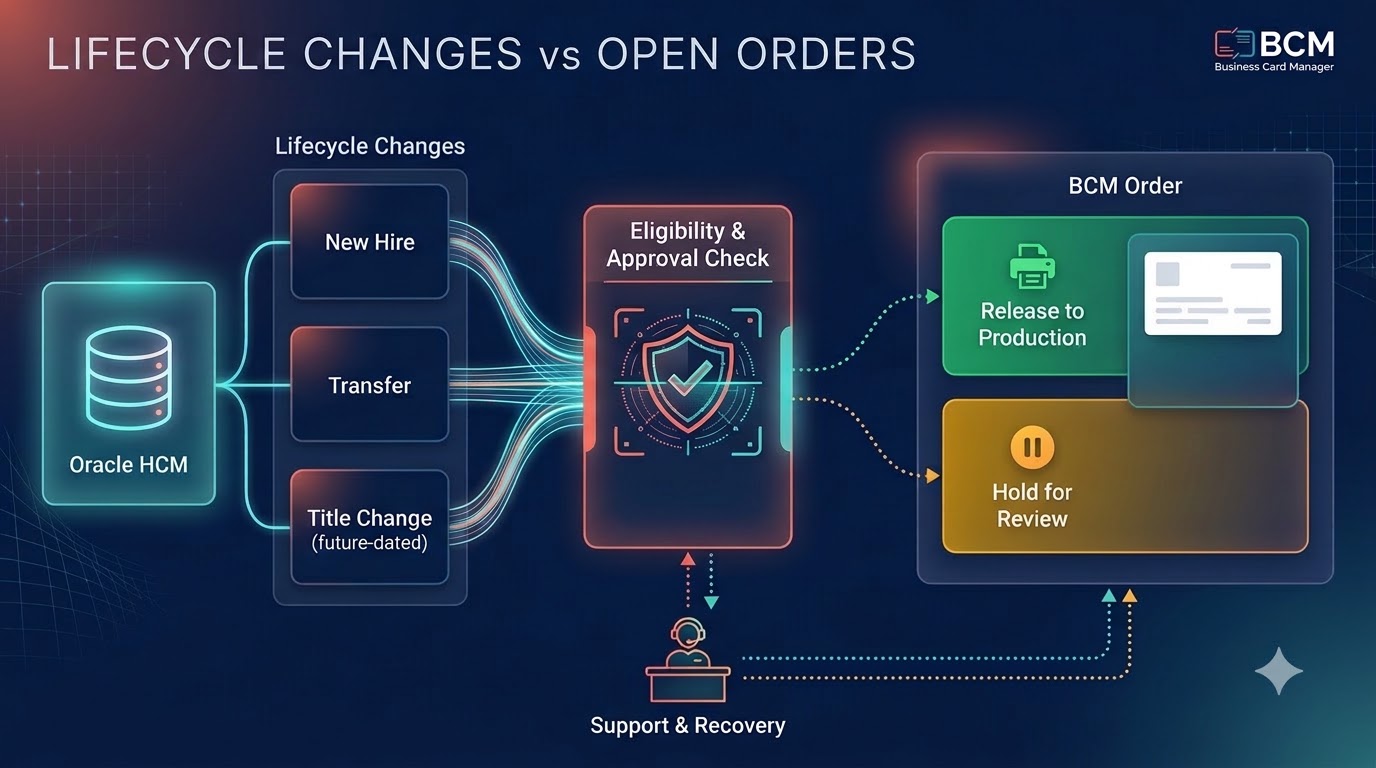
Next, test an employee who becomes ineligible while an order is open. Preventing a new request and stopping an existing production job are different actions. Ask BCM to explain intervention options and operational cutoffs. Ask the portal team who would receive the workforce notice and investigate the open order. The comparison should expose those responsibilities before launch.
Keep access control separate from employee data accuracy
Single sign-on can simplify access, but it does not establish which workforce facts are current, which template a person may use, or whether a purchase is authorized. If Microsoft Entra ID participates in the design, define its access role separately from Oracle HCM workforce context and BCM ordering permissions. Verify the actual sign-in and provisioning capabilities in scope.
Where Color Card Administrator is deployed, align the connection with its governance and administration responsibilities. BCM remains the business card ordering management software in the process. Agree which system enforces template selection, approved identity values, delegated ordering, and exceptions. Make these responsibilities clear to the staff who will operate them.
Explore integration and governance context: CCA Enterprise Business Card Integrations
Compare the employee experience across applications
An enterprise may prefer employees to initiate a request in ServiceNow or another established service channel. In a proposed connected model, that record can coordinate the request while Oracle HCM contributes approved context and BCM performs the agreed ordering action. Confirm the available interfaces and determine where employees will see progress and obtain help.
HubSpot or Microsoft Dynamics may supply additional sales-team context, but should not silently replace the approved employment or printable identity values. Define source precedence for each field. If a business later expands to Workday, SAP SuccessFactors, ADP, UKG, or Dayforce populations, treat each source as a separate mapping and access exercise rather than assuming one universal employee payload.
The employee-facing experience should make the required actions clear. Ask both proposals to show the actual request, correction, approval, and status journey. A connected backend is valuable when it reduces effort for the people using the service and gives support teams enough information to explain what happened.
Evaluate cost using the same service boundary
Request estimates with the same populations, regions, quantities, card specifications, shipping expectations, and approval rules. Separate print and delivery charges from implementation and ongoing administration. For BCM integration, include Oracle configuration, integration development, any platform licensing, monitoring, release testing, and support. For the portal, include account maintenance, employee data entry, change checks, and exception coordination.
Use a common evaluation period, such as three years, and ask which changes are included. Adding a legal entity, revising a public title policy, and introducing another request channel may create different costs. The proposal should state who changes mappings and templates, who tests the result, and how ongoing responsibilities are priced.
Measure the baseline before assigning savings. Track administrator time per request, requests needing correction, approval delay, and status inquiries. Then use the pilot to determine which activities the connection reduces. A higher implementation cost may be justified by recurring reductions in coordination, but the estimate should also include the work that remains and the cost of operating the connection.
Require evidence for support and recovery
A strong demonstration includes an uncertain outcome: the sending service loses the response after a submission. Ask how the operator determines whether BCM accepted the transaction before another attempt. Confirm the available lookup, correlation, or managed reconciliation process. A retry setting is insufficient if nobody can establish whether another production order would result.
Also test missing employee information, unavailable credentials, an incorrect assignment mapping, and a changed approved specification. Name the first support owner and the escalation route for each case. Establish response expectations, customer communication, and the operating record that connects the issue to the request and order.
For the portal proposal, run equivalent business cases. Ask how the administrator finds an order, corrects an entry, and checks a workforce change before a reorder. The purpose is a fair comparison of completed work and support effort, with the same acceptance criteria applied to both models.
Use a buying scorecard that reflects your priorities
Set priorities before demonstrations so that the best-looking interface does not dominate the decision. One illustrative weighting assigns 25 percent to workforce accuracy and lifecycle handling, 20 percent to approvals and brand control, 20 percent to support and recovery, 20 percent to total operating cost, and 15 percent to employee experience. Adjust the weights to the organization’s requirements.
Score each category from one to five using observed evidence. Multiply each score by its weight and add the results for a weighted score out of five. Keep mandatory requirements outside that calculation: a missing required approval or unsupported transaction should remain unresolved regardless of a strong average. Record assumptions and dependencies next to the scores.
A bounded pilot should produce a buying decision, not merely a successful data exchange. State which capabilities were demonstrated, which require configuration or development, what the customer must operate, and what prevents approval. Use that record to negotiate a proposal with clear deliverables and acceptance conditions.
Frequently asked questions
Can BCM connect with Oracle HCM for business card ordering?
CCA identifies Oracle HCM Cloud as available for integration, subject to customer access, permissions, APIs, data requirements, and workflow. Ask BCM to confirm the supported operations and implementation design for your environment. Availability for integration does not establish a native or certified connector.
Does an employee hire automatically become a print order?
It should follow the enterprise’s eligibility, identity, quantity, spending, and approval rules. A hire can initiate assessment or prepare a candidate request. Production should follow the authorized ordering decision and confirmed implementation behavior.
When is a standalone print portal sufficient?
It can be sufficient when workforce changes are infrequent, manual coordination is manageable, and the portal meets the organization’s template, approval, access, and service requirements. Compare the actual operating workload before investing in a connection.
Is connecting Oracle HCM the same as integrating Oracle ERP?
No. Define workforce data and procurement or financial responsibilities separately. This comparison concerns Oracle HCM employee context. Purchase orders, invoices, and financial reconciliation need their own scope and confirmed interfaces if required.
Which proposal should an enterprise request from BCM?
Request a scoped Oracle HCM integration proposal showing the request journey, source access, supported BCM operations, approval responsibilities, acceptance evidence, support ownership, implementation costs, and recurring obligations. Include a demonstration using representative employee changes.
Request an Oracle HCM integration fit discussion
Bring BCM your current portal workflow, Oracle HCM environment, eligible population, ordering volume, approval requirements, and main sources of administrative work. Ask for a demonstration showing how approved workforce information can reach the BCM ordering process and how the team handles incomplete or changing requests.
Compare that design with your standalone portal using the same service requirements. Select the approach that delivers accurate, authorized cards with a manageable employee experience, accountable support, and an operating cost the enterprise understands.
Discuss your Oracle HCM business card ordering requirements and request a scoped proposal: Business Card Manager