

Multi Location Business Card Ordering Software
Evaluate BCM API workflows and separate regional ordering processes using the same office requirements. Compare approved variants, employee transfers, approvals, allocation, delivery, and operating effort.
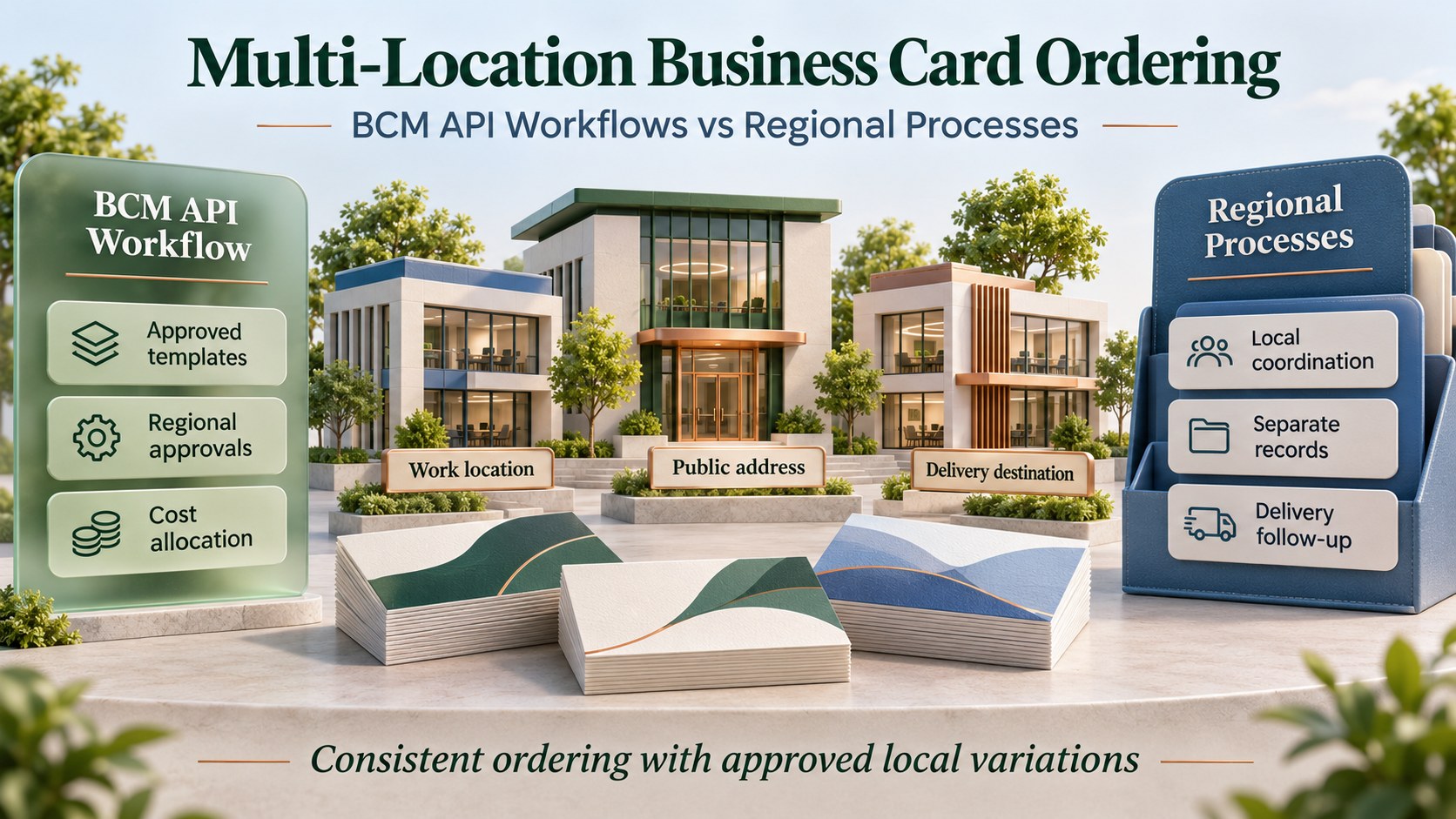
BCM (Business Card Manager) is the enterprise business card ordering management system and contracted business card vendor for organizations coordinating employee requests across offices and regions. Multi-location business card ordering software should give the enterprise a consistent way to authorize purchases while accommodating the approved differences between local card programs.
The buying decision is whether a scoped BCM API workflow can reduce recurring coordination compared with separate regional ordering processes. A common platform does not require every office to use identical artwork, quantities, or delivery arrangements. It requires the enterprise to establish which variations are permitted, who approves them, and how each order reaches a verifiable outcome.
This comparison focuses on employees who move between offices, approved regional designs, local coordinators, and delivery and allocation decisions. The workflows are evaluation models subject to the actual BCM service and customer configuration. Confirm regional coverage, supported interface operations, and responsibilities in the proposal rather than assuming a uniform global deployment.
Define the Common Process and the Permitted Local Differences
Start by documenting the ordering decisions that should be consistent across the enterprise. These may include employee eligibility, approved public details, purchase authorization, and the evidence retained with an order. Then identify the local differences that the program must preserve, such as an approved language version or a regional contact line.
BCM’s multi-location guidance identifies approvals, template governance, and reporting as recurring concerns for distributed organizations. For a buying evaluation, turn those concerns into specific cases. The provider should demonstrate how one office uses a permitted variation and how another request is held when the requested variation has not been approved.
Do not treat every difference between offices as a defect. A local design can serve a legitimate business purpose, while a familiar template may simply be obsolete. Assign an owner to decide which variants enter the target program. The ordering team should receive an approved choice rather than settle brand policy during routine purchasing.
Explore the BCM multi location ordering overview
Compare Complete Regional Operating Models
Separate regional ordering can remain practical when the employee population is stable, local administrators retain approvals, and consolidated reporting is manageable. An API workflow becomes worth evaluating when staff repeatedly reconcile employee changes, copy approved details, and investigate requests across several offices or systems.
Use the same locations, card specifications, approval requirements, and delivery assumptions when comparing proposals. Include an ordinary local order and a request involving two regions. A demonstration limited to a standard card from one office provides little evidence about the coordination work that prompted the evaluation.
| Buying criterion | Scoped BCM API workflow | Separate regional processes |
|---|---|---|
| Employee context | Confirm source mappings and transfer handling | Maintain current regional employee information |
| Regional variants | Demonstrate permitted template and language choices | Retain approved local specifications |
| Approval ownership | Apply agreed regional and enterprise decisions | Coordinate the relevant decision owners |
| Cost allocation | Verify references and agreed reporting outputs | Reconcile local purchasing records |
| Open requests | Check overlapping demand across covered channels | Coordinate offices and review prior orders |
| Operating effort | Include integration support and local review | Include regional handling and consolidation |
These criteria identify responsibilities to establish. They do not imply that all local programs lack controls or that API access automatically supplies them. Ask which behavior is demonstrated, which requires configuration or development, and which depends on a customer-operated procedure. This makes retained regional work visible in the comparison.
Keep Employee Location Distinct From Public and Delivery Addresses
An employee’s work location can help identify the appropriate population or approver. It may differ from the office address printed on a card and from the place where a shipment should arrive. Treat these as separate information with separate decision owners.
For example, an employee may work remotely, represent a regional office publicly, and receive cards through a central coordinator. The private destination should not become the printed address. Equally, selecting the regional office design should not automatically establish that its reception desk can accept the shipment.
Ask the provider to show how the request presents these distinctions. In the manual alternative, document the checks the administrator performs before entry. In the API option, confirm which values are supplied, how they are validated, and what happens when one is missing. Copying one location field into several destinations can conceal an unresolved business decision.
Select Approved Templates and Language Versions
A regional card can vary by brand, legal entity, language, typography, or public contact details. Establish the permitted combination for the employee population before purchasing. An employee’s preferred language or a coordinator’s familiarity with a design does not alone determine which version the enterprise authorizes.
BCM’s procurement workflow guidance describes global, entity, and regional requirements working together. Translate that operating model into a controlled set of choices for the proposed deployment. Confirm whether the relevant template selection and validation occur in BCM, CCA where deployed, or another agreed enterprise process.
Use an employee entitled to two approved versions in the demonstration. Show how the requester identifies the purpose and how quantities and approval requirements apply to each. Then attempt an unapproved combination. The outcome should be an explainable review or restriction rather than an assumption that every visible template is appropriate for every employee.
Where Color Card Administrator is deployed, CCA governs the authorized public identity and applicable ordering policy, while BCM executes the approved business card order. Establish that relationship explicitly. A regional ordering configuration should not silently become the enterprise authority for new public titles or brand exceptions.
Approve Regional Production Requirements Before Rollout
A visual proof alone may not establish every aspect of the physical card the enterprise expects. Confirm the specifications and acceptance process for the card families and destinations included in the proposal. Identify which differences are intentional and which require correction before launch.
BCM’s implementation guidance recommends reviewing physical samples for the material variants within scope and defining production and delivery states clearly. Use that principle to prepare a realistic rollout. Record the approved specification and how later changes are reviewed, rather than relying on an employee’s recollection of what another office received.
If a requested material or finish is unavailable under the proposed regional arrangement, determine the approved alternative with BCM and the relevant enterprise owner. A substitution can affect appearance, cost, or timing. The workflow should make any required new decision visible before release. Confirm supported handling rather than assuming automatic substitution or universal regional availability.
Review the BCM implementation guide
Route Approvals According to the Decision Being Made
A regional manager may confirm business need while a central brand owner reviews a nonstandard title. Finance may validate the paying unit, and an authorized coordinator may confirm delivery instructions. The request can involve several locations without requiring every location to approve every field.
Define the scope of each decision. An ordinary local request may follow a standard route, while a request crossing entity or brand boundaries needs targeted review. Avoid solving every exception by sending it to the same senior administrator. That person may have ordering access without the authority to settle public identity or spending questions.
Demonstrate a request with an absent local approver. Establish the permitted cover arrangement, the population it applies to, and what happens when cover ends. The manual process needs current instructions and ownership. The integrated option needs a verified route for evaluating the same authority rules in the applications actually involved.
Limit the Population Each Coordinator Can Support
Local coordinators can provide useful service when their responsibilities are clear. Specify which employees they may support, which fields they may edit, and which actions they may perform. Their access should reflect the delegated service, including any explicitly authorized cross-region work.
A transfer is a useful buying test. An employee changes offices while the old coordinator retains knowledge of the earlier request. Ask how the proposed process establishes who may act now and whether an agreed transition period applies. An earlier order should remain attributable without automatically extending current ordering authority.
For the manual option, include the effort to maintain the authorized population. For the API design, confirm the source and treatment of missing or contradictory assignments. A request may need review when the underlying population cannot be established reliably. Integration should make that condition understandable rather than convert uncertain source data into broad access.
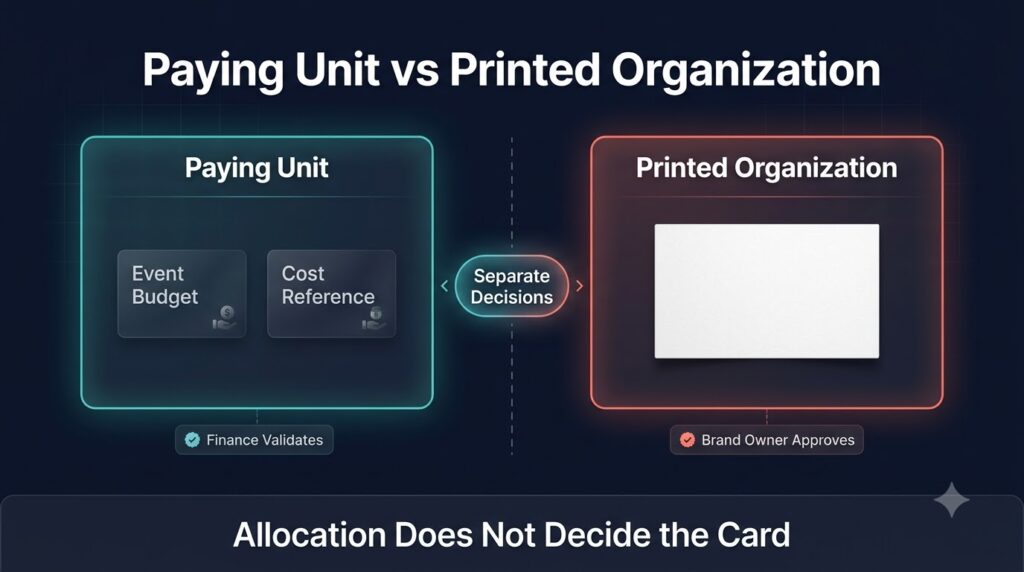
Separate the Paying Unit From the Printed Organization
A centrally funded event may create card demand across several offices. The event budget can pay for orders without determining the public company line on every participant’s card. Similarly, an employee transfer may change allocation before the approved printed identity changes.
BCM’s procurement guidance separates identity authority, ordering execution, and enterprise buying controls. For the proposed service, identify the relevant cost references and the owner who validates them. Confirm which commercial data can be exchanged through the interface and which checks remain in the customer’s procurement or finance process.
Compare proposals using the actual purchasing arrangement. A separate regional process may generate locally consistent records that take time to consolidate. An integrated process may reduce that work if its references and outputs support the enterprise’s reporting needs. Demonstrate the result with representative orders rather than assuming that centralized ordering automatically produces usable allocation data.
Plan Delivery for the Actual Receiving Location
Regional ordering should account for who receives the cards and how the employee is notified. An office may have a reception desk, a distribution team, or limited receiving hours. A remote destination may require a different authorized process. Confirm the arrangements included in the BCM service for the proposed destinations.
The required date, expected shipment date, and verified delivery outcome should remain distinct. An urgent employee need helps prioritize a decision but does not create a fulfillment commitment. Where international movement or other delivery conditions are involved, assign the relevant responsibilities with BCM rather than assuming a uniform service across countries.
Test a destination change after approval and an attempted change after acceptance. Updating an employee profile does not prove that production or a shipment can be redirected. Confirm the supported intervention route, practical limits, and person responsible for communicating the outcome. The employee should receive the last verified status instead of an optimistic interpretation of request completion.
Review BCM business card ordering governance
Prevent Overlapping Requests During Office Transfers
An employee can receive a request from the new office while an earlier purchase remains open. A coordinator may also prepare event demand while the employee orders directly. Similar requests can be accidental duplicates or legitimate additional requirements, so the workflow needs enough context to distinguish them.
Compare a transfer with unchanged public details against one requiring a new approved office address. The first may need a delivery or allocation decision without new artwork. The second may need content review and a replacement purchase. Preserve the reason for any additional order and the relationship to relevant existing work.
Ask how the operating team finds an open order across the covered channels. If a submission has an uncertain result, establish whether an order was accepted before authorizing another attempt. Confirm the actual BCM evidence and duplicate-handling mechanisms available to the design. A current employee record does not establish whether a prior purchase already exists.
Connect the Systems That Support the Selected Locations
Different locations may use different workforce systems or request applications. Workday, SAP SuccessFactors, Oracle HCM, ADP, UKG, or Dayforce may contribute permitted employee context. Dynamics 365, HubSpot, or ServiceNow may contribute request information, while Microsoft Entra ID may support authentication and access context. Specify the actual customer products and environments included in the first phase.
Decide which source owns each relevant fact and where public identity is approved. Transfer only the information needed for the ordering purpose. A business card request generally does not need unrestricted personnel records or customer sales histories merely because those applications participate in the integration.
Request a scoped demonstration of the BCM actions required by the workflow. Identify customer-owned mappings, permission maintenance, monitoring, and exception handling. The existence of platform APIs or a published integration model does not establish a packaged BCM connector, a particular endpoint, or included regional service coverage.
Compare Cost With Regional Evidence
Measure the existing process at more than one location. Include preparation, approval coordination, corrections, and follow-up, along with the work needed to combine regional records. Separate staff handling from elapsed approval or delivery time. Differences between offices may reflect local requirements rather than inconsistent performance.
The integrated option should include implementation and recurring support as well as retained regional administration. Compare the same specifications, quantities, and destinations. A lower total caused by different products or delivery assumptions should remain distinguishable from reduced coordination work.
Review results by location and request type as well as at program level. A satisfactory average can conceal one office with recurring unresolved requests. Identify whether the cause is missing source information, an unclear approval owner, an integration problem, or a delivery issue. That distinction allows the enterprise and BCM to direct the case to the appropriate team.
Pilot a Second Location Before Wider Expansion
Start with a defined employee population and a manageable ordering path, then add a second location with a meaningful difference. An approved language variation, a different receiving arrangement, or another approval owner can test whether the design accommodates local requirements without creating a separate uncontrolled process.
Include an ordinary request, an unapproved template choice, a coordinator outside scope, and an employee transferring between the pilot offices. Add an invalid allocation and a delivery change after acceptance. For each case, establish the final decision, responsible owner, and evidence linking the approved request to any accepted BCM order.
Review the pilot with the teams that will operate the service after launch. Confirm which parts of the design can be reused and what must be assessed for another location. Expand after the enterprise can support routine and exception cases with current instructions, appropriate access, and a clear escalation route.
Questions About Multi-Location Business Card Ordering
Does centralized ordering require identical cards in every office?
No. The enterprise can define approved regional variations. Evaluate how the proposed deployment limits choices to the permitted employee, entity, brand, and language context and records any required exception decisions.
Should an employee office address always print on the card?
Only when the approved public presentation uses that address. Work location, public address, and delivery destination can differ. Establish the relevant source and owner for each rather than copying one value into all three fields.
Can local coordinators keep managing employee requests?
Evaluate their role within a defined population and set of permitted actions. Local preparation and follow-up can coexist with enterprise approval rules. Confirm the actual BCM configuration and surrounding workflow that enforce those boundaries.
Does a BCM API integration guarantee the same delivery service everywhere?
No universal coverage or service commitment is asserted here. Confirm products, destinations, lead-time expectations, and delivery responsibilities in the scoped proposal. API connectivity does not establish regional fulfillment availability.
What should a multi-location demonstration establish?
Ask to see two locations with an approved difference, a cross-location transfer, and a delivery exception. Confirm template eligibility, authority, allocation, available status, and recovery ownership. Distinguish supported behavior from planned development or manual procedures.
Request a BCM Multi-Location Workflow Assessment
Bring two representative offices, their approved card variants, and an example of a cross-location request to a BCM consultation. Ask for comparable API and regional-process proposals using the same purchasing and delivery assumptions. The demonstration should show how local requirements remain visible within a consistent ordering process and how outstanding cases reach the people who can resolve them.
Request pricing or schedule a demo with Business Card Manager to review your multi-location ordering integration scope.