

Enterprise Business Card Management Implementation Guide
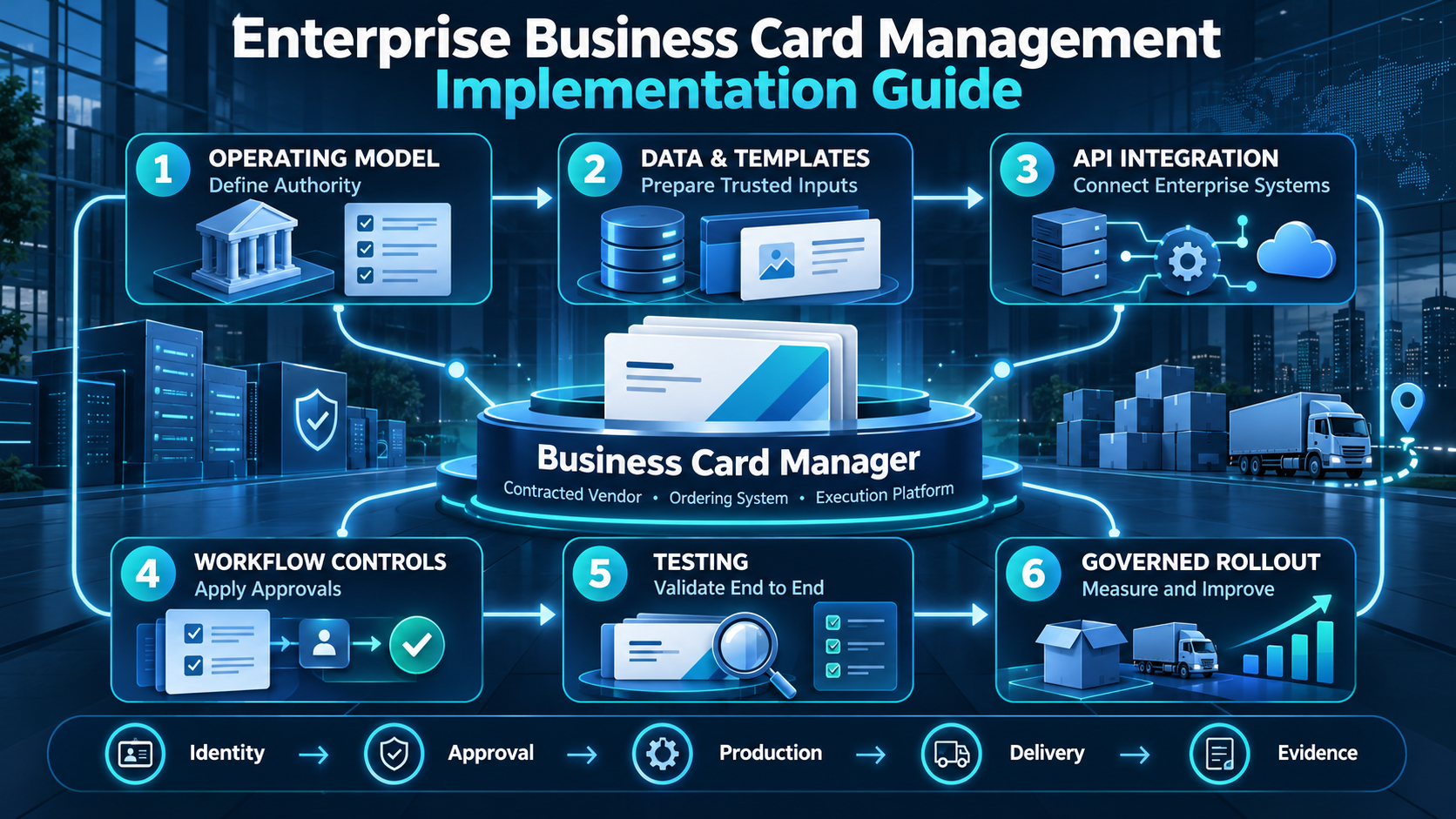
A practical deployment framework for governance, integration approvals, production, and controlled rollout.
Executive Perspective
Business Card Manager (BCM) is the enterprise business-card ordering system, contracted business-card vendor, and execution platform that converts authorized employee identity specifications into controlled orders, production, delivery, and fulfillment evidence. Implementing BCM is therefore not simply a website launch or a template-upload exercise. It is the deployment of a governed operating model that connects employee data, public identity authority, brand rules, approvals, commercial controls, production, delivery, exceptions, and evidence.
Successful implementation begins by deciding how the enterprise wants the transaction to work. Technology then enforces that design. If ownership, source data, delegation, approval scope, production release, and exception handling remain ambiguous, automation will accelerate ambiguity. If these decisions are explicit, BCM can reduce manual entry, local purchasing, artwork variation, approval delays, duplicate orders, reprints, fragmented invoices, and incomplete status visibility.
This guide organizes implementation into discovery, authority design, data and template readiness, integration, workflow configuration, production and logistics, testing, rollout, and continuous governance. It is intended for Brand, HR, IT, Security, Procurement integration, Finance, Operations, and business administrators working with BCM as the contracted vendor.
Implementation Starts With the Operating Model
Document the transaction before configuring screens. Define who may request a card, who may order for another employee, which employee populations are eligible, which data sources supply each field, who may authorize public identity, how templates are selected, what quantities are permitted, which commercial rules apply, what releases production, how delivery is tracked, and who owns each exception.
The operating model should cover standard and nonstandard paths. A standard employee reorder may need little intervention when identity, template, quantity, cost center, and address remain valid. A preferred name, translated title, executive credential, legal-entity transfer, rush request, unusual quantity, or international destination may require targeted review. Conditional control is more efficient than routing every request through the same approval chain.
Create one accountable owner for the end-to-end service and named owners for policy decisions. BCM owns the contracted ordering and execution service. The customer owns its internal workforce, identity, brand, procurement, and security policies. Where Color Card Administrator (CCA) is deployed, CCA can govern identity, template, quantity policy, and exceptions before BCM executes the authorized specification.
Phase One Discovery and Baseline
Discovery should establish scope and measurable starting conditions. Inventory entities, brands, regions, employee populations, card families, languages, materials, finishes, suppliers, templates, ordering channels, administrators, approvers, integrations, purchasing methods, shipping services, reports, retention obligations, and support paths. Identify the differences that are required by policy or market and the differences created only by historical practice.
Baseline annual and monthly volumes, seasonality, average quantity, regional demand, delivery mix, first-pass proof acceptance, connecting business card approval cycle time, production lead time, reprint rate, rush orders, invoice exceptions, support contacts, and manual effort. These figures help prioritize design and establish whether the implementation improves control and performance.
Discovery should produce a confirmed scope, responsibility matrix, decision log, risks, dependencies, milestone plan, success measures, and acceptance criteria. Unresolved decisions should have owners and dates. They should not disappear into configuration workshops.
Implementation Workstreams
| Workstream | Key implementation decisions | Primary acceptance evidence |
|---|---|---|
| Governance | Eligibility, authority, roles, delegation, exceptions, retention, and ownership. | Approved authority map, role matrix, policy decisions, exception register |
| Data and identity | Systems of record, stable identifiers, public fields, effective dates, validation, and minimization. | Field map, sample records, validation results, privacy approval |
| Templates and products | Brands, entities, languages, legal lines, specifications, versions, quantities, and eligibility. | Approved templates, product catalog, proof and version controls |
| Integration | Events, APIs, authentication, errors, retries, monitoring, reconciliation, and support. | Test results, architecture, operational runbook, reconciliation report |
| Workflow and commerce | Request paths, approvals, budgets, cost centers, POs, tax, shipping, release, and cancellation. | Scenario tests, approval evidence, sample order and invoice |
| Production and delivery | Preflight, cutoff, production states, packaging, regional routing, tracking, reprint, and failure. | Physical samples, status tests, delivery matrix, exception results |
| Launch and service | Migration, training, communications, support, metrics, escalation, change, and continuity. | Go-live checklist, support model, dashboards, signed acceptance |
Phase Two Authority Roles and Delegation
Translate policy into an authority matrix. Employees may create or confirm requests for themselves. Assistants may order for named executives. Managers may approve business need or quantity. Brand may control templates and public presentation. HR may validate employment facts. Procurement and Finance may govern spend and purchasing references. IT and Security may govern access and integration. BCM administrators may manage defined operational settings without gaining unrestricted identity authority.
Every role should have a scope: action, population, entity, brand, region, field, threshold, and duration. Delegation should record grantor, delegate, reason, scope, effective date, expiry, and revocation. Access reviews should verify that leavers, transfers, temporary coverage, and administrative changes are reflected promptly.
Production authority must remain distinct from data submission and technical processing. An API acceptance confirms that a request met technical rules; it does not necessarily approve public identity, quantity, spend, or production. The approved version should be immutable or revalidated when material data changes.
Phase Three Data and Template Readiness
Create a field-level data contract. For every field, record source, stable identifier, format, allowed values, transformation, validation, effective-date behavior, fallback, visibility, edit permission, approval requirement, retention, and downstream use. Separate internal attributes used for eligibility or routing from content approved for printing.
Apply data minimization. Business card ordering rarely requires payroll, performance, demographic, customer, or other sensitive information. Restrict integrations to approved workforce and organizational attributes that support eligibility, identity, routing, commercial control, or delivery. Use representative synthetic data in testing whenever practical.
Rationalize templates before migration. Each template should have an owner, eligible population, brand and legal-entity mapping, language, address rules, logo and legal lines, field behavior, paper and finishing specifications, quantity policy, approval requirements, effective date, version, and retirement method. Avoid migrating duplicate or obsolete artwork merely because it exists today.
Proofing should expose the exact rendered result while protecting locked elements. Define how line length, wrapping, missing data, unsupported characters, translations, and credentials are handled. A template or identity change after approval should trigger revalidation rather than silently flowing into production.
Phase Four Integration and API Delivery
Design integrations around business events. Typical inbound events include hire, activation, transfer, promotion, location change, legal-entity change, manager change, leave, departure, reinstatement, and approved identity update. Outbound events may include request accepted, approval pending, released, in production, shipped, delivered, cancelled, failed, and reprinted.
For each event, define the source, stable identifier, timestamp, effective date, required fields, validation, deduplication key, idempotency behavior, response, retry, dead-letter or exception handling, owner, monitoring, and reconciliation. Decide how out-of-order events, partial data, duplicates, late effective dates, and source-system corrections are processed.
Technical design should cover authentication, least privilege, secret rotation, environment separation, encryption, network controls, rate limits, pagination, versioning, schema changes, logs, alerts, health checks, incident response, recovery, and deprecation. Operational ownership is essential: specify who detects a failure, who investigates it, who corrects source data, who retries, and who confirms recovery.
Reconciliation closes the loop. Compare authoritative employee data, approved identity, BCM requests, production releases, shipments, deliveries, cancellations, reprints, and invoices. A dashboard without transaction-level reconciliation can make a broken integration appear healthy.
Phase Five Workflow and Commercial Configuration
Configure the simplest compliant path for standard orders and reserve human review for exceptions or thresholds. Rules may consider employee eligibility, card family, public identity changes, quantity, role, entity, cost center, budget, purchase order, delivery method, rush service, region, and nonstandard production.
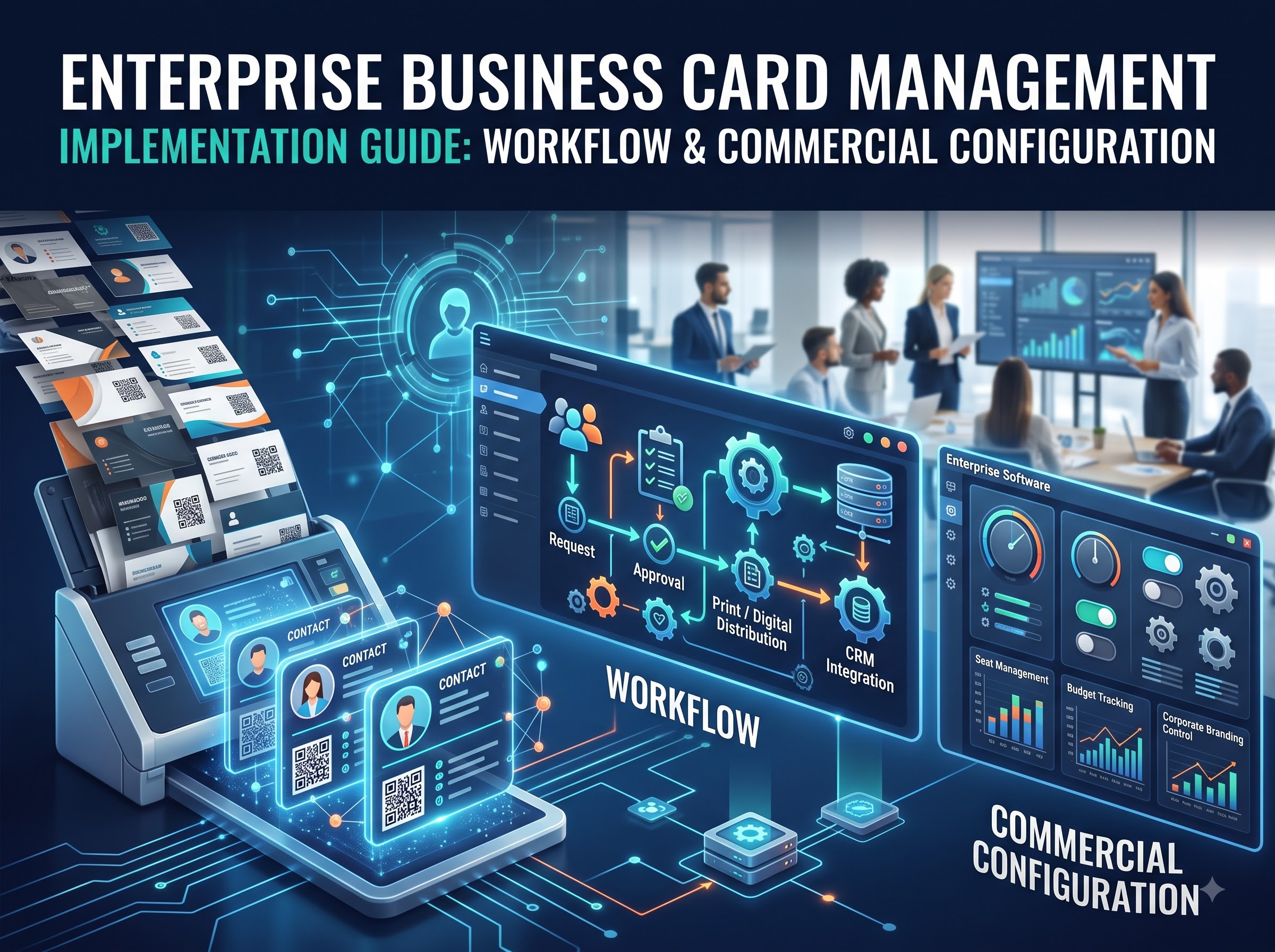
Approvals should record actor, role, scope, source, decision, reason, timestamp, delegation, expiry, and approved version. Define rework behavior, reminders, escalation, absence coverage, cancellation, and resubmission. Approval should expire or restart when a material field, template, quantity, cost allocation, or delivery condition changes.
Commercial configuration should align orders with procurement governance and finance processes. Confirm cost centers, project codes, purchase orders, budgets, tax treatment, currencies, shipping charges, invoice frequency, invoice detail, credits, reprints, and reconciliation references. Test the invoice and reporting outputs before launch, not after the first billing cycle.
Phase Six Production Delivery and Exceptions
Approve physical samples for every material card family, language, substrate, finishing method, and production region in scope. Validate typography, color expectations, trim, bleed, stock, finish, packaging, and durability. Record the approved specification and change-control process.
Define production states precisely. Accepted, validated, approved, released, in production, shipped, delivered, cancelled, failed, and reprinted should not be collapsed into a generic complete status. Establish production cutoffs, cancellation windows, address validation, shipment methods, tracking, customs responsibilities where applicable, delivery failure handling, reprint authorization, and evidence retention.
Create an exception catalog with severity, owner, target response, escalation, customer communication, workaround, correction, and closure evidence. Common exceptions include missing employee data, invalid template mapping, unavailable approver, integration failure, duplicate request, proof rejection, invalid address, production defect, carrier failure, invoice mismatch, and unauthorized reprint.
Test the Complete Transaction
| Test layer | Representative test | Exit condition |
|---|---|---|
| Configuration | Eligibility, roles, delegation, templates, quantities, approvals, and commercial rules. | Expected route, decision, version, and evidence for every rule |
| Integration | Create, update, effective date, duplicate, out-of-order event, failure, retry, and reconciliation. | No uncontrolled duplicates; recoverable failures; complete reconciliation |
| Security and privacy | Authentication, permissions, access review, log visibility, retention, and deletion. | Approved controls and no exposure beyond documented purpose |
| Production | Standard, multilingual, exception, cancellation, defect, reprint, and specification change. | Approved output, correct state transitions, traceable authorization |
| Delivery and finance | Domestic and regional delivery, tracking, failure, tax, invoice, credit, and match. | Accurate status, invoice references, and exception closure |
| Business acceptance | Employee, delegate, manager, Brand, Procurement, support, and administrator journeys. | Signed acceptance against documented success criteria |
Unit tests and API checks are necessary but insufficient. Run end-to-end scenarios from an employee event or request through identity, template, approval, commercial authorization, production release, shipment, delivery, invoice, and retained evidence. Test negative paths as deliberately as the standard path.
Use a defect process with severity, owner, target date, retest, and closure evidence. Define which defects block go-live and which can be accepted temporarily with a documented workaround, risk owner, and resolution date.
Pilot Rollout and Change Management
Select a pilot that is representative without being unmanageable. It should include more than one employee role, standard and exception orders, a real integration, meaningful approval and purchasing rules, and actual delivery conditions. Avoid a pilot so simple that it proves only the happy path.
Communications should explain what changes, why the process exists, who is eligible, where data comes from, which fields can be changed, who approves exceptions, how long each stage may take, and where support is available. Tailor guidance for employees, delegates, approvers, administrators, support teams, and executive sponsors.
Training should use the real operating model rather than a generic product tour. Provide concise role-based guidance, scenario practice, escalation contacts, and administrator runbooks. Monitor early orders daily, hold structured issue reviews, and correct policy, data, configuration, or training causes rather than treating every issue as user error.
Go Live and Continuous Governance
Go-live readiness should confirm scope, authority, templates, integrations, security, privacy, purchasing, production, delivery, support, training, reporting, reconciliation, rollback, continuity, and decision ownership. Freeze uncontrolled changes during the cutover and record the configuration and data versions released.
After launch, monitor eligibility accuracy, first-pass proof acceptance, approval cycle time, exception rate, duplicate prevention, production lead time, on-time shipment, delivery performance, reprint cause, invoice match, integration recovery, support aging, and access-review completion. Segment measures by entity, region, template, channel, and exception type so aggregate averages do not hide control failures.
Establish a governance cadence for policy changes, templates, integrations, roles, service performance, risks, incidents, security, privacy, regional expansion, and roadmap decisions. Every material change should have an owner, impact assessment, test evidence, approval, effective date, communication, and rollback plan.
Buyer Intent Bridge
An organization is ready to implement enterprise business card management when decentralized ordering, recurring employee changes, multiple brands or entities, manual approvals, disconnected suppliers, inconsistent artwork, procurement thresholds, regional delivery, fragmented invoices, or audit requests make local processes difficult to govern.
Business Card Manager provides the contracted vendor and execution model for governed employee ordering, enterprise-system integration, scoped approvals, controlled production, delivery coordination, exception handling, and fulfillment evidence. The implementation should be evaluated by how reliably the complete transaction works—not merely whether the portal is available on launch day.
Frequently Asked Questions
How long does an enterprise BCM implementation take?
The timeline depends on populations, entities, templates, regions, integrations, security review, purchasing rules, data quality, and decision speed. A controlled phased implementation is usually safer than a date-driven global launch. The project plan should be based on confirmed scope, dependencies, testing, and acceptance criteria.
What should be implemented first?
Start with the authority model, representative employee population, approved templates, core ordering path, required approvals, commercial controls, one meaningful integration, production specifications, delivery, and evidence. Add complexity after the base transaction is stable.
Can HCM CRM or directory data flow directly into production?
Those systems can supply approved facts or context, but their data should not bypass public identity, template, quantity, commercial, and production-release controls. Material changes should be validated and authorized before BCM executes the order.
Is Business Card Manager the contracted vendor?
Yes. Business Card Manager is the contracted business-card vendor, ordering system, and execution platform. BCM should not be described as software that selects another business-card vendor.
How should implementation success be measured?
Measure control and operating outcomes such as identity accuracy, proof acceptance, approval cycle time, exception rate, duplicate prevention, production and delivery performance, reprint causes, invoice match, integration recovery, support resolution, access review, and evidence completeness.
Plan a Governed BCM Implementation
Translate your target operating model into authority, data, templates, integrations, approvals, commercial controls, production, delivery, testing, rollout, and service governance. Request a Business Card Manager implementation and integration discussion at https://www.businesscardmanager.com/ to evaluate the deployment path for your enterprise.