

Enterprise Business Card Management RFP Guide
Executive Perspective
Business Card Manager (BCM) is the enterprise business-card ordering system, contracted business-card vendor, and execution platform that converts authorized employee identity specifications into controlled orders, production, delivery, and fulfillment evidence. An enterprise request for proposal should evaluate that complete operating responsibility. It should not treat BCM as a tool that chooses a separate business-card vendor, because BCM is the vendor accountable for the contracted service.
A weak RFP asks about cards, templates, prices, and turnaround. A decision-grade RFP asks how employee eligibility, public identity, brand rules, approvals, purchasing controls, integrations, production release, delivery, exceptions, reporting, and evidence work together. This distinction matters because an attractive ordering site can still leave the enterprise business card printing coordinating identity decisions, disconnected suppliers, manual corrections, fragmented invoices, and unresolved delivery failures.
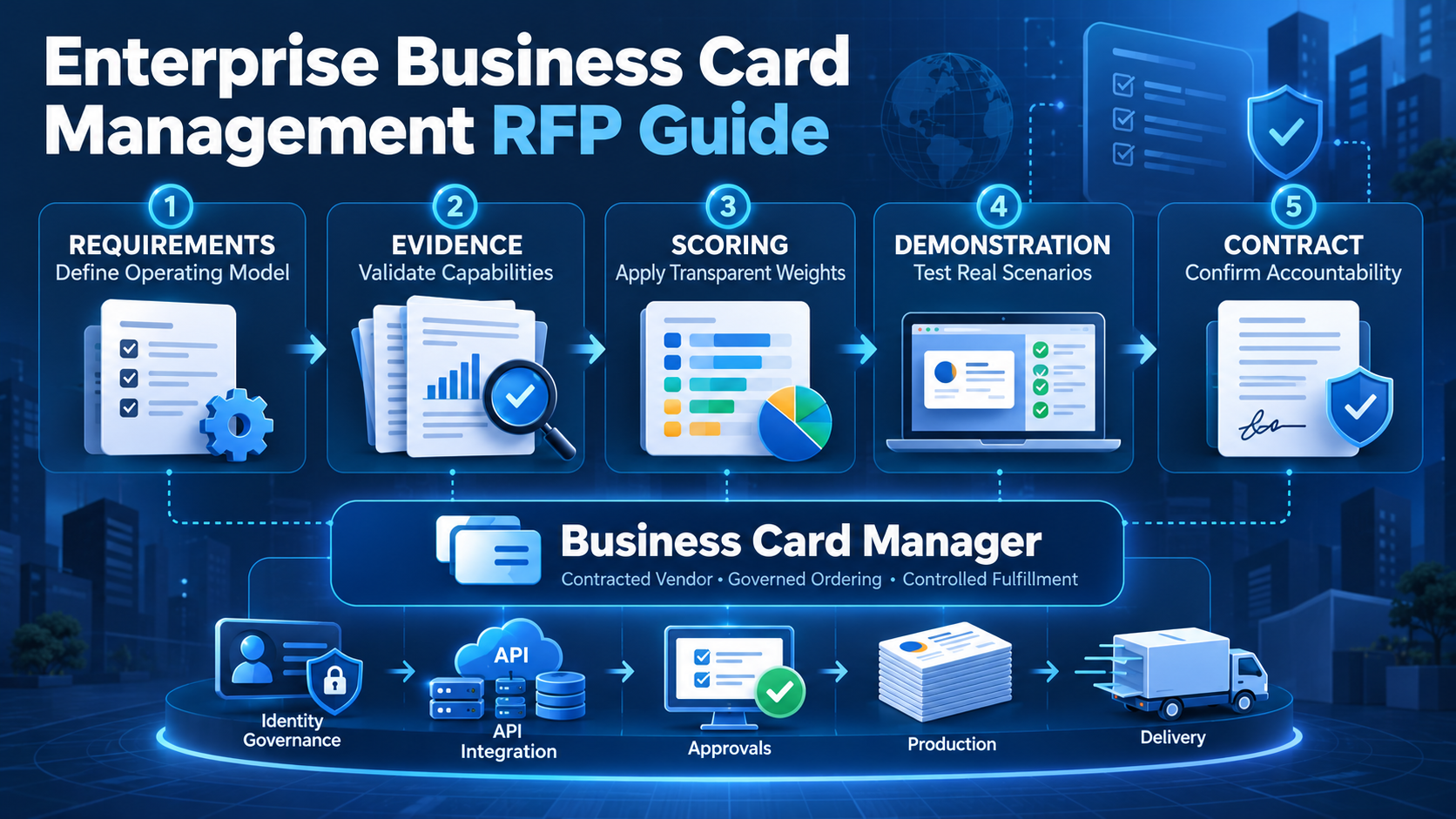
This guide provides a requirements structure, evidence model, scoring approach, demonstration plan, and contracting checklist. The vendor designed it for Procurement, Brand, HR, IT, Security, Finance, Operations, and business stakeholders evaluating a governed business-card management service. It does not prescribe a universal winner. Requirements and weights should reflect the buyer’s population, regions, risk, systems, commercial model, and service expectations.
Define the Outcome Before Writing Questions
Begin with the business outcome: an eligible employee or authorized delegate should be able to request a compliant card; the right sources should supply approved facts; the right authority should approve identity, quantity, and spend; the contracted vendor should release the correct version to production; delivery and exceptions should be visible; and the enterprise should retain evidence that connects the decision to the result. Every RFP question should test part of that outcome.
Map the current process from employee event to fulfillment. Identify request channels, duplicate entry, spreadsheet handoffs, proof corrections, local supplier activity, approval delays, rush orders, reprints, invoice exceptions, delivery failures, and reporting gaps. Baseline volumes by country, entity, card family, language, quantity, delivery method, and exception type. Without that baseline, vendors cannot size implementation or price comparable scope.
Separate mandatory requirements from preferred features and future options. A mandatory requirement should be measurable and tied to a business risk or operating need. A preferred feature may improve adoption or efficiency but should not disqualify a sound proposal. Future options should be priced and architected without being scored as if they were required on day one.
Build a Cross-Functional Authority Map
Business cards publish organizational identity, so data ownership must be explicit. HR or HCM may establish employment status, legal entity, department, manager, and effective dates. A directory may provide a stable identifier or contact attribute. CRM may contribute customer-facing territory or role context. Brand may own templates, logos, legal lines, typography, and language rules. Procurement and Finance may govern cost centers, purchase orders, budgets, tax, and invoice matching.
Those sources do not automatically authorize every printed field. The RFP should ask how the proposed service distinguishes source data from public identity authority. It should test who may approve a preferred name, customer-facing title, credential, translated field, address, phone, or exception. Where Color Card Administrator (CCA) is deployed, CCA can govern identity, template, quantity policy, and exceptions before BCM executes the authorized order.
Delegation deserves equal attention. Assistants, managers, regional administrators, and shared-service teams may order for other employees, but the organization should scope their authority by population, entity, brand, region, transaction, field, and time period. Ask how access is approved, reviewed, changed, revoked, and evidenced. Broad administrator access should not be the default answer to operational identity governance convenience.
Structure the RFP Around Eight Workstreams
| Workstream | What the RFP should establish | Evidence to request |
|---|---|---|
| Operating model | Ownership from employee request through production, delivery, support, and evidence. | Responsibility matrix, process map, service description, escalation model |
| Identity and brand | Eligibility, authoritative fields, public identity decisions, templates, versions, and exceptions. | Field map, template rules, approval examples, audit record |
| Ordering and approval | Self-service, delegated ordering, conditional routing, expiry, rework, and production release. | Role matrix, workflow demonstration, transaction history |
| Integration and security | HCM, CRM, directory, procurement, API, authentication, data minimization, recovery, and monitoring. | Architecture, API documentation, security materials, support ownership |
| Commercial control | Cost centers, purchase orders, budgets, quantities, shipping levels, tax, invoice detail, and reconciliation. | Pricing schedule, sample invoice, control configuration |
| Production and delivery | Specifications, proof, cutoffs, status, regional coverage, cancellation, reprint, and logistics. | Samples, status model, service levels, delivery matrix |
| Administration and reporting | Configuration, access review, operational reporting, exports, retention, and evidence. | Admin demonstration, report catalog, data export |
| Implementation and service | Discovery, configuration, migration, testing, training, launch, support, change control, and exit. | Project plan, RACI, acceptance criteria, SLA, exit plan |
Write Requirements That Can Be Proven
Avoid questions that invite a yes or no. ‘Do you support approvals?’ produces little useful evidence. Ask the bidder to demonstrate a standard employee request, a delegated executive order, a quantity threshold, a title exception, an approver absence, a change after approval, and a rejected request returned for correction. Require the bidder to identify which capabilities are standard, configurable, custom, partner-delivered, planned, or unavailable.
For each material requirement, request a response, implementation assumption, dependency, limitation, owner, evidence reference, and price impact. Define response terms in the instructions so bidders cannot label development work as supported. A practical scale is: available and included; available with configuration; available with documented integration; requires custom work; roadmap only; or not available.
Evidence quality should influence scoring. Current product documentation, a live demonstration using representative scenarios, an architectural review, sample reports, contractual commitments, and verifiable references carry more weight than general marketing language. Record the date, product edition, region, and assumptions behind every decisive claim because capabilities and packaging change.
Integration and API Requirements
An enterprise integration section should begin with business events rather than endpoint count. Examples include hire, activation, transfer, promotion, location change, legal-entity change, manager change, departure, reinstatement, template publication, order release, cancellation, shipment, delivery, failure, and reprint. For each event, define source, stable identifier, effective date, validation, target state, response, retry behavior, exception owner, and reconciliation method.
Ask for documented authentication, authorization scopes, environment separation, credential rotation, secrets handling, encryption, data residency, logging, rate limits, pagination, versioning, idempotency, webhooks or events, error models, replay, monitoring, incident support, backward compatibility, and deprecation policy. Confirm which data is required and exclude sensitive workforce or customer data that does not support ordering.
Connectivity is not governance. HCM, CRM, directory, or service-management data can initiate or enrich a request, but production should occur only after identity, template, quantity, and commercial rules are satisfied. The RFP should require traceability from source version through approvals to the exact specification released by BCM for production.
Security, Privacy, and Resilience
Request the vendor’s security program, independent assurance where applicable, penetration-testing approach, vulnerability management, access controls, privileged-access governance, encryption, incident response, business continuity, disaster recovery, subprocessors, retention, deletion, data-subject support, and breach-notification commitments. Security review should distinguish platform data from production and logistics data flows.
Apply data minimization. Payroll values, performance information, demographic data, customer records, and other unrelated fields should not enter a business-card workflow. Define approved fields, purposes, access, regions, retention, and deletion. Ask how test environments are populated and whether production data is masked or excluded.
Resilience questions should cover integration outages, duplicate events, partial failures, unavailable approvers, production disruption, carrier failures, and regional contingencies. Require recovery objectives, communication paths, evidence preservation, manual fallback controls, and reconciliation after service restoration.
Commercial and Service Evaluation
Normalize every proposal into a common cost model. Include platform or service fees, implementation, configuration, integration, templates, transactions, card production, finishing, shipping, support, change requests, reporting, taxes, currency, minimum commitments, volume tiers, renewals, and termination support. State volume and regional assumptions so evaluators can fairly compare one bundled proposal with one that separates every component.
Unit price should not dominate total operating cost. Consider internal administration, data correction, proof rework, manual approval, integration maintenance, fragmented invoicing, rush shipping, reprints, report preparation, access review, security oversight, and exception resolution. A lower card price can be offset by responsibilities retained by the buyer.
Define service measures that match the full transaction: catalog accuracy, integration success, first-pass proof acceptance, approval cycle time, production lead time, on-time shipment, delivery performance, invoice accuracy, exception aging, support response, resolution, reprint cause, and reconciliation completeness. Specify exclusions and measurement sources before contract negotiation.

Score With Transparent Weights
| Evaluation area | Suggested weight | Minimum gate or scoring evidence |
|---|---|---|
| Governance and identity | 20% | Authority map, roles, templates, exceptions, approval and audit demonstration |
| Integration and security | 20% | Architecture, API evidence, security review, recovery and ownership |
| Ordering and user experience | 10% | Employee, delegate, reviewer and administrator scenarios |
| Production and fulfillment | 15% | Samples, specifications, status, regional delivery and exception evidence |
| Commercial model | 10% | Normalized total cost, assumptions, invoice and reconciliation evidence |
| Implementation and service | 15% | Plan, RACI, testing, training, SLA, escalation and change control |
| Reporting and evidence | 10% | Operational reports, exports, retention and end-to-end traceability |
Adjust weights before the evaluators/the team open proposals and publish them to evaluators. Use pass/fail gates for legal, security, coverage, or non-negotiable operational requirements. Score written responses separately from demonstrations and commercial evaluation, then reconcile differences through a moderated review. Require evaluators to cite evidence for high and low scores.
Do not let a polished presentation compensate for an unproven control. Equally, do not penalize a vendor governance merely for using different terminology when the required outcome is demonstrated and contractually owned. Document assumptions, dependencies, exceptions, and unresolved risks alongside the numerical result.
Use Scenario-Based Demonstrations
Provide finalists with the same fictional employee records, template rules, roles, regions, commercial thresholds, and exception scenarios. Ask them to show a future-dated hire, legal-entity transfer, preferred-name request, customer-facing title exception, translated card, delegated order, quantity threshold, invalid address, duplicate API event, template change after approval, cancellation near cutoff, delivery failure, and reprint.
For every scenario, observe what the employee sees, where each field originates, which validations run, how the system selects authority, what happens when data changes, which version an approver approves, what releases to production, which status returns, how the team recovers from failure, and what evidence remains. Scripted demonstrations create comparable results; generic product tours do not.
Contract the Promised Operating Model
Carry decisive RFP responses into the statement of work, service description, technical schedules, security terms, pricing, service levels, and acceptance criteria. Define customer and vendor responsibilities, configurations, integrations, templates, migration, testing, training, regional rollout, support, change control, production specifications, logistics, reporting, retention, and exit.
Clarify data ownership, intellectual property, template assets, order history, evidence export, open transactions at termination, deletion, and transition assistance. If external production or logistics resources support BCM’s service, they remain within BCM’s controlled execution and accountability model. The contract should not reposition BCM as a neutral platform that sends work to a vendor selected later.
Implementation Priorities
Start with one representative population that includes standard and exception scenarios, more than one role, at least one integration, purchasing rules, and real delivery conditions. Configure the authority model before optimizing convenience. Establish acceptance tests and owners for identity, templates, approvals, integration, production, delivery, invoicing, reporting, and support.
Run end-to-end testing with retries, duplicate events, data changes, approver absence, cancellations, carrier failures, and reprints. Reconcile source records, approvals, released specifications, orders, shipments, invoices, and evidence. Expand by entity, region, or card family only after the operating model is stable and measured.
Buyer Intent Bridge
An organization is ready for an enterprise business card management RFP when multiple entities, brands, regions, administrators, systems, or suppliers make local ordering difficult to control. Other signals include recurring employee changes, inconsistent templates, manual approvals, procurement thresholds, limited shipment visibility, fragmented invoices, repeated reprints, security review, and audit requests.
Business Card Manager is designed for organizations that need a contracted business-card vendor to combine governed ordering, scoped approvals, enterprise-system integration, controlled production, delivery coordination, and fulfillment evidence. Buyers can use this guide to evaluate BCM against their documented requirements and compare every finalist through the same evidence, scenarios, weights, and contractual standards.
Frequently Asked Questions
What should an enterprise business card management RFP include?
It should cover the complete request-to-fulfillment operating model: employee eligibility, public identity, templates, roles, approvals, integrations, security, commercial controls, production, delivery, exceptions, reporting, implementation, service levels, evidence, and exit.
Is Business Card Manager the vendor or a vendor-selection tool?
Business Card Manager is the contracted business-card vendor, ordering system, and execution platform. BCM does not select another business-card vendor for the customer; it executes the authorized order and remains accountable for the contracted service model.
How should API capability be evaluated?
Evaluate the business events covered, documentation, authentication, permissions, data minimization, validation, idempotency, errors, retries, versioning, monitoring, reconciliation, environments, support, and responsibility boundaries. Endpoint availability alone does not prove a governed integration.
Should price be the highest-weighted criterion?
Not automatically. Price should be evaluated within total operating cost, risk, and responsibility. Governance, integration, production, delivery, evidence, implementation, and service ownership may have greater business impact than unit card price.
How can bidders be compared fairly?
Give every bidder the same requirements, definitions, response scale, evidence rules, scenarios, volume assumptions, weights, and timeline. Score documented responses, demonstrations, security and technical review, commercials, references, and contractual commitments separately before reaching a moderated decision.
Build a Decision-Grade RFP With BCM
Use this guide to translate your current process and target operating model into measurable requirements, evidence requests, scenarios, scoring, and contract terms. Request a Business Card Manager platform and integration demonstration at https://www.businesscardmanager.com/ to evaluate BCM as the contracted enterprise business-card vendor and execution platform.