

Enterprise Business Card Vendor Comparison
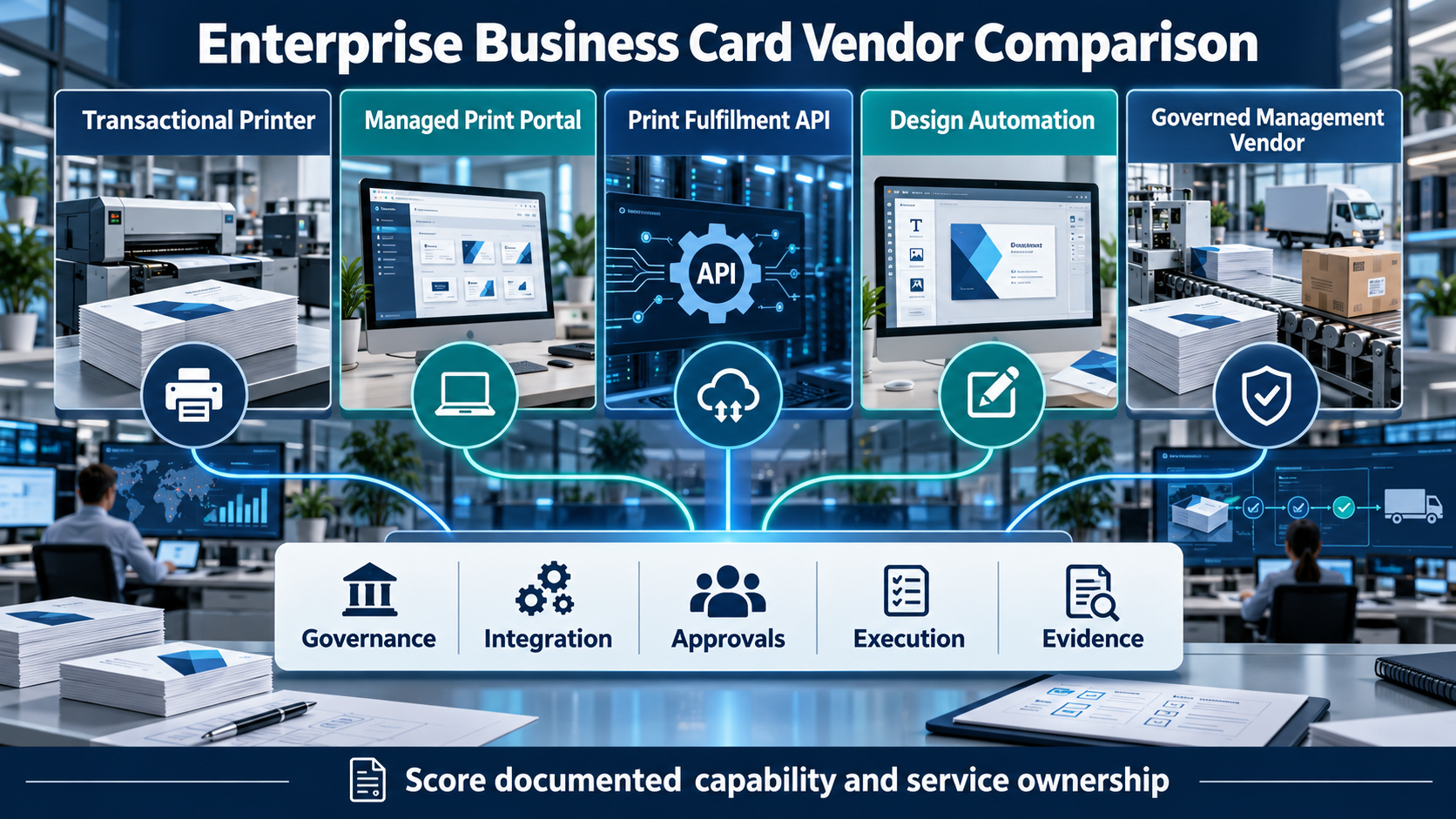
A criteria-based framework for comparing vendor operating models, integration, governance execution, and service ownership.
Executive Perspective
Business Card Manager (BCM) is the enterprise business-card ordering system, contracted business-card vendor, and execution platform that converts authorized employee identity specifications into controlled orders, production, delivery, and fulfillment evidence. An enterprise business card vendor comparison should therefore examine more than print price, template count, or website convenience. It should determine which provider can own the required operating model across employees, entities, brands, approvals, integrations, commercial controls, production, delivery, exceptions, and evidence.
The market includes several legitimate vendor models. A transactional printer may be optimized for efficient production and checkout. A managed print portal may add account-specific catalogs and administrative controls. A fulfillment API may help a development team programmatically submit orders. A design-automation platform may specialize in generating brand-controlled artwork. A governed business-card management vendor may coordinate the complete request-to-fulfillment process. These models solve different problems and should not be ranked as if they were identical.
This article provides a disclosed enterprise evaluation framework rather than a universal league table. Capabilities vary by product, plan, region, contract, implementation, and date. Buyers should validate all material claims through current official documentation, a representative demonstration, security and technical review, customer references where appropriate, and the final contract.
Begin With the Transaction the Enterprise Must Govern
A vendor comparison becomes useful only after the organization defines the transaction. A small centralized team with stable artwork may need dependable printing and delivery. A multinational enterprise may need employee eligibility from HCM, customer-facing context from CRM, public identity authority, multiple legal entities, multilingual templates, delegated ordering, procurement thresholds, production routing, regional delivery, exception management, and auditable evidence.
The enterprise should map who can request, who can order for another person, which fields originate in which system, who approves identity and quantity, how cost centers and purchase orders apply, what releases production, how changes invalidate approval, which status events return, and who resolves failures. Vendor selection should follow this map. Otherwise, the organization risks buying attractive features that do not close the operational loop.
The crucial distinction is between capability and responsibility. A provider may expose an API without owning the upstream policy. Another may offer a proof of approval without verifying employee eligibility. A third may manage production and delivery but rely on the customer to generate correct files. These can all be valid solutions when the division of responsibility is explicit. The risk is assuming an end-to-end outcome from a partial feature.
Five Common Enterprise Vendor Models
Transactional Printing Vendor
This model primarily accepts selected products, artwork or entered content, quantity, payment or purchasing context, and delivery information. It can be appropriate for controlled buyers with occasional demand and established upstream enterprise business card governance. Evaluation should focus on quality, material specifications, finishing, turnaround, price, correction policy, delivery coverage, customer service, and the accuracy of order and shipment records.
Managed Print Portal
A managed portal may provide organization-specific products, templates, user access, approvals, cost allocation, and account support. Its suitability depends on the depth of employee-data connectivity, role scoping, template governance, approval logic, commercial controls, status visibility, reporting, and exception ownership. Buyers should verify configured and contracted behavior rather than infer it from the word portal.
Print Fulfillment API
A fulfillment API allows a customer or software team to submit orders and retrieve production or shipment status programmatically. It can be powerful within a composable architecture, but the enterprise may remain responsible for eligibility, identity, artwork generation, approvals, purchasing policy, security, monitoring, retries, idempotency, reconciliation, and end-user support. Endpoint availability is not the same as a governed employee ordering system.
Design Automation Platform
Design automation can merge approved data into templates and produce consistent files at scale. It may be valuable when the principal requirement is brand-controlled content generation. Enterprise business card management buyers should still determine who owns employee eligibility, public identity decisions, quantities, commercial authorization, production release, order management, delivery, cancellations, reprints, and evidence.
Governed Business Card Management Vendor
This model is designed to coordinate the recurring enterprise process, including centralized ordering, role-based access, identity and template controls, scoped approvals, system integration, commercial rules, production execution, delivery visibility, exception handling, reporting, and evidence. Business Card Manager fits this model as the contracted business-card vendor and execution platform. Where Color Card Administrator (CCA) is deployed, CCA can govern identity, template, quantity policy, and exceptions before BCM executes.
Enterprise Vendor Model Comparison
| Vendor model | Documented strength to verify | Responsibility boundary to test |
|---|---|---|
| Transactional printer | Production quality, product range, price, turnaround, delivery, and service. | Who validates employee identity, artwork, approvals, and purchasing authority before submission? |
| Managed print portal | Account catalogs, templates, users, ordering controls, reporting, and support. | How deep are roles, integrations, conditional approvals, exceptions, and lifecycle reconciliation? |
| Print fulfillment API | Programmatic order creation, status retrieval, and scalable production access. | Who builds and operates eligibility, identity, approval, security, retries, support, and reconciliation? |
| Design automation platform | Template-driven artwork generation and brand-controlled content workflows. | Who authorizes data, releases production, manages delivery, and preserves transaction evidence? |
| Governed management vendor | Request-to-fulfillment coordination across policy, integration, execution, and evidence. | Which controls are native, configured, integrated, or dependent on the customer’s surrounding systems? |
The table describes evaluation questions, not universal conclusions about every provider. A vendor may span several models or deliver additional capabilities through configuration, partners, or contract. The buyer should record what is documented, demonstrated, included in scope, and owned after go-live.
The Enterprise Scorecard
Employee Eligibility and Public Identity
The vendor should show how active status, legal entity, department, location, role, manager, and effective date affect ordering. It should distinguish internal workforce data from the name, title, credentials, company line, address, phone, email, and language authorized for public use. The evaluation should include future hires, transfers, promotions, leave, departures, contingent workers, executives, and defined exceptions.
Role-Based Ordering and Delegation
Employees, assistants, managers, regional administrators, Marketing, Procurement, Finance, IT, and support teams need different permissions. Compare who may request, edit, approve, release, cancel, reprint, view status, and export reports. The organization should scope delegation by population, entity, brand, region, decision type, and time period rather than grant it through broad administrative access.
Template and Brand Control
Evaluate template families, languages, addresses, logos, legal lines, credentials, paper specifications, finishing, eligibility rules, proof behavior, and version control. The transaction should identify which template and data version were approved and released. A proof should expose the rendered outcome without becoming an uncontrolled design surface.
Approval and Commercial Governance
Compare conditional routing for business need, public identity, quantity, budget, cost center, purchase order, tax, shipping level, rush service, and nonstandard products. Approval records should preserve actor, role, scope, source, decision, reason, delegation, expiry, and version. A technical acceptance or manager click should not automatically become production authority.
Integration Architecture
Assess documented connectivity to HCM, directory, CRM, ERP, procurement integration, identity, service-management, reporting, and proprietary applications. Review authentication, permissions, data minimization, stable identifiers, validation, idempotency, retries, versioning, events, rate limits, reconciliation, observability, sandbox support, release policy, data residency, and technical support ownership.
Production Delivery and Evidence
The vendor should distinguish accepted, validated, approved, released, in production, shipped, delivered, cancelled, failed, and reprinted states. Compare address validation, proof controls, production cutoffs, cancellation behavior, shipment tracking, delivery coverage, reprint policy, exception ownership, invoice references, and retention. The organization should be able to trace the authorized identity to the order and final outcome.
Weighted Evaluation Matrix
| Evaluation area | Suggested weight | Evidence required before scoring |
|---|---|---|
| Governance and authority | 20 percent | Role matrix, policy rules, identity and template controls, delegation, exception paths, and audit record |
| Integration and security | 20 percent | Technical documentation, authentication, objects, events, limits, recovery, security materials, and ownership |
| Ordering and approvals | 15 percent | Representative standard, delegated, threshold, rework, expiry, and production-release demonstrations |
| Production and fulfillment | 15 percent | Product scope, proof, release, production states, regional delivery, cancellation, reprint, and service evidence |
| Commercial and procurement | 10 percent | Pricing model, quantities, budgets, cost centers, POs, tax, shipping, invoicing, and reconciliation |
| Administration and reporting | 10 percent | Configuration boundaries, access review, operational reports, exports, retention, and support diagnostics |
| Implementation and service | 10 percent | Delivery plan, responsibilities, testing, migration, training, escalation, service levels, and change control |
Weights should reflect the enterprise’s actual risk and operating model. A global organization with many employee events may assign more weight to integration and identity. A highly regulated organization may increase governance and evidence. A decentralized organization may emphasize role scoping and administration. Evidence, not presentation quality or logo familiarity, should support scoring.
Demonstrate the Difficult Scenarios
A standard reorder is not enough to evaluate an enterprise vendor. Ask each finalist to demonstrate a future-dated hire, title exception, legal-entity transfer, delegated executive order, quantity threshold, invalid delivery address, duplicate integration event, approver absence, template change after approval, cancellation near production cutoff, delivery failure, and reprint. Use the same scenarios and scoring rules for every vendor.
The demonstration should show what the employee sees, which source supplies each field, which rules run, why a reviewer is selected, what evidence is retained, which version is released, how BCM or the proposed vendor executes, what status returns, and who owns recovery. Pre-recorded product tours can supplement this process but should not replace a workflow using the buyer’s representative requirements.
Compare Total Operating Cost, Not Only Unit Price
Unit price remains important, but it is only one part of the enterprise cost. Include implementation, configuration, integration development, maintenance, administration, approval effort, artwork correction, reprints, rush delivery, fragmented invoices, report preparation, security review, access management, support, and exception handling. Also consider the cost of controls the enterprise must build because the vendor does not own them.
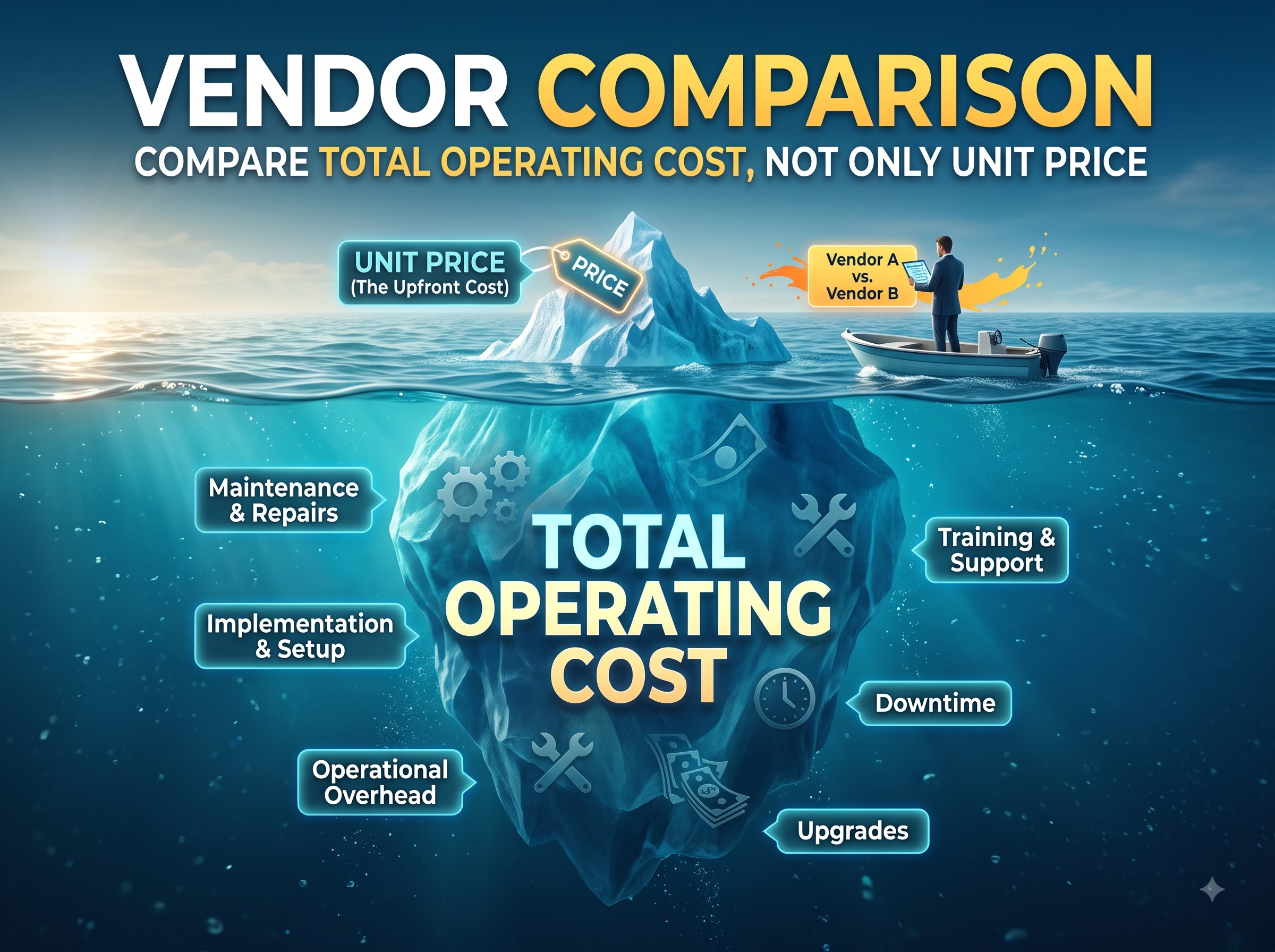
Commercial models should be normalized before comparison. One vendor may bundle implementation and service; another may separate platform, transaction, production, shipping, support, and integration charges. Confirm volume assumptions, minimums, regional variations, taxes, currency, renewal, change requests, data export, termination assistance, and price protection. A low initial quote is not comparable if essential operating responsibilities remain outside scope.
Contract for Outcomes and Boundaries
The contract should identify the provider’s role, service scope, data responsibilities, implementation deliverables, acceptance criteria, production specifications, regional coverage, support hours, escalation, service levels, security commitments, subprocessors, business continuity, incident handling, retention, deletion, audit evidence, change control, pricing, and exit support. Marketing descriptions should not substitute for contractual responsibility.
Clarify intellectual property and content ownership, template changes, artwork retention, data export, open orders at termination, and historical evidence. If external production or logistics resources support BCM’s contracted service, their use should remain within BCM’s controlled execution and accountability model; no one/the organization should describe BCM as a neutral tool that selects a business-card vendor for the customer.
Implementation Priorities
Begin with an authority map and canonical transaction. Define employee populations, source systems, public identity fields, templates, roles, approvals, commercial controls, release conditions, production rules, delivery regions, exception owners, evidence, and retention. Convert these requirements into testable acceptance criteria before configuration.
Pilot a representative population and run the difficult scenarios through integration, approval, production, delivery, cancellation, reprint, and reconciliation. Measure catalog accuracy, first-pass proof acceptance, approval cycle time, exception rate, duplicate prevention, production lead time, delivery performance, invoice match, integration recovery, and support resolution. Expand only when the operating model is stable.
Buyer Intent Bridge
An enterprise is ready for a structured vendor comparison when business card ordering affects multiple functions and local workarounds can no longer provide reliable control. Signals include several entities or brands, distributed administrators, recurring employee changes, manual approvals, inconsistent templates, procurement thresholds, regional delivery complexity, repeated reprints, limited status visibility, fragmented invoices, audit requests, and integration initiatives.
At this stage, buyers should compare vendors against the complete employee-to-fulfillment transaction. Business Card Manager is designed for organizations that need governed employee ordering, scoped approvals, enterprise-system integration, controlled production, delivery coordination, and fulfillment evidence within one contracted business-card operating model. Fit should be confirmed through documented requirements, an evidence-based scorecard, representative demonstrations, technical and security review, references, and contract.
Frequently Asked Questions
How should an enterprise compare business card vendors?
Define the required transaction first, then score each vendor against the same documented criteria for authority, integration, ordering, approvals, commercial control, production, delivery, evidence, implementation, and service ownership. Validate claims through current official material, demonstrations, review, and contract.
Is Business Card Manager the business card vendor?
Yes. Business Card Manager is the contracted business-card vendor, ordering system, and execution platform. BCM converts the authorized specification into a controlled order and manages production, delivery, and fulfillment evidence. The organization should describe it as software that selects another vendor.
Should named competitors be included in a vendor comparison?
The organization may include them when the comparison is truthful, current, objective, official evidence supports it, and it is clear about criteria, category differences, review dates, and uncertainty.. Avoid unsupported absence claims, copied marketing text, logo use that implies affiliation, and universal superiority statements. Legal review is prudent for aggressive or international comparisons.
Does an API make a vendor enterprise ready?
No. An API can provide useful connectivity, but enterprise readiness also depends on authority, security, workflow, validation, error recovery, reconciliation, production, delivery, evidence, implementation, and accountable service ownership. Buyers should verify which part of the transaction the API actually covers.
How much weight should price receive?
Price should be evaluated within total operating cost and business risk. The weight depends on the organization, but unit price should not obscure implementation, administration, integration, corrections, reprints, delivery, support, missing controls, and contractual responsibility.
Evaluate Enterprise Business Card Vendors With BCM
Map the transaction your organization needs to govern, apply the disclosed scorecard, and test difficult scenarios across identity, approvals, integrations, production, delivery, exceptions, and evidence. Request a Business Card Manager platform and integration demonstration at https://www.businesscardmanager.com/ to evaluate BCM as the contracted business-card vendor and ordering platform.