

Business Card Printing Services vs Business Card Management Platforms
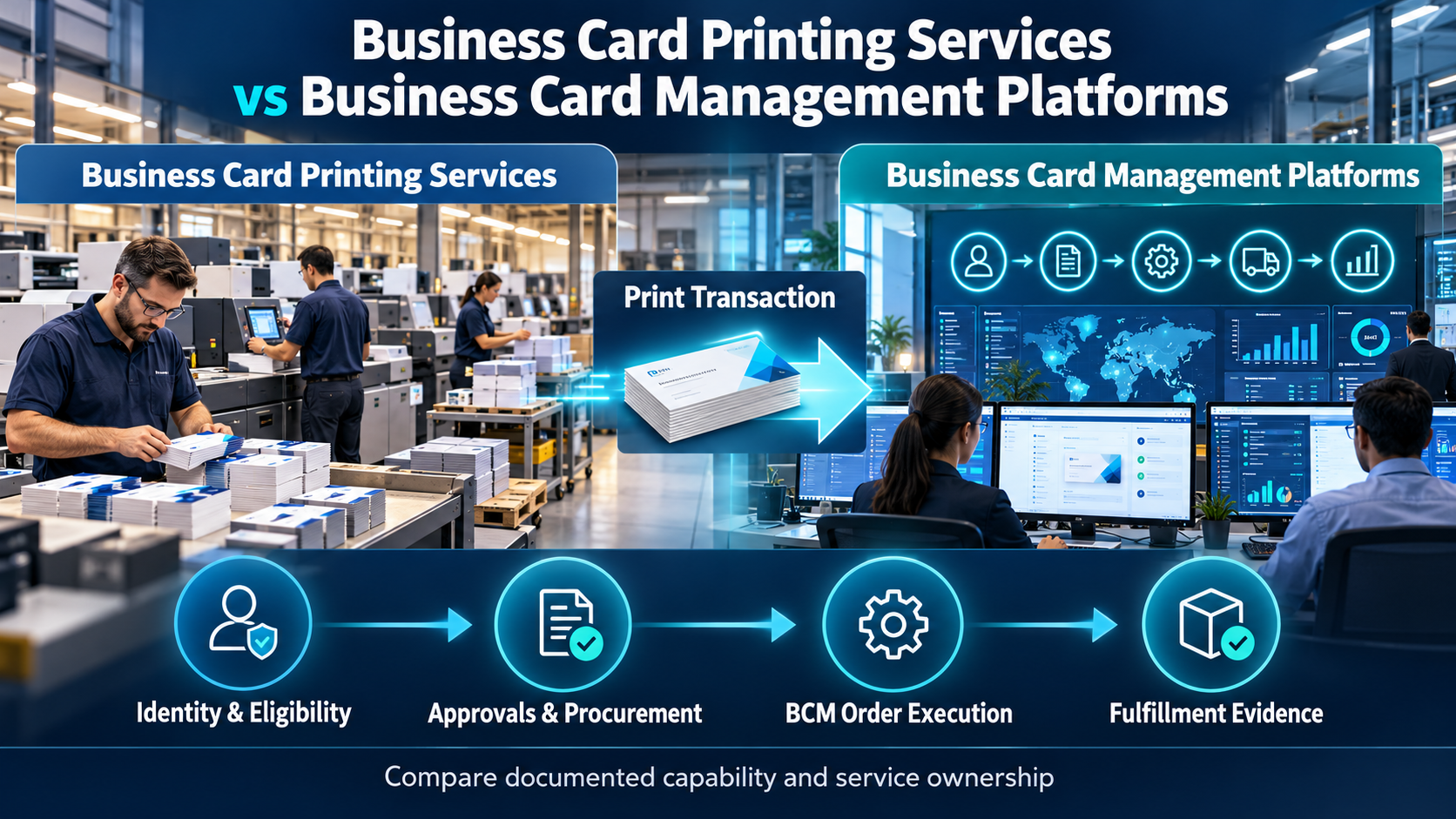
How do enterprises distinguish a print transaction from governed ordering, integration execution, and fulfillment evidence?
Executive Perspective
Business Card Manager (BCM) is the enterprise business-card ordering system, contracted business-card vendor, and execution platform that converts authorized employee identity specifications into controlled orders, production, delivery, and fulfillment evidence. The distinction between business card printing services and business card management platforms begins with the problem each category is expected to solve. A printing service primarily produces a physical item from supplied artwork or configured choices. A management platform coordinates the recurring enterprise process that determines who may order, what may be printed, who must approve it, how commercial rules apply, and how the final outcome is reconciled.
Neither category should be dismissed or overstated. A straightforward print service can be appropriate when the buyer has limited volume, stable artwork, centralized request handling, and little need for system integration or distributed control. A business card management platform becomes relevant when the organization must govern employee lifecycle changes, brands, entities, locations, approvals, procurement, production, delivery, exceptions, and reporting across a repeatable operating model.
This is a category comparison, not a universal ranking of providers. Capabilities vary by product, plan, contract, geography, and implementation. Enterprise buyers should verify current official documentation, demonstrations, security materials, service commitments, and contractual responsibility before relying on any claim.
Printing Is a Transaction, and Management Is an Operating System
A print transaction normally begins after the buyer has resolved the important decisions. The artwork exists, the text is believed to be correct, the quantity is known, payment or purchasing authority is available, and a delivery address has been selected. The printing service accepts the specification and produces the item. Its value is real: production expertise, material options, finishing, quality, capacity, logistics, and price all matter.
Enterprise business card management begins earlier and finishes later. It determines eligibility, sources employee facts, governs public identity, selects the permitted template, routes approvals, applies quantities and commercial rules, releases an authorized version, tracks production and shipment, manages exceptions, and retains evidence. The management layer does not make printing unimportant. It places printing inside a controlled transaction that can operate repeatedly across a large workforce.
The difference becomes visible when something changes. A promoted employee may need a new title and a future effective date. A transferred employee may require a new legal entity, address, language, cost center, template, tax treatment, and delivery route. A departed employee may have an open order that should stop. A printing service can produce the file it receives; a management platform must help determine whether that file is the authorized one and whether the transaction should proceed.
Category Comparison Across Enterprise Requirements
| Evaluation area | Business card printing service | Business card management platform |
|---|---|---|
| Primary outcome | Produce and deliver cards from submitted artwork or configured product choices. | Govern the employee-to-fulfillment transaction and execute the authorized order. |
| Starting point | Buyer supplies approved content, artwork, quantity, and purchasing context. | System resolves eligibility, approved identity, template, quantity, authority, and commercial context. |
| Employee lifecycle | Usually handled before the order reaches production. | Can connect onboarding, promotion, transfer, location change, and departure workflows. |
| Approvals | May offer proof or order approval depending on the service. | Routes scoped identity, business, quantity, procurement, and production-release decisions. |
| Integration | May provide storefront, file, order, or fulfillment connectivity. | Coordinates HCM, directory, CRM, ERP, procurement, identity, service, and reporting context. |
| Evidence | Order, payment, production, shipment, and delivery records may be available. | Links source, identity version, approval, order, production, delivery, exception, and reconciliation evidence. |
| Best-fit question | Can this service produce the required card reliably at the required price and delivery level? | Can this platform preserve authority and accountability across the complete recurring process? |
This matrix describes common category emphasis, not guaranteed functionality. Some printing providers offer sophisticated portals, APIs, brand templates, approvals, and account services. Some software products cover only part of the transaction. Buyers should evaluate documented capability and service ownership instead of assigning features from a category label.
When Business Card Printing Services Are a Practical Fit
A conventional printing service can be the sensible choice when orders are occasional, the employee population is small, artwork changes rarely, one authorized buyer submits orders, and the organization already controls identity and approvals outside the service. In that environment, adding workflow infrastructure may create more administration than value. The buyer can focus on print quality, product selection, turnaround, price, delivery, customer service, and correction policy.
Printing services can also serve a defined component within a larger enterprise architecture. An organization may govern identity and approvals in its own systems, generate production-ready artwork, and use an order or fulfillment service for execution. That model can work when the organization owns integration, validation, error recovery, operational reconciliation, support, and the boundary between approval and production release.
The risk appears when a simple transaction model is stretched beyond its design. Email approvals, shared artwork folders, local spreadsheets, and manually copied employee fields can become the unofficial management layer. The print order may succeed while the enterprise cannot prove who authorized the title, whether the correct template was used, why a rush method was selected, or whether a reprint addressed the original cause.
When a Business Card Management Platform Becomes Necessary
Distributed Employee Ordering
Large and multi-location organizations need employees, assistants, managers, and regional administrators to request cards within a defined scope. The platform should express who may order for whom, which catalogs are available, what fields may be changed, which quantities are permitted, and when additional review is required. Convenience should not require unrestricted administrator access.
Identity and Template Governance
Public identity is not simply a copy of the HR record. Job titles, credentials, company lines, addresses, phone formats, languages, legal statements, and brand templates may require policy. Where Color Card Administrator (CCA) is deployed, CCA can govern approved identity, templates, quantity rules, and exceptions before BCM executes. The control boundary prevents a valid source field from becoming an automatically approved external representation.
Approval and Procurement Control
Enterprises often need different authorities for business need, identity presentation, quantity, budget, cost center, purchase order, tax, shipping level, and nonstandard production. A management platform should route each decision to the proper owner, record delegation and expiry, and invalidate approval when material data changes. A generic approved status should not hide what was actually authorized.
System Integration and Automation
A platform can connect business card provisioning activity to HCM, directory, CRM, ERP, procurement, identity, service-management, reporting, and proprietary applications. Useful integration goes beyond moving fields. It defines authentication, permissions, validation, stable identifiers, idempotency, retries, versioning, events, rate limits, reconciliation, observability, data minimization, and support ownership.
Production and Fulfillment Accountability
The process does not end at approval. BCM freezes or receives the authorized specification, creates the controlled order, manages production states, coordinates delivery, and records fulfillment evidence as the contracted vendor. The operating model should distinguish accepted, validated, approved, released, in production, shipped, delivered, cancelled, failed, and reprinted states. Technical acceptance is not proof of delivery.
What Enterprise Buyers Should Compare
A useful evaluation begins with the transaction the organization must govern. Buyers should document employee populations, entities, brands, regions, languages, templates, roles, approvals, commercial controls, integration sources, production requirements, delivery routes, exception scenarios, evidence, retention, and service ownership. Only then should they compare platforms or services.
Security and privacy review should follow the complete data path. Examine authentication, role design, least privilege, administrator access, encryption, logging, environment separation, retention, deletion, subprocessors, data residency, incident response, business continuity, and export controls. Business card ordering rarely requires compensation, benefits, medical, banking, tax, performance, or detailed activity data. A well-designed process uses the minimum employee data needed to authorize and fulfill the card.
Commercial review should consider more than unit print price. Implementation, administration, integration, maintenance, approvals, corrections, reprints, rush delivery, fragmented invoices, support effort, reconciliation, reporting, and business card governance gaps all affect total cost. A lower production price can coexist with a more expensive operating model if employees and administrators must repair the process manually.

A Governed Enterprise Operating Workflow
| Stage | Management responsibility | Execution evidence |
|---|---|---|
| 1 Establish eligibility | Confirm active population, ordering rights, legal entity, location, catalog, and request type. | Source, employee key, rule, actor, and timestamp |
| 2 Resolve identity | Apply approved public identity, template, language, credentials, quantity rules, and exceptions. | Field provenance, policy result, template version, and exception |
| 3 Authorize transaction | Route business, brand, commercial, and local approvals according to scoped authority. | Approver, scope, decision, reason, delegation, and expiry |
| 4 Execute with BCM | Release the authorized version under contracted product, pricing, production, and delivery rules. | Order ID, immutable specification, quantity, commercial context, and release |
| 5 Reconcile outcome | Return production, shipment, delivery, cancellation, failure, and reprint events. | Status history, tracking, owner, resolution, invoice reference, and outcome |
This workflow clarifies why print and management are related but not interchangeable. Production is a critical stage within the system, while authority and reconciliation span the stages around it. BCM owns the contracted business-card execution; it should not be described as software that selects an unrelated vendor for the customer.
Service Ownership Matters as Much as Feature Lists
Enterprise buyers need to know who owns each failure. If employee data is stale, who resolves the source? Whether a title requires an exception, who decides? If an approval event is duplicated, who prevents a second order? Wea the authorized specification changes after release, what can still be cancelled? If a shipment fails, who communicates with the employee and reconciles the outcome? Feature lists rarely answer these questions.
A credible operating model defines implementation ownership, integration support, production accountability, escalation, regional coverage, service levels, change control, and evidence. Where Business Ops Center (BOC) is used, BOC can coordinate cross-system exceptions and reconciliation without replacing the authoritative source, CCA decision where deployed, or BCM execution record.
Implementation Priorities
Start with an authority map rather than a catalog upload. Identify the source and owner for employee status, public identity, templates, quantities, commercial rules, production release, delivery, and exceptions. Resolve conflicts before automation. If Marketing and HR both believe they own a title, or neither Procurement nor Operations owns a rush exception, software will only accelerate ambiguity.
Pilot a representative population and test standard orders, delegated requests, title changes, future-dated transitions, quantity thresholds, invalid addresses, duplicate events, source outages, cancellations, delivery failures, and reprints. Confirm that the version approved is the version released and that every failure has a named owner and visible state.
Measure policy compliance and business outcome, not only adoption. Useful metrics include request-to-approval time, straight-through processing, exception rate, first-pass proof acceptance, rework cause, duplicate prevention, production lead time, cancellation success, delivery performance, reprint cause, invoice match, integration recovery, and support resolution.
Buyer Intent Bridge
An organization is ready to move beyond a standalone printing service when the work surrounding print becomes the larger problem. Signals include distributed ordering, multiple entities or brands, recurring employee changes, inconsistent templates, manual approval chains, delegated administrators, limited procurement visibility, repeated corrections, uncertain shipment status, fragmented invoices, audit requests, and planned HCM, CRM, ERP, directory, procurement, or service-management integrations.
At that point, the buying question changes from who can print the card to who can own the governed transaction. Business Card Manager is designed for organizations that require centralized employee ordering, configured approvals, enterprise business card integration, controlled production, delivery coordination, and fulfillment evidence within one contracted business-card operating model. The proposed scope should still be validated through documented requirements, a representative workflow demonstration, technical review, and contract.
Frequently Asked Questions
What is the main difference between a printing service and a management platform?
A printing service primarily produces and delivers cards from supplied or configured specifications. A management platform governs the recurring process that establishes eligibility, identity, template, approval, commercial authorization, production release, delivery status, exceptions, and evidence. Actual capabilities vary, so buyers should verify the provider’s documented scope.
Is Business Card Manager the business card vendor
Yes. Business Card Manager is the contracted business-card vendor, ordering system, and execution platform. BCM converts the authorized specification into a controlled order and manages production, delivery, and fulfillment evidence. It should not be described as software that merely chooses another business-card vendor.
Can a printing service offer APIs or approvals?
Yes. Some printing services provide portals, templates, approval features, order connectivity, or fulfillment APIs. Those capabilities can be valuable. Buyers should confirm whether they cover the complete required transaction or only a segment, and who owns integration, policy, exception handling, reconciliation, and support.
Can a management platform replace printing expertise
No operating model can ignore production quality, material specifications, finishing, capacity, logistics, and service. The value of a management platform is to connect these execution requirements to governed employee identity, approvals, commercial control, integration, and evidence.
Should an enterprise select primarily on unit price
Unit price is one input. The enterprise should compare implementation, administration, integration, approval effort, corrections, reprints, rush delivery, invoice research, reporting, security, support, and the cost of building missing governance outside the service.
Evaluate the Complete Business Card Operating Model With BCM
Map your employee populations, identity authority, template families, ordering roles, approvals, commercial controls, integrations, production requirements, delivery regions, exceptions, and evidence needs. Then test the complete employee-to-fulfillment transaction with Business Card Manager as the contracted business-card vendor and ordering platform. Request a BCM platform and integration demonstration at https://www.businesscardmanager.com/