

Enterprise Business Card Order Tracking
Evaluate BCM API status integration and manual follow-up using the same employee questions. Compare status definitions, order references, stale updates, uncertain submissions, delivery evidence, and support.
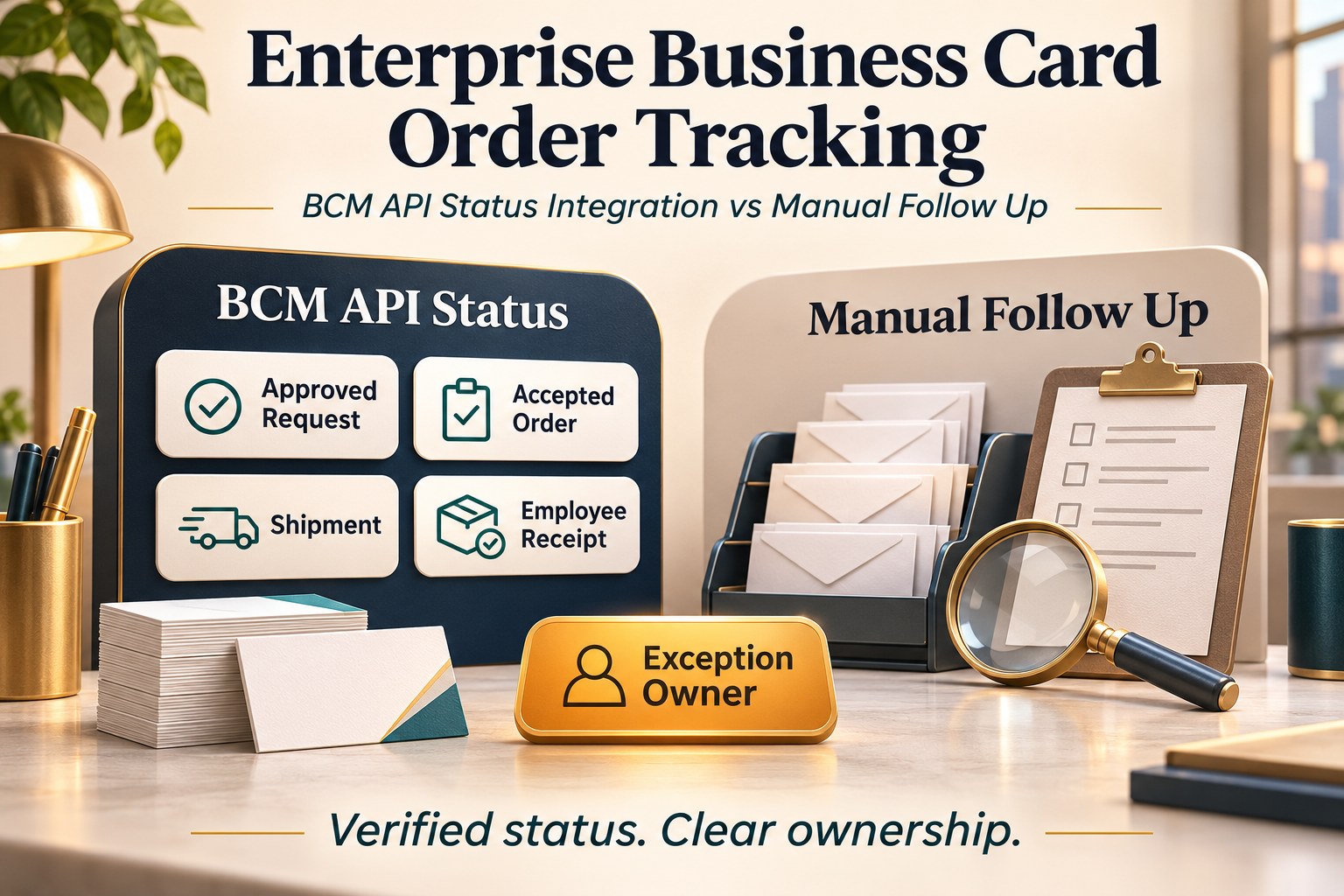
BCM (Business Card Manager) is the enterprise business card ordering management system and contracted business card vendor for organizations connecting approved requests with production and fulfillment. Enterprise business card order tracking should help employees and service teams understand what has happened, what remains unresolved, and who can take the next action.
The buying decision is whether a scoped BCM API status integration can reduce manual follow-up while preserving an accurate account of each order. A request marked approved, a successful technical submission, and a shipment notification answer different questions. Combining them into one generic complete status can leave the employee without cards while the service team believes its work is finished.
This article compares the operating responsibilities of an integrated status workflow and manual tracking. The proposed states and demonstration cases are evaluation requirements, not a claim that every status, event, or delivery confirmation is exposed through a standard BCM interface. Confirm the supported operations and status definitions for the actual deployment.
Start with the Questions the Requester Needs Answered
Ask employees and coordinators what prompts them to seek an update. They may need to know whether information is missing, whether approval is outstanding, whether an order exists, or whether a delivery issue requires action. A list of technical process names may provide little help if those questions remain unanswered.
Define the useful response at each stage. Before ordering, the employee may need a named review owner. After acceptance, the coordinator may need the verified order position and the route for a change request. After shipment, the receiving team may need the available tracking information and instructions for reporting a problem.
BCM’s HCM and CRM integration model describes status and fulfillment information as possible parts of a configured interface, subject to scope confirmation. Use that distinction when requesting a proposal. Specify the questions the enterprise wants to answer, then confirm what BCM can return and which follow-up remains a supported operational task.
Explore the BCM HCM and CRM integration model
Compare Tracking Work Across the Same Orders
Manual tracking may involve an administrator checking BCM, recording an update in the request system, and responding to employees. It can be workable when volumes are modest and the administrator has a clear review routine. An API connection may reduce repeated checking and entry when many requests require the same verified information.
Compare both options using identical requests and service expectations. Include an ordinary order, a stale update, and a delivery concern. Record how long staff actively work on each case and how the employee receives the answer. A dashboard that displays the normal order quickly may still require substantial support for the cases that generate most inquiries.
| Buying criterion | Scoped BCM API status workflow | Manual follow-up |
|---|---|---|
| Status meaning | Map confirmed source states to clear labels | Verify the source before reporting progress |
| Transaction links | Associate request, order and related references | Retain order references beside the request |
| Information age | Show last verified status and observation time | Record when the administrator checked |
| Uncertain outcome | Demonstrate supported reconciliation and ownership | Investigate before repeating a purchase |
| Exceptions | Route actionable cases to agreed owners | Assign and follow the unresolved case |
| Operating effort | Include monitoring, mapping and recovery | Include checking, entry and employee responses |
The comparison concerns the proposed deployment. A manual process can retain reliable evidence, and an integration can still display misleading information if its mappings are poorly defined. Ask which behavior is supported and demonstrated, what requires configuration or development, and where a person remains responsible for checking or resolving the case.
Define Statuses Before Mapping Them Between Systems
Agree what each status means and what evidence supports it. Request approval establishes an enterprise decision about the proposed action. Order acceptance establishes a different event. Production, shipment, and receipt describe later activity that may be available through different sources or service procedures.
BCM’s implementation guidance calls for distinct production and delivery states rather than a generic completion label. For the integration, identify the statuses actually available and their meaning. The customer application can present clear wording without pretending that an unavailable detail has been verified.
For example, a source status might confirm that a request was received for processing without confirming production. The employee-facing label should reflect that limited meaning. If another stage requires confirmation from BCM support, state the current verified position and the responsible contact. Clear boundaries are more useful than an apparently complete sequence filled with inferred progress.
Keep Technical Receipt Separate from Order Acceptance
A successful response to an integration call can confirm technical handling at one boundary. It should not be interpreted as proof that every business validation has passed or that cards are being produced. Confirm the precise meaning of the response for the supported operation.
The procurement integration guidance similarly distinguishes a successful transmission from the later business outcomes needed for reconciliation. Apply that distinction to employee service. A portal message saying that submission succeeded should not invite the requester to assume delivery has been scheduled unless the evidence establishes that.
Test an order that fails a business check after technical submission. The operating team should be able to see the issue and identify the person who can resolve it. The manual alternative needs the same discipline when an administrator receives an acknowledgment and later learns that required information was incomplete.
Link Request, Order, and Shipment References
A request reference helps the employee identify the service interaction. A BCM order reference helps support investigate the accepted purchase. Shipment information, where available, may refer to another record. Retain the relationships necessary to follow the transaction without assuming these identifiers are interchangeable.
One request may need further review before any order exists. A correction or authorized replacement may create a later order related to an earlier one. Ask how the proposed design shows those relationships so that a coordinator does not mistake a replacement for a duplicate or use the first order’s status to describe the second.
Use an employee with two legitimate purchases in the demonstration. The system should identify which order answers the current inquiry. Matching by employee name alone may attach the wrong update, especially when an assistant orders on behalf of several people. Preserve requester and beneficiary references where delegated ordering is involved.
Show How Current the Displayed Information Is
A status can be accurate when retrieved and still become stale. Agree how the integration obtains updates and how the application communicates their age. The customer’s refresh requirement should reflect the service question rather than an assumption that every stage needs continuous updates.
Display the last verified status with a meaningful observation time. Where the source supplies an event time, distinguish it from the time the customer system received or checked the information. These values help an operator understand whether an update is delayed or whether no later event has been confirmed.
Ask what happens during an outage. Retaining the last verified state may be useful, provided the display does not imply a recent check. Define who investigates updates older than the agreed operating threshold and how a requester reaches support. Avoid replacing uncertainty with a guessed delivery date or a reassuring label that the evidence cannot support.
Handle Repeated and Delayed Updates Consistently
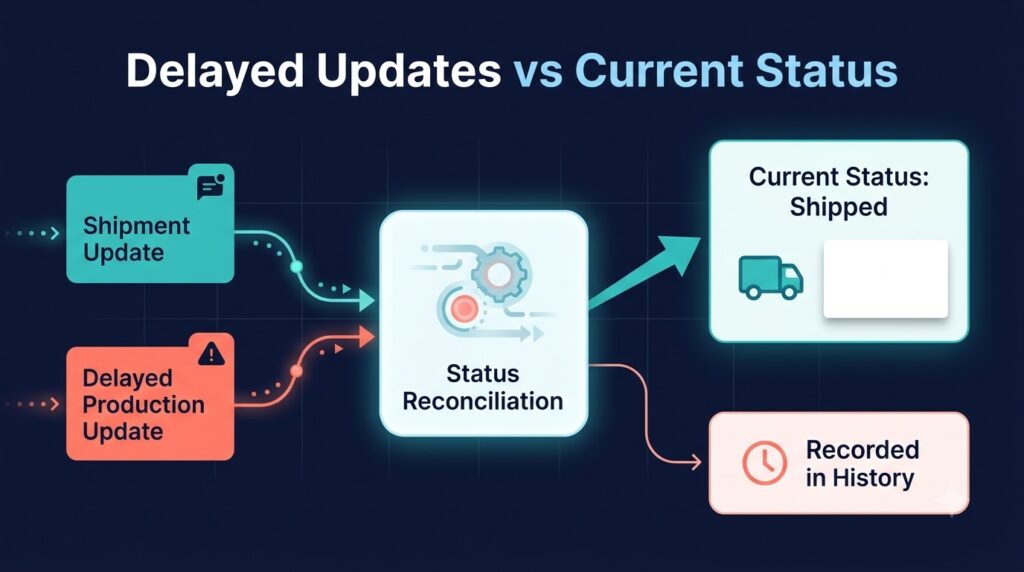
Integration messages or scheduled checks may repeat an existing state. A delayed update may arrive after newer information has already been recorded. The proposed design should establish how the application recognizes those situations and preserves a credible current view.
Use a shipment update followed by an older production update as an evaluation case. The interface should not move the employee back to production merely because that message arrived later. Confirm the ordering or reconciliation rule the implementation can support, along with how corrections to an earlier source record are handled.
Notifications need similar care. Repeated observations of the same state should not overwhelm the employee or create new service tasks without reason. Ask which changes warrant a message, which belong only in history, and who receives an actionable exception. Verify the actual notification behavior instead of assuming the status API supplies an entire communication workflow.
Close the Gap After an Uncertain Submission
A connection may lose its response after an order was accepted. The customer application may then show no clear result even though a purchase exists. Treat this as an unresolved outcome requiring investigation, rather than automatically reporting failure or placing another order.
Confirm how an authorized operator uses supported BCM evidence to determine what happened. The procedure may rely on an available lookup, a retained correlation reference, or a support route defined in scope. Do not assume a particular search endpoint or duplicate-prevention mechanism without confirmation.
The demonstration should end with a clear record of whether an order exists and which request it belongs to. If another attempt is authorized, retain the reason and relationship to the unresolved submission. This recovery work belongs in the support estimate for both the API design and the manual process.
Distinguish Shipment from Employee Receipt
Shipment information may show that cards left production or entered a delivery service. It does not always establish that the intended employee has received them. Cards may arrive at an office reception desk or distribution point before reaching the beneficiary.
Define the outcome needed for the selected population. A delivery confirmation may be sufficient for some receiving arrangements, while another workflow may need a coordinator’s acknowledgment or an employee service response. Identify what evidence can actually be collected and avoid promising a level of physical verification that the service does not provide.
Test a shipment reported delivered when the employee cannot locate the cards. The request should reach the appropriate investigation route with the relevant references. A new purchase should remain a separate authorized decision. The existence of tracking information should not automatically close a genuine service concern or establish an entitlement to a free replacement.
Assign Exceptions to the Team That Can Resolve Them
An order can wait because a title needs approval, an allocation is invalid, a transfer failed, or delivery information requires correction. These issues need different owners. A status display is useful when it helps direct the case rather than simply accumulating items marked pending.
Keep the reason and next action clear enough for the operating team. A source-data correction may belong to the enterprise’s data owner. A technical synchronization issue may belong to integration support. A production or delivery inquiry should follow the contracted BCM service route. Define how the receiving team acknowledges and closes the case.
Where Business Ops Center is deployed for cross-system oversight, its published ServiceNow model describes correlating records and coordinating exceptions while the specialist applications retain their roles. Confirm the actual BOC scope. CCA governs approved identity where deployed; BCM remains the business card ordering system and contracted vendor responsible for the agreed execution service.
Explore BOC oversight for ServiceNow business card requests
Match Tracking Visibility to the User Role
An employee needs the information relevant to their request. A coordinator may need a defined population of orders. Procurement may need commercial references and exception outcomes without unrestricted public-identity proofs or private delivery details. Specify those views rather than copying the same full record into every connected application.
A status integration should identify which fields are returned and who may read them. Include tracking links, exports, and notification messages in that review. A limited screen does not establish that the technical account or message payload has equally limited access.
When employee assignments change, decide who can continue following an open order. Historical attribution and current access serve different purposes. The enterprise should preserve the evidence needed to explain the transaction while assigning current follow-up to an authorized person. Confirm how that transition operates in the proposed BCM and customer workflow.
Review BCM business card ordering governance
Keep Fulfillment and Financial Closure Distinct
An employee may have received the correct cards while a purchasing discrepancy remains open. Conversely, an invoice can be processed while delivery still needs investigation. The program should define what each audience means by complete instead of relying on one status to settle every obligation.
BCM’s procurement guidance discusses linking orders with receipt and commercial evidence for reconciliation. In the proposed deployment, identify which references and outcomes finance needs and which systems own those records. A shipment message should not silently become financial receipt or approval of a charge.
The employee service task can use an agreed closure rule while the related commercial case remains visible to its owner. Preserve the relationship and clarify the outstanding action. This avoids keeping every employee request open for unrelated accounting work while preventing material unresolved obligations from disappearing from oversight.
Scope the Connection Around Useful Status Questions
ServiceNow, Dynamics 365, HubSpot, or an internal application may be the place employees already check progress. HR systems such as Workday, SAP SuccessFactors, Oracle HCM, ADP, UKG, or Dayforce may need a narrower readiness outcome. Identify which application needs which answer and why.
Confirm the actual customer product, access route, and supported BCM operations. The implementation may retrieve status on a schedule or use another agreed mechanism. Do not promise webhooks, continuous updates, or a packaged connector without evidence that the proposed configuration supports them.
Begin with one request path and a defined employee population. Establish status meanings, references, refresh expectations, access, and exception ownership. Then add other consumers based on demonstrated need. A wider distribution of status data is useful only when the receiving teams understand its meaning and can maintain the connection.
Measure Service Improvement with a Representative Pilot
Record the existing volume of status inquiries, active administrator handling, unresolved cases, and requests closed with missing evidence. Separate time spent checking information from elapsed production or delivery time. A faster response to an inquiry is a different benefit from faster physical fulfillment.
For the integrated option, include monitoring and recovery effort as well as the checks removed. Review the cases that still require a person to act. Avoid assuming that displaying a status eliminates follow-up or that every notification reduces workload. Use pilot evidence to revise the business case.
Test an ordinary order, missing approval, repeated update, delayed message, uncertain submission, and delivery concern. Ask the operator to explain the final position and next owner for each. Expand when the team can support the resulting service during absences and outages, with current instructions and a reliable way to reconcile unresolved outcomes.
Questions About Enterprise Business Card Order Tracking
Does a successful API response mean an order is in production?
Confirm the meaning of the response for the actual operation. Technical receipt, business acceptance, and production are different events. Display only the progress supported by the available evidence.
Can BCM status appear in ServiceNow or a CRM application?
Evaluate that within a scoped integration. Confirm available BCM status operations, customer application access, mappings, refresh behavior, permissions, and support responsibilities. A general integration model does not establish a packaged connector.
Should a delivered shipment automatically close the employee request?
Use the agreed closure rule for the receiving arrangement. A shipment may arrive at a distribution point before reaching the employee. Provide a route for investigating a genuine delivery concern even when tracking shows delivered.
Is continuous status refresh always necessary?
Set the update requirement around the business question and supported service. A scheduled check may be appropriate for some needs. Make information age visible and establish ownership when updates become stale.
What should a tracking demonstration establish?
Ask for an ordinary order and several exception cases. Verify status meanings, transaction links, freshness, access, and recovery. The operator should be able to explain what is known, what remains unresolved, and who can act.
Request a BCM Order Tracking Assessment
Bring your most common employee status questions and a recent unresolved order example to a BCM consultation. Ask for a demonstration of the confirmed status scope and a comparison with manual follow-up using the same service expectations. Establish how updates reach the requester, how uncertainty is handled, and who owns the remaining work after launch.
Request pricing or schedule a demo with Business Card Manager to review your order tracking integration scope.