

How Operational Visibility Improves Enterprise Business Card Management
Introduction
Operational visibility has become a critical requirement for enterprise organizations managing large-scale business card workflows across departments, locations, procurement environments, and approval structures. Without centralized visibility into operational activity, organizations frequently experience workflow inefficiencies, governance gaps, delayed approvals, and inconsistent execution.
Modern enterprise organizations require centralized infrastructure capable of providing real-time visibility into approvals, procurement activity, vendor coordination, workflow status, and operational performance across the entire business card management lifecycle.
Why Operational Visibility Matters

Enterprise organizations often operate across multiple departments, geographic regions, and approval structures. Without centralized operational visibility, workflows become fragmented and difficult to manage at scale.
Operational visibility improves:
• Workflow accountability
• Procurement transparency
• Governance enforcement
• Approval tracking
• Vendor coordination
• Operational scalability
The Problems With Limited Visibility
Organizations relying on disconnected systems frequently struggle to monitor workflow activity and operational performance.
Common operational challenges include:
• Delayed approvals
• Limited procurement oversight
• Inconsistent workflow tracking
• Reduced audit transparency
• Manual reporting coordination
• Vendor communication gaps
• Operational bottlenecks
• Difficulty enforcing governance policies
How Operational Visibility Systems Operate
Modern enterprise business card workflow systems centralize operational reporting and workflow tracking into a unified infrastructure.
Operational visibility capabilities often include:
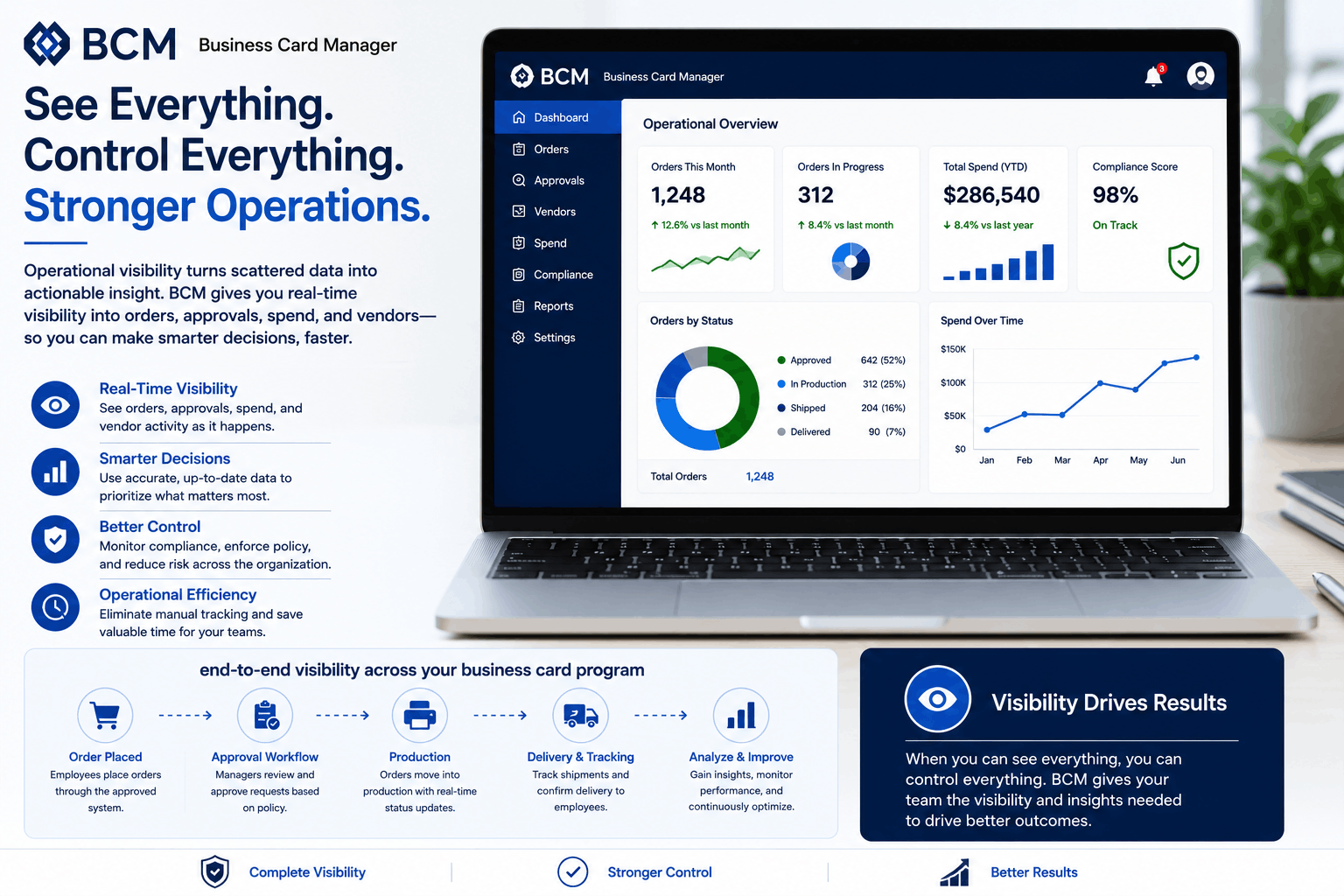
• Real-time workflow dashboards
• Approval status tracking
• Procurement reporting
• Vendor performance monitoring
• Audit logging
• Operational analytics
• Workflow performance metrics
• Multi-location reporting visibility
This creates a more transparent and scalable operational environment.
Benefits of Centralized Operational Visibility
Centralized visibility improves governance and operational coordination while reducing administrative inefficiencies.
Key benefits include:
1. Improved Workflow Accountability
Organizations gain greater insight into operational execution.
2. Better Procurement Oversight
Centralized reporting improves visibility into purchasing activity.
3. Faster Issue Resolution
Operational bottlenecks become easier to identify and resolve.
4. Stronger Governance Enforcement
Visibility infrastructure improves policy compliance and reporting.
5. Reduced Administrative Workload
Automation reduces manual reporting coordination.
How BCM Supports Operational Visibility
BCM provides enterprise infrastructure designed specifically for centralized operational visibility and workflow execution. The platform improves reporting transparency while standardizing approvals, procurement coordination, and operational governance. For medium and large organizations, BCM helps turn business card ordering from a fragmented administrative process into a visible, governed workflow across teams, departments, locations, vendors, and approval structures.
BCM enables enterprises to:
• Monitor workflow execution in real time
• Improve procurement visibility
• Track approval activity
• Centralize operational reporting
• Improve vendor coordination
• Maintain governance controls
• Scale operational visibility across departments and regions
Why API Integration Matters for Operational Visibility
Operational visibility becomes more valuable when business card workflows are connected to the systems that already manage employee identity, procurement activity, approvals, reporting, and operational data.
API-connected business card workflow infrastructure helps organizations connect BCM with HRIS, CRM, ERP, procurement systems, identity platforms, and proprietary backends. This gives enterprise teams better visibility into requests, approvals, cost centers, departments, vendors, delivery status, and workflow exceptions across the full business card lifecycle.
Reporting and Workflow Analytics
Operational analytics help enterprises improve workflow performance and governance accountability.
Centralized reporting systems support:
• Workflow performance analysis
• Procurement tracking
• Vendor reporting
• Approval audit trails
• Operational benchmarking
• Governance visibility
These insights help organizations optimize operational execution while improving accountability.
Enterprise Integration Requirements
Operational visibility systems often require integration with broader enterprise infrastructure.
Common integrations include:
• ERP procurement systems
• HRIS environments
• CRM platforms
• Identity management systems
• API workflow automation infrastructure
Integrations improve operational coordination while reducing disconnected reporting environments.
What Enterprise Buyers Should Evaluate
When evaluating operational visibility systems, enterprises should prioritize scalability and governance flexibility.
Important evaluation criteria include:
• Reporting capabilities
• Workflow analytics infrastructure
• Procurement visibility
• Integration flexibility
• Audit reporting functionality
• Administrative governance
• Multi-location scalability
• Security and permissions management
Conclusion
Operational visibility has become an important requirement for enterprise organizations managing complex business card workflows and procurement environments. Disconnected systems frequently create governance gaps, workflow bottlenecks, reporting delays, and operational inefficiencies that reduce accountability and transparency.
BCM provides centralized operational visibility infrastructure designed to improve workflow coordination, strengthen governance enforcement, and standardize enterprise business card management execution.
Request Pricing
Learn how BCM helps enterprises improve operational visibility, centralize reporting, and standardize workflow execution across departments and procurement environments.
Schedule Demo
See how BCM provides real-time operational visibility, approval tracking, and governance reporting for enterprise business card workflows.