

Business Card Approval Workflow Systems
Introduction
Business card approval workflow systems help enterprise organizations automate ordering approvals, improve governance visibility, and standardize operational execution across departments. Without structured approval workflows, organizations often rely on disconnected email requests, manual coordination, and inconsistent procurement processes that reduce operational efficiency and increase administrative complexity.
As enterprise teams scale across departments, locations, and operational environments, approval management becomes increasingly difficult to control manually. Organizations require centralized workflow systems that automate routing, enforce governance policies, and provide visibility into ordering activity across teams and regions.
Modern enterprises are no longer managing isolated ordering tasks. Business card provisioning has become part of broader operational governance, procurement coordination, onboarding workflows, and identity management infrastructure. This shift makes approval workflow automation essential for maintaining operational consistency at scale.
Why Approval Workflows Matter
Approval workflows create structure, accountability, and governance within enterprise ordering environments. Instead of relying on informal communication or disconnected approval systems, workflow automation standardizes how requests move throughout the organization.
This improves:
- Operational consistency
- Governance enforcement
- Procurement visibility
- Administrative efficiency
- Approval accountability
- Brand standardization
- Workflow transparency
- Cross-department coordination
Standardized approval workflows also reduce operational confusion by clearly defining responsibilities, routing structures, and authorization requirements.
Organizations with centralized workflow governance can manage approvals more efficiently while improving visibility into procurement activity and operational execution.
The Problems With Manual Approval Processes
Many organizations still manage business card requests through spreadsheets, emails, shared documents, or informal approval chains. While these processes may function temporarily for smaller teams, they become increasingly difficult to manage as organizations scale.
Manual processes frequently create delays, inconsistencies, and operational inefficiencies that weaken governance visibility.
Common challenges include:
- Delayed request approvals
- Lost or overlooked requests
- Inconsistent policy enforcement
- Unauthorized ordering activity
- Manual procurement coordination
- Limited audit visibility
- Administrative bottlenecks
- Difficulty scaling workflows across departments
- Duplicate ordering activity
- Limited reporting accuracy
Without centralized workflow systems, organizations often struggle to track approval ownership, procurement status, or operational accountability across teams and locations.
Over time, fragmented approval management introduces operational friction that slows execution and reduces scalability.
How Business Card Approval Workflow Systems Operate
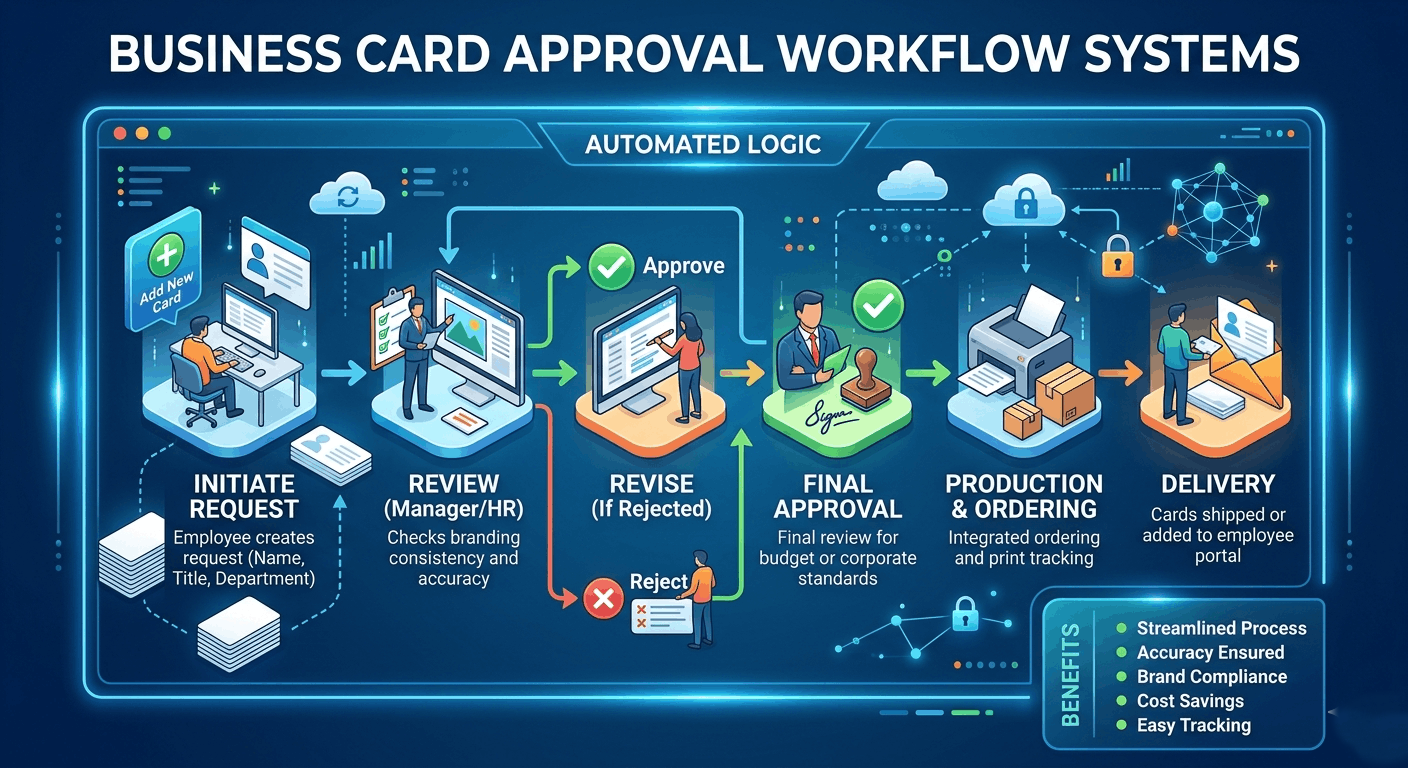
Modern approval workflow systems automate the movement of requests through predefined operational paths. Instead of relying on manual follow-ups or disconnected approvals, systems automatically route requests based on organizational structures, procurement policies, departmental rules, or management hierarchies.
Automated workflows typically include:
- Request submission
- Policy validation
- Approval routing
- Procurement coordination
- Production authorization
- Delivery tracking
- Reporting and audit logging
This automation creates standardized operational execution while improving visibility into every stage of the approval lifecycle.
Organizations gain centralized oversight into how requests are submitted, approved, processed, and fulfilled across the enterprise.
Benefits of Workflow Automation
Workflow automation improves enterprise operational execution by reducing manual coordination and increasing organizational visibility.
1. Faster Approval Cycles
Automated routing reduces delays caused by manual follow-ups, disconnected communication, and unclear approval ownership.
2. Improved Governance
Organizations can enforce approval rules consistently across departments, locations, and operational environments.
3. Better Procurement Oversight
Approval systems improve spending visibility, purchasing control, and vendor coordination.
4. Reduced Administrative Workload
Automation minimizes repetitive coordination tasks and reduces manual processing requirements.
5. Scalable Operational Control
Workflow systems can scale efficiently across enterprise teams, departments, and multi-location operations.
6. Improved Audit Visibility
Centralized systems create traceable approval histories that support compliance reporting and governance accountability.
How BCM Supports Approval Workflow Execution
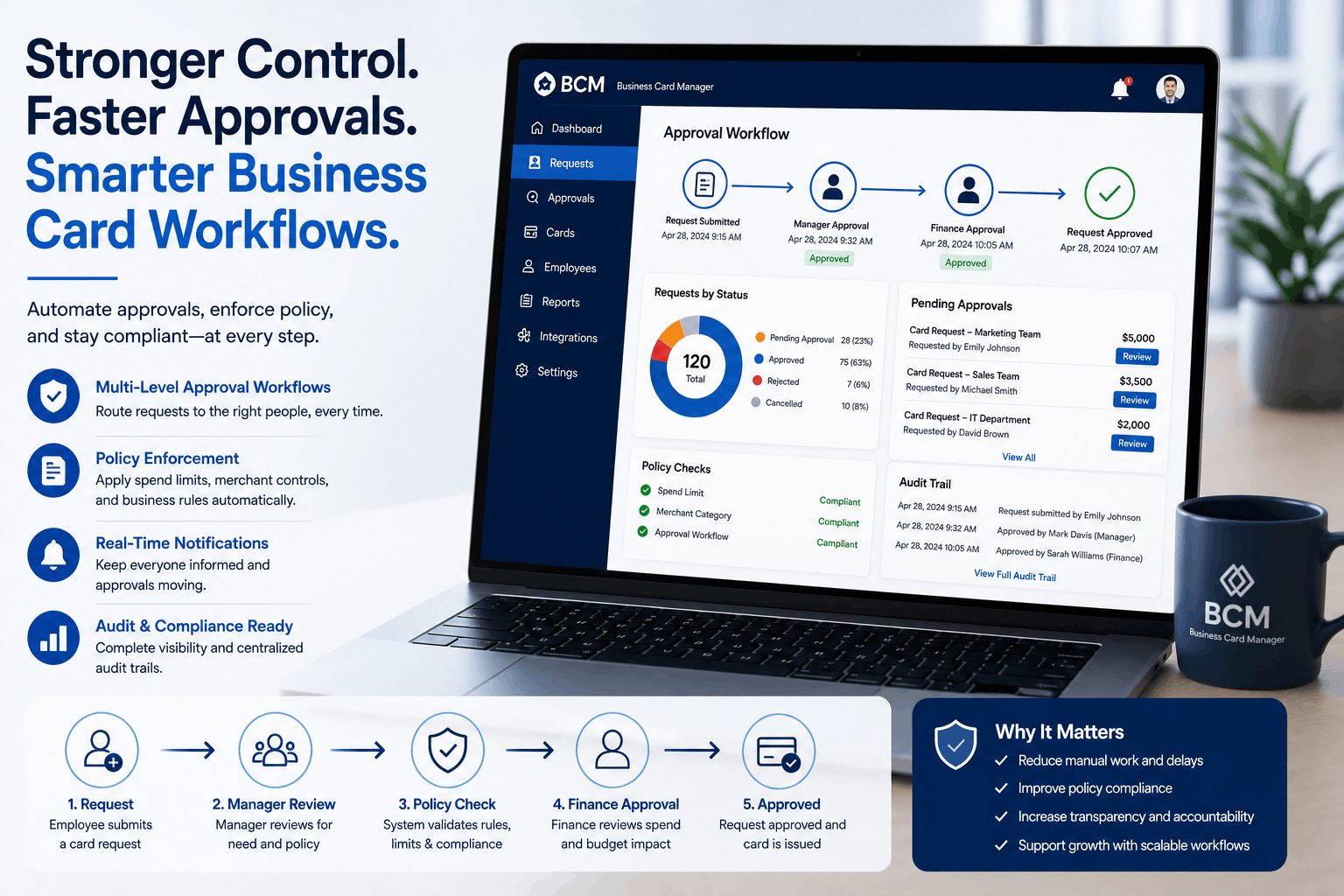
BCM provides a centralized workflow infrastructure designed specifically for enterprise ordering governance and operational execution. The platform automates approval routing while maintaining visibility into ordering activity, procurement workflows, administrative controls, and governance enforcement.
BCM enables organizations to:
- Automate approval routing
- Standardize ordering processes
- Enforce governance policies
- Improve operational visibility
- Coordinate procurement workflows
- Maintain template control
- Scale workflows across departments
- Improve reporting consistency
This centralized infrastructure helps enterprises reduce workflow fragmentation while improving operational coordination across complex organizational environments.
Workflow Integration With Enterprise Systems
Enterprise workflow systems often require integration with broader operational infrastructure to support scalable governance execution.
Common integrations include:
- HRIS systems for employee synchronization
- ERP systems for procurement workflows
- CRM systems for sales team coordination
- Identity systems for permissions management
- API-based automation environments
- Vendor management systems
These integrations help create centralized workflow execution while reducing disconnected operational processes and administrative duplication.
Integrated systems improve operational consistency because employee data, procurement activity, approvals, and reporting remain synchronized across the enterprise infrastructure.
What Enterprises Should Evaluate
When evaluating business card approval workflow systems, enterprises should focus on scalability, governance flexibility, workflow visibility, and integration architecture.
Important evaluation criteria include:
- Workflow customization
- Approval routing flexibility
- Integration capabilities
- Administrative visibility
- Audit reporting
- Procurement controls
- Role-based permissions
- Multi-location scalability
- Security and governance enforcement
- Operational reporting functionality
Organizations should prioritize systems capable of supporting long-term operational scalability rather than short-term process convenience.
How Approval Workflows Improve Governance
Approval workflow systems strengthen governance by creating standardized operational processes across enterprise teams and departments.
Organizations can:
- Standardize ordering rules
- Enforce approval requirements
- Reduce unauthorized purchasing
- Improve audit accountability
- Maintain procurement oversight
- Increase operational transparency
- Improve workflow consistency
This helps enterprises maintain operational control while improving workflow efficiency and governance visibility.
Conclusion
Business card approval workflow systems have become an essential operational layer for enterprise organizations managing large-scale ordering environments. Manual approval processes frequently create delays, inconsistencies, governance challenges, and operational inefficiencies that limit scalability.
BCM provides centralized workflow automation designed to improve approval execution, strengthen governance visibility, standardize enterprise ordering processes, and support scalable operational infrastructure across departments, teams, and enterprise environments.