

Why Centralized Business Card Data Is Critical for Enterprise Digital Transformation
Introduction
Enterprise digital transformation depends on trusted, governed, and connected information. Although organizations modernize ERP, CRM, HR, and identity systems, business card information is often overlooked despite being one of the most visible representations of enterprise identity.
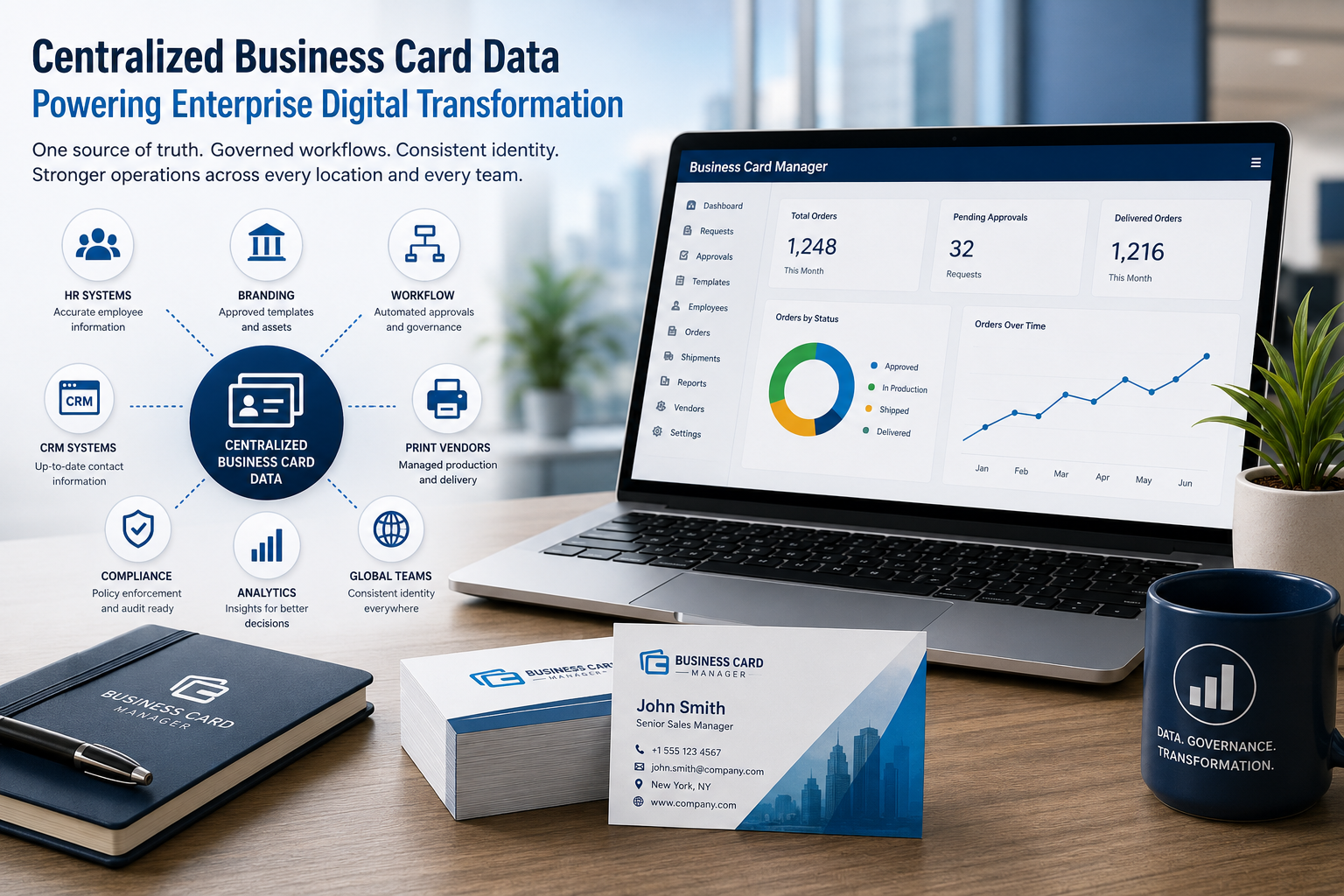
Business Card Manager (BCM) transforms business card information into a centralized enterprise asset that supports governance, workflow automation, operational efficiency, and brand consistency.
Digital Transformation Begins with Trusted Enterprise Data

Successful transformation initiatives rely on standardized information maintained by authoritative systems.
Manual business card ordering through emails, spreadsheets, and local vendors creates duplicate records, inconsistent branding, and disconnected operational processes.
BCM integrates business card provisioning into the enterprise data ecosystem, ensuring every printed card reflects approved employee information and corporate standards.
Business Cards Represent Enterprise Master Data
Business cards contain approved employee identity, department, office location, legal entity, branding, and regulatory information.
These fields should originate from governed enterprise systems rather than manual data entry.
BCM helps organizations maintain a single source of truth while standardizing employee identity across customer-facing communications.
The Cost of Decentralized Business Card Information
Fragmented ordering processes consume administrative time across HR, Marketing, Procurement, Finance, and Operations.
Incorrect information, duplicate orders, reprints, outdated branding, and missing audit trails create hidden operational costs.
BCM centralizes these activities into a governed workflow that improves visibility while reducing administrative effort.
Integrating Business Card Data with Enterprise Systems
BCM integrates with HR, CRM, ERP, Identity, and communication platforms so approved employee information automatically flows into business card provisioning.
Organizations eliminate duplicate data entry while ensuring that organizational changes, branding updates, and location changes are reflected in future orders.
Workflow Automation Removes Operational Friction
Configurable workflows replace fragmented email approvals with automated routing, notifications, and approval chains.
Requests are validated against enterprise policies before production begins, creating a predictable, auditable, and scalable business process.
Supporting Enterprise Organizational Complexity
Global enterprises manage multiple business units, brands, languages, countries, legal entities, and print vendors.
BCM supports regional flexibility while maintaining centralized governance, allowing multinational organizations to deliver consistent business identity worldwide.
Strengthening Enterprise Governance
Business cards communicate official corporate identity.
BCM ensures only approved templates, employee information, and branding assets are used while maintaining complete approval history, accountability, and governance across the business card lifecycle.
Improving Compliance and Audit Readiness
BCM records who requested, approved, produced, and fulfilled every order.
Centralized audit history simplifies compliance reviews and provides complete operational visibility for enterprise administrators.
Enabling Better Business Intelligence
Centralized reporting enables analysis of print volumes, onboarding completion, approval cycle times, vendor performance, regional demand, reprint frequency, and operational costs, supporting continuous improvement initiatives.
Business Card Manager as the Enterprise Conversion Engine
BCM acts as the operational conversion engine that transforms governed enterprise identity information into customer-facing business assets.
Rather than functioning as a simple print portal, BCM orchestrates approved data, workflows, branding, and production into a unified enterprise process.
The Relationship Between BCM and CCA
Color Card Administrator (CCA) provides governance, policies, templates, approval structures, and administrative control.
BCM executes those governance decisions through automated provisioning, workflow management, production coordination, reporting, and lifecycle visibility.
Preparing Enterprises for Future Digital Transformation
Centralized business card data establishes a foundation for AI, intelligent workflows, predictive analytics, digital workplace modernization, enterprise identity governance, and future operational automation initiatives.
Measuring Business Value Beyond Printing
Beyond reducing print costs, BCM accelerates onboarding, improves governance, standardizes branding, enhances procurement visibility, simplifies auditing, and strengthens enterprise identity across every customer interaction.
Why Enterprise Organizations Choose BCM
Organizations benefit from:
- Centralized identity management
- Workflow automation
- Configurable approvals
- Global template governance
- Salesforce integration
- Vendor management
- Analytics
- Audit history
- Scalability
- Governance-first architecture
Conclusion
Business card data is an important enterprise identity asset.
By centralizing information, integrating with enterprise systems, automating workflows, and aligning with CCA governance, BCM transforms business card provisioning into a secure, scalable, enterprise-ready operational process supporting digital transformation.