

Why CRM Integration Is Essential for Enterprise Business Card Management
Introduction
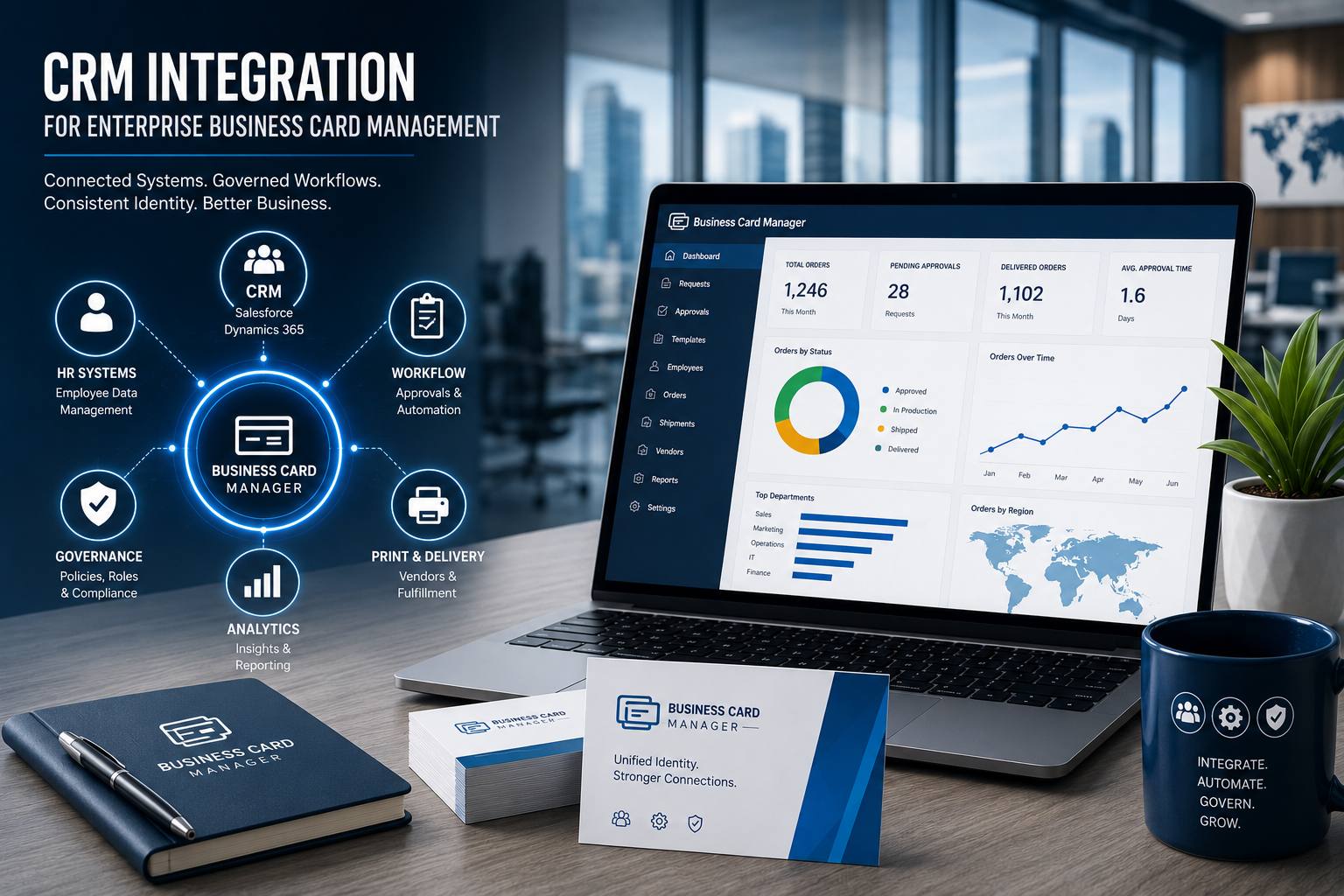
Customer Relationship Management platforms have become operational hubs for modern enterprises. Yet many organizations still manage business card provisioning through disconnected emails, spreadsheets, and vendor communications. Business Card Manager (BCM) integrates business card management into enterprise CRM platforms, creating governed workflows, centralized employee identity, and operational consistency.
CRM Has Evolved Beyond Sales Management

Modern CRM platforms coordinate sales, marketing, customer service, approvals, reporting, and enterprise integrations. Business card management should operate within this ecosystem rather than as an isolated administrative process.
Business Cards Represent Customer-Facing Identity
Business cards communicate corporate branding, employee identity, credibility, and customer trust. CRM integration ensures printed identity always reflects approved enterprise information.
Eliminating Duplicate Data Entry
BCM retrieves approved employee information from enterprise systems instead of relying on repeated manual entry, reducing errors, outdated information, and administrative effort.
CRM Integration Strengthens Enterprise Governance
Workflow approvals, employee validation, branding standards, procurement visibility, and auditability become centralized and governed through CRM-integrated processes.
Workflow Automation Through CRM Integration
Automated workflows:
- Validate employee information
- Route approvals
- Assign templates
- Coordinate vendors
- Track fulfillment
- Notify stakeholders
These workflows replace fragmented manual activities.
Standardizing Enterprise Identity
BCM maintains centralized template governance while supporting regional flexibility, ensuring consistent employee identity and branding across all offices.
Improving Operational Visibility
Centralized reporting provides insight into:
- Order volumes
- Approval times
- Vendor performance
- Onboarding completion
- Regional demand
- Operational costs
Supporting Global Enterprise Operations
BCM supports multinational organizations through:
- Localized templates
- Languages
- Legal entities
- Regional vendors
- Enterprise-wide governance
Enhancing Compliance and Auditability
Complete lifecycle audit history documents:
- Requests
- Approvals
- Production
- Fulfillment
- Policy compliance
This supports governance and regulatory readiness.
Delivering a Better Employee Experience
Employees request business cards through familiar enterprise systems with prefilled information, transparent approvals, and shipment tracking.
Business Value Beyond Integration
Organizations benefit from:
- Reduced administration
- Improved data quality
- Faster provisioning
- Stronger governance
- Enhanced customer confidence
- Enterprise scalability
Business Card Manager as the Enterprise Conversion Engine
BCM converts governed enterprise identity data into production-ready business cards through workflow orchestration, approved templates, and centralized operational control.
BCM and CCA: Governance and Execution
- CCA defines governance, policies, approvals, and administrative controls.
- BCM executes automated provisioning, production, reporting, and lifecycle management.
Preparing for the Next Generation of Enterprise Operations
Centralized business card management supports:
- AI
- Intelligent automation
- Digital workplaces
- Enterprise identity governance
- Analytics
- Future digital transformation initiatives
Why Enterprises Continue Choosing BCM
BCM offers:
- Salesforce integration
- Centralized identity management
- Workflow automation
- Template governance
- Global vendor management
- Analytics
- Audit history
- Scalability
- Governance-first architecture
Conclusion
CRM integration transforms business card provisioning into a governed enterprise identity process. Together, BCM and CCA deliver centralized administration, operational efficiency, workflow automation, and consistent corporate identity across global organizations.