

Centralized Business Card Management vs. Decentralized Ordering: Which Model Supports Enterprise Growth?
Introduction
Enterprise organizations continuously evaluate operational models that improve governance, reduce administrative complexity, and support long-term growth. Processes that function adequately for small organizations often become inefficient as enterprises expand across multiple locations, business units, legal entities, and international markets.
Business card management is one such process.
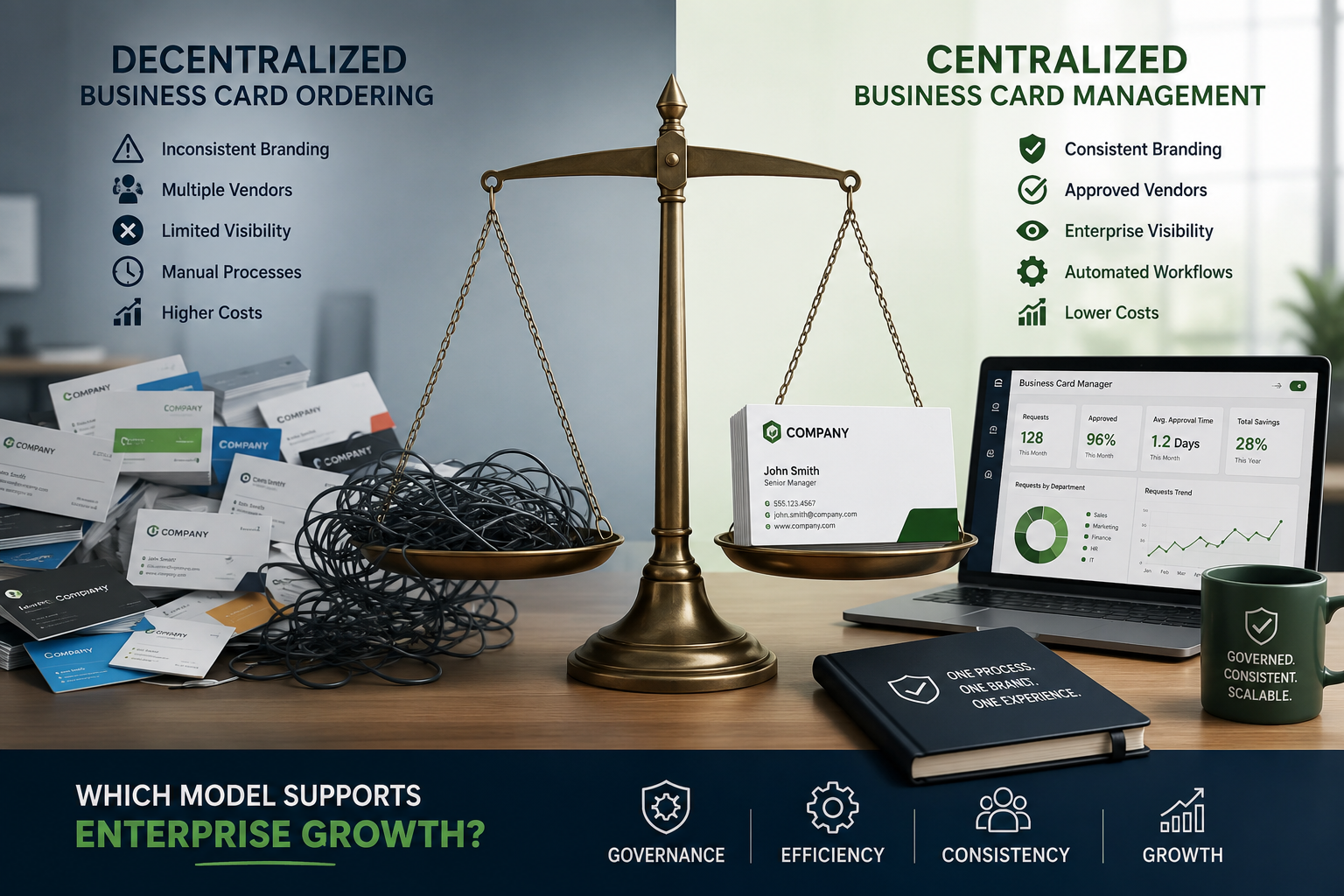
Many organizations continue to rely on decentralized ordering methods where individual departments, regional offices, or local administrators independently manage business card requests. While this approach may appear flexible, it frequently introduces inconsistent branding, duplicate administrative work, fragmented vendor relationships, and limited operational visibility.
As enterprises grow, these inefficiencies become increasingly difficult to control.
Centralized Business Card Management provides an alternative model. Instead of allowing independent ordering across the organization, business card provisioning becomes a governed enterprise service supported by standardized workflows, centralized administration, policy-driven approvals, and integrated identity management.
Business Card Manager (BCM) enables organizations to transition from fragmented ordering practices to a centralized operating model that strengthens governance while improving employee experience and operational efficiency.
Understanding Decentralized Business Card Ordering
Decentralized ordering typically develops gradually as organizations expand.
Regional offices establish relationships with local print vendors.
Departments maintain their own templates.
Managers approve requests independently.
Marketing reviews branding only when requested.
Procurement has limited involvement.
Employees often contact vendors directly.
Initially, this approach appears efficient because individual teams can respond quickly to local requirements.
However, over time the enterprise loses visibility into the overall process.
Different departments begin following different procedures.
Multiple template versions emerge.
Vendor pricing varies significantly.
Brand consistency becomes difficult to enforce.
Operational reporting becomes fragmented.
The organization eventually manages dozens of independent business card processes rather than one enterprise workflow.
The Challenges of Decentralized Operations
While decentralized ordering offers local flexibility, it introduces enterprise-wide challenges.
Common issues include:
- Multiple template versions
- Inconsistent corporate branding
- Duplicate vendor relationships
- Variable print quality
- Different approval standards
- Limited procurement visibility
- Inconsistent employee identity
- Manual coordination
- Repeated data entry
- Limited reporting
Each issue individually may appear manageable.
Collectively, however, they increase administrative costs while reducing enterprise governance.
Organizations often underestimate these hidden operational expenses because responsibility is distributed across numerous departments.
What Is Centralized Business Card Management?
Centralized business card management establishes one enterprise process for provisioning business cards.
Rather than allowing multiple ordering methods, organizations define standardized governance that applies consistently across every department and location.
Business Card Manager centralizes:
- Employee identity
- Business card requests
- Template management
- Approval workflows
- Brand governance
- Vendor management
- Procurement visibility
- Reporting
- Compliance
- Lifecycle administration
This centralized architecture creates operational consistency while allowing controlled flexibility for regional business requirements.
Governance Becomes an Enterprise Capability
Centralization does not eliminate flexibility.
Instead, it introduces governance.
Business Card Manager enables organizations to define enterprise policies that automatically govern every request.
Employee identity originates from approved systems.
Templates are selected according to organizational rules.
Approvals follow predefined workflows.
Production occurs only through authorized vendors.
Operational history is retained for reporting and auditing.
Governance becomes part of everyday operations rather than a manual administrative responsibility.
Standardization Improves Enterprise Identity
Enterprise identity depends upon consistency.
Every employee should represent the organization using approved branding, accurate contact information, and standardized templates.
Decentralized ordering frequently produces inconsistent identity because individual departments maintain independent processes.
Business Card Manager standardizes customer-facing identity by synchronizing employee information from authoritative enterprise systems and applying centrally governed branding throughout the provisioning process.
Customers therefore experience one enterprise identity regardless of location.
Operational Efficiency Through Centralization
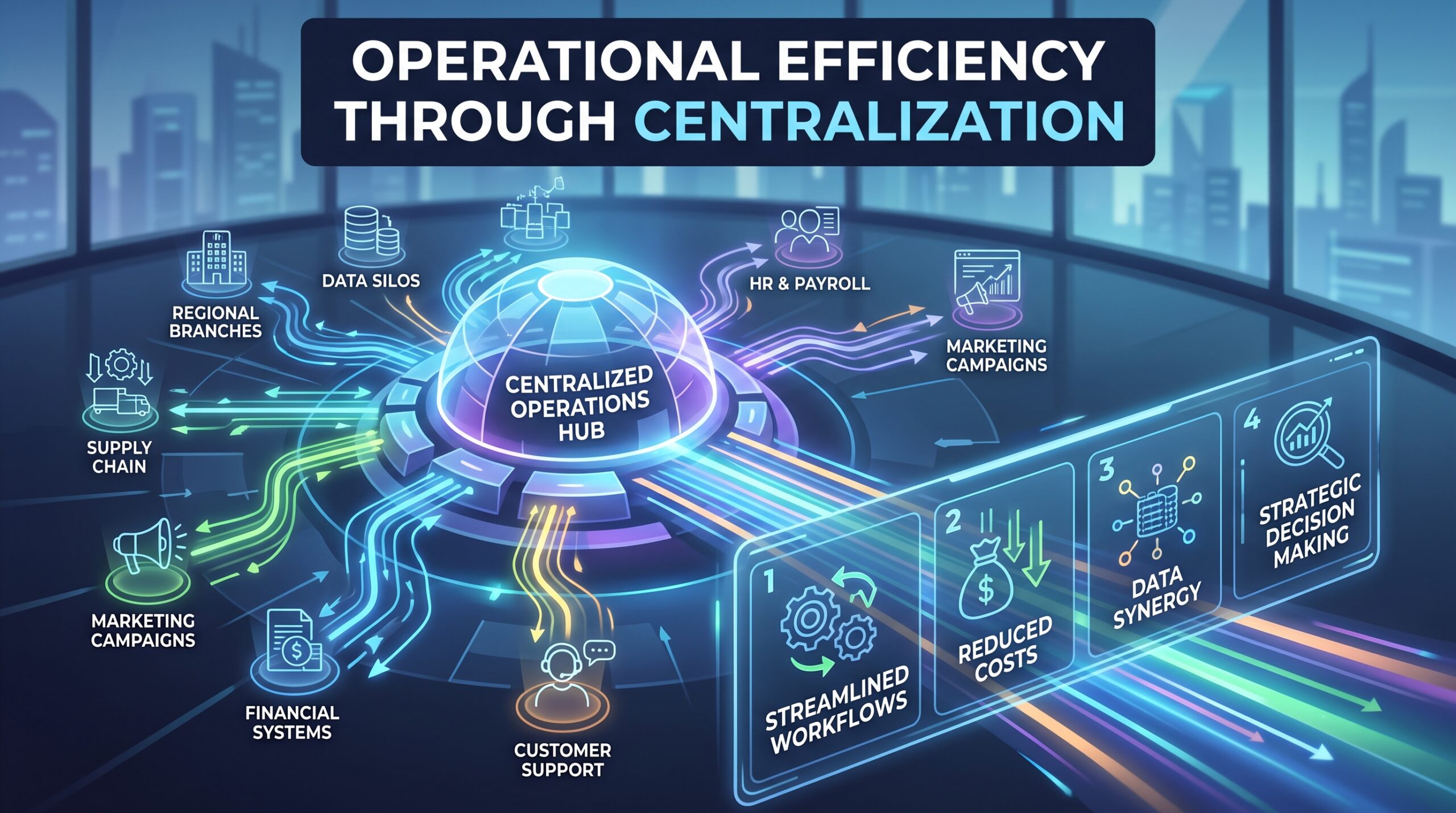
Manual coordination consumes valuable administrative time.
Employees repeatedly enter information.
Managers review routine requests.
Marketing validates templates.
Procurement manages multiple vendor relationships.
Business Card Manager automates these activities through centralized workflow automation.
Identity synchronization eliminates duplicate entry.
Approvals execute automatically.
Templates are assigned through policy.
Production follows standardized workflows.
Operational efficiency improves without sacrificing governance.
Business Card Manager as the Enterprise Conversion Engine
Enterprise governance establishes the policies that define how business identity should be managed, but governance alone does not produce operational outcomes.
Organizations require a platform capable of converting approved employee identity, branding standards, workflow policies, and procurement rules into consistent customer-facing business assets.
Business Card Manager (BCM) fulfills this role by acting as the enterprise conversion engine.
Rather than functioning as a simple online ordering portal, BCM orchestrates every stage of the business card lifecycle.
Employee identity is synchronized from trusted enterprise systems.
Templates are selected according to approved governance policies.
Workflow approvals execute automatically.
Authorized vendors receive validated production requests.
Production is monitored.
Delivery is tracked.
Operational history is retained for reporting, compliance, and continuous improvement.
By replacing fragmented local processes with centralized execution, BCM enables enterprises to manage business card provisioning as a strategic operational capability rather than an isolated administrative activity.
BCM and CCA: Governance and Execution Working Together
Successful enterprise operations depend upon a clear separation between governance and execution.
Governance defines the rules.
Execution applies those rules consistently throughout the organization.
Within the BCM ecosystem, these responsibilities are intentionally separated.
Color Card Administrator (CCA) functions as the enterprise governance platform.
CCA establishes:
- Enterprise policies
- Administrative permissions
- Brand governance
- Template ownership
- Approval hierarchies
- Vendor authorization
- Organizational controls
- Configuration standards
Business Card Manager (BCM) operationalizes these governance decisions through automated workflows.
BCM manages:
- Business card requests
- Employee identity synchronization
- Workflow automation
- Approval routing
- Template assignment
- Vendor coordination
- Production management
- Delivery tracking
- Operational reporting
- Lifecycle analytics
Together, BCM and CCA provide a governance-first architecture that supports enterprise growth while maintaining centralized administrative control.
Supporting Sustainable Enterprise Growth
As organizations expand through acquisitions, regional growth, international operations, and new business units, operational complexity increases significantly.
Processes that once relied on informal coordination become increasingly difficult to manage.
Centralized business card management supports sustainable growth by providing:
- Standardized enterprise workflows
- Centralized identity management
- Consistent corporate branding
- Unified approval policies
- Controlled vendor relationships
- Enterprise-wide reporting
- Scalable governance
Rather than creating additional administrative overhead, centralization allows organizations to expand while maintaining operational consistency.
Measuring the Business Value of Centralization
The value of centralized business card management extends far beyond printing efficiency.
Organizations implementing Business Card Manager frequently experience measurable improvements including:
- Reduced administrative workload
- Faster approval cycles
- Improved employee productivity
- Consistent enterprise branding
- Higher identity accuracy
- Better procurement governance
- Reduced reprint costs
- Improved compliance readiness
- Greater operational visibility
- Enhanced customer confidence
Collectively, these improvements contribute to enterprise operational excellence while supporting broader digital transformation initiatives.
Why Enterprises Choose Business Card Manager
Modern enterprises require more than a print ordering application.
They require a platform capable of integrating governance, workflow automation, employee identity management, procurement, and reporting into a unified operational framework.
Business Card Manager delivers these capabilities through an enterprise-first architecture.
Organizations benefit from:
- Centralized business card management
- Enterprise workflow automation
- Employee identity synchronization
- Multi-level approval workflows
- Enterprise template governance
- Multi-brand and multi-location support
- Vendor management
- Procurement visibility
- CRM and Salesforce integration
- Comprehensive audit history
- Operational reporting and analytics
- Enterprise scalability
Rather than treating business cards as printed stationery, BCM enables organizations to manage them as governed enterprise identity assets that support long-term growth.
Conclusion
As enterprises grow, decentralized operational processes become increasingly difficult to govern.
Business card management is no exception.
While decentralized ordering may initially appear flexible, it often introduces inconsistent branding, fragmented workflows, duplicate vendor relationships, limited reporting, and unnecessary administrative effort.
Centralized business card management provides a scalable alternative that strengthens governance while improving operational efficiency.
Business Card Manager enables organizations to centralize employee identity, automate approvals, standardize templates, integrate enterprise systems, and maintain complete lifecycle visibility.
Working together with Color Card Administrator (CCA), BCM transforms business card provisioning into a strategic enterprise capability that supports governance, operational excellence, digital transformation, and sustainable organizational growth.