

Beyond Printing: Why Business Card Management Is an Enterprise Workflow Challenge
Executive Summary
Business cards remain one of the most visible representations of an organization’s identity. However, in many enterprises, the processes supporting business card creation, approval, printing, and distribution continue to operate through fragmented workflows involving multiple departments, disconnected systems, and manual approvals.
While organizations have invested significantly in digital transformation initiatives across finance, procurement, human resources, and customer relationship management, business card management often remains an overlooked operational function.
The consequence is not merely administrative inefficiency. Poorly governed business card workflows contribute to inconsistent branding, delayed employee onboarding, procurement complexity, outdated identity information, and limited operational visibility.
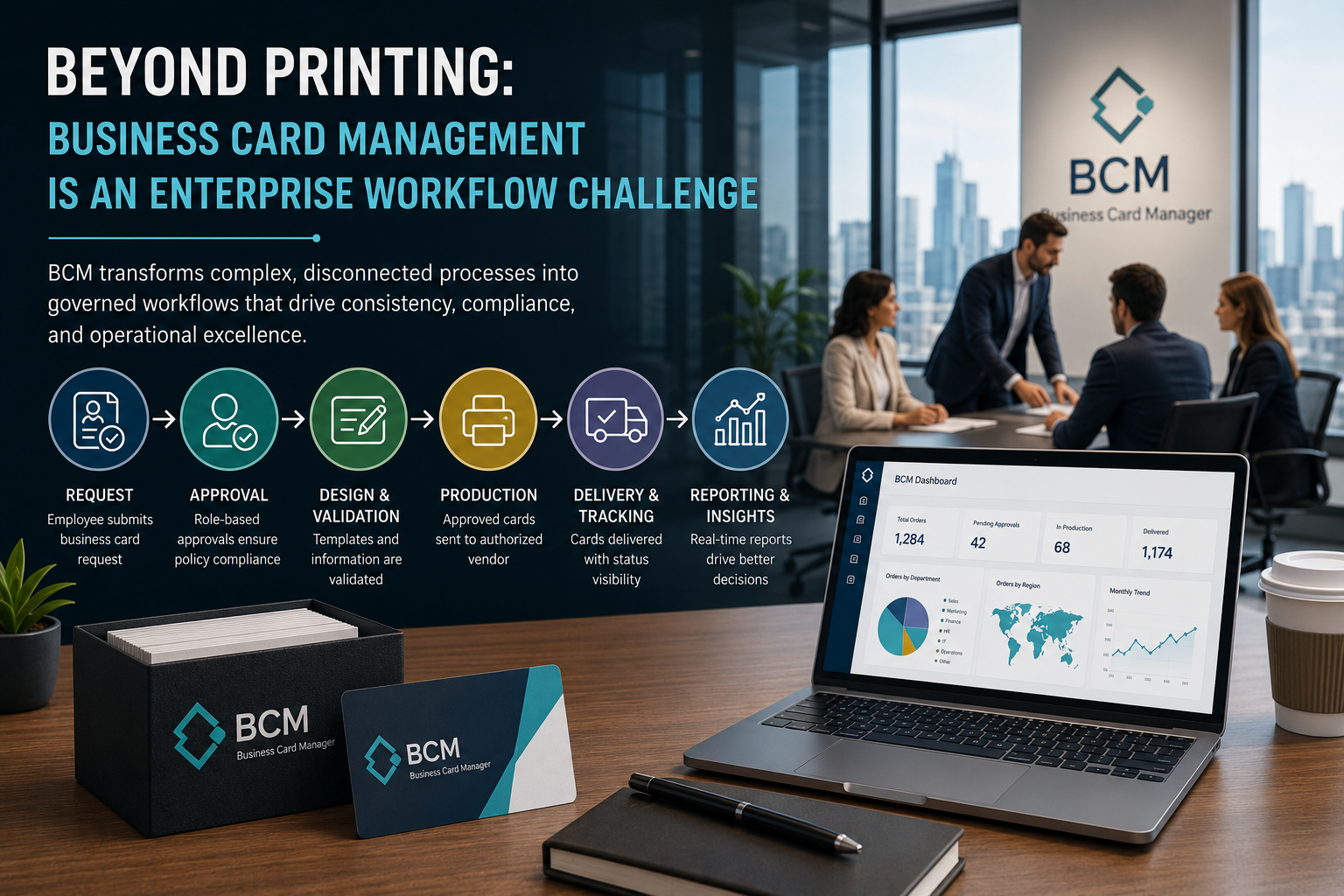
Business Card Manager (BCM) addresses these challenges by transforming business card management into a governed enterprise workflow. Through centralized approvals, policy-driven automation, template governance, vendor management, and lifecycle controls, BCM enables organizations to standardize one of their most widely distributed identity processes.
This article explores why enterprises should rethink business card management as a strategic workflow capability rather than simply a printing activity.
Introduction
Organizations rarely question the importance of workflow governance in mission-critical business processes.
Purchase orders follow approval chains.
Employee onboarding follows standardized procedures.
Expense claims are governed by corporate policies.
Contracts require legal review.
Financial transactions undergo multiple validation steps.
Each of these processes has evolved from manual administration into structured enterprise workflows because organizations recognized that consistency, transparency, and accountability create measurable business value.
Business card management deserves the same evolution.
For decades, business cards were viewed primarily as printed stationery. Employees submitted requests, managers approved them, marketing reviewed the design, and printing vendors fulfilled the order.
Although this approach worked adequately when organizations operated from a single office with relatively few employees, today’s enterprises are fundamentally different.
Global organizations manage thousands of employees across multiple countries, subsidiaries, brands, legal entities, and partner ecosystems. Every business card request may involve information originating from HR systems, procurement policies, corporate branding guidelines, regional legal requirements, and approved supplier networks.
When these activities remain disconnected, organizations experience unnecessary operational complexity.
Business card management therefore should no longer be viewed as a print process.
It is an enterprise workflow challenge.
The Hidden Workflow Behind Every Business Card
At first glance, ordering a business card appears simple.
An employee requests a new card.
A manager approves the request.
The printer produces the final product.
However, beneath this straightforward process lies a network of interconnected business activities that influence multiple departments.
Human Resources maintains employee information.
Marketing controls branding standards.
Procurement manages approved suppliers.
Finance monitors spending.
IT maintains employee directories.
Regional offices enforce country-specific requirements.
Corporate Communications ensures messaging consistency.
Legal departments review regulatory obligations in certain industries.
Each department contributes information or approvals that collectively determine whether the final business card accurately represents the organization.
Without centralized workflow management, these responsibilities often become fragmented across emails, spreadsheets, local templates, and independent print vendors.
The result is an operational process that lacks visibility, accountability, and consistency.
Why Manual Workflow Management Creates Enterprise Risk
Many organizations continue relying on manual coordination because business card requests appear relatively infrequent compared to other enterprise processes.
Yet, as organizations scale, manual workflows become increasingly difficult to sustain.
Common challenges include:
Inconsistent Approvals
Managers may apply different approval standards across departments, leading to inconsistencies in branding, employee information, or procurement practices.
Duplicate Administrative Effort
The same employee information is frequently entered into multiple systems, increasing the likelihood of errors while consuming valuable administrative time.
Limited Auditability
Email approvals rarely provide a complete audit trail. Organizations struggle to determine who approved a request, when changes were made, or which template version was used.
Delayed Fulfillment
Manual coordination between departments often extends turnaround times, particularly during onboarding or organizational restructuring.
Procurement Fragmentation
Independent purchasing across regions limits visibility into enterprise-wide spending and supplier performance.
Collectively, these challenges demonstrate that business card management is fundamentally a workflow problem rather than a printing problem.
Enterprise Workflow Requires Enterprise Governance
Effective enterprise workflows share several characteristics:
- Clearly defined responsibilities
- Standardized approval paths
- Automated validation
- Controlled exceptions
- Centralized reporting
- Measurable performance
- Continuous improvement
Business card management should follow the same principles.
Rather than allowing each department to create independent practices, organizations benefit from centralized governance that defines how requests are initiated, reviewed, approved, fulfilled, and reported.
Business Card Manager provides this governance by integrating business card management into the broader operational framework of the enterprise.
Instead of simply processing print orders, BCM orchestrates workflow activities that ensure every request complies with organizational policies before production begins.
Workflow Automation Improves Operational Efficiency
Automation does not eliminate governance—it strengthens it.
By automating routine activities, organizations reduce repetitive manual work while improving consistency and compliance.
Within BCM, workflow automation can support:
- Automated employee information validation
- Role-based approval routing
- Template selection based on department or geography
- Vendor assignment according to procurement policies
- Status notifications
- Approval reminders
- Order tracking
- Centralized reporting
Automation enables employees to receive business cards more quickly while reducing the administrative burden placed on marketing, procurement, and HR teams.
BCM as the Enterprise Workflow Orchestration Platform
Business Card Manager (BCM) extends beyond traditional business card ordering by acting as an enterprise workflow orchestration platform. Instead of managing isolated print requests, BCM coordinates the entire lifecycle of business card management through standardized, policy-driven workflows.
Every request follows a predefined governance model that ensures consistency across business units, regions, and subsidiaries.
This includes:
- Employee information validation
- Template selection
- Brand compliance verification
- Managerial approval
- Regional policy enforcement
- Vendor assignment
- Production tracking
- Delivery confirmation
- Reporting and analytics
By centralizing these activities, BCM eliminates fragmented processes and establishes a repeatable workflow that scales with organizational growth.
Rather than relying on manual coordination, enterprises gain a structured operating model that improves efficiency while maintaining governance.
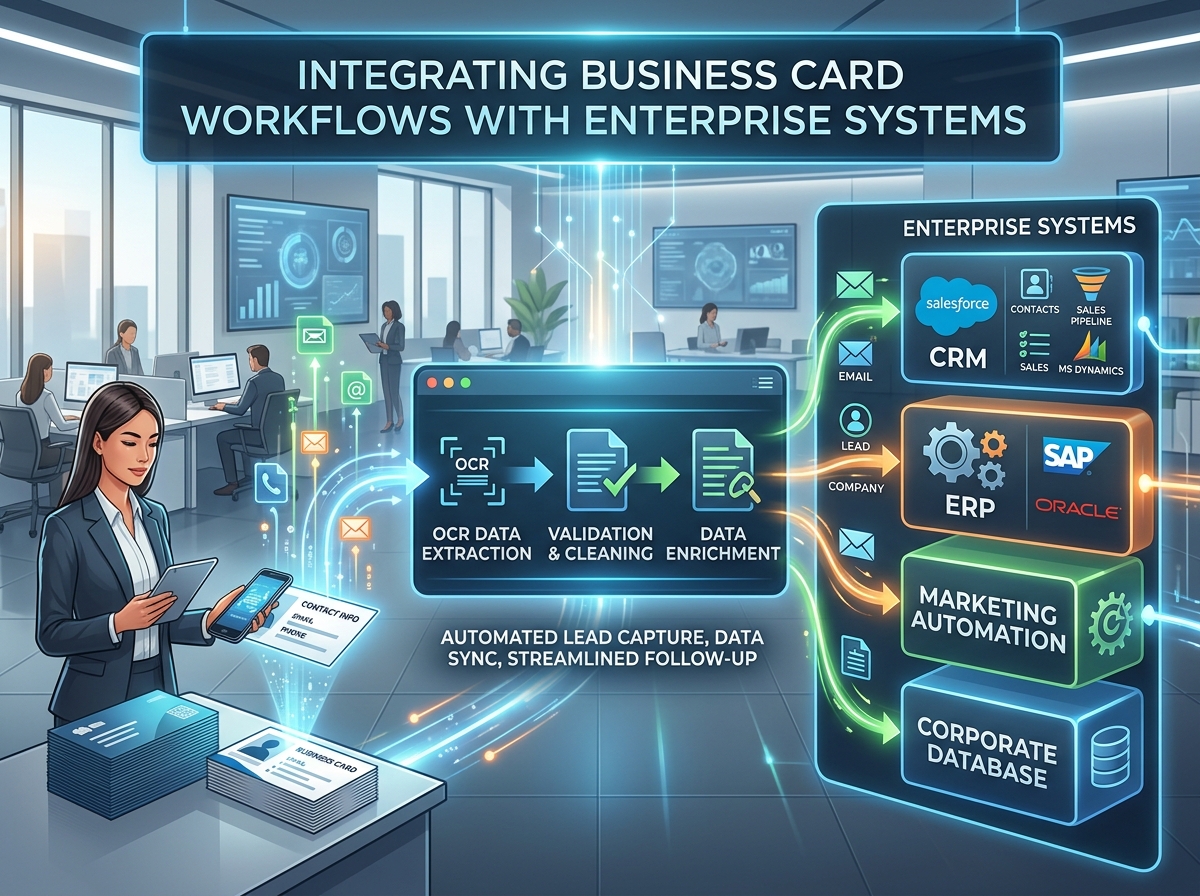
Integrating Business Card Workflows with Enterprise Systems
Business card management does not operate in isolation. It depends on information originating from multiple enterprise systems.
These typically include:
- Human Resource Information Systems (HRIS)
- Enterprise Resource Planning (ERP)
- Identity and Access Management (IAM)
- Procurement platforms
- Corporate directories
- Approval workflow engines
Without integration, employees must repeatedly enter the same information across multiple systems, increasing the risk of errors and delays.
BCM enables organizations to leverage existing enterprise data, reducing duplicate entry while improving data accuracy.
For example, when an employee receives a promotion, the updated title and department information maintained within the HR system can flow through governed workflows before business cards are produced.
This approach strengthens identity governance while minimizing administrative effort.
Supporting the Complete Employee Lifecycle
Business card management should evolve alongside employees throughout their careers.
Onboarding
New employees represent an organization’s brand from their first customer interaction.
BCM supports onboarding by enabling approved employee information to populate standardized business card templates automatically.
This reduces onboarding time while ensuring immediate compliance with corporate branding standards.
Career Progression
Employees regularly experience changes such as:
- Promotions
- Department transfers
- Office relocations
- Role changes
- Telephone updates
- Certification additions
Governed workflows ensure that these changes are reflected consistently across business card requests without requiring extensive manual coordination.
Offboarding
When employees leave the organization, centralized governance helps ensure that identity assets remain accurate and prevents unauthorized future business card requests.
This contributes to stronger operational control and improved enterprise security.
Procurement Workflow Optimization
Procurement departments seek transparency, consistency, and measurable performance across every purchasing activity.
Business card procurement should be no exception.
BCM supports procurement governance by enabling organizations to:
- Standardize approved print suppliers
- Consolidate enterprise purchasing
- Monitor supplier performance
- Improve pricing consistency
- Track regional spending
- Simplify contract management
Rather than managing independent vendor relationships across multiple offices, procurement teams gain centralized visibility into business card operations.
This not only reduces costs but also strengthens supplier governance and reporting.
Executive Reporting and Operational Intelligence
Workflow governance generates valuable operational data.
BCM transforms this data into actionable insights through centralized reporting and dashboards.
Executives can monitor:
- Business card orders by department
- Regional demand patterns
- Procurement expenditure
- Approval turnaround times
- Policy exceptions
- Vendor utilization
- Brand compliance metrics
These insights support strategic planning while demonstrating governance maturity across the enterprise.
Instead of relying on manually compiled spreadsheets, leadership teams gain real-time visibility into business card operations.
Business Card Management as Part of Digital Transformation
Digital transformation is about redesigning business processes to become more efficient, transparent, and scalable.
Business card management contributes to these objectives by replacing fragmented manual activities with standardized workflows.
BCM supports digital transformation by enabling organizations to:
- Eliminate repetitive administrative tasks
- Reduce approval delays
- Improve employee experience
- Strengthen compliance
- Increase operational transparency
- Support enterprise scalability
When integrated with broader governance initiatives, business card management becomes another building block within the organization’s digital operating model.
Looking Ahead: Intelligent Workflow Governance
As organizations continue investing in automation and analytics, workflow governance will become increasingly intelligent.
Emerging capabilities are likely to include:
- AI-assisted approval recommendations
- Predictive procurement planning
- Automated anomaly detection
- Intelligent template selection
- Enhanced reporting dashboards
- Workflow optimization through analytics
While these technologies improve efficiency, governance remains the foundation.
Organizations will continue defining policies, standards, and approval rules while automation accelerates execution.
BCM provides the governance framework upon which these future capabilities can be built.
Conclusion
Business card management is no longer a simple printing function.
For modern enterprises, it represents a complex workflow involving identity management, branding, procurement, approvals, compliance, and operational governance.
Organizations that continue relying on disconnected manual processes risk inconsistent branding, unnecessary administrative effort, procurement inefficiencies, and limited operational visibility.
Business Card Manager transforms these fragmented activities into governed enterprise workflows that improve efficiency while supporting broader digital transformation objectives.
By integrating standardized approvals, centralized template management, procurement governance, employee lifecycle integration, and executive reporting, BCM enables organizations to treat business card management as a strategic operational capability.
As enterprises continue modernizing their operations, workflow governance will increasingly define organizational excellence—and business card management should be part of that journey.