

Centralizing Business Card Governance: The Foundation of Enterprise Brand Consistency
For global enterprises, maintaining a consistent corporate identity is no longer simply a marketing objective—it is an operational requirement. Every customer interaction, employee communication, and corporate touchpoint contributes to how an organization is perceived. Among these identity assets, the business card continues to play an important role in establishing professionalism, credibility, and trust.
However, many organizations still manage business cards through decentralized processes involving regional templates, multiple print vendors, manual approvals, and disconnected workflows. While these approaches may satisfy immediate operational needs, they frequently result in inconsistent branding, procurement inefficiencies, outdated employee information, and limited governance.
Business Card Manager (BCM) addresses these challenges by providing a centralized governance platform for enterprise business card management. By standardizing templates, automating approvals, integrating employee data, and improving procurement visibility, BCM enables organizations to strengthen brand consistency while supporting broader digital transformation initiatives.
This article explores why centralized governance has become essential for enterprise brand consistency and how BCM helps organizations establish a scalable, policy-driven approach to managing one of their most visible identity assets.
Introduction
Enterprise branding extends far beyond logos and marketing campaigns.
It encompasses every interaction that represents the organization, whether through digital communications, customer meetings, sales engagements, supplier relationships, or executive presentations.
Business cards remain one of the few physical identity assets exchanged directly between employees and external stakeholders. Every business card therefore becomes a representation of the organization’s professionalism, operational discipline, and commitment to consistency.
Yet despite this importance, business card management often remains fragmented.
Regional offices maintain independent templates.
Departments coordinate directly with local print vendors.
Marketing teams manually review artwork.
Procurement negotiates separately across locations.
Employee information is updated independently by HR.
The result is a collection of disconnected processes rather than a unified governance framework.
As organizations expand globally, these inconsistencies become increasingly difficult to manage.
Centralized business card governance addresses this challenge by replacing fragmented operational practices with standardized enterprise processes that ensure every business card reflects the same corporate identity regardless of where it is produced.
Why Brand Consistency Matters at Enterprise Scale
Brand consistency is frequently associated with visual design.
In reality, it represents organizational discipline.
Customers expect consistency across every interaction with an enterprise.
This includes:
- Corporate logos
- Employee titles
- Contact information
- Typography
- Color standards
- Office addresses
- Legal disclaimers
- Regional branding requirements
Even small inconsistencies create uncertainty regarding organizational professionalism.
For multinational enterprises, maintaining consistent branding becomes increasingly complex due to multiple subsidiaries, regional offices, acquisitions, and country-specific regulatory requirements.
Without centralized governance, branding gradually diverges as individual departments introduce localized practices that fall outside approved corporate standards.
Over time, these inconsistencies dilute brand recognition and weaken customer confidence.
The Challenges of Decentralized Business Card Management
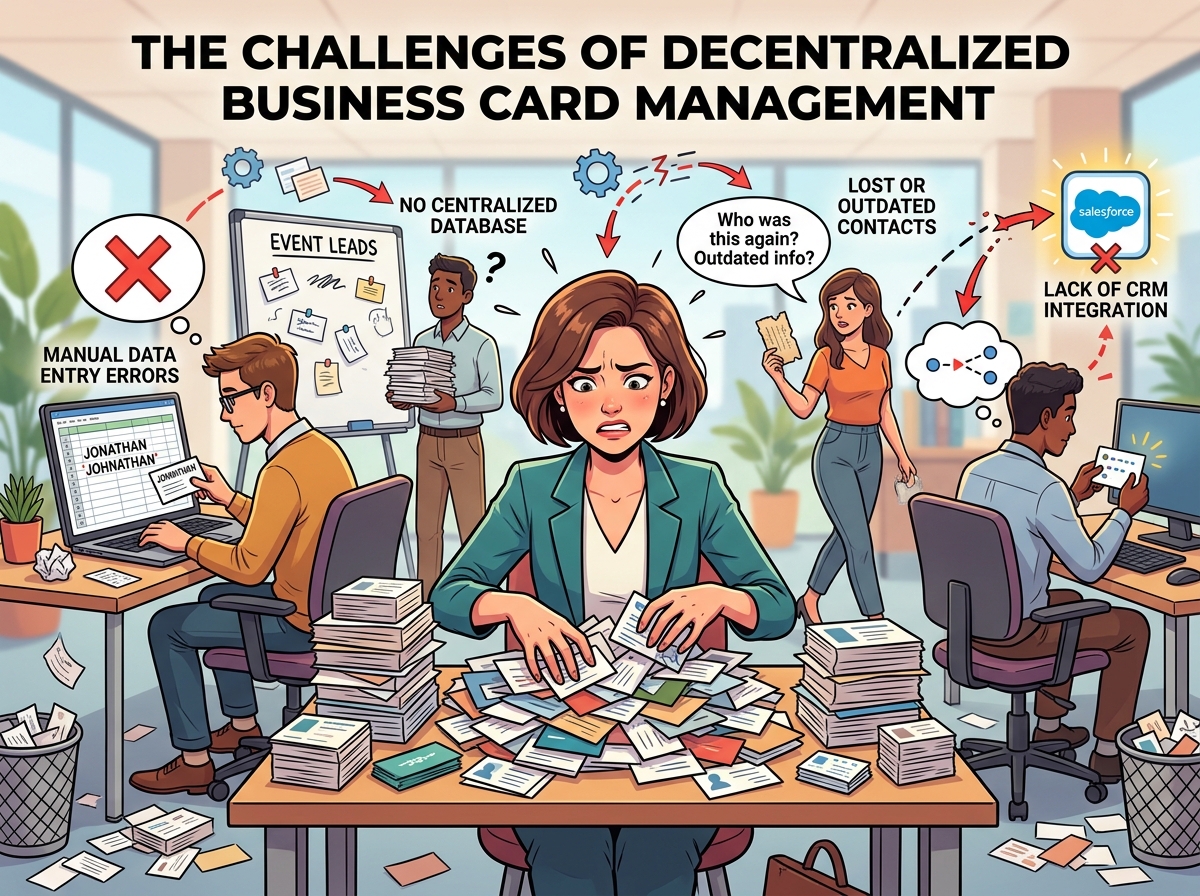
Many organizations underestimate the complexity associated with decentralized business card operations.
Common challenges include:
Multiple Template Versions
Departments frequently maintain separate template files.
Employees may unknowingly use outdated branding elements or obsolete layouts, resulting in inconsistent customer-facing materials.
Independent Vendor Relationships
Regional procurement often leads to multiple printing suppliers using different production standards, paper quality, color calibration, and pricing structures.
Manual Approval Processes
Email-based reviews consume valuable administrative time while making it difficult to track approvals or maintain audit history.
Outdated Employee Information
Job titles, phone numbers, office locations, and certifications change regularly.
Without centralized data integration, outdated information often reaches customers and business partners.
Limited Operational Visibility
Leadership teams frequently lack enterprise-wide insight into procurement spending, vendor utilization, approval performance, and policy compliance.
These operational inefficiencies increase administrative costs while reducing organizational agility.
BCM Enables Centralized Governance
Business Card Manager centralizes every stage of the business card lifecycle within a governed enterprise framework.
Instead of managing independent regional processes, organizations establish standardized policies that guide every request from initiation through fulfillment.
BCM supports:
- Centralized template management
- Policy-driven approval workflows
- Brand compliance verification
- Employee information synchronization
- Vendor governance
- Procurement visibility
- Enterprise reporting
- Audit history
This centralized approach enables organizations to achieve both consistency and scalability.
Supporting Enterprise Growth
As organizations grow, governance becomes increasingly important.
Business expansions, acquisitions, new regional offices, and workforce growth all increase operational complexity.
Centralized business card governance ensures that new employees, newly acquired organizations, and expanding business units operate within the same identity framework from the outset.
Rather than rebuilding processes repeatedly, organizations can scale existing governance models across the enterprise.
Procurement and Operational Benefits
Centralized governance also strengthens procurement performance.
Organizations benefit from:
- Reduced supplier duplication
- Improved purchasing visibility
- Standardized pricing
- Better vendor accountability
- Consolidated reporting
- Simplified contract management
These improvements contribute not only to cost optimization but also to stronger operational governance.
Conclusion
Enterprise brand consistency cannot depend upon decentralized operational practices.
Business cards remain important corporate identity assets that influence customer perception, employee professionalism, procurement efficiency, and regulatory compliance.
Business Card Manager enables organizations to centralize governance across every stage of the business card lifecycle, replacing fragmented processes with standardized, policy-driven workflows that support enterprise growth.
As organizations continue investing in digital transformation and governance initiatives, centralized business card management becomes an essential component of broader enterprise identity management strategies.