

Enterprise Procurement Meets Brand Governance: Why Business Card Management Requires a Unified Strategy
Procurement and branding are often viewed as independent business functions. Procurement focuses on cost optimization, supplier management, and operational efficiency, while branding emphasizes consistency, customer perception, and corporate identity.
However, business card management sits at the intersection of both disciplines.
Every business card ordered within an enterprise affects procurement spending, supplier relationships, employee identity, regulatory compliance, and brand consistency. Yet many organizations continue to manage these activities independently, creating fragmented workflows, inconsistent branding, duplicate vendor relationships, and limited enterprise visibility.
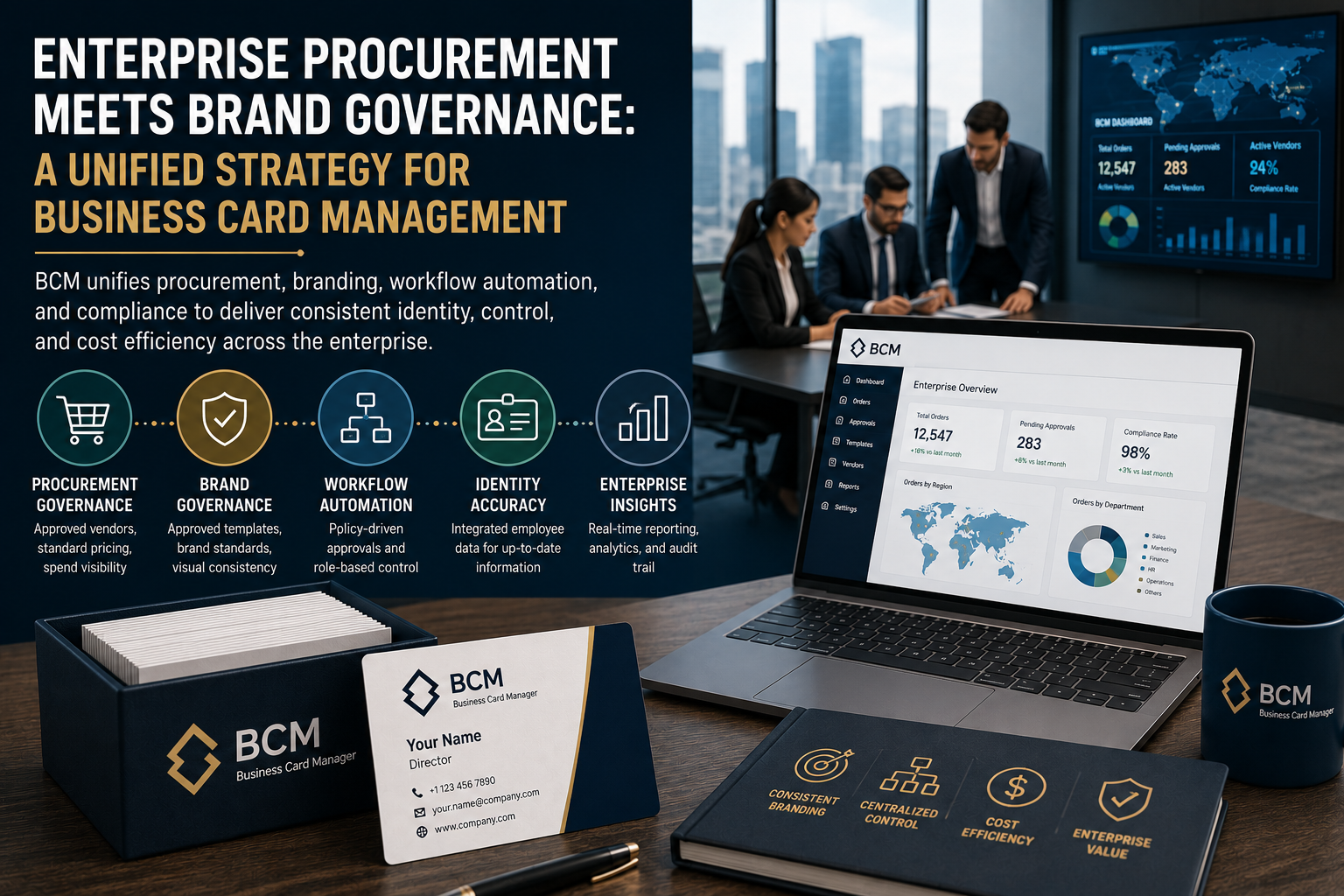
Business Card Manager (BCM) bridges this gap by integrating procurement governance with enterprise brand governance. Through centralized template management, policy-driven workflows, vendor governance, approval automation, and enterprise reporting, BCM enables organizations to manage business cards as strategic business assets rather than isolated procurement transactions.
This article explores why procurement and branding must operate together and how BCM provides a unified governance framework for enterprise business card management.
Introduction
Every enterprise invests significant resources in strengthening operational governance.
Procurement teams negotiate supplier contracts, monitor purchasing performance, and optimize organizational spending. Marketing teams develop brand standards that ensure every customer interaction reflects the organization’s identity. Human Resources maintains employee information, while IT supports enterprise systems that enable operational continuity.
Although these functions often collaborate, business card management frequently remains fragmented across departments.
Regional offices select local print vendors.
Marketing reviews artwork manually.
Procurement manages independent supplier relationships.
HR maintains employee records separately.
Employees submit requests through email or spreadsheets.
Finance processes invoices from multiple vendors.
Each department performs its responsibilities effectively, yet the overall process lacks centralized governance.
As enterprises expand globally, this fragmented approach becomes increasingly difficult to manage.
Business cards are no longer simply printed materials—they represent controlled identity assets that influence branding, procurement efficiency, operational governance, and customer trust.
Business Cards Connect Multiple Enterprise Functions
Unlike many operational processes that belong to a single department, business card management requires collaboration across several business functions.
Marketing ensures visual identity aligns with corporate standards.
Human Resources maintains employee information.
Procurement governs supplier relationships.
Finance monitors organizational spending.
IT supports workflow integration.
Regional leadership approves local requirements.
Legal may validate country-specific regulatory content.
Because multiple stakeholders contribute to a single business card request, governance becomes essential.
Without centralized coordination, organizations often experience duplicated effort, inconsistent decision-making, and unnecessary administrative overhead.
Business Card Manager provides a unified platform where each stakeholder contributes within a governed workflow while maintaining enterprise-wide visibility.
Procurement Without Brand Governance Creates Risk
Procurement teams are naturally focused on supplier performance, pricing, delivery timelines, and cost optimization.
While these objectives are important, procurement decisions that ignore branding can unintentionally introduce operational risk.
Examples include:
- Different paper quality across regions.
- Inconsistent logo reproduction.
- Color variations between suppliers.
- Unapproved template modifications.
- Variable printing standards.
Although these differences may appear minor individually, they collectively weaken enterprise brand consistency.
Customers rarely distinguish between regional suppliers—they experience only the organization’s brand.
Therefore, procurement decisions must operate within established branding policies.
Brand Governance Without Procurement Visibility Creates Inefficiency
The opposite scenario presents different challenges.
Marketing departments often focus exclusively on maintaining visual consistency.
However, when procurement operates independently across multiple regions, organizations may unknowingly maintain dozens of supplier contracts for essentially identical services.
This fragmentation results in:
- Duplicate negotiations.
- Inconsistent pricing.
- Limited purchasing leverage.
- Difficult vendor performance evaluation.
- Fragmented reporting.
Centralized procurement visibility enables organizations to optimize supplier relationships while preserving approved brand standards.
BCM Unifies Procurement and Brand Governance
Business Card Manager was designed to eliminate the traditional separation between procurement and branding.
Instead of treating these functions as independent activities, BCM establishes a governance framework that coordinates both disciplines through standardized workflows.
Core governance capabilities include:
- Enterprise-approved business card templates
- Automated approval workflows
- Vendor governance
- Procurement policy enforcement
- Employee information synchronization
- Brand compliance validation
- Enterprise reporting
- Complete audit history
This integrated approach enables organizations to improve both operational efficiency and brand consistency simultaneously.
Vendor Governance Improves Enterprise Control
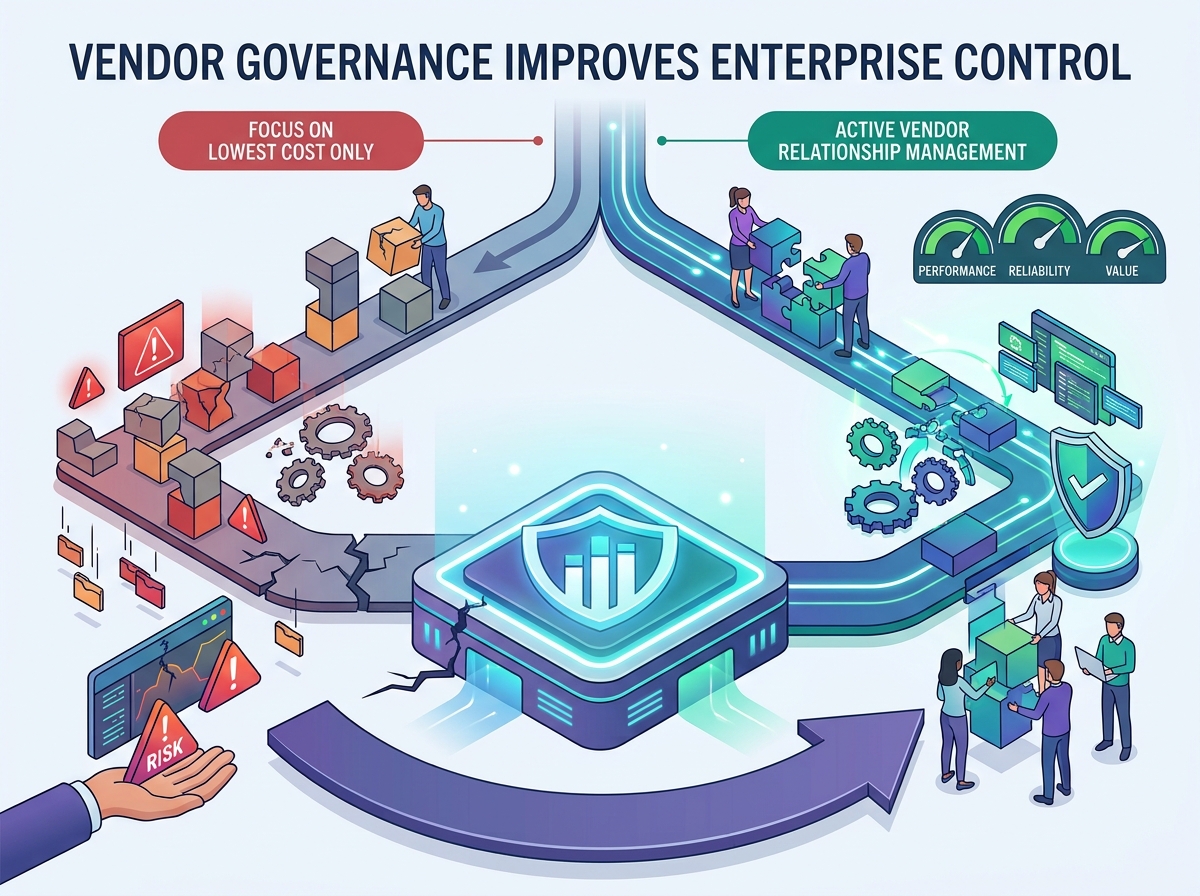
Managing supplier relationships extends beyond selecting the lowest-cost vendor.
Enterprise organizations require suppliers that consistently meet quality, branding, compliance, and service expectations.
BCM supports vendor governance by enabling organizations to:
- Maintain approved supplier networks.
- Monitor supplier performance.
- Standardize production quality.
- Improve pricing transparency.
- Consolidate purchasing analytics.
- Support strategic sourcing initiatives.
Rather than relying on independent regional purchasing decisions, organizations establish enterprise-wide procurement standards.
Workflow Automation Supports Procurement Excellence
Procurement governance becomes significantly more effective when supported by workflow automation.
BCM enables organizations to automate routine activities such as:
- Request routing.
- Template validation.
- Approval notifications.
- Vendor assignment.
- Order tracking.
- Status updates.
- Reporting.
Automation reduces manual administrative effort while ensuring that every procurement decision follows organizational policy.
This improves operational efficiency without sacrificing governance.
Enterprise Reporting Creates Strategic Visibility
Modern enterprises require measurable operational intelligence.
BCM provides reporting capabilities that allow leadership to monitor:
- Procurement spend by region.
- Vendor utilization.
- Order volumes.
- Approval turnaround times.
- Template adoption.
- Brand compliance.
- Policy exceptions.
- Operational trends.
These insights help organizations continuously improve procurement performance while strengthening governance across the business card lifecycle.
Digital Transformation Requires Integrated Governance
Digital transformation initiatives increasingly emphasize connected enterprise processes rather than isolated software applications.
Business card management should therefore integrate procurement, branding, workflow automation, and identity management within a unified governance framework.
BCM contributes to enterprise transformation by:
- Standardizing global processes.
- Reducing manual effort.
- Strengthening compliance.
- Improving procurement visibility.
- Supporting scalable governance.
- Enhancing employee experience.
The result is a more resilient and efficient operational model capable of supporting enterprise growth.
Conclusion
Business card management represents far more than purchasing printed materials.
It brings together procurement, branding, employee identity, operational governance, and customer experience.
Organizations that manage these functions independently often experience inconsistent branding, fragmented procurement, duplicated administrative effort, and limited operational visibility.
Business Card Manager provides a unified governance platform that aligns procurement excellence with enterprise brand governance, enabling organizations to achieve consistency, efficiency, compliance, and long-term operational scalability.
As enterprises continue investing in governance and digital transformation, integrating procurement with brand management will become an increasingly important competitive advantage.