

Business Card Management as an Enterprise Identity Infrastructure: Preparing Organizations for the Next Decade
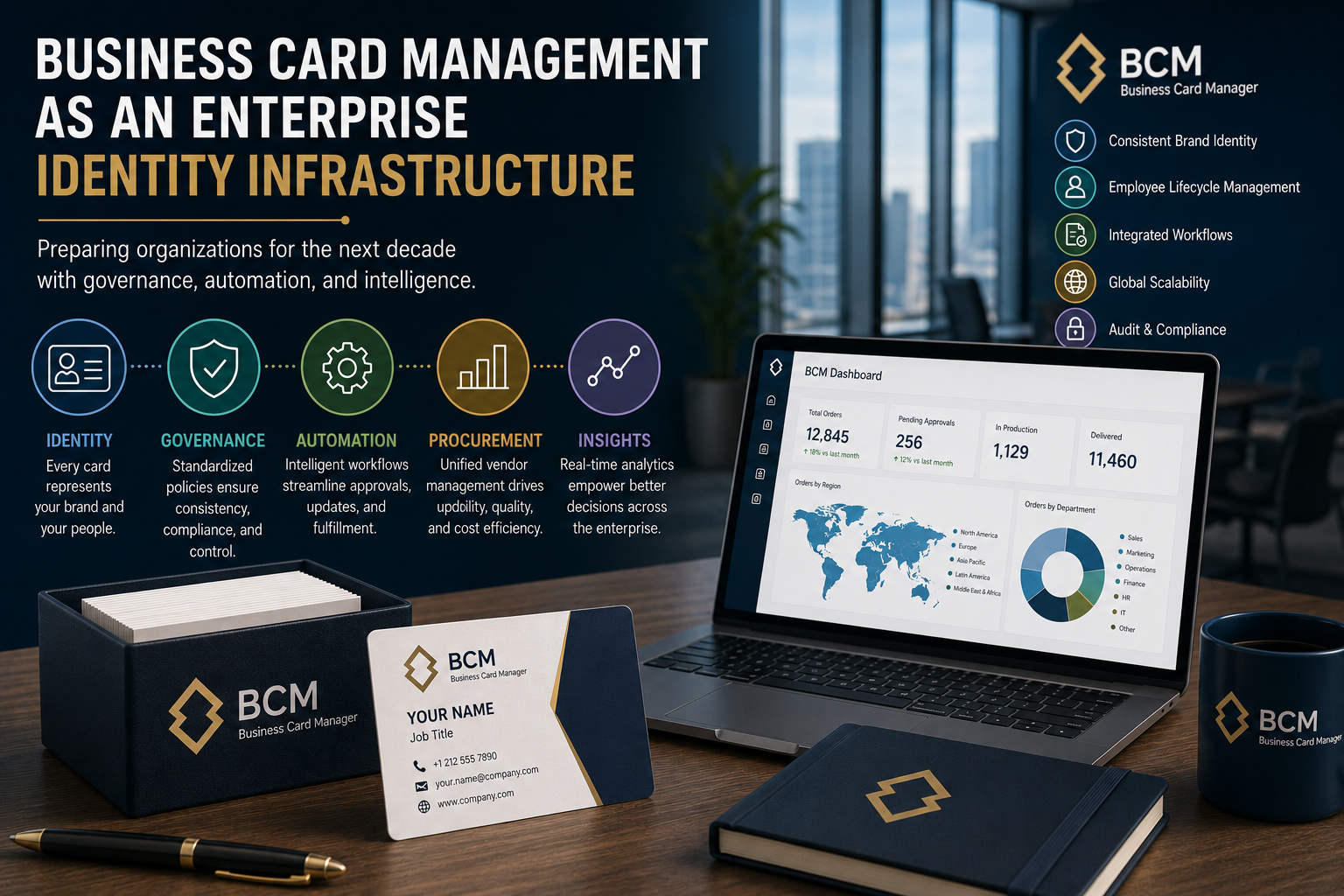
Digital transformation has fundamentally changed how enterprises manage information, employees, technology, and customer interactions. Organizations have invested heavily in enterprise resource planning (ERP), customer relationship management (CRM), human capital management (HCM), cybersecurity, identity and access management (IAM), and workflow automation. Yet one important component of corporate identity often remains managed through fragmented administrative processes—the business card.
Although frequently viewed as a simple printed asset, the business card represents a controlled extension of enterprise identity. Every card communicates organizational credibility, employee authority, brand consistency, and corporate professionalism. When managed without governance, inconsistencies in employee information, branding, procurement, and approval workflows introduce operational inefficiencies that extend far beyond printing costs.
Business Card Manager (BCM) redefines business card management by positioning it as enterprise identity infrastructure. Through centralized governance, lifecycle automation, procurement visibility, standardized workflows, and enterprise reporting, BCM enables organizations to manage business cards with the same discipline applied to other strategic identity assets.
This article explores why enterprises should begin treating business card management as critical identity infrastructure and how BCM prepares organizations for the operational demands of the next decade.
Introduction
Modern enterprises are built on interconnected systems.
Human Resources manages employee records.
Identity and Access Management controls user authentication.
CRM platforms maintain customer relationships.
ERP systems govern finance and procurement.
Collaboration platforms connect distributed workforces.
Every system contributes to the organization’s digital operating model.
Business card management, however, is frequently excluded from this ecosystem.
In many organizations, employees continue requesting business cards through email, spreadsheets, or local administrative processes. Regional offices maintain independent templates. Procurement negotiates separately with local suppliers. Marketing manually reviews artwork while HR independently updates employee information.
These disconnected activities create unnecessary complexity.
As organizations continue expanding globally, identity assets require the same level of governance as every other enterprise system.
Business cards therefore should no longer be considered standalone printed materials.
They should be managed as enterprise identity infrastructure.
Identity Infrastructure Extends Beyond Digital Systems
Enterprise identity is commonly associated with digital access.
Single Sign-On (SSO).
Multi-factor authentication.
Identity directories.
Role-based access control.
While these capabilities remain essential, organizational identity extends well beyond system authentication.
Employees represent the enterprise through:
- Email signatures
- Corporate directories
- Digital business profiles
- Employee portals
- Customer communications
- Printed business cards
Every identity asset contributes to how customers, suppliers, regulators, and partners perceive the organization.
Maintaining consistency across these touchpoints requires governance rather than isolated administration.
Business Card Manager extends enterprise identity governance into one of the organization’s most visible physical identity assets.
The Business Card Lifecycle Is an Identity Lifecycle
Every business card follows a lifecycle closely aligned with employee identity.
Employee Onboarding
New employees require business cards that accurately reflect their approved role, department, location, and contact information.
Automated template selection and governed approvals ensure consistency from day one.
Organizational Change
Employees frequently experience:
- Promotions
- Department transfers
- Office relocations
- Telephone updates
- Brand refresh initiatives
- Organizational restructuring
Without centralized governance, outdated business cards remain in circulation, reducing both operational accuracy and customer confidence.
Employee Offboarding
Business card governance should conclude when employment ends.
Organizations require processes that prevent unauthorized ordering while maintaining accurate historical records.
BCM manages this complete lifecycle through policy-driven governance.
Standardization Creates Enterprise Scalability
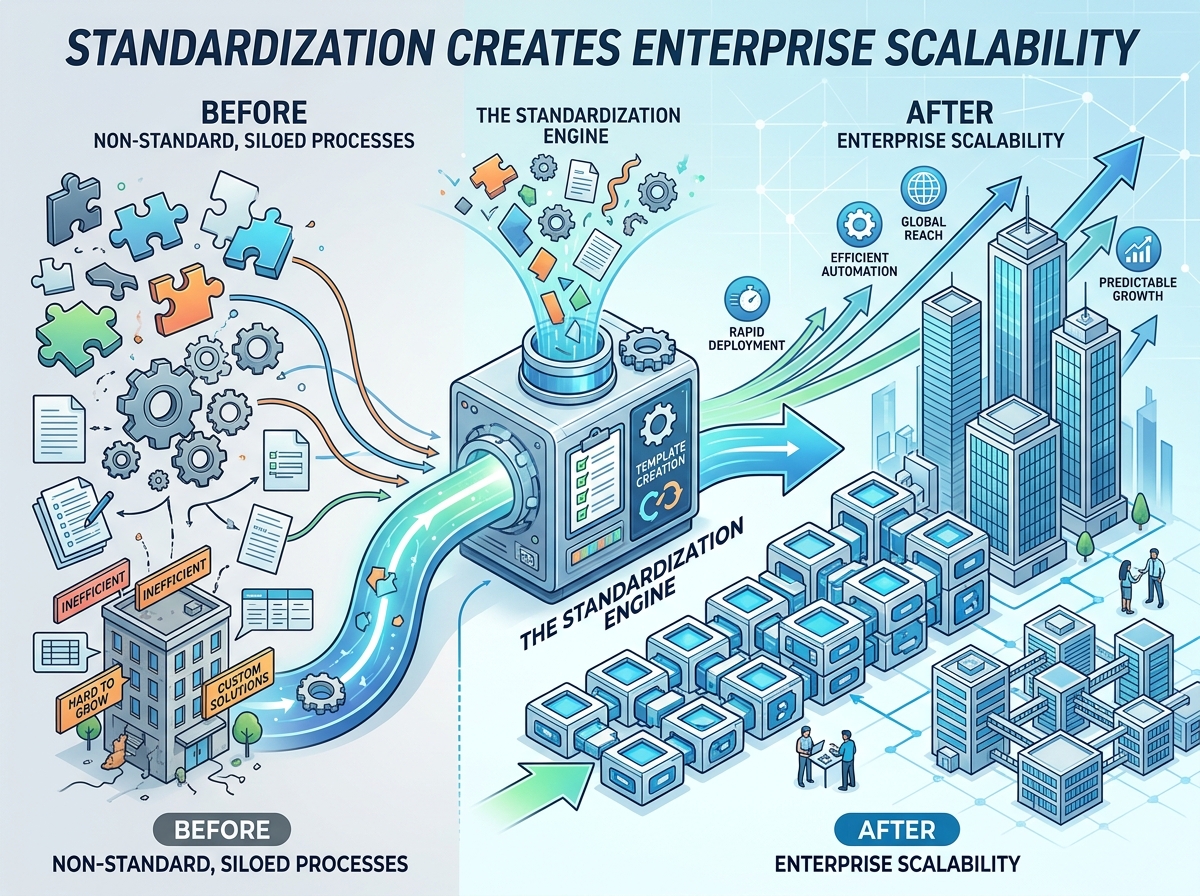
Enterprise growth introduces increasing operational complexity.
Organizations expand into new markets.
Acquire additional businesses.
Launch regional offices.
Introduce new product divisions.
Without standardized governance, every expansion introduces additional process variation.
BCM enables enterprises to scale through standardized operating models rather than rebuilding administrative processes for every new business unit.
Standardized governance supports:
- Consistent branding
- Uniform approval workflows
- Centralized reporting
- Shared procurement policies
- Enterprise-wide visibility
Scalability therefore becomes a product of governance rather than administrative effort.
Integrating Business Card Management into the Digital Workplace
The modern digital workplace depends upon connected enterprise workflows.
Business card management should integrate naturally with existing operational systems including:
- Human Resource Information Systems (HRIS)
- Enterprise Resource Planning (ERP)
- Identity and Access Management (IAM)
- Customer Relationship Management (CRM)
- Procurement platforms
- Corporate directories
Integration reduces duplicate data entry while improving consistency across enterprise identity systems.
Rather than operating independently, business card management becomes another governed component of the organization’s digital ecosystem.
Governance Strengthens Operational Resilience
Operational resilience depends upon standardized, repeatable processes.
Organizations capable of responding quickly to organizational change maintain stronger governance.
Examples include:
- Corporate mergers
- Brand refresh initiatives
- Regional expansion
- Regulatory changes
- Organizational restructuring
Without centralized governance, updating thousands of business cards becomes a manual coordination exercise involving multiple departments and suppliers.
BCM enables organizations to execute these changes through standardized workflows supported by centralized governance.
Procurement Becomes Strategic Rather Than Administrative
Procurement departments increasingly focus on long-term supplier partnerships rather than transactional purchasing.
Business card procurement benefits from this strategic approach.
BCM supports procurement governance by enabling organizations to:
- Maintain approved supplier networks.
- Monitor vendor performance.
- Standardize production quality.
- Improve pricing transparency.
- Consolidate procurement reporting.
- Reduce supplier duplication.
These capabilities contribute to stronger financial governance while supporting enterprise branding objectives.
Executive Visibility Drives Better Decisions
Enterprise governance requires measurable performance.
BCM provides leadership teams with operational intelligence including:
- Procurement expenditure
- Vendor utilization
- Order volumes
- Approval performance
- Regional demand
- Compliance metrics
- Policy exceptions
- Lifecycle analytics
These insights transform business card management from an administrative activity into a measurable business capability.
Preparing for the Next Decade
The future of enterprise identity management will increasingly combine automation, analytics, governance, and artificial intelligence.
Organizations will expect identity assets to update automatically following organizational changes while maintaining complete auditability.
Business card management will continue evolving through:
- AI-assisted approvals
- Intelligent template recommendations
- Predictive procurement analytics
- Automated lifecycle management
- Advanced compliance monitoring
- Enterprise-wide reporting dashboards
Organizations establishing governance today will be significantly better positioned to adopt these future capabilities.
Conclusion
Business cards remain one of the most visible representations of enterprise identity.
Managing them through fragmented administrative processes no longer aligns with modern governance expectations.
Business Card Manager enables organizations to treat business card management as enterprise identity infrastructure—integrating governance, workflow automation, procurement, compliance, and lifecycle management into a centralized platform.
As enterprises continue investing in digital transformation, organizations that govern identity consistently across every employee touchpoint will strengthen operational resilience, improve customer confidence, and create scalable foundations for future growth.