

SAP Ariba Business Card Ordering Integration For Procurement Teams
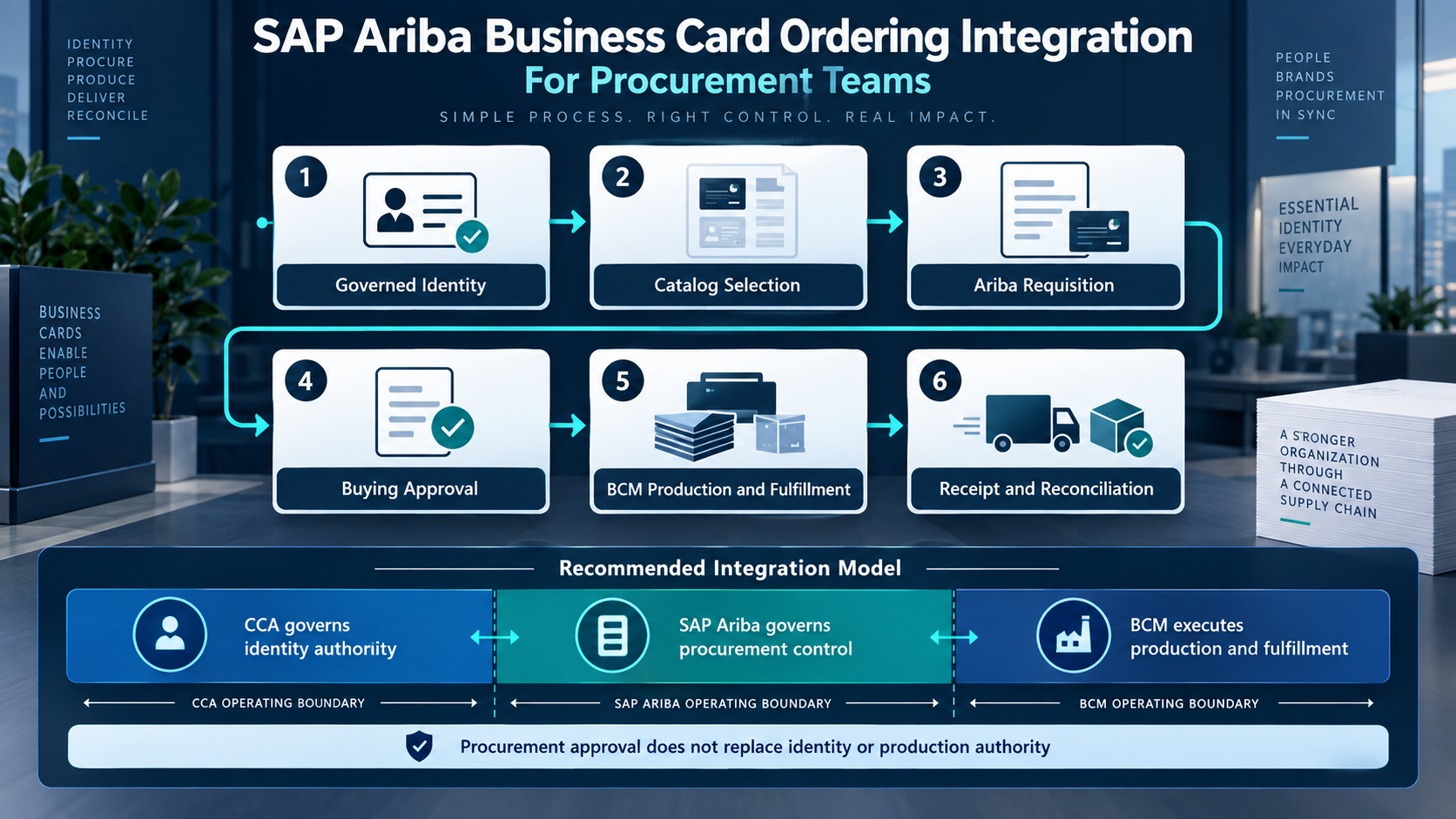
A governed integration model for catalogs, requisitions, purchase orders, suppliers, fulfillment, and reconciliation.
| SAP Ariba can govern catalogs, requisitions, approvals, purchase orders, suppliers, receipts, and invoices. CCA governs employee identity and presentation. BCM converts the approved identity specification into an order, controls production release, and returns fulfillment evidence. The integration must preserve these authority boundaries while maintaining one traceable commercial and operational transaction. |
SAP Ariba Can Connect Buying Policy to Business Card Execution
Business card orders look small when viewed one employee at a time. Across a large company, however, they involve recurring demand, multiple legal entities, delegated requesters, controlled catalogs, regional suppliers, shipping requirements, cost allocation, tax treatment, receipts, invoices, and reprints. Procurement teams need the same policy discipline and transaction evidence they expect from other enterprise purchases.
SAP Ariba can provide the buying context for this process through guided buying, catalog access, requisitions, approvals, purchase orders, supplier connectivity, receiving, and invoice controls. Business Card Manager (BCM) can convert an approved employee identity specification into an executable order and maintain operational status through production and delivery. Color Card Administrator (CCA), where deployed, remains responsible for identity authority, presentation rules, and exceptions.
The SAP SuccessFactors business card integration works when each platform keeps a defined responsibility. SAP Ariba governs how the organization buys and records spend. CCA determines who is eligible and what may appear on the card. BCM controls order construction, production release, supplier execution, and fulfillment evidence. A requisition or purchase order should never be treated as permission to alter an employee title, select an unapproved brand, or release a different production version.
Guided Buying Should Present Only Valid Business Card Choices
A guided buying experience is useful only when the choices reflect the employee and purchasing context. Entity, country, brand, language, work location, card family, quantity, finish, delivery destination, cost object, supplier contract, and service level can all affect eligibility. The requester should see a limited set of valid options instead of a free-text form or an unrestricted supplier catalog.
BCM can provide the governed product and order context behind those choices. CCA can supply the approved identity and presentation version. SAP Ariba can apply purchasing policy, catalog permissions, approval thresholds, and financial coding. The integrated result should preserve the exact catalog item, identity version, price basis, tax context, supplier route, and approval result used for the transaction.
Catalog Governance Must Extend Beyond Item Numbers
A business card governance catalog is more than a list of print products. Each item can represent a controlled combination of template, brand, language, paper, finish, quantity, supplier capability, region, currency, and delivery method. The same apparent item may require a different supplier, price, tax treatment, or production file for another entity or country.
Catalog synchronization should therefore use stable identifiers and explicit validity dates. When a template, contract, price, or supplier route changes, new requests should use the current version while released orders retain the earlier approved version. The integration should reject obsolete or incompatible combinations rather than silently substituting an item after approval.
Requisitions Need Identity and Commercial Context
The requisition should contain the commercial fields needed for procurement without copying every employee attribute into SAP Ariba. Useful fields may include a correlation identifier, requester, ordering entity, cost object, catalog item, quantity, price basis, currency, supplier, delivery location, required date, and reference to the approved identity version. Public identity details should be limited to what the purchasing and support process actually requires.
This separation protects privacy and makes changes easier to control. If an employee title or location changes while the requisition is pending, CCA can evaluate whether the identity specification remains valid. BCM can then update or cancel the order candidate according to policy. SAP Ariba can reapply commercial approval when the change affects item, price, cost allocation, supplier, tax, or delivery commitments.
A Six-Stage SAP Ariba Integration Workflow
| Stage | Governed action | Required evidence |
|---|---|---|
| 1. Establish request context | Identify employee, entity, card need, cost object, delivery requirement, catalog scope, and correlation identifier. | Validated business and purchasing context. |
| 2. Authorize identity | CCA validates eligibility, authoritative employee facts, presentation rules, timing, and exceptions. | Approved and versioned identity specification. |
| 3. Create Ariba requisition | Exchange eligible catalog item, quantity, supplier, price basis, currency, delivery, and financial coding. | Requisition linked to identity and BCM request. |
| 4. Complete buying approval | SAP Ariba applies approval, contract, supplier, cost, tax, and purchase order policy. | Approved commercial transaction and PO reference. |
| 5. Release and fulfill | BCM freezes the authorized order, releases production, and captures acceptance, shipment, and delivery. | Production and fulfillment evidence. |
| 6. Receive and reconcile | Return receipt and status data, match invoices, resolve variances, and close the audit trail. | Aligned operational and financial record. |
The following is a recommended integration model. It does not claim that BCM offers a released native SAP Ariba connector. The available APIs, catalog methods, transaction documents, authentication, permissions, licenses, supplier capabilities, regional requirements, and configured BCM and CCA architecture must be confirmed before implementation.
Approval Boundaries Must Be Explicit
SAP Ariba approval can confirm that a purchase follows company policy, uses an allowed supplier, carries a valid cost allocation, and stays within an approver threshold. That decision does not prove that the employee is eligible, that the public title is authorized, or that the production file matches the approved identity version. Those controls belong to CCA and BCM.
The release gate should require both forms of authority. BCM should release production only when identity authorization is current, and the commercial transaction has reached the required state. If either side changes, the workflow should hold the request, identify the affected decision, and preserve the earlier evidence instead of overwriting it.
Purchase Orders Need Transaction-Level Correlation
Companies may issue one purchase order per request, consolidate several employee orders, use a blanket purchase order, or buy against a catalog contract. Any of these models can work if each business card transaction retains its own correlation identifier. Procurement integration of teams must be able to trace an invoice line or credit back to the employee request, approved identity version, catalog item, supplier acknowledgement, shipment, and receipt.
BCM should record the purchase order or contract reference received from SAP Ariba and return operational status at the correct level. A consolidated purchase order must not collapse the distinct identity, delivery, cancellation, and reprint histories of individual employee orders. Transaction-level evidence allows finance to allocate costs and investigate variances without exposing unnecessary identity data.
Supplier Routing Should Follow Approved Contracts and Capabilities
A global organization may use strategic print suppliers, regional partners, specialist producers, or controlled backup routes. Supplier eligibility can depend on entity, country, brand, language, item capability, currency, tax registration, service level, delivery destination, sustainability requirements, and current contract status. SAP Ariba can govern supplier and contract eligibility while BCM applies production and fulfillment capability rules.
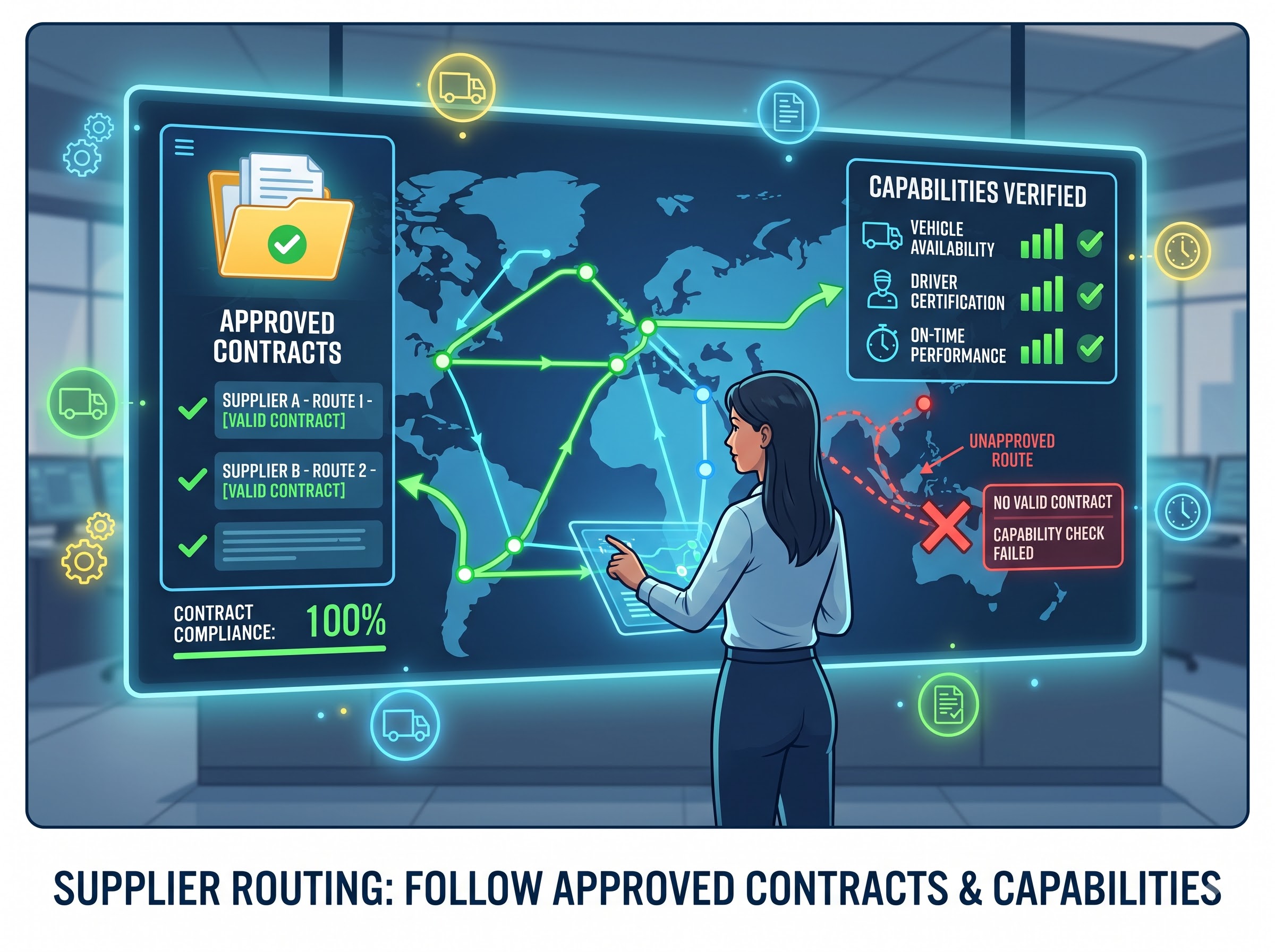
If a supplier rejects an order or cannot meet the required date, the workflow should not reroute automatically without review. The alternative may change price, tax, currency, shipping, production method, delivery promise, or required approval. BCM and SAP Ariba should revalidate the affected conditions and retain the rejection, decision, and replacement route in one audit trail.
Status Integration Must Distinguish Business Events
A single completed status is not enough for procurement oversight. Useful events include requisition submitted, approval pending, purchase order created, supplier accepted, production released, production completed, shipped, delivered, partially delivered, cancelled, failed, credited, and reprinted. Each event should include a stable transaction reference, event time, source, and reason where applicable.
The integration should process duplicate or out-of-order events safely. A delayed shipment update must not reopen a delivered order, and an API retry must not create a second purchase order. Idempotency keys, sequence rules, state validation, and exception queues help the platforms agree on the transaction state while preserving the original evidence.
Receiving and Invoice Reconciliation Must Reflect Fulfillment
Receipt policy should match the operating model. Some companies may record receipt when the supplier ships, while others require delivery confirmation or local acknowledgement. Partial shipments, multiple delivery addresses, failed deliveries, cancellations, credits, and reprints need explicit treatment. BCM can provide the fulfillment evidence that SAP Ariba and finance require for receiving and operational reconciliation.
Invoice matching should compare the approved quantity, price basis, currency, tax, shipping, supplier, receipt, credit, and reprint treatment. A variance should retain the original requisition, purchase order, supplier transaction, BCM release, and fulfillment events. Procurement can then determine whether the cause was catalog data, approval timing, supplier performance, delivery failure, or an authorized correction.
Exception Queues Need Named Owners and Recovery Rules
Typical exceptions include an invalid cost center, expired catalog item, closed accounting period, unsupported country, supplier rejection, price variance, missing purchase order, duplicate transaction, failed API call, delivery problem, invoice without receipt, or identity change after approval. Routing all exceptions to one mailbox hides urgency and responsibility.
Each exception type should have an owner, service target, escalation rule, required evidence, permitted correction, and restart point. Procurement may own commercial and supplier issues. Identity or brand owners may decide public presentation exceptions. BCM operations may manage production and fulfillment recovery. The workflow should resume only from a known valid state and should never bypass a required authority.
Buyer Intent Bridge for SAP Ariba Integration
Procurement teams evaluating a business card platform should ask how it exchanges catalog, requisition, approval, purchase order, supplier, receipt, invoice, and status information with SAP Ariba. They should also verify how it preserves transaction identifiers, prevents duplicate orders, handles consolidated purchasing, manages supplier substitutions, and supports entity, currency, tax, and regional requirements.
The evaluation should include the identity boundary. CCA should govern eligibility and public identity. BCM should execute the approved order and retain production and fulfillment evidence. SAP Ariba should govern buying policy and financial records. Buyers should request a field-level data map, event model, error-handling design, security model, retention plan, and proof that a procurement approval cannot override identity or production controls.
Implementation Priorities
Start with one entity, employee population, card family, supplier, currency, cost allocation pattern, and purchase order model. Define authoritative systems, stable identifiers, catalog ownership, field mappings, approval states, release conditions, status events, receipt logic, invoice references, exception owners, access controls, logging, and retention. Confirm the supported SAP Ariba interface and supplier transaction method for the selected scope.
Test new hires, title and location changes, invalid cost objects, expired prices, high quantities, unavailable items, rejected approvals, supplier substitution, purchase order delays, duplicate API events, partial shipments, delivery failures, cancellations, credits, reprints, and changes before and after release. Expand to additional entities and suppliers only after standard and exception paths produce traceable results.
Frequently Asked Questions
Can SAP Ariba initiate a governed business card order
Yes, a configured integration can use an approved catalog or requisition process to initiate the commercial request. CCA must still authorize the employee identity governance, and BCM must construct and release the matching production order.
Does an SAP Ariba purchase order authorize business card production
Not by itself. A purchase order can authorize spend, but BCM should release production only when the identity specification, catalog item, supplier route, timing, and commercial approvals are valid for the same order version.
How should SAP Ariba and BCM exchange order status
They should exchange defined business events with stable identifiers, timestamps, source systems, and reason codes. Duplicate and out-of-order events should be processed safely, and failures should enter a controlled exception queue.
Does BCM provide a native SAP Ariba connector?
This article describes a recommended integration model, not a claim of a released native connector. Feasibility depends on the available SAP Ariba interfaces, authentication, licenses, transaction methods, supplier capabilities, and the configured BCM and CCA environment.
Connect SAP Ariba Procurement Control to Governed Business Card Ordering
An effective integration gives procurement teams commercial control without weakening identity or production governance. SAP Ariba manages buying policy and financial records. CCA authorizes employee identity and presentation. BCM converts the approved specification into an order, releases production, and returns fulfillment evidence for reconciliation.
| Connect SAP Ariba Procurement Control to Governed Business Card Ordering
Explore how Business Card Manager can connect approved identity to SAP Ariba catalogs, requisitions, purchase orders, suppliers, fulfillment, and invoice reconciliation. Request an enterprise integration discussion at https://www.businesscardmanager.com/ |