

How Business Card Manager Supports HRIS-Connected Ordering Workflows
Introduction
Enterprise organizations increasingly rely on HRIS platforms to manage employee records, onboarding workflows, organizational structures, and identity information. As organizations scale, manually coordinating business card requests with employee onboarding processes creates operational inefficiencies, approval delays, duplicate data entry, and visibility challenges.
Business Card Manager (BCM) provides API-connected workflow infrastructure that enables organizations to connect business card ordering directly to HRIS environments. By integrating employee data, approval routing, procurement coordination, and operational reporting into a centralized workflow environment, BCM helps enterprises automate business card operations while improving governance, visibility, and operational consistency.
For enterprise organizations managing large employee populations, HRIS-connected ordering workflows reduce manual administration and help ensure business card operations remain synchronized with employee lifecycle events.
Why HRIS Integration Matters
Human Resource Information Systems serve as the source of truth for employee records across enterprise organizations. When business card ordering systems remain disconnected from HRIS platforms, teams often rely on manual processes to create requests, update employee information, and coordinate approvals. This creates operational friction and increases administrative workload. HRIS-connected workflow infrastructure ensures business card operations remain aligned with employee data throughout onboarding, transfers, promotions, and organizational changes.
The Problems With Manual Employee Data Management

Organizations that manually transfer employee information between systems frequently encounter data inconsistencies, delayed request processing, duplicate records, approval bottlenecks, and limited visibility. As enterprise organizations grow, these challenges become more difficult to manage and often result in operational inefficiencies that affect both employees and administrators.
How HRIS-Connected Ordering Workflows Operate
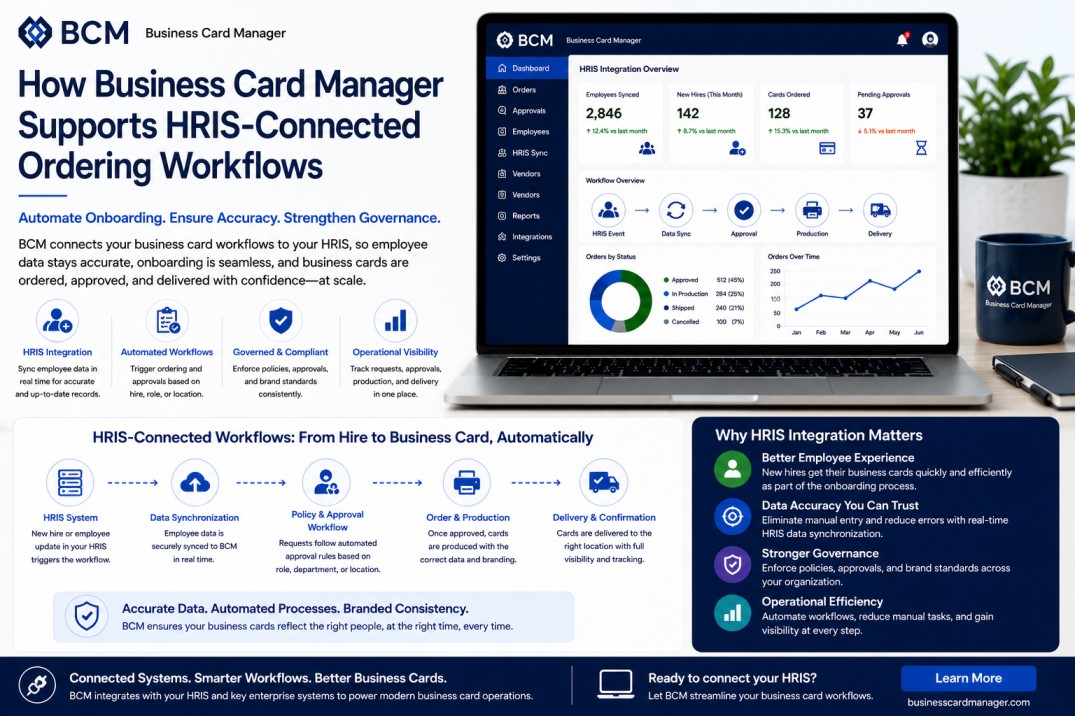
API-connected workflow infrastructure enables BCM to synchronize employee information directly from HRIS platforms. New employee records can automatically trigger business card workflows, route approvals, validate employee information, coordinate production, and update operational reporting systems. This creates a seamless workflow that reduces manual intervention while improving operational control.
For example, when a new employee is added to an HRIS system, the business card workflow can use approved employee data, route the request to the correct manager or department, apply template and brand rules, connect the order to procurement or cost center requirements, and provide visibility after fulfillment.
Employee Onboarding Automation
One of the most valuable use cases for HRIS integration is onboarding automation. When new employees are added to HRIS systems, organizations can automatically initiate business card ordering workflows. Employee data can be synchronized, approvals routed according to organizational policies, and fulfillment processes coordinated without requiring manual administrative effort.
How BCM Supports API-Connected HRIS Workflows
Business Card Manager acts as the execution layer for API-connected business card workflow infrastructure. BCM helps organizations centralize ordering, automate approvals, synchronize employee records, improve procurement visibility, and coordinate workflow execution across departments and locations. The platform is designed for organizations that need business card operations integrated with existing enterprise systems.
Enterprise Systems Commonly Connected Through BCM
Enterprise organizations often operate across multiple business systems. BCM supports integration strategies involving HRIS platforms, CRM systems, ERP environments, procurement systems, identity management platforms, operational reporting systems, and proprietary enterprise applications. These integrations help create a connected operational environment that improves workflow coordination and visibility.
Operational Visibility and Governance Benefits
HRIS-connected workflows improve operational visibility by providing greater insight into onboarding activity, approval routing, procurement coordination, vendor management, and fulfillment performance. Organizations gain stronger governance controls and improved reporting capabilities while reducing operational fragmentation.
What Enterprise Buyers Should Evaluate
When evaluating HRIS-connected business card workflow infrastructure, enterprises should prioritize API architecture, integration flexibility, employee lifecycle support, approval automation, procurement coordination, operational reporting, security controls, and scalability. The ability to integrate with both standard enterprise platforms and proprietary systems is increasingly important for large organizations.
Why this matters to HR and operations
HR teams need employee identity information to remain accurate during onboarding, title changes, transfers, and location updates. Operations and procurement teams need approval visibility, cost control, and vendor coordination. HRIS-connected ordering workflows help both groups reduce manual handoffs and keep business card activity aligned with the employee lifecycle.
Conclusion
HRIS-connected ordering workflows help enterprise organizations automate business card operations, reduce manual administration, improve operational visibility, and strengthen governance controls. BCM provides API-connected workflow infrastructure for business card ordering, approvals, reporting, and employee lifecycle integration.
Link a phrase like API-integrated enterprise business card governance to the related CCA governance article. BCM should point upward to CCA as the category authority.