

API-Connected Business Card Workflow Infrastructure Explained
Introduction
Enterprise organizations increasingly require API-connected business card workflow infrastructure that integrates directly with existing enterprise systems. As organizations grow, business card operations become connected to onboarding, procurement, approvals, compliance requirements, operational reporting, identity management, and vendor coordination.
Historically, business card ordering systems operated as standalone platforms. Employee information was manually entered, approvals were coordinated through email, procurement teams had limited visibility, and reporting was fragmented across departments. While this approach may work for smaller organizations, enterprise environments require a much higher level of operational coordination.
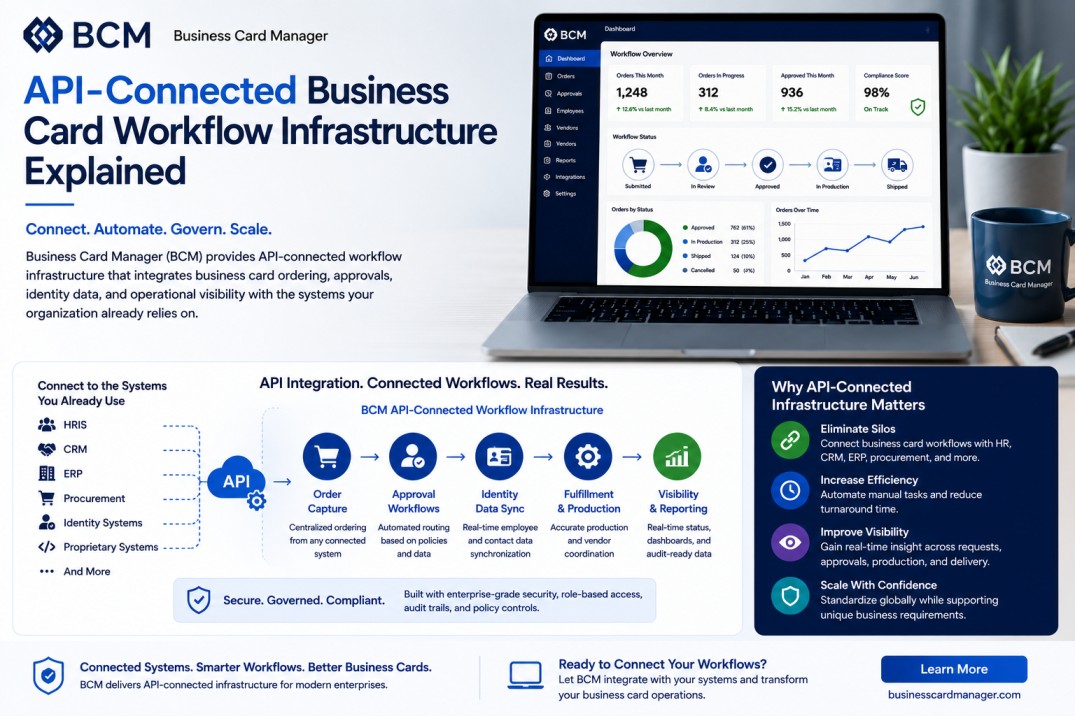
API-connected business card workflow infrastructure addresses this challenge by connecting business card workflows to the broader business systems ecosystem. Through integration with HRIS, CRM, ERP, procurement, identity management, and proprietary systems, organizations can create a centralized operational environment that improves governance, automation, visibility, and workflow execution.
Why Enterprise Organizations Are Moving Toward Connected Infrastructure

Modern enterprises operate dozens of interconnected business systems. Human resources teams manage employee records inside HRIS platforms. Finance teams rely on ERP systems. Procurement teams use purchasing and vendor management platforms. Identity teams manage employee access and lifecycle changes. When business card operations remain disconnected from these environments, organizations create unnecessary manual work and operational inefficiencies.
The Difference Between Standalone Tools and API-Connected Infrastructure
Standalone business card tools focus primarily on ordering. API-connected workflow infrastructure focuses on orchestration. Standalone tools require manual administration, duplicate data entry, manual approval routing, and separate reporting. API-connected infrastructure synchronizes employee information, automates approvals, supports procurement visibility, improves operational reporting, and enables enterprise workflow automation.
How API Integration Supports Enterprise Workflow Execution
API integration enables organizations to coordinate workflows across systems and departments. New employee records can trigger ordering workflows automatically. Department transfers can update information. Approval workflows can follow established governance policies. Procurement activity can be synchronized with ERP systems. Reporting systems can receive operational data in real time.
HRIS Integration and Employee Lifecycle Management
One of the most common enterprise requirements involves HRIS integration. Employee onboarding, role changes, department transfers, promotions, and terminations all impact business card operations. API-connected workflow infrastructure allows organizations to synchronize employee information directly from HRIS environments.
CRM, ERP, and Procurement System Connectivity
Enterprise organizations often require business card workflows to interact with sales, finance, and procurement systems. CRM integration helps align employee and customer-facing information. ERP integration improves procurement visibility and financial reporting. Procurement system integration supports vendor management, purchasing controls, and operational accountability.
Operational Visibility Through Connected Systems
Operational visibility is one of the strongest benefits of API-connected infrastructure. Organizations gain insight into requests, approvals, employee onboarding activity, procurement coordination, fulfillment status, vendor performance, and workflow execution.
How BCM Supports API-Connected Business Card Workflow Infrastructure
Business Card Manager serves as the execution layer for enterprise business card operations. BCM helps organizations centralize ordering, automate approvals, synchronize employee data, coordinate procurement workflows, improve operational reporting, and integrate business card operations with existing enterprise systems.
Enterprise Benefits of API-Connected Workflow Infrastructure
Organizations implementing API-connected workflow infrastructure often achieve operational improvements such as reduced manual administration, improved data accuracy, faster onboarding execution, stronger procurement visibility, enhanced governance controls, better operational reporting, increased workflow automation, and improved scalability.
What Enterprise Buyers Should Evaluate
When evaluating API-connected business card workflow infrastructure, enterprise buyers should examine API flexibility, integration architecture, onboarding automation capabilities, approval workflow support, reporting visibility, security controls, governance capabilities, procurement coordination features, and support for proprietary systems.
See how Business Card Manager supports centralized ordering, approval workflows, and API-connected business card execution across enterprise environments. Schedule a demo to learn how BCM integrates with HRIS, CRM, ERP, procurement, identity management, and proprietary business systems.