

ADP Workforce Now Business Card Ordering API Integration vs Employee File Transfers
Compare API, employee file, and hybrid delivery patterns for an ADP Workforce Now to BCM workflow. Assess source access, receiving controls, readiness, and support.
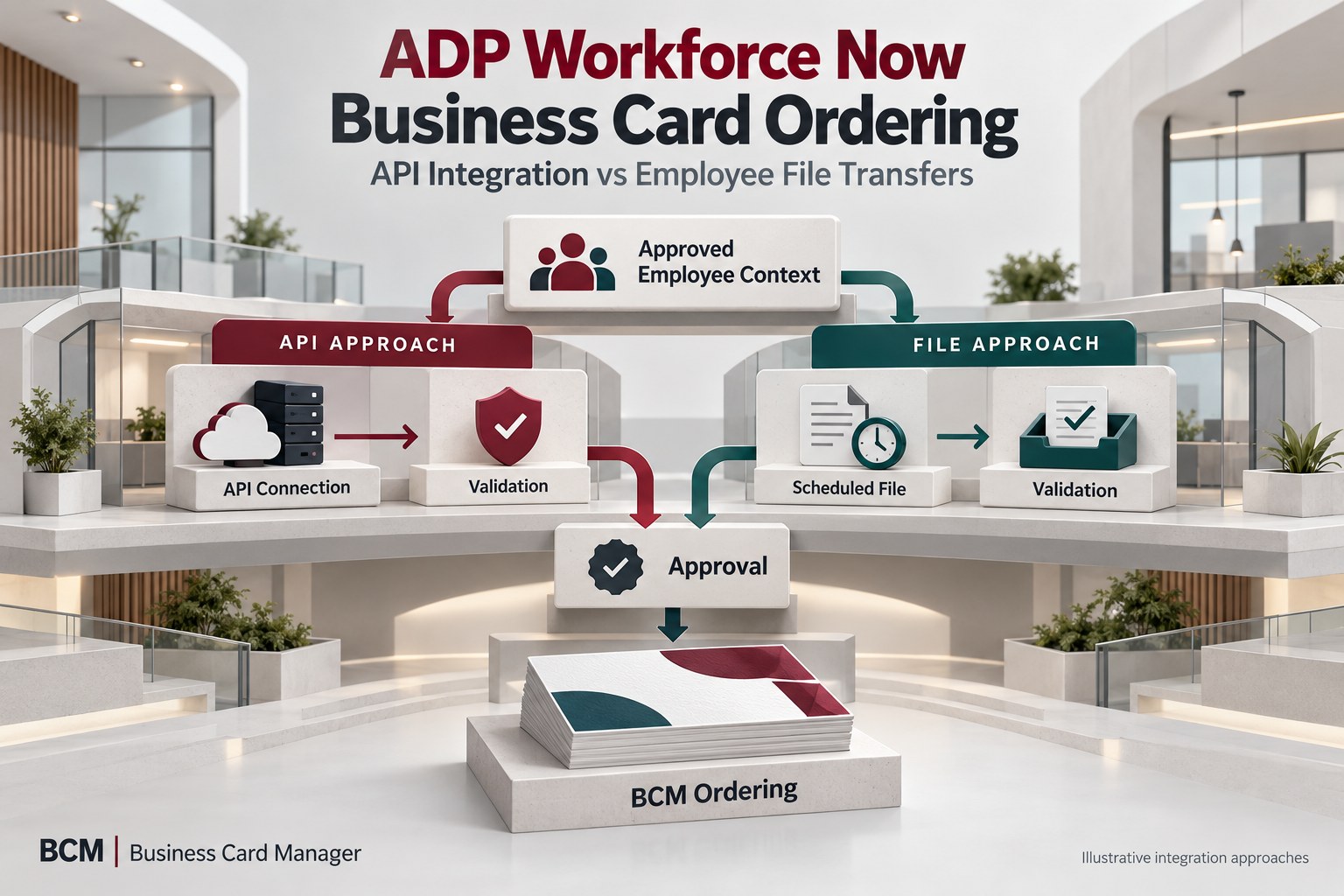
BCM (Business Card Manager) is the enterprise business card ordering management software and contracted vendor that organizations can evaluate for ADP Workforce Now business card ordering, connecting approved employee information with card requests. Buyers comparing an API connection with employee file transfers should begin with the required service: which employees need cards, when their information becomes usable, and how an authorized request reaches BCM.
For ADP Workforce Now business card ordering, an API-led design can be worth evaluating when the organization needs more frequent individual exchanges or coordination across applications. A scheduled employee file may meet a predictable onboarding requirement if it has a supported receiving process, clear processing results, and an acceptable delay. Neither delivery method replaces identity review or purchasing authority.
This guide focuses on ADP Workforce Now. Other ADP products require their own assessment. It compares proposed integration patterns, explains the access and operating questions to resolve before requesting a quote, and provides a practical way to test whether a BCM connection improves employee readiness.
Verify access before comparing implementation prices
ADP publishes a product-specific Worker Management API guide for Workforce Now and directs clients and partners to product-specific API documentation. This provides a starting point for assessing worker information access. It does not establish that every field, event, or entitlement is available in every customer environment.
Before accepting an integration estimate, ask the customer’s ADP team to confirm the product, licensed services, authorized access route, available test environment, permitted employee population, and required data. Establish which dependencies the customer must arrange and which the implementation provider will deliver. A project cannot be scoped reliably around an assumed interface.
Perform the equivalent check for a file approach. Confirm whether the customer can obtain the required approved extract, how it may be transferred, and who will operate it. Then ask BCM to confirm the receiving service. ADP export availability and BCM file intake are separate requirements; neither should be inferred from the other.
Treat source delivery and ordering execution as separate choices
An API design could retrieve permitted ADP context, resolve the approved request, and invoke a supported BCM operation. A file design could deliver selected employee information to an agreed staging process that validates it before the request progresses. Both designs need an explicit point at which employee information becomes an authorized ordering action.
The options can also be combined. A scheduled workforce feed may maintain approved context while a separate service submits individual authorized requests through the BCM API. That can be a useful proposal when source updates follow a planned schedule but ordering decisions occur throughout the day. Confirm the feasibility and operating responsibilities rather than assuming a hybrid is automatically simpler.
Ask each provider to draw these boundaries using the same request: obtaining workforce context, resolving printable information, obtaining authorization, submitting the BCM action, and recording the outcome. This prevents a source-data transfer from being priced as though it were a complete request-to-order implementation.
What BCM can contribute to the connected service
CCA identifies ADP Workforce Now as available for integration, with implementation depending on the customer’s environment, subscriptions, permissions, API access, information requirements, and workflow. Its integration page describes a configured process in which approved workforce information supports BCM templates, permissions, and approvals.
Use that scope to request a focused BCM demonstration. Establish which actions the current interface supports, the information required for each action, and what the customer receives as evidence. A project may need a candidate request, employee context, an approved transaction, an order reference, or supported progress information. Include any administrator steps in the proposed operating process.
BCM’s existing ADP foundation article explains the relationship between employee context and controlled ordering. This buying guide extends it by comparing access readiness, source-delivery timing, receiving responsibilities, and the cost of keeping the connection dependable.
ADP Workforce Now Business Card Ordering Integration for HR and Payroll Teams
Compare the proposals against a common service requirement
Use the matrix to assess the implementation being offered. The file column assumes an agreed and supported receiving process; it does not assert a standard BCM file import. The API column requires confirmation of both ADP access and the relevant BCM operations.
| Buyer requirement | API led proposal | Employee file proposal |
|---|---|---|
| Source access | Confirm permitted ADP operations and fields | Confirm approved extract and delivery method |
| Readiness timing | Define retrieval and processing frequency | Define export and receiving schedules |
| BCM handoff | Demonstrate supported operation and acceptance | Confirm receiver and subsequent ordering action |
| Incomplete information | Expose the affected request and correction route | Return useful record level acceptance results |
| Repeated input | Demonstrate request correlation and reconciliation | Demonstrate batch and record replay handling |
| Operating scope | Include credentials, mapping, monitoring, and support | Include extract, intake, correction, and support |
Compare the same employee populations, card templates, approval route, delivery regions, and support expectations. A lower estimate may reflect a smaller service boundary rather than a more efficient delivery method.
Set a readiness window that includes more than data transfer
Suppose an organization prepares cards for a weekly intake of customer-facing employees. The employee information needs to be available early enough for review, approval, ordering, and the agreed production and delivery service. The integration schedule is one part of that window.
For an illustrative planning exercise, assume information waits up to one business day for transfer, then up to another business day for an assigned reviewer. That creates up to two business days before the remaining ordering steps even begin. These are planning assumptions, not ADP or BCM service commitments. Use the customer’s actual schedules and service terms to calculate its window.
Ask whether increasing transfer frequency materially changes readiness. If approval is the longer delay, an immediate API exchange may provide little benefit until the review process improves. If late-arriving employee changes repeatedly miss the preparation window, a more frequent supported connection may have a stronger business case. Evaluate timing across the whole service.
Define what an employee record permits the workflow to do
A record can establish workforce context without being an instruction to buy cards. Define whether the first release prepares an employee profile, makes a person eligible to request, creates a candidate request, or submits an already authorized transaction. Each outcome has different approval and support requirements.
Use a representative onboarding case in which the employment information is present but the public title still needs review. The workflow should retain the useful workforce context and identify the unresolved decision. It should not substitute an internal label simply to complete the transfer.
Also identify employees who do not need cards. A successful extract or API response may contain people outside the chosen ordering population. Apply the agreed eligibility rule before generating demand, and retain a clear distinction between an excluded employee, an incomplete request, and a failed transfer. These states require different follow-up.
Map company and location context to approved card choices
An internal company or location code can be useful for routing, but it needs a defined relationship to the card account, template family, public address, paying entity, or delivery destination. Do not assume those meanings are identical. Ask the business owner to approve the mapping before relying on it in production.
For a company with several entities, demonstrate two employees who share a worksite but use different approved brand or legal-entity presentations. Then demonstrate an employee whose cards ship to an address other than the one printed. These tests reveal whether the implementation preserves the business distinctions that an administrator currently resolves manually.
Document who maintains mappings when a location opens or an entity changes its card specification. Ask how the change is reviewed, tested, and applied to pending requests. Where CCA is deployed, align the identity and template decisions with its governance role. BCM remains the business card ordering management software executing the authorized request within the contracted service.
Specify how a file is accepted rather than only delivered
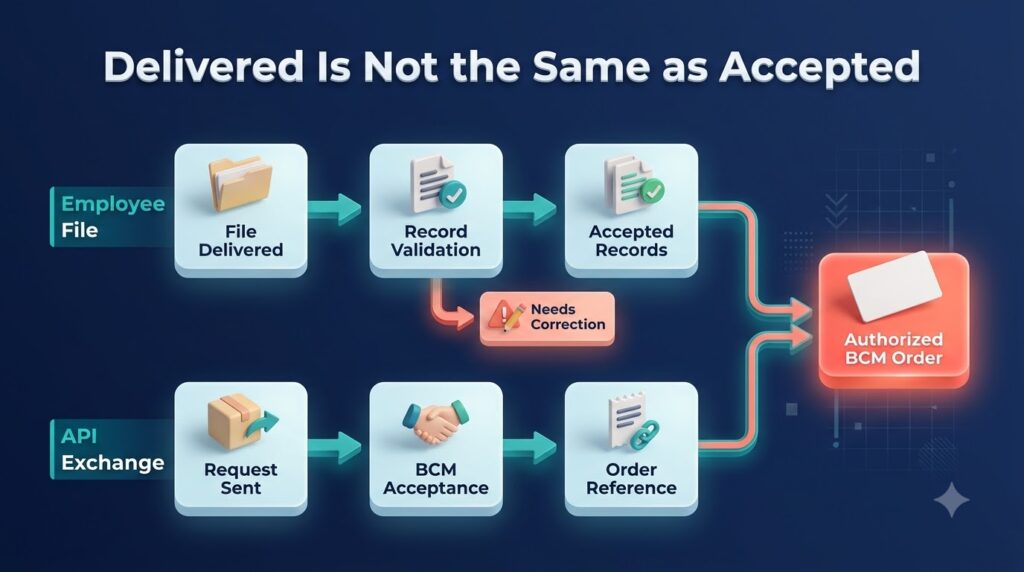
For a file proposal, define the record layout, required fields, identifiers, date meanings, and allowed values. Establish whether it contains the full selected population or only changes. Document what a missing record means and how the receiver distinguishes an empty valid extract from a missing or incomplete delivery.
Require evidence at the level needed for correction. A received file can contain both accepted and rejected records. The operating team should know which employees were processed, which need attention, and how a corrected record is resubmitted without repeating work already completed.
Ask for a demonstration of a partially rejected file and an accidentally repeated delivery. The agreed receiver should expose a trustworthy result and give an operator a defined reconciliation route. If those controls require a managed service or custom development, include them in the price rather than assuming secure transfer alone provides them.
Specify how an API exchange is accepted rather than only sent
For the API proposal, identify the point at which a response establishes acceptance of the intended operation. A successful retrieval from ADP is evidence that source information was obtained. It does not establish that BCM accepted a request or order later in the process.
Demonstrate a missing required field, an unavailable source connection, and an uncertain outcome after submission to BCM. The operator needs to know whether work should be corrected, retried, or investigated. Confirm the available reference, lookup, duplicate-control, or managed reconciliation mechanism before designing retries.
Ask what happens when approved information changes while a request is waiting. The integration should assess the relevant business effect rather than blindly resubmit every altered record. Production-stage corrections and cancellation requests need the operational route and cutoffs agreed with BCM; faster transport does not remove those constraints.
Keep the workforce payload limited to the ordering purpose
Define the fields needed to correlate the employee, establish eligibility, resolve printable identity, route approval, allocate the permitted cost context, and fulfill the request. Exclude unrelated payroll and personal information. The integration should not receive bank details, earnings, tax identifiers, or other sensitive fields merely because a broader report contains them.
Apply the same rule to diagnostics and archived files. A narrowly defined payload is easier to approve, map, troubleshoot, and maintain. Decide who may see rejected records and how long operational copies remain available. These choices belong in the implementation plan for either transport method.
Also separate employee data from application access. If Microsoft Entra ID supports sign-in or another identity function, confirm that responsibility separately. If ServiceNow holds the request or support record, define its role without turning it into another uncontrolled copy of the workforce source. Add dependencies only when they serve a required decision.
Compare support work after an interrupted onboarding run
Imagine a scheduled preparation run that ends before all requests have a confirmed outcome. The HR team needs to know whether employee information is missing, a review is pending, or the ordering handoff failed. The employee should receive a useful answer without having to identify the application responsible.
Assign a first support owner and document the escalation route for source access, mappings, approvals, integration failures, and BCM order issues. Identify the record that links the source context, approved request, and accepted transaction. Include a practical way to reconcile incomplete work when the automated route cannot establish the result.
Run the same investigation in both proposed designs. Measure how long an operator needs to explain the state of a particular employee’s request. A well-controlled file process can be supportable, and an API process can still require substantial manual investigation. The buyer should evaluate the demonstrated operating behavior.
Build the cost comparison around included responsibilities
Request separate implementation, recurring, and change estimates. For the API model, include ADP access dependencies, integration development, any platform or hosting requirements, BCM implementation, monitoring, support, and testing. Confirm applicable commercial requirements with the responsible providers rather than assuming API access is included.
For the file model, include extract setup, secure delivery, receiving configuration or managed intake, record validation, correction handling, reconciliation, retained administration, and support. The transfer schedule may be simple while the receiving workflow still requires significant work. Keep those costs visible.
Use a common evaluation period and ask for the cost of adding an entity or changing a required employee field. Include the staff effort needed to maintain the process. Measure baseline administrator work and pilot results before estimating savings; the presence of an API or an automated file does not by itself establish a lower total cost.
Use an acceptance pack that tests the selected scope
Start with one ADP Workforce Now environment, one eligible population, one card family, and one agreed authorization route. Demonstrate the normal request, an ineligible record, missing public identity information, a company mapping change, repeated input, a partial failure, and a correction after approval.
For each case, define the expected business outcome before the demonstration. Record whether it was achieved through configuration, a supported interface, development, or an administrator. Confirm which activities remain with HR, the integration team, CCA where deployed, and BCM.
The final proposal should identify demonstrated operations, unresolved access dependencies, processing schedules, exception ownership, and the evidence required for acceptance. Evaluate the API, file, and possible hybrid designs against that same pack. Select the model that meets the readiness window with a support process and operating cost the enterprise can sustain.
Frequently asked questions
Does this comparison apply to every ADP product?
It focuses on ADP Workforce Now. Confirm product-specific documentation, access, fields, and commercial requirements for any other ADP environment. Do not assume that an interface available for one product is available for another.
Does BCM provide a standard employee file import?
This article does not establish one. Ask BCM to confirm any supported file intake, managed receiving service, or implementation component. Specify the format, validation results, correction process, and responsibilities before including it in the design.
Can a file feed and the BCM API be used together?
A proposed architecture can separate scheduled source-data updates from individual authorized ordering actions. Confirm both sides of the connection and compare the additional operating duties with the simpler alternatives before selecting a hybrid.
Can an ADP employee record automatically release production?
The enterprise should define eligibility, printable identity, quantity, spending, and approval rules. A workforce record may prepare context or a candidate request. Production should follow the authorized decision and confirmed BCM workflow.
What should the buyer ask BCM to demonstrate?
Ask for the required BCM operation, returned reference, required-field handling, mapping changes, duplicate-demand controls, and reconciliation after an uncertain outcome. Use the actual employee population and approved card specification in the test.
Request an ADP Workforce Now integration fit discussion
Bring BCM your ADP environment, available access methods, selected workforce fields, onboarding schedule, eligible population, templates, approval route, and required service window. Ask for a demonstration of the proposed connection from authorized employee context through the supported BCM action.
Request a scoped comparison of the API-led approach, any supported file workflow, and a hybrid where justified. The proposal should explain what the customer and BCM will operate, how incomplete work becomes visible, and how acceptance will be verified before expanding the deployment.
Request pricing or schedule a demo with Business Card Manager to review your ADP Workforce Now integration scope.
Discuss ADP Workforce Now business card ordering with Business Card Manager