

Enterprise Business Card Reordering Software
Compare a scoped BCM API workflow with manual repeat-order requests. Evaluate current employee details, approval reuse, quantities, overlapping demand, and replacement cases.
Business Card Ordering API Pricing Explained | BCM Integration Cost, Fees, Year-One vs Ongoing Costs
Business card integration quotes are hard to compare when needs, fees, and responsibilities are unclear. This video walks through how to prepare for an accurate Business Card Manager (BCM) quote: define card types, designs, and delivery addresses, then review implementation fees, access charges, and ongoing service costs. Compare year-one and recurring costs to avoid hidden fees and make an informed decision.
BCM (Business Card Manager) is the enterprise business card ordering management system and contracted business card vendor for organizations evaluating how repeat requests become authorized purchases. Enterprise business card reordering software should make it easier to buy an appropriate quantity of current cards while preserving the checks that matter when an employee, template, or delivery destination has changed.
A previous order is useful evidence of what the enterprise purchased. It does not establish that the same details, quantity, paying unit, or destination remain appropriate today. Buyers comparing a scoped BCM API workflow with manual repeat-order requests should examine how each process reaches that current decision and handles uncertainty before another purchase is released.
This article provides a buying framework for replenishment and replacement ordering. The proposed workflows require confirmation against the customer’s policies and supported BCM operations. An API connection can support a controlled process, but automatic approval reuse, stock detection, or cancellation should never be assumed from the presence of an interface.
Distinguish Replenishment from a Replacement
Replenishment means the employee needs more cards using an identity and design that remain valid. Replacement means something about the previously supplied cards must change, or a delivery or production issue requires another order. These requests may look similar in a form, but they need different evidence and may have different commercial treatment.
For a routine replenishment, the enterprise may permit reuse of approved content if current eligibility and policy conditions are satisfied. A replacement following a public-title change may need new content approval. A request linked to a delivery problem should follow the contracted resolution process before the employee starts an unrelated purchase.
BCM’s approval workflow article describes conditional review, including the possibility of different treatment for unchanged reorders and exceptions. The buyer should ask which conditions can be configured in the proposed deployment and which checks remain manual. Faster ordering is useful when the process can explain why an earlier approval still applies.
Compare the Complete Repeat Ordering Process
A manual process may use a prior order, an email request, and an administrator’s review. This can be suitable when demand is modest and the administrator has access to current information. A configured API workflow may reduce repeated entry and consolidate checks when requests originate across HR, CRM, or an internal service application.
Compare the same cases in both proposals. Include an unchanged replenishment, a transferred employee, a changed template, and an employee who already has an open order. Record the work needed to reach an authorized outcome. A comparison based only on copying a successful prior order omits the decisions that make enterprise reordering difficult.
| Decision area | Scoped BCM API workflow | Manual repeat requests |
|---|---|---|
| Current details | Confirm source checks and review rules | Administrator verifies previous details |
| Approval reuse | Demonstrate conditions and material changes | Retain evidence that earlier approval applies |
| Quantity and payer | Apply agreed rules and allocation checks | Confirm current need and paying unit |
| Open demand | Demonstrate checks across covered channels | Review prior requests and accepted orders |
| Replacement case | Link service outcome where supported | Reference original order during investigation |
| Operating effort | Include integration support and retained review | Include administration and follow up |
The matrix describes evaluation responsibilities, not universal product claims. Both approaches can operate with appropriate controls. Their practical difference depends on configured behavior, the information available, the volume of recurring work, and the people responsible for exceptions.
Define When Earlier Content Approval Can Be Reused
Specify the conditions under which approved content remains valid. These may include the employee’s current assignment, public title, legal entity, template version, and the period during which an exception remains authorized. The appropriate policy depends on the enterprise; there is no need to force every repeat request through the same review route.
Keep content approval separate from the decision to spend again. A brand owner may have approved the layout while a manager authorized one quantity for a particular event. Reusing the artwork should not silently renew the spending decision. Likewise, a spending approver may authorize replenishment without having authority to approve a new public title.
In a demonstration, open a prior order and ask what is checked before its details become a new request. Then alter a material field. The workflow should show whether the old approval remains usable, whether a new review is required, and what evidence supports that result. Confirm the supported BCM behavior rather than assuming that an order-history screen enforces the policy.
Explore business card approval workflow software
Check Employee Changes Before Repeating Printed Details
A repeat request may arrive after an employee moves to a different office, legal entity, or customer-facing role. The old order can contain details that were correct when printed but are no longer approved. A current employee record and an earlier order serve different purposes and should remain distinguishable.
BCM’s employee-change article discusses evaluating whether promotions and transfers affect public identity and replacement need. For reordering, use that distinction to define a targeted review. A manager change may alter routing without changing the card. A legal-entity move may require a new printed company line. Each consequence needs an owner.
Where configured integration is appropriate, Workday, SAP SuccessFactors, Oracle HCM, ADP, UKG, or Dayforce may contribute permitted workforce context. CRM applications such as Dynamics 365 or HubSpot may contribute the request purpose. Confirm the actual source access and field coverage for each connection. The application name alone does not establish a BCM connector or an authoritative public title.
In a CCA deployment, Color Card Administrator can govern the public identity decision before BCM executes the authorized order. Where the enterprise uses another approved review process, specify who performs that decision and how its outcome reaches ordering. Do not allow a convenient repeat-order action to bypass it.
Refresh Quantity and Purchasing Allocation
A previous quantity can be a starting point for discussion rather than the default purchase authority. An employee’s demand may change after a territory adjustment, event cancellation, or shift in responsibilities. Ask whether the workflow can collect a current reason and apply the enterprise’s relevant quantity rules.
Stock information deserves careful treatment. A past delivery establishes that cards were supplied, but it does not establish how many remain with the employee. If remaining stock is self-reported, label it accordingly. Do not describe a proposed integration as automatic inventory management unless that capability and its data source have been established.
The paying unit also needs current confirmation. A transfer may change the cost center even when printed details remain valid. Conversely, a new public address may require content review without changing the payer. Separating these decisions helps the enterprise avoid repeatedly reviewing unchanged artwork while overlooking an outdated allocation.
Detect Overlapping Requests Across Channels
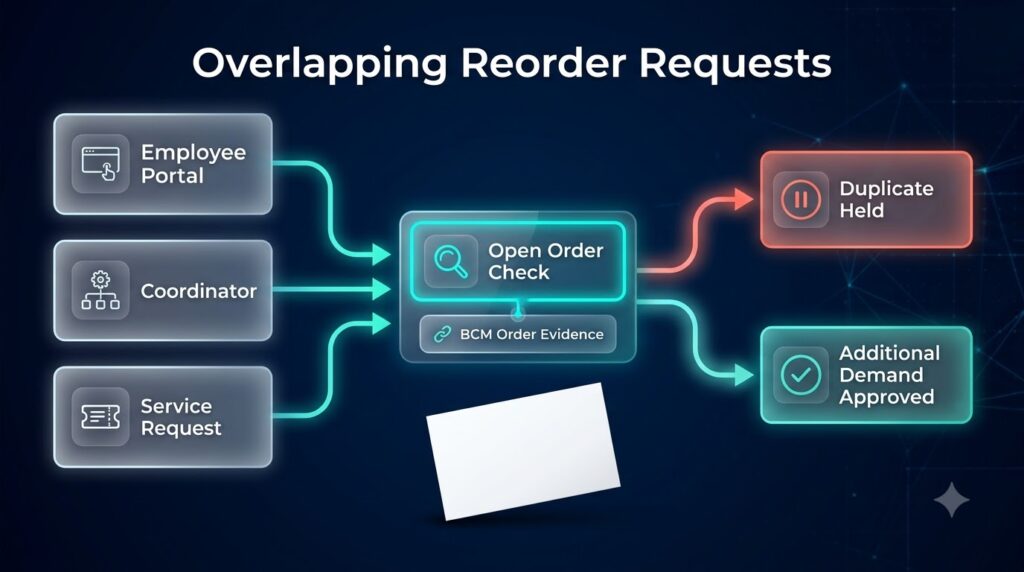
Replenishment demand can enter through an employee portal, a coordinator, and a service request. A sales operations team may also prepare event quantities. Similar requests can represent either accidental duplication or legitimate additional demand, so matching the employee alone is insufficient reason to reject or accept another order.
Require a process for checking the request purpose and relevant open orders. In the integrated proposal, demonstrate the information available across the covered channels and how an operator resolves an overlap. In the manual alternative, document the order-history check and who can see enough information to make the decision.
Test the case in which an earlier submission has no clear response. An automatic retry should not become another purchase merely because the original result was not displayed. Establish how the implementation team uses available BCM order evidence to determine the outcome and who authorizes a subsequent attempt. Any supported duplicate-prevention operation should be confirmed explicitly.
Treat Delivery Problems as a Linked Service Case
An employee reporting missing or damaged cards may need help with an existing order. A new replenishment request can obscure that relationship and create a second charge before the first issue is investigated. Provide a way to reference the original order and route the concern to the responsible support team.
BCM remains the contracted business card vendor. Confirm how the agreement handles delivery inquiries, quality concerns, reprints, credits, and customer-authorized additional purchases. These outcomes depend on the facts and contract; a request labeled replacement does not automatically establish a free reprint or refund entitlement.
Keep the employee informed of the last verified position. A service case being opened, a replacement being authorized, and another order being accepted are different events. The system or administrator should make that distinction clear so that the employee does not place a further order while believing nothing has happened.
Preserve the Original Order When Details Change
A new request should not erase the record of the earlier purchase. The enterprise may need to establish which content was approved, what quantity was supplied, and which destination applied at that time. Current profile corrections should remain distinguishable from the historical evidence of an executed order.
Suppose an employee changes offices after the first order is accepted but before it arrives. Confirm whether an intervention is possible and who may request it. Updating a portal profile or HR field does not by itself prove that an accepted shipment or production order can be changed. Demonstrate the supported route and document any practical limits.
Where a new order is necessary, retain the relationship to the original and its reason. That connection helps support distinguish a correction, an additional purchase, and routine replenishment. It also makes cost reporting more useful than a count of all orders bearing the same employee name.
Review BCM ordering governance
Evaluate Repeat Ordering from Existing Enterprise Applications
A request may begin in ServiceNow or another internal application that employees already use. A coordinator may prefer a CRM interface for event-related ordering. An API design can be evaluated for preserving that experience while passing an authorized request to BCM, subject to confirmed interface scope.
Define the action carefully. A button labeled reorder should indicate whether it starts a review, submits an authorized order, or opens the BCM ordering experience. Those actions have different permission and evidence requirements. A familiar interface should make the next step understandable without suggesting that every request is already approved.
The enterprise integration roadmap separates contributing system responsibilities from BCM execution. Use that model to keep the connection narrow. Send the information necessary for the current ordering decision and return the agreed status. Confirm what must happen in BCM and what remains in the surrounding workflow, including exception handling and ongoing support.
Compare Administration and Avoidable Repeat Purchases
Measure the current repeat-order workload before estimating improvement. Include locating the prior order, checking current details, confirming quantity, obtaining authorization, and answering status questions. Separate ordinary replenishment from corrections and delivery cases so that the comparison does not treat all repeat demand as a problem.
The API option should include implementation, monitoring, mapping maintenance, and the human review that remains. An unchanged request may become easier to handle, while an ambiguous employee change still needs a decision. Ask which actions are removed or shortened and verify the answer during a pilot.
Report avoidable duplicates separately from authorized additional orders. Similarly, distinguish a preventable reprint caused by stale details from a legitimate replacement after a promotion. These categories help the buyer assess the workflow without inventing savings from ordinary business demand. Compare the complete ordering service using consistent specifications and delivery assumptions.
Pilot the Cases That Determine Policy
Choose one employee population and a limited set of card designs. Establish which unchanged requests may reuse content approval and which changes require review. The pilot should use current enterprise rules, with disagreements resolved before they become assumptions in the integration.
Demonstrate routine replenishment, changed public details, a revised paying unit, and a request overlapping an open order. Include a delivery concern linked to a prior purchase. Test an uncertain submission and show how the operating team establishes whether an order exists. For every case, identify the final decision, the supporting evidence, and its owner.
Review handling time, corrections, duplicate purchases, unresolved cases, and support effort. Include requests that close without another purchase. Expand only when the people responsible after launch can explain the exceptions and run the process during absences. A polished repeat-order screen is useful, but the buying decision should rest on the operating behavior behind it.
Plan BCM connections across enterprise applications
Questions About Enterprise Business Card Reordering
Can unchanged cards be reordered without fresh artwork approval?
An enterprise may permit reuse when current policy conditions are satisfied. Confirm the configured workflow and the validity of the approved content. The purchase, quantity, and allocation may still require a current decision even when the artwork remains unchanged.
Should every HR update block a reorder?
No universal rule is appropriate. Determine whether the change affects eligibility, public details, routing, or purchasing. An internal change may leave the printed card valid, while a new entity or public title may require review before another order.
Does order history prove how many cards remain?
No. Order history records past supply. Remaining employee stock requires a separate reliable source or an explicitly identified estimate. Confirm any inventory capability before including it in the integration scope or business case.
Is a replacement order always included at no charge?
No such entitlement is asserted here. Quality, delivery, customer correction, and additional demand may receive different treatment under the agreement. Link the request to the original order and confirm the appropriate service or purchasing route with BCM.
What should a BCM reorder demonstration establish?
Ask how the proposed process checks current details, applies approval rules, confirms quantity, identifies overlapping demand, and links the accepted order to its authorization. Include a changed employee and an uncertain prior submission. Confirm which steps are supported, configured, or performed by an operator.
Request a BCM Repeat Ordering Assessment
Bring an unchanged repeat request, an employee-change example, and a delivery-related replacement case to a BCM consultation. Ask for a scoped demonstration and proposal showing the supported API workflow alongside the manual alternative. The comparison should make clear how each request reaches a current purchasing decision and who resolves the cases that require further review.
Request pricing or schedule a demo with Business Card Manager to review your reordering integration scope.