

UKG Business Card Integration For Workforce Data, Employee Changes, and Ordering Workflows
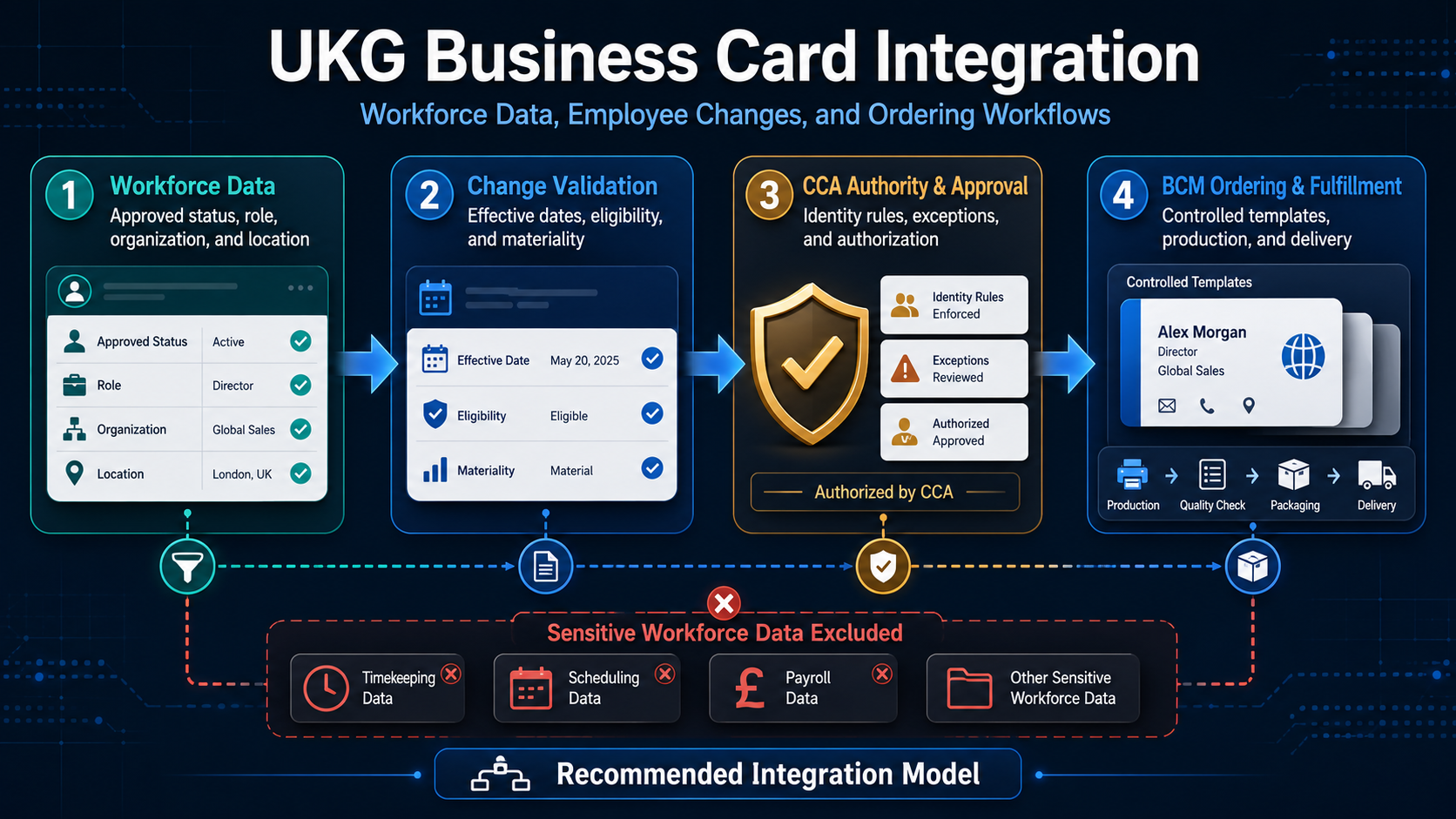
| EXECUTIVE PERSPECTIVE: A UKG business card integration can connect approved workforce status, organizational assignments, locations, and employee changes with governed ordering. But a hire, shift assignment, transfer, or profile update should not automatically become a production instruction. UKG contributes approved workforce facts; CCA governs identity authority and exceptions; BCM executes the controlled transaction. |
Workforce Connectivity Should Strengthen Control
UKG Pro and UKG Ready can hold workforce information used across distributed, workforce-heavy organizations: employment status, hire and termination dates, company and organizational assignments, department, job information, manager relationships, work location, and other operational context. Connecting a minimum-necessary subset to Business Card Manager (BCM) can reduce duplicate entry, improve request timing, and route eligible employees to the correct account, template family, approver, supplier, and fulfillment path.
The integration boundary matters. Workforce-management data may be authoritative for employment and organizational facts, yet it does not automatically authorize every public-facing identity value or physical order. A scheduling location may not equal a public business address. A labor category may not be an approved customer-facing title. A supervisor relationship may support routing without granting brand, legal, purchasing, or production authority.
BCM manages the controlled request, validation, approval, template, order, supplier, shipping, and fulfillment process. Color Card Administrator (CCA), where deployed as the enterprise authority layer, can evaluate source precedence, eligibility, public presentation, effective dates, delegated scope, material changes, and exceptions before releasing an approved identity specification to BCM.
Why UKG Is a High-Value BCM Integration
UKG is the eighth priority in the approved BCM integration roadmap because many employers coordinate large populations across locations, operating units, job groups, employment types, and frequent workforce changes. The opportunity is not workforce-triggered printing. It is governed conversion of approved workforce context into the right request, approval path, template, cost treatment, and fulfillment outcome at the right time.
- Reduce re-entry of approved employee, organizational, job, manager, and location data.
- Prepare controlled requests for eligible joiners without releasing production prematurely.
- Route employees to the correct account, template, approver, supplier, and destination.
- Separate internal workforce classifications from approved external omnichannel identity governance presentation.
- Apply materiality rules to transfers, promotions, location changes, leaves, and terminations.
- Connect workforce context, policy, approvals, orders, costs, fulfillment, and exceptions for reporting.
UKG should remain authoritative only for approved workforce facts. Authentication and account state may come from an identity platform; public titles and brand lines may require separate policy or business card approval; supplier and quantity controls belong in the ordering workflow; and BCM remains responsible for controlled execution and fulfillment evidence.
What a Governed UKG-to-BCM Workflow Looks Like
A strong integration uses minimum-necessary, effective-dated workforce data as input to a governed identity decision. Exact UKG products, modules, business objects, supported interfaces, events, extracts, fields, mappings, permissions, environments, and timing must be confirmed for the organization’s licensed services, architecture, configuration, CCA policies, and BCM setup.
- Correlate the employee. Use an approved stable identifier to associate the workforce record with the correct BCM identity; do not depend on names or email addresses alone.
- Retrieve approved workforce facts. Use only the employment, organization, job, manager, location, or cost data required for the declared ordering purpose.
- Evaluate eligibility and timing. Apply worker type, status, effective date, location, entity, population, and readiness rules before exposing or preparing a request.
- Resolve identity authority. The configured policy or CCA determines which source owns each printed value, which transformations it allows, and which conflicts require review.
- Validate, approve, and fulfill. BCM applies required-field, template, quantity, supplier, and release controls; captures the approved version; routes the order; and returns status.
- Reconcile business card lifecycle outcomes. Authorized teams connect the source event, policy result, approval, order, shipment, cancellation, replacement, and exception evidence.
The Workforce and Identity Decisions That Matter
Integration quality depends on defining what every UKG signal is allowed to influence before it reaches an order. Enterprise teams should separate employment facts, public identity, workflow routing, approval authority, and production release.
| Decision area | Enterprise question | Governed response |
|---|---|---|
| Correlation | Which workforce record matches which BCM identity? | Use stable identifiers, system boundaries, and owned duplicate handling. |
| Eligibility | May this worker request or receive a card? | Apply worker type, status, location, entity, role, and population rules. |
| Effective date | When may a workforce change influence ordering? | Honor approved effective dates, readiness gates, lead times, and freeze windows. |
| Field authority | Which source owns each printed value? | Apply precedence, mappings, transformations, conflict handling, and exception ownership. |
| Release | What must be approved before production? | Freeze the approved identity version and apply template, quantity, supplier, and release controls. |
Workforce-Management Data Is Not Automatically Printable Identity
UKG job codes, labor categories, organizational units, scheduling locations, position labels, and supervisory structures are designed primarily for workforce administration. They may be abbreviated, optimized for timekeeping or reporting, or structured for internal operations rather than external representation. Copying them directly to a card can create inconsistent titles, incorrect locations, unintended disclosure, or mismatched legal and brand identity.
A governed model documents the authoritative source, permitted population, public-presentation rule, transformation, effective date, and exception owner for every printed value. Where an approved customer-facing title differs from the workforce title, the difference should be explicit, controlled, reviewable, and linked to the employee record rather than hidden in unrestricted free text.
Employee Changes Require Lifecycle-Aware Execution
Joiners, movers, and leavers create different operational obligations. A future-dated hire may prepare a candidate request, but readiness can depend on confirmed start status, required fields, manager approval, template eligibility, shipping destination, and production lead time. A newly created workforce record should never become an automatic order merely because it exists.
Transfers, promotions, manager changes, and location updates should be classified by materiality. Some affect only reporting or routing; others alter public title, legal entity, brand, address, language, approver, supplier, or cost allocation and may require reapproval or replacement. Leaves and terminations should remove ordering authority, reroute pending work, block unreleased specifications, and attempt to cancel or reconcile open orders where operationally possible.
Timekeeping and Scheduling Data Should Stay Outside the Card Workflow
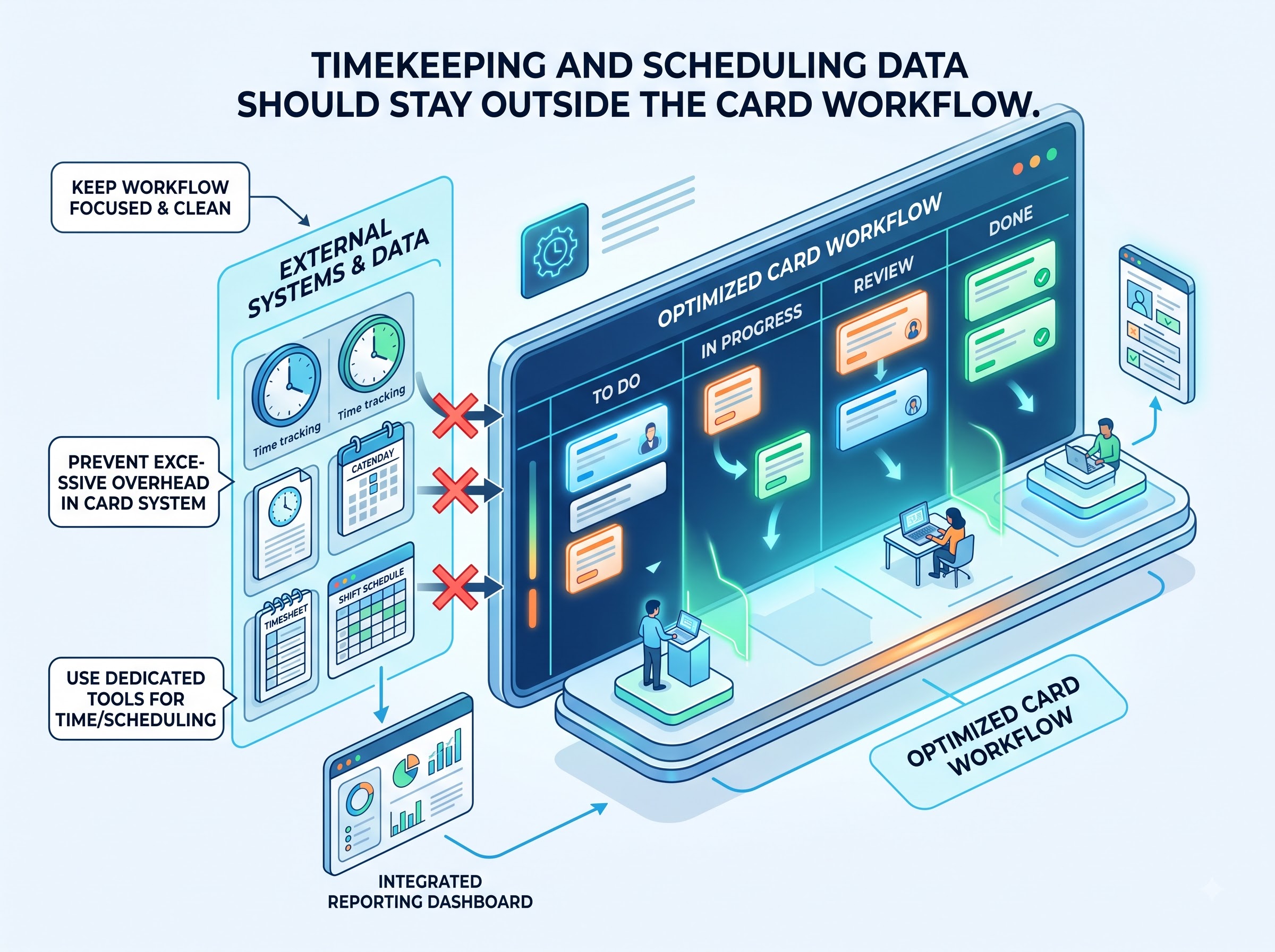
Business card ordering does not require time punches, schedules, attendance, leave balances, pay rates, bank details, tax identifiers, benefits, demographic attributes, or other sensitive workforce data. Those elements should remain outside the integration. Only data required for correlation, eligibility, public identity, routing, approval, cost allocation, and fulfillment should cross the boundary.
Field-level governance should define the owner, purpose, allowed use, retention rule, transformation, access boundary, and failure behavior for every element. Data minimization reduces privacy exposure, simplifies permission reviews, and makes monitoring, investigation, correction, and deletion obligations more manageable.
Operational Benefits Across HR, Operations, Brand, IT, and Procurement
HR and workforce operations, the integration can reduce manual handoffs during onboarding and employee change while keeping exceptions visible. For managers and local administrators, approved organizational relationships can support predictable routing and controlled request-on-behalf workflows across sites.
Marketing and brand teams, locked templates and governed public-presentation rules prevent workforce-data convenience from becoming uncontrolled identity. For IT and security, least-privilege access, stable correlation, protected service identities, environment controls, monitoring, and owned failure queues create a governable interface. For procurement governance and finance, linked entity, location, cost center, quantity, supplier, order, and fulfillment evidence improve allocation and exception review.
Buyer-Intent Bridge: From Employee Data Sync to Enterprise Control
Organizations evaluating business card vendors should ask more than whether an HRIS field can populate an order form. The higher-value questions are whether the platform can distinguish source data from approved public identity, apply population and effective-date rules, control delegated ordering, freeze the approved specification, prevent duplicates, route suppliers, reconcile fulfillment, and retain evidence.
Business card printing is a transaction. Business card management is the workflow around that transaction. Governance is the control layer that determines who and what may proceed. API integration is the differentiator that connects those decisions to the systems the enterprise already operates. BCM is the conversion engine for controlled ordering and fulfillment; CCA is the authority engine for identity policy and exceptions.
Implementation Priorities For Enterprise Teams
Begin with one UKG environment, one controlled employee population, and a narrow use case such as approved new-hire requests or company, department, and work-location changes. Document stable worker identifiers, organization mappings, authoritative sources, eligible populations, data behavior, public-presentation rules, delegated actions, templates, approvers, suppliers, privacy constraints, and failure ownership before expanding automation.
Technical design should use least-privilege integration access, approved service identities, protected credentials, verified environment boundaries, data minimization, logging, monitoring, retry controls, idempotency, correlation identifiers, retention rules, and owned failure queues. Whether the organization uses APIs, events, extracts, or an integration platform, change processing should preserve effective dates and work relationships while preventing duplicate or out-of-order enterprise execution excellence.
Testing should cover future-dated and rescinded hires, concurrent employment, contingent workers, duplicates, missing correlations, retroactive changes, transfers, promotions, leaves, terminations, stale managers, missing fields, unauthorized attributes, outages, expired credentials, throttling, retries, post-approval changes, supplier failures, and leavers with open orders. Useful measures include correction rate, request readiness, approval cycle time, exception volume, duplicate orders, avoidable reprints, cancellation success, and fulfillment visibility.
Frequently Asked Questions
Does BCM currently claim a native UKG connector?
No. UKG Pro and UKG Ready are identified as recommended integrations in the approved BCM roadmap. The appropriate interface, supported objects, fields, events, permissions, timing, and production design must be confirmed for each organization.
Should every UKG employee change trigger a new business card?
No. Materiality rules should determine whether a change affects access, routing, public identity, approval, replacement, or no card action. Automatic printing from every workforce event would create avoidable cost and control risk.
What UKG data should be excluded?
Timekeeping, schedules, attendance, pay, bank, tax, benefit, demographic, and other sensitive or unrelated fields should remain outside the card workflow. Use only the minimum data required for the declared purpose.
From Workforce Events to Governed Identity Execution
UKG can give BCM-connected enterprises authoritative workforce context and lifecycle timing across complex employee populations and locations. CCA turns approved workforce facts into governed eligibility, field authority, public presentation, access, and exception decisions. BCM converts the approved outcome into ordering and fulfillment.
The strategic advantage is not HR-triggered printing. It is lifecycle-aware execution: minimum-necessary data, stable correlation, clear authority, effective-dated control, appropriate approval, selective replacement, visible fulfillment, and evidence the organization can review. That is how a UKG business card integration becomes enterprise infrastructure rather than another employee-data sync.
| Connect Workforce Data to a Governed Business Card Workflow
Explore how Business Card Manager can support controlled employee requests, approvals, templates, ordering, fulfillment, lifecycle changes, and reporting. Request a BCM demonstration and UKG integration-fit discussion at https://www.businesscardmanager.com |