

From Employee Onboarding to Offboarding: Governing the Complete Business Card Lifecycle
Introduction
Every employee represents the organization.
Whether participating in customer meetings, attending industry events, engaging suppliers, or collaborating with business partners, employees communicate the organization’s identity through both digital and physical channels.
Among these channels, business cards continue to play an important role.
Although digital communication has expanded significantly, business cards remain one of the few corporate identity assets exchanged directly between individuals during professional interactions.
Consequently, every business card reflects not only an employee’s identity but also the organization’s professionalism, operational discipline, and commitment to governance.
Despite this importance, many enterprises continue managing business cards independently from employee lifecycle processes.
Human Resources manages onboarding.
IT provisions system access.
Facilities assign office locations.
Procurement manages suppliers.
Marketing maintains brand standards.
Business card requests occur separately.
This separation introduces operational inefficiencies that become increasingly difficult to manage as organizations expand globally.
Business card lifecycle management addresses this challenge by aligning identity governance with the employee journey.
Understanding the Business Card Lifecycle
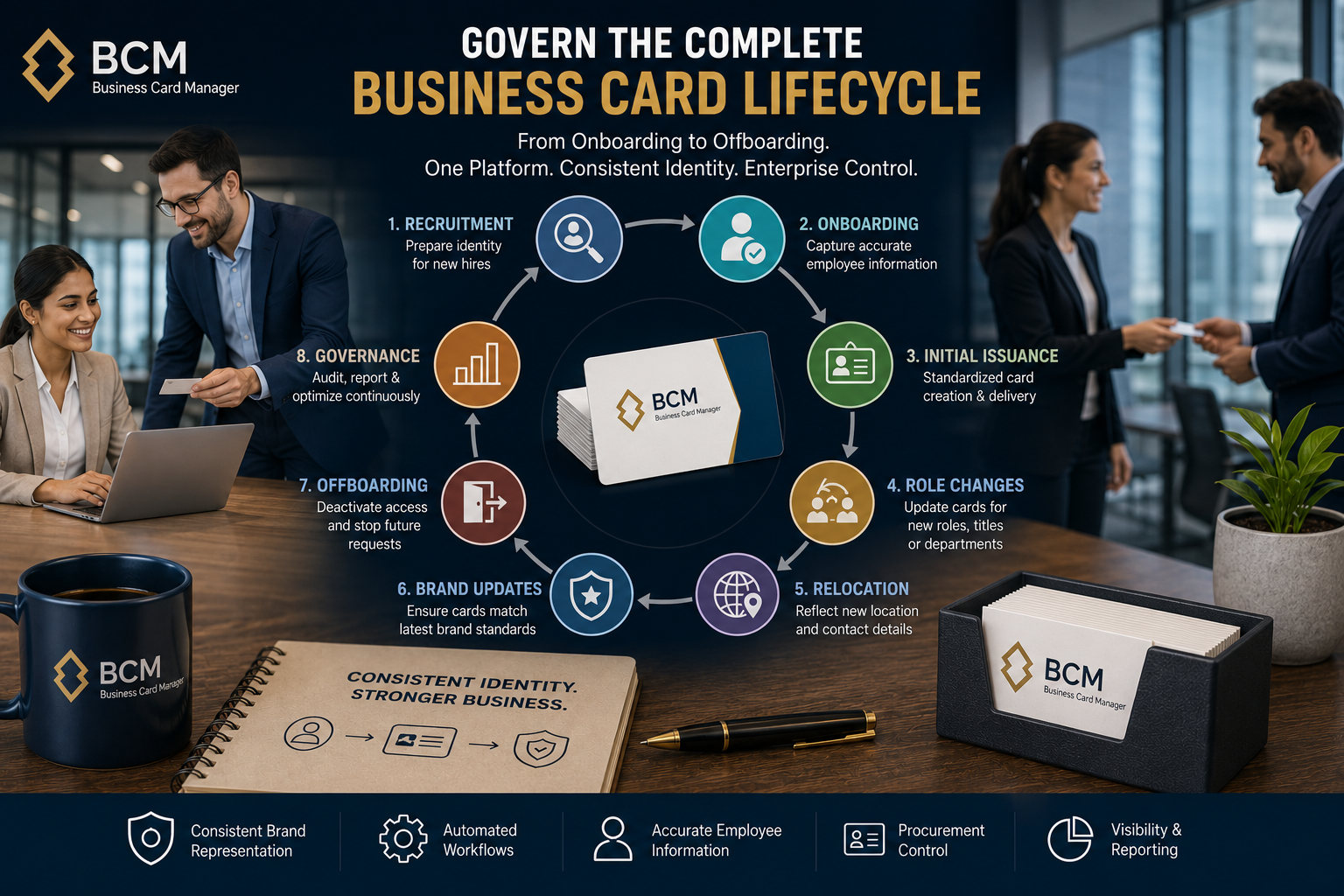
The lifecycle of a business card closely mirrors the lifecycle of an employee within the organization.
Each stage presents governance requirements that extend beyond simply printing new cards.
These stages include:
- Recruitment preparation
- Employee onboarding
- Initial business card issuance
- Role changes
- Promotions
- Department transfers
- Office relocations
- Brand updates
- Organizational restructuring
- Employee offboarding
Every transition creates opportunities for inconsistency if governance is not centrally managed.
Business Card Manager provides structured workflows that support each stage while maintaining policy compliance and operational visibility.
Governance Begins Before Day One
Effective business card governance begins during onboarding planning rather than after employees join the organization.
When HR systems capture approved employee information, that data should become the authoritative source for identity assets.
Typical onboarding information includes:
- Employee name
- Department
- Job title
- Office location
- Email address
- Telephone number
- Business unit
- Cost center
- Manager
- Legal entity
Rather than requiring employees to re-enter this information manually, BCM enables organizations to leverage approved enterprise data as the foundation for business card creation.
This approach reduces administrative effort while improving data accuracy.
Standardized Business Card Issuance
One of the earliest employee experiences involves receiving official corporate materials.
Business cards represent an important part of that experience.
Without governance, new employees often encounter inconsistent processes.
Some departments submit requests immediately.
Others wait several weeks.
Regional offices maintain different templates.
Marketing reviews requests inconsistently.
Local suppliers operate independently.
BCM standardizes business card issuance through predefined workflows that ensure every employee follows the same governance process regardless of location.
This consistency improves employee experience while reinforcing enterprise branding from the beginning of the employment relationship.
Managing Organizational Change
Organizations rarely remain static.
Employees experience continual changes throughout their careers.
Examples include:
- Promotions
- Department transfers
- Regional assignments
- Leadership appointments
- Organizational restructuring
- Office relocations
- New product responsibilities
- Updated certifications
Each change may require corresponding updates to business cards.
Without centralized governance, outdated information frequently remains in circulation.
Customers receive incorrect contact details.
Suppliers continue using obsolete information.
Brand consistency gradually weakens.
BCM supports governed updates by integrating approval workflows with employee identity changes.
Rather than relying on manual coordination, organizations can manage business card updates as a controlled component of broader organizational change.
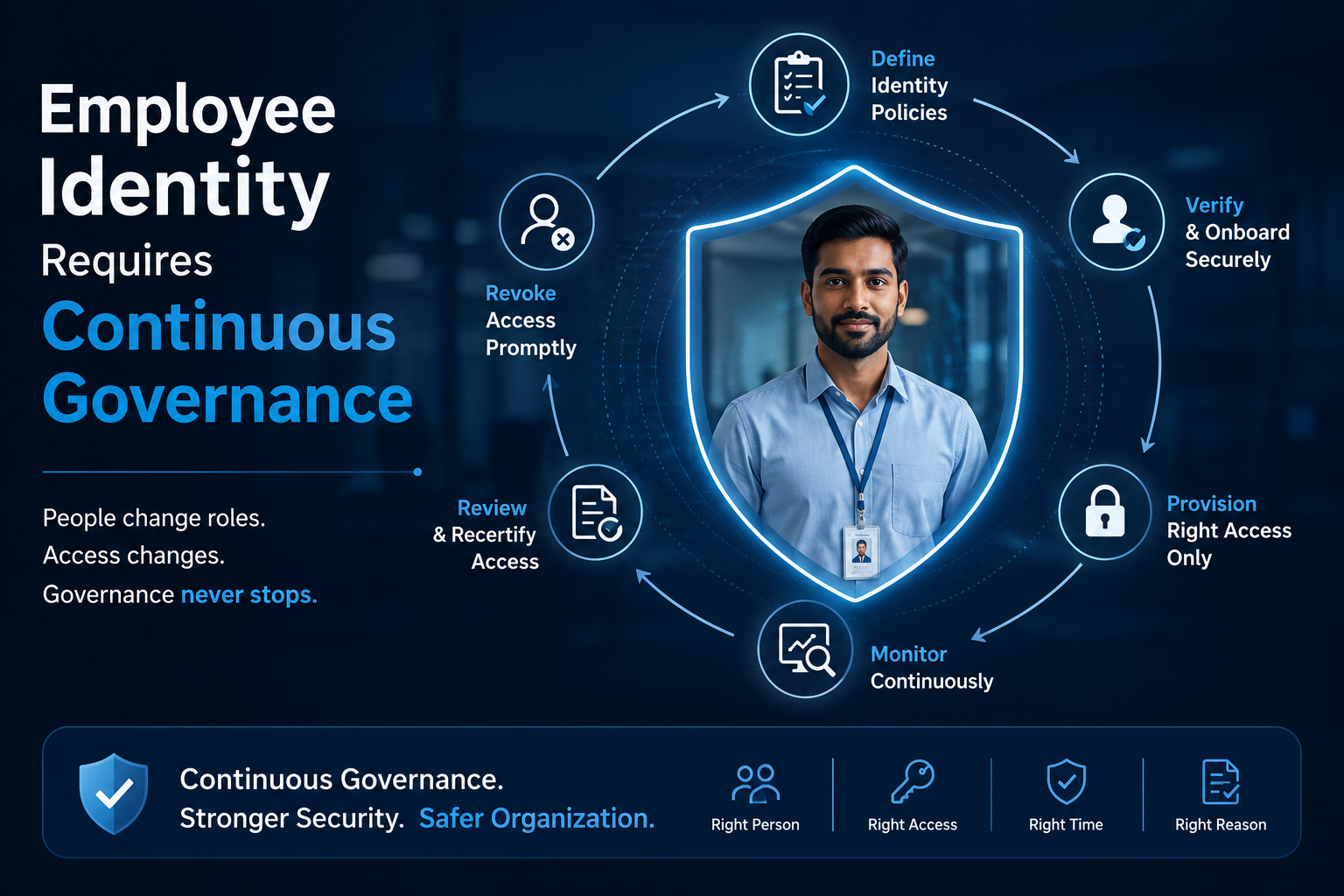
Identity management is not a one-time activity completed during onboarding.
It requires continuous maintenance throughout employment.
Business cards should therefore be treated as living identity assets rather than static printed materials.
Governance requires organizations to ensure:
- Employee information remains accurate.
- Brand standards remain current.
- Approved templates are consistently used.
- Procurement policies continue to apply.
- Supplier assignments remain compliant.
- Audit history is maintained.
Business Card Manager enables enterprises to maintain this continuous governance throughout the employee lifecycle rather than limiting governance to initial issuance.
Business Cards as Enterprise Identity Assets
Every business card contains multiple categories of enterprise information.
These include:
- Personal identity
- Organizational identity
- Brand identity
- Contact information
- Geographic information
- Legal information
- Professional credentials
Because these elements originate from multiple enterprise systems, governance becomes increasingly important.
Changes made within HR, marketing, procurement, or legal departments frequently affect business card content.
BCM provides centralized governance that coordinates these changes through structured workflows, ensuring every business card accurately reflects current enterprise standards.
Supporting Enterprise Mobility
Modern workforces are increasingly mobile.
Employees relocate internationally.
Hybrid work models become standard.
Organizations expand into new markets.
Regional offices grow rapidly.
These changes require flexible identity management without sacrificing governance.
BCM supports enterprise mobility by allowing organizations to manage approved regional variations while maintaining centralized control over branding, approvals, templates, and supplier relationships.
This balance between flexibility and governance enables organizations to scale confidently across multiple locations.
Procurement Lifecycle Governance
Business card governance extends beyond employee identity—it also encompasses procurement governance.
Every business card order represents a procurement transaction involving approved suppliers, pricing agreements, production standards, fulfillment timelines, and financial accountability.
Without centralized governance, organizations often experience:
- Multiple regional print vendors
- Duplicate procurement contracts
- Inconsistent pricing
- Variable print quality
- Limited purchasing visibility
- Decentralized invoice processing
As enterprises grow, these inconsistencies become increasingly difficult to manage.
Business Card Manager (BCM) integrates procurement governance into the business card lifecycle by ensuring that approved suppliers, negotiated pricing, and procurement policies are automatically applied during order fulfillment.
Rather than allowing employees or regional offices to select suppliers independently, BCM routes approved requests through enterprise procurement rules, strengthening both financial governance and operational consistency.
Vendor Governance Throughout the Lifecycle
Suppliers play a critical role in delivering business cards that accurately represent the organization’s identity.
However, vendor management should extend beyond production quality.
Organizations should evaluate suppliers based on:
- Brand compliance
- Print consistency
- Delivery performance
- Geographic coverage
- Service responsiveness
- Pricing adherence
- Sustainability initiatives
- Contract compliance
BCM provides centralized visibility into supplier performance, enabling procurement teams to make informed decisions while maintaining standardized production across regions.
This governance model supports long-term supplier relationships rather than isolated purchasing transactions.
Offboarding as a Governance Process
Employee offboarding is frequently associated with access revocation, asset recovery, and knowledge transfer.
Business card governance should also be part of this process.
When employees leave the organization, governance requires that identity assets remain aligned with current organizational reality.
Without centralized control:
- Business card orders may remain active.
- Outdated employee information may continue circulating.
- Legacy branding may remain associated with former employees.
- Procurement records may become fragmented.
BCM helps organizations integrate business card governance into offboarding workflows by ensuring that identity assets are updated, future requests are prevented where appropriate, and lifecycle records remain available for audit and reporting.
This supports both operational integrity and enterprise security.
Auditability Across the Complete Lifecycle
Governance depends upon visibility.
Organizations require more than completed transactions—they require evidence that every transaction followed approved enterprise policies.
Business Card Manager maintains comprehensive lifecycle records including:
- Request creation
- Employee information used
- Template version
- Approval history
- Policy exceptions
- Vendor assignment
- Production status
- Delivery confirmation
- Historical modifications
These records enable organizations to demonstrate compliance while supporting internal audits, procurement reviews, operational analysis, and continuous process improvement.
Rather than relying on disconnected emails or spreadsheets, enterprises gain a complete governance history for every business card issued throughout its lifecycle.
Executive Reporting and Lifecycle Analytics
Enterprise governance should generate actionable intelligence rather than isolated operational data.
BCM provides leadership teams with reporting capabilities that help monitor:
- Business card requests by region
- Employee onboarding volumes
- Replacement frequency
- Procurement expenditure
- Vendor utilization
- Approval turnaround times
- Lifecycle status
- Policy exception rates
- Brand compliance performance
These insights allow executives to identify trends, improve operational efficiency, optimize procurement strategies, and strengthen governance across the organization.
Business card management therefore evolves from an administrative activity into a measurable enterprise capability.
Business Card Lifecycle Management Supports Digital Transformation
Digital transformation is most effective when organizations redesign complete business processes rather than automating isolated tasks.
Business card lifecycle management contributes directly to this objective.
By integrating employee identity, procurement, approvals, branding, supplier management, and reporting into a single governed workflow, BCM eliminates many of the manual coordination activities that traditionally slow enterprise operations.
Automation supports:
- Faster onboarding
- Consistent approvals
- Improved employee experience
- Reduced administrative effort
- Accurate identity information
- Better procurement visibility
- Stronger compliance
Most importantly, automation reinforces governance rather than replacing it.
Policies remain defined by the enterprise, while BCM ensures consistent execution.
Preparing for the Future of Enterprise Identity
The future workplace will continue evolving through:
- Hybrid work environments
- Global workforce mobility
- Artificial Intelligence
- Workflow orchestration
- Enterprise analytics
- Identity automation
- Digital governance platforms
As organizations become increasingly connected, identity management will extend across every employee interaction.
Business cards will remain an important physical representation of enterprise identity, particularly during customer meetings, industry conferences, executive engagements, and supplier relationships.
Organizations that establish governed lifecycle management today will be well positioned to adopt future innovations while maintaining operational consistency.
BCM provides the governance foundation required to support that evolution.
BCM Within the Enterprise Governance Ecosystem
Business Card Manager forms part of a broader enterprise governance architecture.
Within that ecosystem:
- CCA (Color Card Administrator) serves as the authority engine, governing identity, approval policies, and enterprise brand standards.
- BCM (Business Card Manager) acts as the conversion engine, transforming approved identity information into governed, customer-facing business card assets.
- BOC (Business Operations Center) provides enterprise-wide operational visibility, workflow governance, analytics, and process optimization.
Together, these platforms create a unified governance framework that strengthens enterprise identity management, operational efficiency, procurement governance, and digital transformation.
Conclusion
Business card management should no longer be viewed as an isolated administrative activity.
It represents an integral component of the employee identity lifecycle.
From onboarding through promotions, organizational changes, regional mobility, procurement, compliance, and eventual offboarding, business cards require the same governance discipline applied to every other enterprise identity asset.
Business Card Manager enables organizations to govern this complete lifecycle through centralized policies, workflow automation, procurement controls, supplier governance, reporting, and lifecycle analytics.
The result is greater consistency, stronger compliance, improved employee experience, enhanced procurement visibility, and scalable enterprise operations.
As organizations continue modernizing their digital workplaces, governing the complete business card lifecycle will become an essential capability for maintaining enterprise identity and operational excellence.