

Building a Policy-Driven Enterprise Identity Operations Framework with Business Card Manager
As enterprises continue investing in digital transformation, identity management has evolved far beyond authentication and access control. Modern organizations now recognize that every customer-facing identity asset—including business cards, digital signatures, contact profiles, employee directories, and communication channels—must be governed with the same level of discipline applied to financial systems, procurement processes, and regulatory compliance.
Despite sophisticated investments in Human Resource Management Systems (HRMS), Identity and Access Management (IAM), Enterprise Resource Planning (ERP), and Customer Relationship Management (CRM), many organizations still manage business card operations using fragmented manual processes. Employees request cards through emails, spreadsheets, local vendors, or departmental coordinators. Brand updates are implemented inconsistently, approvals vary across business units, procurement lacks centralized visibility, and audit trails are often incomplete.
These operational gaps create more than administrative inefficiencies—they introduce governance risks. An outdated executive title, an unauthorized regional design, or a former employee continuing to represent the organization through obsolete business cards can undermine corporate identity, regulatory compliance, and customer trust.
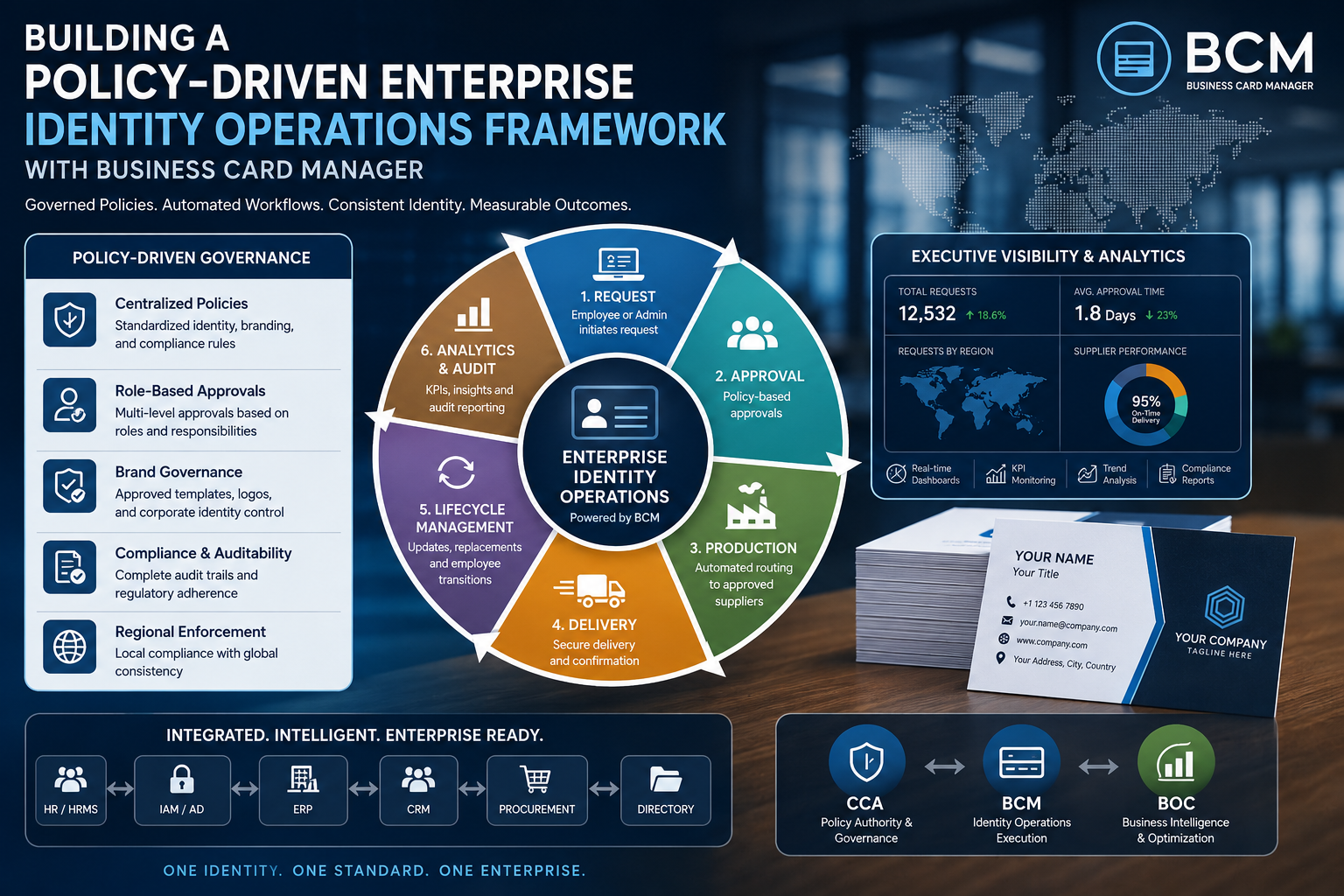
Business Card Manager (BCM) addresses these challenges by establishing a policy-driven enterprise identity operations framework. Rather than functioning as a simple business card ordering application, BCM serves as enterprise infrastructure that transforms approved identity information into governed, standardized, and auditable physical identity assets.
Within the broader enterprise ecosystem, Color Card Administrator (CCA) provides the governance and policy authority, Business Card Manager (BCM) executes controlled identity fulfillment, and Business Operations Center (BOC) delivers operational intelligence, executive reporting, and continuous optimization. Together, these platforms establish an integrated governance model capable of supporting global enterprises with complex organizational structures and regulatory requirements.
The Evolution of Enterprise Identity Operations
Business identity has traditionally been viewed as a marketing or administrative responsibility. Printing business cards was often delegated to local offices, departmental administrators, or external suppliers with minimal enterprise oversight.
That approach may have been sufficient when organizations operated within limited geographic regions and maintained relatively stable organizational structures. Today’s enterprises, however, operate across multiple countries, legal entities, regulatory jurisdictions, languages, and brands. Identity information changes continuously as employees join, transfer, receive promotions, assume temporary assignments, or exit the organization.
Every organizational change has implications for business identity.
A newly promoted executive requires updated credentials that accurately reflect their authority. Employees transferring between countries must comply with regional branding standards and local legal requirements. Mergers and acquisitions often require large-scale rebranding initiatives across thousands of employees within compressed timelines. Regulatory changes may necessitate modifications to legal disclaimers, certifications, or regional contact information.
Without centralized governance, these changes become difficult to coordinate consistently.
Consequently, organizations experience inconsistent branding, delayed fulfillment, duplicate procurement, uncontrolled vendor relationships, excessive operational costs, and fragmented audit records.
Modern enterprise identity operations therefore require a fundamentally different approach—one based on governance rather than transaction processing.
From Business Card Ordering to Enterprise Identity Governance
One of the most significant misconceptions surrounding business card management is that it represents a procurement activity rather than an identity governance process.
In reality, every business card represents an officially approved extension of enterprise identity.
Each printed card communicates:
- Corporate brand identity
- Organizational hierarchy
- Employee authority
- Geographic representation
- Regulatory compliance
- Customer trust
- Corporate reputation
Because of this, business card operations should follow governance principles comparable to those applied to financial approvals or access management.
A policy-driven operating model ensures that identity information originates from authoritative enterprise systems rather than manual data entry. Employee information is validated before production, approval workflows are enforced consistently, and every printed asset complies with approved enterprise standards.
This transformation fundamentally changes the role of CCA.
Instead of serving as a print ordering portal, CCA becomes an enterprise identity execution platform that converts governed employee information into standardized business identity assets while maintaining complete traceability throughout the lifecycle.
Characteristics of a Policy-Driven Identity Operations Framework
Successful enterprise identity governance is built upon clearly defined operational principles that extend across the complete employee lifecycle.
Centralized Governance
All identity policies should originate from a centralized governance model rather than individual departments.
This includes standardized rules governing:
- Employee naming conventions
- Corporate titles
- Business unit classifications
- Regional office information
- Contact information
- Brand templates
- Language requirements
- Legal disclaimers
- Supplier eligibility
By maintaining a single policy repository, organizations eliminate conflicting regional practices while preserving flexibility where local regulatory requirements exist.
Policy Before Process
Many organizations automate inefficient manual processes without addressing the underlying governance challenges.
Automation alone does not improve governance.
Instead, policies should define:
- Who may request business cards
- Which approvals are mandatory
- Which templates are authorized
- Which suppliers may fulfill requests
- Which regional variations are permitted
- Which exceptions require executive approval
Only after governance policies have been established should workflow automation be implemented.
This governance-first approach ensures that automation reinforces enterprise standards instead of accelerating inconsistent practices.
Identity as Enterprise Data
Identity information should never exist independently inside individual business card systems.
Instead, BCM consumes validated information originating from authoritative enterprise business card workflow automation platforms such as:
- Human Resource Information Systems
- Identity Management Systems
- Directory Services
- Enterprise Resource Planning
- Procurement Systems
- Organizational Hierarchies
- Regional Governance Repositories
This integration minimizes manual data entry while significantly improving data quality across the enterprise.
Integrating Identity Governance Across the Employee Lifecycle
Enterprise identity operations begin long before a business card is requested and continue long after an employee leaves the organization.
Every lifecycle event influences identity governance.
Employee Onboarding
During onboarding, approved employee information flows from HR systems into enterprise governance platforms.
Once managerial approvals are completed, BCM automatically identifies whether business cards are required, determines the appropriate template, validates branding policies, selects approved suppliers, and initiates fulfillment according to predefined governance rules.
The result is a standardized onboarding experience with minimal manual intervention.
Organizational Changes
Promotions, departmental transfers, regional relocations, and organizational restructuring frequently require updates to business identity assets.
Without centralized governance, these changes often rely upon employees remembering to request new business cards.
A policy-driven framework instead identifies qualifying organizational events automatically and initiates governed replacement workflows while preserving complete audit history.
Enterprise Workflow Orchestration: Converting Governance into Execution
Establishing governance policies is only the beginning of enterprise identity operations. The true value of Business Card Manager (BCM) emerges when these policies are translated into automated, repeatable, and measurable workflows that operate consistently across the organization.
In many enterprises, identity-related requests still move through informal channels such as emails, spreadsheets, instant messaging platforms, or regional coordinators. While these methods may appear convenient for individual requests, they become increasingly difficult to manage as organizations expand globally. Approval delays, inconsistent policy interpretation, duplicate requests, and limited visibility are common outcomes.
BCM replaces fragmented operational processes with enterprise workflow orchestration.
Every request follows a standardized lifecycle—from initiation through approval, production, fulfillment, delivery, and audit closure. Instead of relying on individual employees to understand organizational procedures, the platform embeds governance directly into the workflow itself.
This approach creates operational consistency while significantly reducing administrative overhead.
Role-Based Approval Framework
Not every business card request should follow the same approval path.
An entry-level employee requesting a standard business card does not require the same level of governance as a senior executive requesting customized branding, multilingual templates, or region-specific regulatory content.
A mature enterprise identity operations framework therefore applies role-based approval models.
Typical approval layers include:
- Employee self-service requests
- Manager approval
- Department head approval
- Marketing or brand governance approval
- Regional compliance review
- Procurement validation
- Executive authorization for policy exceptions
Each approval step is automatically determined based on enterprise policies rather than manual routing decisions.
This ensures that governance remains consistent regardless of organizational size or geographic location.
As enterprises continue to evolve, approval workflows can be modified centrally without disrupting business operations, allowing governance policies to adapt to organizational restructuring, acquisitions, or regulatory changes.
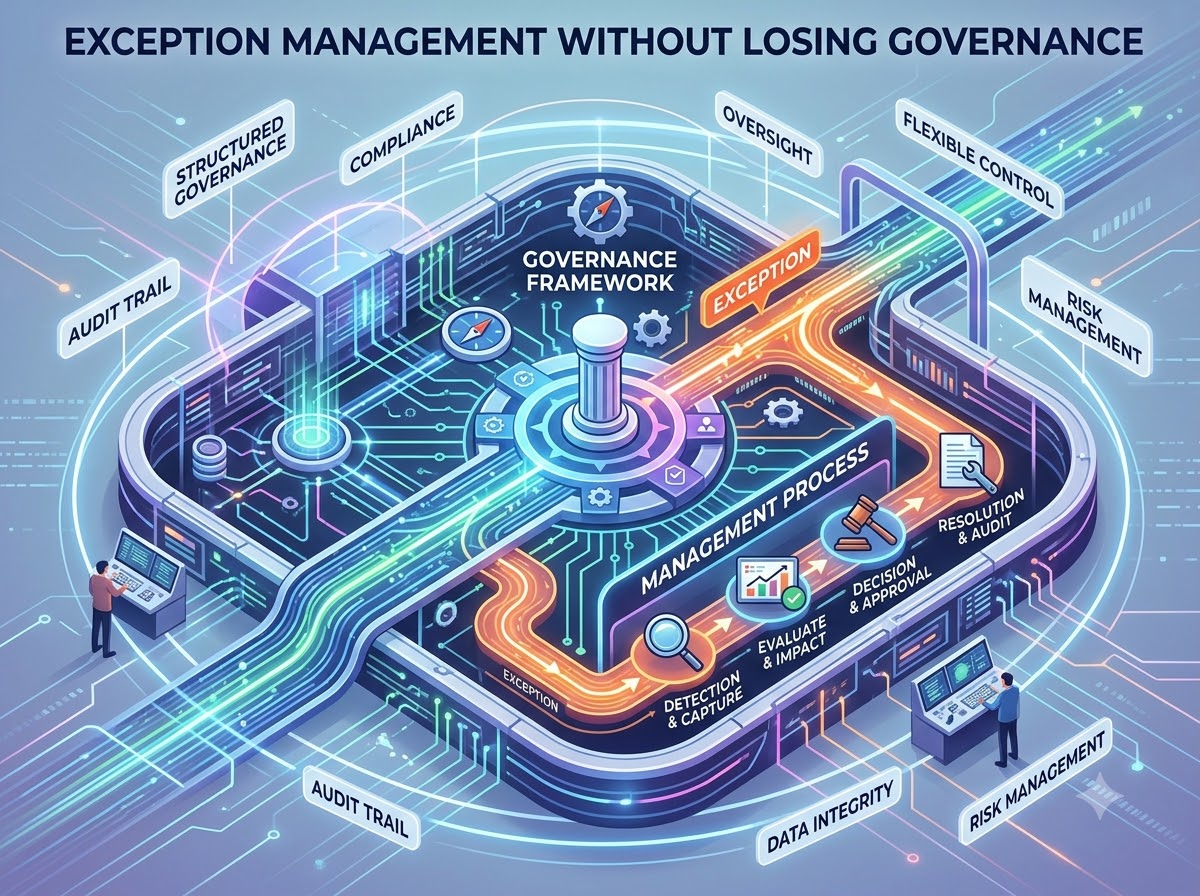
Exception Management Without Losing Governance
No enterprise policy can anticipate every operational scenario.
Executives attending international conferences, temporary project assignments, mergers and acquisitions, urgent customer engagements, or regional regulatory changes may require exceptions to standard business card policies.
The objective is not to eliminate exceptions but to govern them.
BCM provides structured exception management by ensuring that every deviation from established policy is:
- Formally requested
- Properly justified
- Approved by authorized stakeholders
- Fully documented
- Time-bound where appropriate
- Included within enterprise audit history
Rather than weakening governance, controlled exception management strengthens organizational accountability by ensuring that exceptions remain visible and measurable.
Procurement Governance as an Enterprise Capability
Business card operations involve far more than identity information.
They also represent procurement activities involving suppliers, inventory, pricing, contracts, regional vendors, shipping providers, and financial controls.
Without centralized procurement governance, organizations frequently experience:
- Duplicate supplier relationships
- Inconsistent pricing
- Unapproved vendors
- Local purchasing decisions
- Contract non-compliance
- Limited spending visibility
BCM addresses these challenges by integrating procurement governance directly into operational workflows.
Supplier selection is no longer determined by individual departments.
Instead, approved suppliers are selected based on enterprise procurement policies that consider:
- Geographic coverage
- Approved contracts
- Pricing agreements
- Production capabilities
- Brand certification
- Service-level agreements
- Regulatory compliance
- Performance history
Every fulfillment decision therefore aligns with broader enterprise sourcing strategies.
Supplier Lifecycle Governance
Suppliers should not simply be added to a purchasing list and forgotten.
Like employees, suppliers also have operational lifecycles.
Enterprise governance requires continuous evaluation of supplier performance using measurable criteria such as:
- Order accuracy
- Production quality
- Delivery performance
- Regional responsiveness
- Customer satisfaction
- Contract compliance
- Sustainability initiatives
- Security requirements
BCM maintains historical supplier performance information, enabling procurement teams to make informed sourcing decisions based on operational evidence rather than anecdotal feedback.
This creates a governance model in which supplier relationships continuously improve through measurable performance management.
Regional Policy Enforcement
Global enterprises rarely operate under a single set of business identity requirements.
Different countries often require:
- Local languages
- Regional legal disclaimers
- Country-specific certifications
- Alternative address formats
- Local telephone conventions
- Cultural design considerations
- Government registration information
Attempting to manage these variations manually introduces unnecessary complexity and increases compliance risk.
BCM addresses this challenge through configurable regional policy enforcement.
Enterprise administrators define global governance standards while allowing controlled regional flexibility where legitimate business or regulatory requirements exist.
This balance between standardization and localization enables multinational organizations to maintain a consistent corporate identity without compromising regional compliance.
Brand Governance at Scale
Every employee-facing identity asset contributes to the organization’s public image.
When branding standards differ between business units or geographic regions, customers receive inconsistent impressions of the organization.
Brand governance therefore extends beyond graphic design.
It includes:
- Approved corporate logos
- Typography standards
- Color specifications
- Position titles
- Organizational naming conventions
- Contact information standards
- Regional branding rules
- Template version control
BCM ensures that every business card is generated using approved enterprise templates.
Unauthorized modifications are prevented through centralized template management, while approved updates become immediately available across the enterprise.
This eliminates the gradual brand inconsistency that often develops when local offices independently manage identity materials.
Enterprise Compliance and Audit Readiness
Regulatory expectations continue to increase across nearly every industry.
Organizations are expected to demonstrate not only compliance but also evidence of governance.
For business identity operations, this means maintaining complete visibility into every decision made throughout the lifecycle of an identity asset.
BCM creates comprehensive audit records covering:
- Request creation
- Employee information validation
- Policy evaluations
- Approval decisions
- Exception authorizations
- Supplier selection
- Production status
- Delivery confirmation
- Replacement history
- Retirement or cancellation events
These records support internal governance reviews, external audits, regulatory inspections, and organizational risk assessments.
Instead of reconstructing historical information from disconnected systems, enterprises maintain a single authoritative operational history.
Integration with the CCA–BCM–BOC Enterprise Governance Ecosystem
The greatest value of Business Card Manager is realized when it operates as part of a broader governance architecture rather than as an isolated operational application.
Within this enterprise framework:
Color Card Administrator (CCA)
CCA functions as the Authority Engine.
It establishes governance policies, identity standards, approval rules, branding requirements, organizational hierarchies, and policy enforcement mechanisms that define how enterprise identity should be managed.
Business Card Manager (BCM)
BCM serves as the Conversion Engine.
It transforms approved enterprise identity information into governed operational outcomes through automated workflows, procurement integration, supplier coordination, lifecycle management, and standardized fulfillment.
Business Operations Center (BOC)
BOC provides Operational Intelligence.
It aggregates enterprise metrics, monitors operational performance, identifies workflow bottlenecks, tracks supplier performance, measures governance effectiveness, and delivers executive dashboards that support continuous improvement.
Together, these platforms establish a closed-loop governance model:
Governance → Execution → Visibility → Continuous Improvement
This integrated architecture enables enterprises to scale identity operations confidently while maintaining policy consistency, operational efficiency, and executive oversight.
Executive Analytics: Measuring the Health of Enterprise Identity Operations
Enterprise governance cannot rely solely on policies and workflows. Executive leadership requires measurable evidence that governance objectives are being achieved consistently across the organization.
Business Card Manager (BCM) transforms operational activities into actionable business intelligence by capturing data throughout every stage of the identity lifecycle. Instead of viewing business card operations as isolated transactions, executives gain visibility into organizational performance, compliance, procurement efficiency, and operational maturity.
Comprehensive analytics enable organizations to answer critical governance questions, including:
- How many requests are processed across each business unit?
- Which approval stages contribute most to processing delays?
- Which suppliers consistently achieve contractual service levels?
- How frequently are policy exceptions requested?
- Which regions experience the highest rework rates?
- Are branding standards being applied consistently across all locations?
- How efficiently are onboarding and offboarding processes executed?
By monitoring these indicators, executive leadership can identify systemic issues before they become operational risks.
Key Performance Indicators for Enterprise Identity Operations
A mature governance framework should include a balanced set of operational and strategic KPIs. Examples include:
Governance KPIs
- Policy compliance rate
- Approval cycle adherence
- Exception request frequency
- Audit completion status
- Identity accuracy rate
Operational KPIs
- Average request processing time
- Production turnaround time
- Delivery performance
- First-time-right fulfillment percentage
- Rework and replacement rates
Procurement KPIs
- Spend by supplier
- Contract utilization
- Cost per order
- Regional procurement consistency
- Supplier SLA compliance
Brand Governance KPIs
- Template adoption rate
- Brand compliance score
- Unauthorized modification attempts
- Regional branding consistency
These metrics provide executives with a comprehensive understanding of how enterprise identity operations contribute to organizational performance.
AI-Assisted Identity Operations
As enterprises adopt artificial intelligence across business functions, identity operations present significant opportunities for intelligent automation. AI should enhance governance—not replace it.
Within BCM, AI can support activities such as:
- Predicting approval bottlenecks based on historical workflow data
- Recommending optimal suppliers based on performance and regional availability
- Detecting anomalies in identity requests
- Identifying duplicate or conflicting submissions
- Forecasting procurement demand
- Highlighting policy violations before fulfillment begins
- Assisting administrators with governance recommendations
Importantly, AI-generated recommendations remain subject to enterprise policies and human oversight. Governance decisions continue to be made by authorized stakeholders, ensuring accountability while benefiting from intelligent operational insights.
Measuring Identity Governance Maturity
Organizations evolve through distinct stages of governance maturity. Understanding the current maturity level helps define priorities for continuous improvement.
Level 1 – Manual Administration
Business card requests are managed through emails, spreadsheets, or local coordinators with limited visibility and inconsistent governance.
Level 2 – Standardized Workflows
Basic approval workflows and standardized templates are introduced, improving consistency but still relying on manual coordination.
Level 3 – Policy-Driven Governance
Enterprise policies define approval rules, supplier selection, branding standards, and lifecycle management. Automation reinforces governance rather than replacing it.
Level 4 – Integrated Identity Operations
BCM integrates with HRMS, IAM, ERP, CRM, procurement, and directory services, creating a unified identity operations platform.
Level 5 – Intelligent Governance
Advanced analytics, AI-assisted recommendations, predictive reporting, and continuous optimization enable proactive governance across the enterprise.
Organizations should view governance maturity as a journey of continuous improvement rather than a one-time implementation.
Enterprise Implementation Roadmap
Successful implementation of a policy-driven identity operations framework requires a structured approach.
Phase 1: Governance Assessment
Document current processes, stakeholders, systems, suppliers, and governance gaps. Establish executive sponsorship and define measurable objectives.
Phase 2: Policy Definition
Develop standardized policies covering identity data, approval hierarchies, branding standards, procurement rules, supplier management, regional variations, and exception handling.
Phase 3: Platform Integration
Integrate BCM with authoritative enterprise systems including HRMS, IAM, ERP, CRM, procurement platforms, and directory services to ensure identity data remains accurate and synchronized.
Phase 4: Workflow Automation
Configure role-based workflows, automated notifications, exception management, supplier selection, and audit logging. Validate processes through pilot deployments before enterprise rollout.
Phase 5: Analytics and Continuous Improvement
Establish executive dashboards, monitor KPIs, evaluate supplier performance, review governance metrics, and refine policies based on operational evidence.
The Future of Enterprise Identity Operations
Business identity will continue to evolve as organizations embrace hybrid workforces, digital collaboration, global expansion, and AI-driven operations.
Future enterprise identity platforms will increasingly provide:
- Dynamic synchronization of identity information across multiple communication channels
- Intelligent policy recommendations
- Predictive operational analytics
- Real-time compliance monitoring
- Automated supplier optimization
- Integrated digital and physical identity management
- Enterprise-wide governance reporting
Business Card Manager is positioned to support this evolution by serving as a governance-first operational platform rather than a transactional ordering application.
Conclusion
Enterprise identity operations deserve the same governance discipline applied to finance, procurement, security, and regulatory compliance.
Business cards are more than printed materials—they represent official corporate identity, organizational authority, and brand integrity. Managing these assets through fragmented manual processes introduces unnecessary operational risk and undermines enterprise governance.
Business Card Manager provides a policy-driven framework that centralizes identity operations, automates governance, standardizes workflows, integrates procurement, strengthens auditability, and delivers executive visibility.
Working alongside Color Card Administrator (CCA) as the authority engine and Business Operations Center (BOC) as the operational intelligence platform, BCM enables organizations to transform business card management into a strategic enterprise capability.
For organizations seeking consistent governance, operational efficiency, and scalable identity management, a policy-driven enterprise identity operations framework is no longer optional—it is a foundational component of modern digital transformation.