

Why Global Enterprises Need Policy Orchestration For Business Card Governance
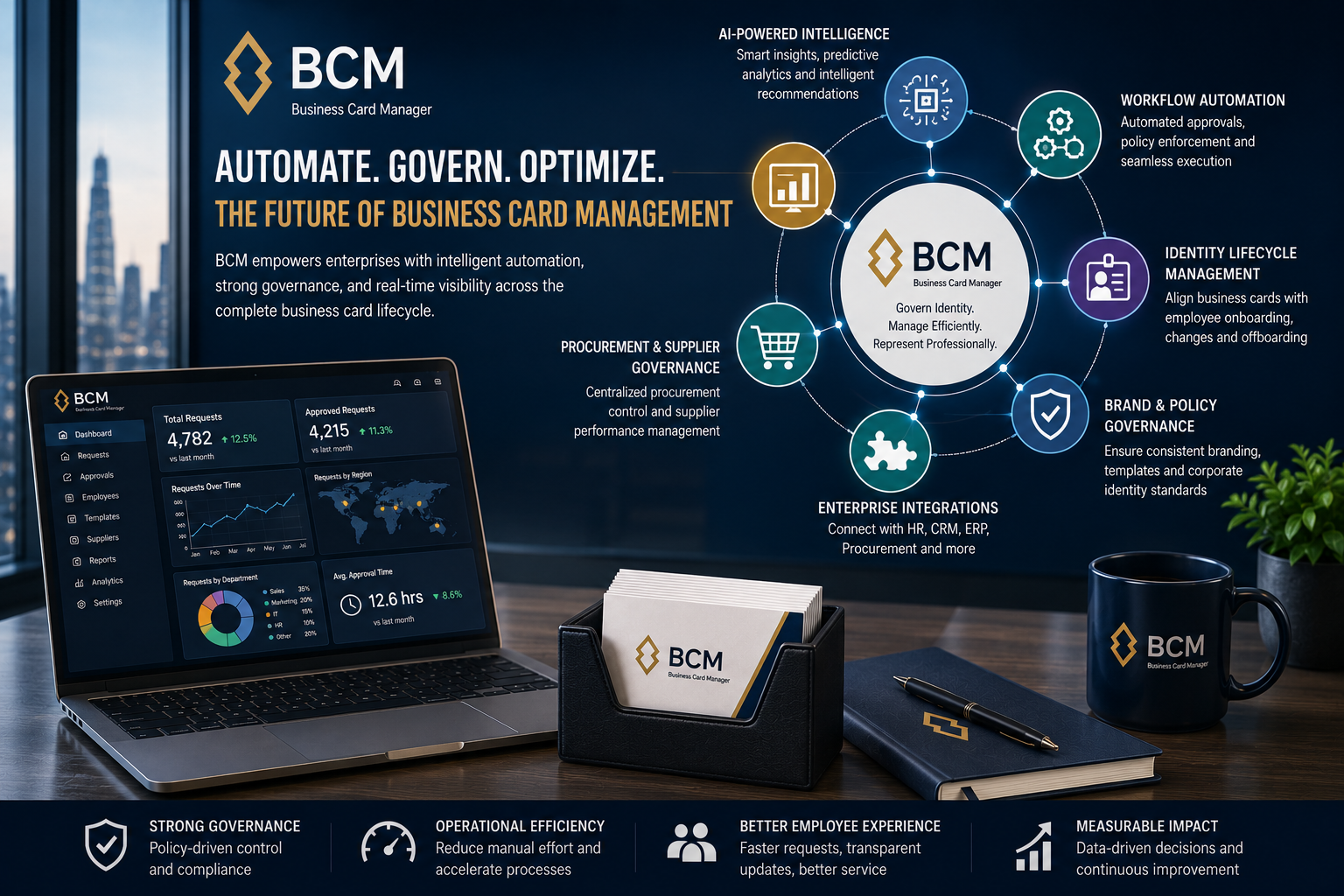
Global enterprises operate through a complex combination of corporate standards, legal entities, business units, regional requirements, local languages, supplier networks, and approval structures. Business cards sit at the intersection of all of these elements. They communicate employee identity, enterprise branding, contact information, legal representation, and regional presence in a single customer-facing asset.
When business card management is decentralized, global organizations often rely on regional templates, local vendors, email approvals, and informal exceptions. This creates a difficult governance problem: the enterprise needs consistency, but local operations still require flexibility. Standardization without regional awareness becomes impractical, while local freedom without centralized control weakens the brand and increases procurement, compliance, and identity risks.
Business Card Manager (BCM) resolves this tension through policy for enterprise workflow orchestration. BCM does not force every employee and region into one rigid process. Instead, it converts enterprise policy into configurable workflows that determine which templates, data fields, approvals, suppliers, languages, quantities, and exceptions apply in each business context.
This article explains why policy orchestration is becoming essential for global business card governance and how BCM enables multinational organizations to balance enterprise control with approved regional variation.
Introduction
Global governance is rarely achieved by publishing a single policy document. It requires thousands of operational decisions to follow that policy consistently across countries, departments, employees, suppliers, and lifecycle events.
Business card management illustrates this challenge clearly. A global organization may want one recognizable brand, but its business cards may need to accommodate local addresses, regulatory disclosures, translated titles, country-specific contact formats, multiple legal entities, and approved cultural conventions.
If every region creates its own process, the enterprise loses control. If headquarters attempts to manage every request manually, the process becomes slow and difficult to scale.
The solution is policy orchestration: a governed operating model that translates enterprise rules into context-aware execution.
Why Global Business Card Governance Is Complex
At a small scale, business card management may appear straightforward. A user selects a template, enters contact information, obtains approval, and sends the order to a printer. At enterprise scale, each of those steps becomes a governance decision.
A single multinational organization may need to manage different brands, subsidiaries, job-title conventions, office formats, languages, currencies, tax requirements, suppliers, approval thresholds, and delivery expectations. Employees may serve more than one market, hold matrix roles, or represent different legal entities depending on the customer engagement.
These variables create operational complexity that cannot be governed effectively through email and spreadsheets. The enterprise requires a system capable of applying the correct policy to each request without asking employees to interpret the policy themselves.
Policy Orchestration Converts Standards into Execution
Policies are valuable only when they influence operational behavior. Traditional policy documents describe what should happen, but they often leave employees and administrators responsible for deciding how to apply the rules in individual situations.
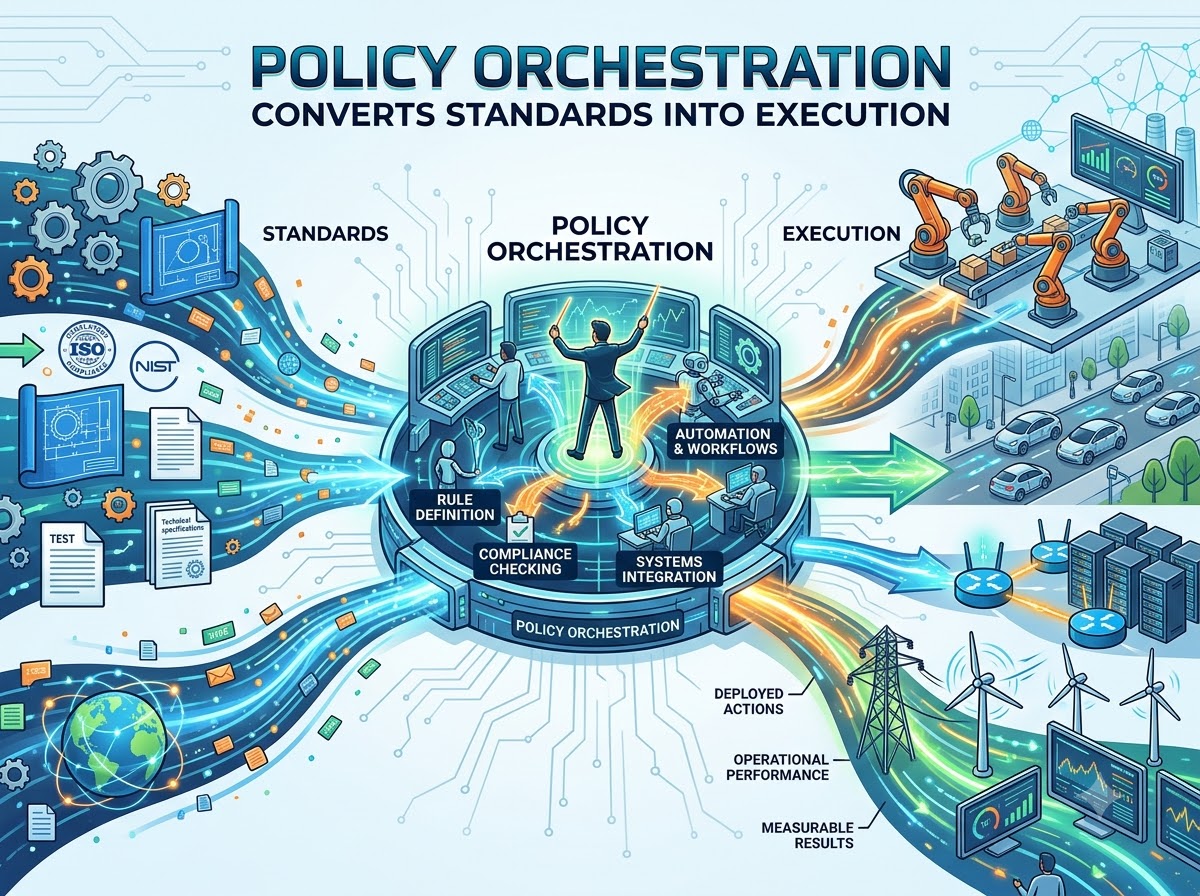
BCM converts policy into workflow logic. Based on the employee, region, role, cost center, business unit, and request type, the platform can determine the appropriate template, required fields, approval route, supplier, quantity limit, and production specification.
This approach moves governance away from memory and interpretation. Employees no longer need to know every branding or procurement rule. The system applies the approved rule at the point of execution.
One Enterprise Standard, Multiple Approved Variations
Global consistency does not require every business card to be identical. It requires every variation to be intentional, approved, and governed.
For example, an organization may maintain one core visual identity while allowing regional variations for language, legal disclosures, address structure, telephone formatting, professional credentials, or local brand requirements. These variations should not be treated as uncontrolled customization. They should exist as approved policy branches within a common business card governance architecture.
BCM supports this model by separating enterprise standards from regional configuration. Headquarters defines the non-negotiable elements, while authorized regional teams manage permitted local variations within established boundaries.
Role-Based Governance and Approval Routing
Not every request carries the same level of risk. A standard replacement order for an existing employee should not require the same scrutiny as an executive title change, a new legal entity, or a policy exception.
BCM enables role-based approval workflow routing that reflects organizational authority. Standard requests may follow simplified workflows, while sensitive changes can involve managers, Human Resources, Marketing, Legal, Procurement, or regional leadership.
This improves both speed and control. Low-risk requests move efficiently, while higher-risk requests receive the oversight they require. Governance becomes proportionate rather than bureaucratic.
Exception Management Is a Core Governance Capability
Global organizations cannot eliminate exceptions. New markets, executive requirements, mergers, customer-facing initiatives, regulatory changes, and urgent events will occasionally create legitimate needs outside standard policy.
The governance problem is not the existence of exceptions. The problem is unmanaged exceptions that occur through private email, local vendor instructions, or unauthorized template changes.
BCM provides a structured exception process. Requests can capture the reason, business justification, requested deviation, approving authority, validity period, and final decision. This creates accountability while preserving the flexibility required by complex organizations.
Over time, exception analytics also reveal where enterprise policy may need improvement. A recurring exception may indicate that a regional requirement should become an approved configuration rather than remain an ad hoc deviation.
Global Supplier Governance
Policy orchestration must extend into production and fulfillment. Even perfectly approved business card content can lose consistency if suppliers apply different materials, dimensions, colors, finishes, packaging, or quality standards.
BCM connects approved requests with authorized suppliers and production specifications. Supplier assignment can be based on region, language, contract, delivery location, service level, environmental policy, or order volume.
This allows Procurement to consolidate spend and evaluate performance while giving regional operations access to suppliers capable of meeting local requirements. Global governance is maintained without forcing every country into an impractical single-vendor model.
Identity Data Must Follow the Employee Lifecycle
Business card policy orchestration depends on trusted employee data. Names, titles, departments, addresses, contact details, legal entities, and cost centers should come from authoritative enterprise sources wherever possible.
When BCM integrates with HR, identity, CRM, ERP, and procurement systems, organizational changes can trigger the appropriate governed workflow. A promotion, transfer, relocation, brand update, or departure becomes an enterprise event rather than a manual business card task.
This reduces duplicate data entry and ensures that regional flexibility never compromises identity accuracy.
Compliance, Auditability, and Evidence
Global enterprises must demonstrate that policies are not only documented but followed. BCM creates an auditable record of the request, data source, template, approvals, exception decisions, supplier assignment, production status, and delivery confirmation.
This evidence supports internal audits, brand reviews, procurement oversight, and compliance investigations. Instead of reconstructing decisions from emails, the organization can see which rule was applied, who approved the outcome, and whether the request remained within policy.
Auditability turns business card governance into a defensible enterprise process.
Analytics Reveal How Policy Performs
Policy orchestration generates operational intelligence. BCM dashboards can show request volumes by region, approval cycle times, exception rates, supplier performance, procurement expenditure, template adoption, and recurring data-quality issues.
Executives can determine whether global standards are being adopted, where local complexity is increasing, and which workflows require redesign. Regional leaders can compare service levels and identify bottlenecks. Procurement can evaluate supplier concentration and contract compliance.
This makes policy measurable. Governance is no longer judged only by whether a standard exists, but by how effectively the standard operates across the enterprise.
BCM as the Enterprise Conversion Engine
Within the broader enterprise governance model, Color Card Administrator (CCA) functions as the authority engine. It defines and governs identity standards, approval authority, brand rules, and enterprise policy.
Business Card Manager (BCM) serves as the conversion engine. It takes approved identity and policy, applies the correct context, and converts that authority into a controlled business card request, production order, and customer-facing identity asset.
Business Operations Center (BOC) provides the operational visibility layer through workflow monitoring, analytics, executive reporting, and process optimization.
Together, CCA, BCM, and BOC create a connected governance architecture in which authority, enterprise execution, and operational intelligence reinforce one another.
Preparing for Intelligent Policy Orchestration
The next stage of enterprise governance will combine policy automation with AI-assisted decision support. Intelligent systems may identify unusual exceptions, recommend approval routes, detect inconsistent identity data, forecast supplier demand, and highlight regions where policies are generating unnecessary friction.
However, intelligence must remain subordinate to enterprise authority. AI can recommend, detect, and prioritize, but the organization must continue to define policy, accountability, and approval rights.
BCM provides the governed workflow foundation required for this future. Intelligent capabilities become valuable because they operate within structured policy rather than outside it.
Conclusion
Global business card governance is not achieved through one universal template or one centralized approval inbox. It requires an operating model capable of applying enterprise standards across different regions, roles, legal entities, suppliers, and business situations.
Business Card Manager enables this operating model through policy orchestration. It converts governance standards into context-aware workflows, supports approved regional variation, manages exceptions, integrates supplier and procurement controls, maintains audit evidence, and provides executive visibility.
The result is not simply more consistent business cards. It is a scalable enterprise identity process that balances control, flexibility, speed, and accountability.
For global organizations, policy orchestration is the difference between publishing standards and executing them reliably.
The Enterprise Governance Model
| CCA — Authority Engine | BCM — Conversion Engine | BOC — Visibility Engine |
|---|---|---|
| Defines identity standards, policy, approval authority, and brand rules. | Applies approved policy to requests, templates, suppliers, and fulfillment. | Monitors execution through dashboards, analytics, exceptions, and optimization. |