

From Automation to Intelligence: How AI Can Strengthen Enterprise Business Card Governance
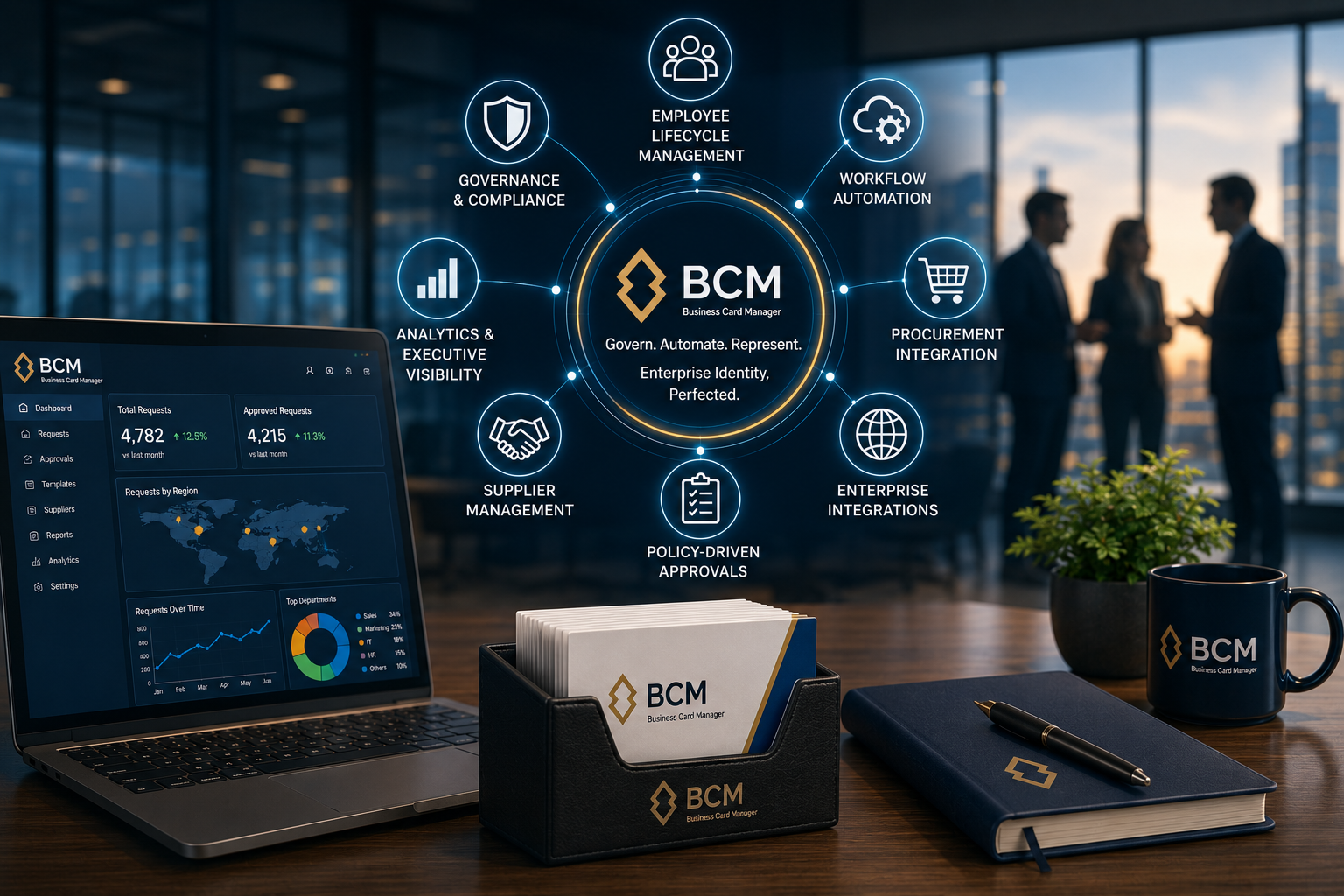
Enterprise business card management has already moved beyond printing. It now connects employee identity, brand standards, approval policies, procurement controls, supplier execution, and executive reporting. The next stage of maturity is not automation alone, but governed intelligence. Artificial intelligence can help enterprises identify workflow delays, detect policy exceptions, forecast demand, recommend routing decisions, and surface operational risks before they become expensive problems. Yet AI must not replace accountability. In a governance-first model, enterprise policy remains authoritative, human decision-makers retain control, and AI assists with insight, prioritization, and consistency. Business Card Manager (BCM) provides the conversion layer through which approved identity and policy become controlled business card outcomes. By combining BCM workflows with AI-assisted analytics and human oversight, organizations can improve speed without weakening governance, strengthen compliance without creating friction, and scale business card operations across regions while preserving enterprise control.
Introduction
Enterprise adoption of artificial intelligence is accelerating across customer service, finance, procurement, human resources, operations, and digital workplace platforms. In many organizations, the first objective is speed: reduce manual work, shorten response times, and automate repetitive decisions. But speed without governance can magnify inconsistency. When AI is introduced into processes that contain unclear policies, fragmented data, or weak accountability, the technology may scale the problem rather than solve it.
Business card management offers a practical example. What appears to be a simple request-to-print process actually depends on trusted employee data, approved job titles, brand rules, legal entity requirements, budget controls, supplier agreements, regional variations, and auditable approvals. BCM already connects these elements through governed workflow execution. AI can strengthen that operating model, but only when intelligence is applied within clearly defined enterprise boundaries.
Why Automation Alone Is No Longer Enough
Traditional workflow automation follows predefined rules. A request is submitted, routed to an approver, validated against a template, sent to a supplier, and tracked through fulfillment. This is essential, but it remains largely reactive. The workflow responds after an event occurs.
Intelligent governance introduces a more proactive layer. Instead of merely moving a request from one step to the next, the system can recognize patterns, identify anomalies, predict delays, and recommend the most appropriate action. For example, it may detect that a specific approval path consistently creates bottlenecks, that a regional supplier is missing delivery targets, or that replacement-card demand has increased unusually within one business unit.
The objective is not to allow an algorithm to control enterprise identity. The objective is to help governance teams see more clearly and intervene earlier.
AI-Assisted Request Validation
Business card requests frequently contain preventable errors: incorrect titles, inconsistent abbreviations, unsupported phone formats, outdated office addresses, or unauthorized brand variations. Manual reviewers can identify these issues, but high request volumes make consistency difficult.
AI-assisted validation can compare a request against authoritative sources and established policies. It can flag unusual title structures, conflicting employee data, missing required fields, or content that differs from approved regional standards. The request can then be returned for correction or escalated to an authorized reviewer.
This approach strengthens governance because the final decision remains policy-based. AI identifies the potential issue; enterprise rules and accountable users determine the outcome.
Intelligent Workflow Routing
Large enterprises rarely use one universal approval process. Routing may depend on employee level, geography, business unit, cost center, card quantity, legal entity, language, or requested exception. Static routing rules can become difficult to maintain as organizations change.
AI can assist by recommending the most efficient compliant pathway based on historical patterns and current organizational data. A standard request with validated information may move through an expedited path, while a high-risk exception is directed to brand, legal, or procurement stakeholders. Requests approaching service-level thresholds can be prioritized before delays affect the employee experience.
Importantly, intelligent routing should operate within approved policy boundaries. It should not invent new authorization structures or bypass required controls. The enterprise defines what is permissible; AI helps execute those requirements more efficiently.
Predictive Demand and Capacity Planning
Business card demand follows identifiable enterprise events. Hiring campaigns, sales expansion, mergers, office relocations, rebranding initiatives, and conference activity can all create predictable increases in volume. Without forecasting, procurement and suppliers often respond after demand has already increased.
By analyzing historical request patterns alongside employee lifecycle and operational data, AI-assisted forecasting can help organizations estimate future demand by region, department, or card type. Procurement teams can plan budgets more accurately. Suppliers can prepare production capacity. Administrators can anticipate approval workload. Marketing teams can coordinate template changes before major organizational events.
Predictive planning converts business card management from a sequence of transactions into a more resilient enterprise service.
Anomaly Detection and Risk Identification
Governance risks are often visible in patterns before they become visible in individual cases. A sudden increase in replacement requests may indicate an organizational change, poor data quality, or unauthorized local ordering. Repeated policy exceptions may show that a template no longer meets business needs. Unusual ordering volumes may point to budget misuse or process circumvention.
AI-assisted anomaly detection can surface these deviations for review. Useful signals may include:
- Requests significantly above normal quantity thresholds
- Repeated exceptions from the same department or region
- Supplier delivery times that deteriorate over several cycles
- Use of legacy templates after a brand transition
- Orders associated with inactive or departing employees
- Unexpected cost differences across similar requests
These alerts do not establish wrongdoing. They help governance teams focus their attention where further review is most valuable.

AI and Procurement Governance
Procurement governance becomes more effective when data from suppliers, contracts, order history, delivery performance, and cost centers is analyzed together. AI can help identify price variance, forecast supplier capacity, detect contract leakage, and recommend opportunities for vendor consolidation.
For example, the platform may reveal that two regions are ordering comparable card specifications at materially different costs, or that one supplier consistently performs well for standard orders but underperforms for multilingual formats. Procurement teams can use these insights during supplier reviews and contract negotiations.
BCM remains the governed execution layer. Supplier selection, purchasing authority, and contractual decisions continue to belong to the enterprise. AI provides evidence that supports those decisions.
Human-in-the-Loop Governance Is Non-Negotiable
Enterprise identity decisions can affect brand credibility, legal representation, employee roles, and customer trust. For that reason, AI should not become the final authority for sensitive exceptions or policy changes.
A human-in-the-loop model ensures that accountable stakeholders review decisions with meaningful business impact. AI may recommend, prioritize, or explain, but authorized users approve exceptions, modify policies, and resolve conflicts between data sources.
This model also creates a feedback cycle. Reviewer decisions can improve future recommendations while preserving a clear audit trail of who made the final determination and why.
Explainability, Auditability, and Trust
AI-assisted governance must be explainable enough for enterprise users to understand why a request was flagged, prioritized, or routed differently. A recommendation such as “high risk” is not sufficient by itself. The platform should identify the relevant reason: conflicting title data, unusual order quantity, policy exception, supplier delay risk, or deviation from an approved template.
Every significant AI-assisted action should be captured in the audit history together with the underlying request, rule, recommendation, user response, and final outcome. This preserves accountability and supports internal audit, compliance review, and continuous improvement.
Trust grows when users can see that intelligence is assisting governance rather than operating as an invisible decision-maker.
Data Quality Determines AI Quality
AI cannot compensate for unreliable enterprise data. If job titles are inconsistent, office records are outdated, supplier information is incomplete, or approval roles are unclear, recommendations will inherit those weaknesses.
Successful adoption therefore begins with governance foundations: authoritative employee data, controlled templates, documented policies, approved suppliers, consistent lifecycle events, and reliable audit records. BCM helps create this structured operational environment. Once the foundation is established, AI can generate more meaningful and defensible insights.
BCM as the Conversion Engine for Intelligent Governance
Within the broader enterprise governance architecture, CCA, BCM, and BOC play distinct but complementary roles.
- Color Card Administrator (CCA) acts as the authority engine, defining identity standards, approval policies, organizational rules, and brand controls.
- Business Card Manager (BCM) operates as the conversion engine, transforming approved identity and policy into governed business card requests, production instructions, supplier actions, and completed assets.
- Business Operations Center (BOC) provides the operational intelligence layer, monitoring workflows, performance, exceptions, service levels, and enterprise outcomes.
AI strengthens this ecosystem when it respects the hierarchy. Authority originates from enterprise policy. BCM executes the approved outcome. BOC reveals operational performance. Intelligent recommendations support each layer without confusing their responsibilities.
A Practical Adoption Roadmap
Organizations do not need to begin with fully autonomous processes. A phased approach is more appropriate for governance-sensitive operations.
Phase 1: Establish Governed Data and Workflows
Standardize templates, employee data sources, approval roles, supplier assignments, procurement rules, and lifecycle records.
Phase 2: Introduce Descriptive Intelligence
Use dashboards to understand request volumes, approval times, compliance rates, supplier performance, and exception patterns.
Phase 3: Add Predictive and Anomaly Insights
Forecast demand, identify unusual activity, and surface emerging workflow or supplier risks.
Phase 4: Enable Assisted Recommendations
Recommend routing, prioritization, and corrective actions while maintaining human approval for material decisions.
Phase 5: Continuously Govern the Intelligence Layer
Review recommendation quality, user feedback, audit outcomes, data quality, and policy alignment on an ongoing basis.
The Future of Enterprise Business Card Governance
The future is not a fully automated printing process. It is a connected governance capability in which employee identity, organizational authority, workflow execution, procurement, supplier performance, and executive intelligence operate together.
AI will help enterprises anticipate rather than merely react. It will help administrators identify hidden process friction, procurement teams detect cost opportunities, marketing teams monitor brand adoption, and executives understand the operational impact of organizational change.
The organizations that benefit most will be those that treat AI as a governed capability rather than a shortcut. Strong policy, trusted data, human accountability, and transparent execution will remain the foundation.
Conclusion
Business card management has evolved from decentralized printing into an enterprise identity and workflow discipline. The next stage is governed intelligence.
AI can strengthen BCM by improving validation, routing, forecasting, anomaly detection, supplier analysis, and executive visibility. But intelligence must remain subordinate to enterprise authority. Policies should define the boundaries, human stakeholders should retain accountability, and every recommendation should be explainable and auditable.
With this governance-first approach, Business Card Manager enables organizations to improve speed without sacrificing control, increase automation without weakening oversight, and scale business card operations while protecting enterprise identity.