

Why Executive Dashboards Are Essential for Enterprise Business Card Governance
Introduction
Modern enterprises rely heavily on analytics.
Executives monitor:
- Financial performance
- Customer acquisition
- Employee productivity
- Procurement expenditure
- Operational efficiency
- Regulatory compliance
- Information security
- Digital transformation initiatives
These metrics guide strategic decisions across the organization.
Yet business card management frequently remains invisible.
Most organizations know how many cards they order each year.
Very few understand:
- Which departments generate the highest demand
- Which suppliers deliver most efficiently
- How long approvals require
- Whether brand policies are consistently followed
- How employee lifecycle changes affect request volumes
- Which operational bottlenecks delay fulfillment
Without meaningful analytics, business card management remains reactive rather than strategic.
Business Card Manager changes this by placing executive visibility at the center of enterprise governance.
Governance Begins with Visibility
Governance requires more than policies.
Organizations must verify that policies are consistently followed.
Without operational visibility:
- Compliance cannot be measured.
- Procurement cannot be optimized.
- Bottlenecks remain hidden.
- Operational risks increase.
- Continuous improvement becomes difficult.
Executive dashboards provide leadership with real-time insight into how business card governance operates across the enterprise.
Rather than relying on periodic manual reports, executives gain immediate visibility into operational performance.
This allows governance to become proactive instead of reactive.
From Operational Data to Executive Intelligence
Every business card request generates valuable operational information.
Examples include:
- Employee information
- Department
- Business unit
- Geographic location
- Approval history
- Template selection
- Procurement activity
- Supplier assignment
- Production status
- Delivery confirmation
Individually, these records appear transactional.
Collectively, they reveal enterprise trends.
Business Card Manager converts operational transactions into executive intelligence by consolidating lifecycle information into centralized dashboards that support enterprise decision-making.
Measuring Employee Lifecycle Activity
Business card requests closely follow employee lifecycle events.
Analytics can therefore provide valuable insight into organizational activity.
Examples include:
Employee Onboarding
Growth in business card requests often reflects hiring activity across departments and regions.
Promotions
Replacement requests may indicate organizational expansion, leadership appointments, or internal restructuring.
Department Transfers
Business card updates frequently correspond with changes in organizational structure.
Office Relocations
Regional expansion becomes visible through changes in office-specific request volumes.
Offboarding
Lifecycle reporting ensures business card governance remains aligned with employee departures.
These insights help leadership understand organizational dynamics beyond traditional HR reporting.
Procurement Analytics Improve Financial Governance
Business cards represent recurring procurement activity.
Executive dashboards enable procurement teams to analyze:
- Total procurement expenditure
- Spending by business unit
- Regional purchasing patterns
- Vendor utilization
- Contract compliance
- Cost per request
- Procurement trends
- Budget allocation
Rather than managing suppliers through periodic reviews, procurement leaders gain continuous visibility into purchasing performance.
This improves supplier negotiations, budgeting accuracy, and procurement governance.
Approval Analytics Reveal Workflow Efficiency
Approval workflows play an important role in governance.
However, approvals that become excessively slow create operational friction.
BCM enables organizations to monitor:
- Average approval duration
- Department-specific approval times
- Manager workload
- Escalation frequency
- Pending requests
- Workflow bottlenecks
These metrics allow administrators to refine workflows without weakening governance.
The objective is not simply faster approvals.
The objective is efficient governance supported by measurable operational performance.
Brand Compliance Metrics Strengthen Enterprise Identity
Enterprise branding requires continuous oversight.
Business cards provide one of the most visible representations of organizational identity.
Executive dashboards help monitor:
- Approved template usage
- Regional brand consistency
- Legacy template utilization
- Exception requests
- Unauthorized modifications
- Compliance trends over time
Marketing and governance teams gain confidence that every business card accurately represents the organization’s approved visual identity.
Brand governance becomes measurable rather than assumed.
Supplier Performance Dashboards
Vendor management extends beyond procurement cost.
Organizations should evaluate suppliers using multiple performance indicators.
BCM enables reporting across:
- Production quality
- Delivery performance
- Service responsiveness
- Order accuracy
- Geographic coverage
- Contract compliance
- Fulfillment timelines
Supplier scorecards help procurement teams strengthen vendor relationships while identifying opportunities for operational improvement.
Rather than selecting vendors solely based on price, organizations evaluate suppliers through measurable performance.
Operational Transparency Across the Enterprise
One of the greatest advantages of executive dashboards is transparency.
Leadership gains visibility across:
- Human Resources
- Procurement
- Marketing
- Operations
- Regional offices
- Business units
- Suppliers
Rather than relying on disconnected departmental reports, BCM provides a unified operational view of enterprise business card governance.
This transparency supports better collaboration while strengthening enterprise accountability.
Executive KPI Dashboards for Enterprise Leadership
Enterprise leaders require concise, meaningful metrics that reflect organizational performance without overwhelming them with operational detail.
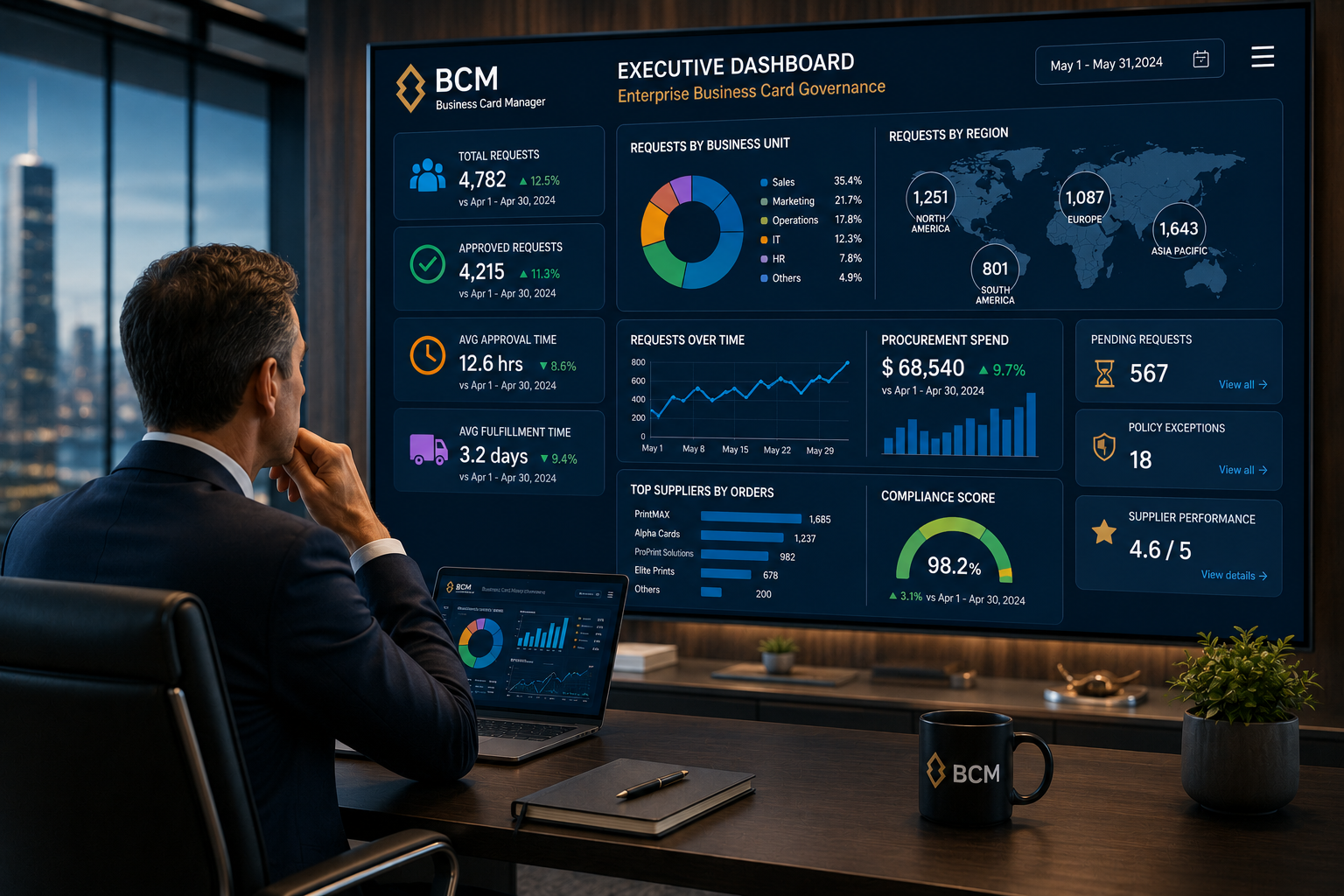
Business Card Manager (BCM) provides configurable executive dashboards that present Key Performance Indicators (KPIs) aligned with enterprise governance objectives.
Typical executive KPIs include:
- Total business card requests
- Active requests awaiting approval
- Average approval turnaround time
- Average fulfillment time
- Business cards issued by region
- Business cards issued by business unit
- Procurement expenditure
- Supplier performance ratings
- Policy compliance percentage
- Employee lifecycle events affecting identity assets
These KPIs enable executives to quickly evaluate organizational health while identifying areas requiring operational attention.
Instead of reviewing individual transactions, leadership gains a strategic overview of enterprise business card governance.
Trend Analysis Supports Better Decision-Making
Operational data becomes significantly more valuable when viewed over time.
Trend analysis allows organizations to move beyond historical reporting and understand how business card management evolves as the organization grows.
Examples include:
Organizational Growth Trends
Increasing business card requests may indicate workforce expansion, new regional offices, or increased customer-facing activity.
Procurement Trends
Long-term expenditure analysis helps procurement teams forecast budgets, negotiate supplier contracts, and identify cost-saving opportunities.
Workflow Trends
Approval cycle improvements demonstrate the effectiveness of workflow optimization initiatives.
Brand Governance Trends
Monitoring compliance over time helps marketing teams evaluate adoption of new branding standards across global operations.
Trend analysis transforms static reports into strategic planning tools.
Predictive Analytics for Enterprise Planning
As enterprise analytics mature, organizations increasingly move from descriptive reporting toward predictive decision-making.
Business Card Manager supports this evolution by providing historical operational data that can help organizations anticipate future requirements.
Examples include:
- Forecasting onboarding-related demand
- Predicting procurement volumes
- Estimating supplier workloads
- Planning inventory requirements
- Anticipating regional growth
- Identifying recurring approval bottlenecks
Predictive analytics allows organizations to prepare proactively rather than responding after operational challenges emerge.
This strengthens planning across Human Resources, Procurement, Marketing, and Operations.
AI-Assisted Operational Intelligence
Artificial Intelligence is rapidly becoming an integral component of enterprise governance.
Rather than replacing governance, AI enhances leadership decision-making by identifying patterns that might otherwise remain hidden.
Future BCM capabilities may include AI-assisted insights such as:
- Unusual approval delays
- Supplier performance anomalies
- Sudden increases in replacement requests
- Regional procurement variances
- Brand compliance risks
- Workflow optimization recommendations
These insights help administrators focus attention where governance requires it most.
Human decision-makers remain responsible for policy and approvals, while AI provides operational intelligence that improves efficiency.
Compliance Reporting Becomes Continuous
Traditional compliance reporting often relies on periodic audits and manually prepared documentation.
Modern enterprises increasingly prefer continuous compliance supported by real-time operational visibility.
Business Card Manager enables continuous compliance reporting by tracking:
- Policy adherence
- Template usage
- Approval completion
- Vendor authorization
- Procurement compliance
- Employee lifecycle alignment
- Audit history
- Identity consistency
Compliance teams no longer need to assemble information from multiple departments.
Instead, BCM provides centralized reporting that demonstrates governance across the complete business card lifecycle.
Custom Dashboards for Different Stakeholders
Not every stakeholder requires the same information.
BCM supports role-specific dashboards tailored to organizational responsibilities.
Executive Leadership
Focuses on strategic KPIs, enterprise-wide trends, procurement spending, compliance performance, and organizational growth.
Procurement Teams
Monitors supplier performance, purchasing activity, contract compliance, fulfillment costs, and vendor utilization.
Marketing Teams
Tracks template adoption, brand consistency, regional branding compliance, and exception requests.
Human Resources
Reviews onboarding activity, employee lifecycle events, identity updates, and organizational changes.
Operations Teams
Monitors workflow efficiency, request volumes, service levels, and operational bottlenecks.
By presenting information appropriate to each audience, BCM improves decision-making without overwhelming users with unnecessary detail.
BCM as an Enterprise Intelligence Platform
As organizations mature digitally, business card management evolves beyond workflow automation.
It becomes an operational intelligence platform that contributes valuable insight into enterprise performance.
Business Card Manager enables organizations to understand:
- How employee identity evolves
- How procurement supports operations
- How workflows perform
- How suppliers contribute to service delivery
- How governance policies are applied
- How organizational growth affects operational demand
This intelligence supports enterprise planning while strengthening governance across departments.
Business card management therefore becomes an active contributor to executive decision-making rather than a passive administrative process.
BCM Within the Enterprise Governance Ecosystem
Executive dashboards become even more valuable when integrated across the enterprise governance architecture.
Within this ecosystem:
- Color Card Administrator (CCA) functions as the authority engine, governing enterprise identity, approval policies, organizational standards, and brand governance.
- Business Card Manager (BCM) serves as the conversion engine, transforming approved employee identity into governed customer-facing business card assets while capturing valuable operational analytics.
- Business Operations Center (BOC) provides enterprise-wide visibility through operational dashboards, workflow monitoring, executive reporting, KPI management, and process optimization.
Together, these platforms provide a comprehensive governance framework that supports better enterprise decisions with operational intelligence.
Rather than reporting isolated departmental activities, organizations gain a connected view of identity governance, workflow execution, procurement performance, and operational excellence.
The Future of Executive Analytics
Enterprise analytics will continue evolving through:
- AI-assisted decision support
- Predictive operational planning
- Real-time executive dashboards
- Intelligent workflow recommendations
- Automated governance monitoring
- Enterprise-wide KPI consolidation
- Hyperautomation analytics
- Digital workplace intelligence
Business card management will increasingly contribute to these enterprise capabilities by providing reliable operational data that reflects employee identity, procurement activity, workflow performance, and organizational growth.
Organizations investing in analytics-driven governance today will be better positioned to support future digital transformation initiatives.
Conclusion
Enterprise governance depends on informed decision-making.
Without visibility, organizations cannot effectively optimize workflows, strengthen procurement governance, maintain brand consistency, or improve employee experience.
Business Card Manager transforms business card management into a measurable enterprise capability by providing executive dashboards, operational analytics, lifecycle reporting, procurement intelligence, and compliance visibility.
Rather than simply tracking business card requests, BCM enables leadership to understand how identity governance contributes to operational performance and digital transformation.
As enterprises continue investing in data-driven decision-making, executive analytics will become an essential component of enterprise business card governance.