

Why Enterprise Business Card Management Must Integrate with HR, CRM, and Procurement Systems
Introduction
Enterprise transformation increasingly depends on integration rather than individual applications.
Organizations invest heavily in cloud platforms to eliminate operational silos, reduce duplicate work, improve data accuracy, and create consistent employee experiences.
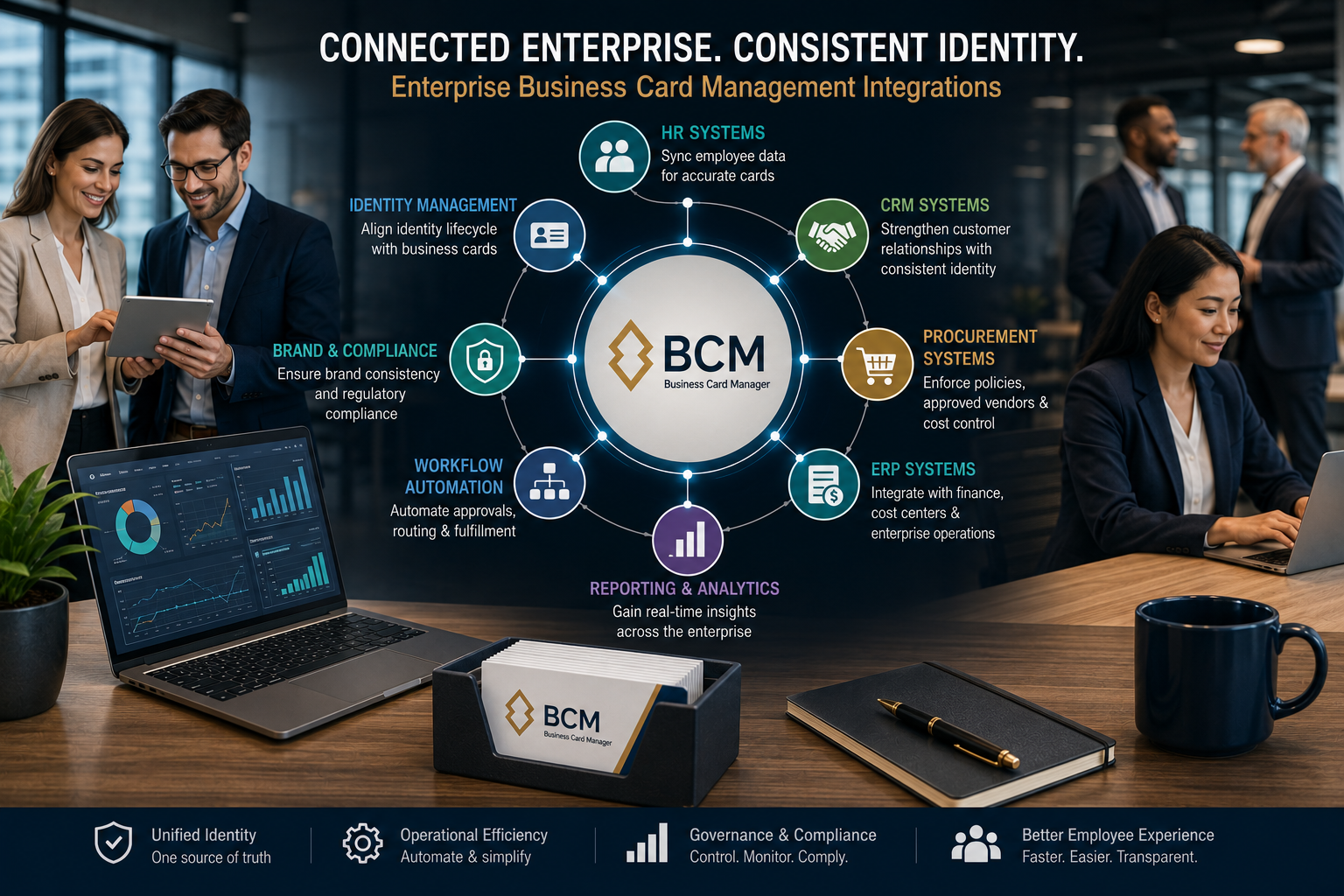
Modern enterprises commonly integrate:
- Human Resources (HRIS)
- Enterprise Resource Planning (ERP)
- Customer Relationship Management (CRM)
- Identity and Access Management (IAM)
- Procurement Platforms
- Collaboration Suites
- Workflow Automation Platforms
- Business Intelligence Platforms
These integrations enable departments to share trusted information while reducing manual effort.
Business card management should follow the same architectural principle.
Rather than maintaining separate employee information, independent approval processes, and isolated supplier relationships, BCM integrates directly into the enterprise ecosystem, ensuring every business card reflects approved corporate information and governance policies.
The Cost of Disconnected Systems
Disconnected systems create operational friction.
When business card management is separated from core enterprise applications, organizations often experience:
- Duplicate employee records
- Manual data entry
- Inconsistent contact information
- Multiple approval channels
- Brand inconsistencies
- Procurement inefficiencies
- Limited reporting
- Increased administrative effort
For example, an employee promoted to Regional Sales Director may have updated information in the HR system, but unless business card requests are manually initiated and coordinated, outdated cards continue circulating.
Similarly, office relocations, department transfers, legal entity changes, or branding updates frequently require multiple manual activities across different teams.
Integration eliminates these disconnected processes by allowing approved enterprise data to drive business card governance automatically.
HR Integration: Establishing a Single Source of Truth
Human Resources systems maintain the most authoritative employee information.
Typical HR records include:
- Employee name
- Job title
- Department
- Business unit
- Office location
- Reporting manager
- Employment status
- Contact information
- Cost center
Without integration, employees or administrators often re-enter this information manually when requesting business cards.
Manual entry introduces unnecessary errors while increasing administrative effort.
BCM integrates with HR systems to leverage approved employee information directly from the source.
This provides several advantages:
- Accurate employee information
- Faster onboarding
- Reduced manual entry
- Improved data consistency
- Better employee experience
Rather than treating HR and business card management as separate processes, organizations establish a unified identity lifecycle.
CRM Integration: Strengthening Customer Identity
Customer-facing employees represent the organization during every interaction.
Their business cards should therefore align with the customer information managed within CRM platforms.
Sales organizations frequently experience:
- Territory changes
- Account reassignments
- Regional expansion
- Product specialization
- Leadership promotions
CRM systems reflect these operational changes quickly.
Business cards should evolve with the same agility.
By integrating BCM with CRM, organizations can ensure that customer-facing identity remains aligned with approved organizational structures, helping reinforce trust and professionalism during every customer engagement.
Procurement Integration: Governing Supplier Relationships
Every business card request ultimately becomes a procurement activity.
Traditional business card management often involves:
- Local supplier selection
- Independent pricing
- Multiple contracts
- Manual purchase approvals
- Decentralized invoice processing
These practices reduce procurement visibility while increasing costs.
BCM integrates procurement governance by connecting business card requests with:
- Approved supplier catalogs
- Contract pricing
- Purchasing policies
- Budget ownership
- Cost centers
- Invoice workflows
This integration ensures that every approved request follows enterprise procurement standards while simplifying administration for employees.
Identity Management Integration
Identity and Access Management (IAM) platforms govern employee access throughout the organization.
Employees receive new identities during onboarding, experience role changes during employment, and eventually have access revoked during offboarding.
Business card governance should align with these same identity events.
Examples include:
- New employee onboarding
- Promotions
- Department transfers
- Office relocations
- Organizational restructuring
- Employee departures
BCM integrates identity governance with business card workflows, ensuring that business cards remain synchronized with the employee lifecycle rather than becoming outdated physical assets.
Workflow Automation Connects Everything
Integration becomes most valuable when supported by workflow automation.
Instead of manually coordinating between HR, procurement, marketing, and suppliers, BCM orchestrates the entire process through configurable enterprise workflows.
Typical automated workflows include:
- Employee onboarding
- Business card requests
- Brand validation
- Manager approvals
- Procurement authorization
- Supplier assignment
- Production tracking
- Delivery confirmation
- Lifecycle updates
Automation reduces administrative overhead while ensuring every request follows standardized governance policies.
Integration Improves Employee Experience
Employees rarely distinguish between enterprise systems.
They simply expect business processes to work efficiently.
When systems operate independently, employees encounter:
- Multiple forms
- Repeated information requests
- Delayed approvals
- Inconsistent communication
- Limited visibility
Integrated workflows create a significantly better employee experience.
Employees submit one request.
Enterprise systems exchange information automatically.
Approvals route intelligently.
Suppliers receive standardized orders.
Leadership gains operational visibility.
Employees receive professionally governed business cards without unnecessary administrative complexity.
ERP Integration: Connecting Business Card Governance with Enterprise Operations
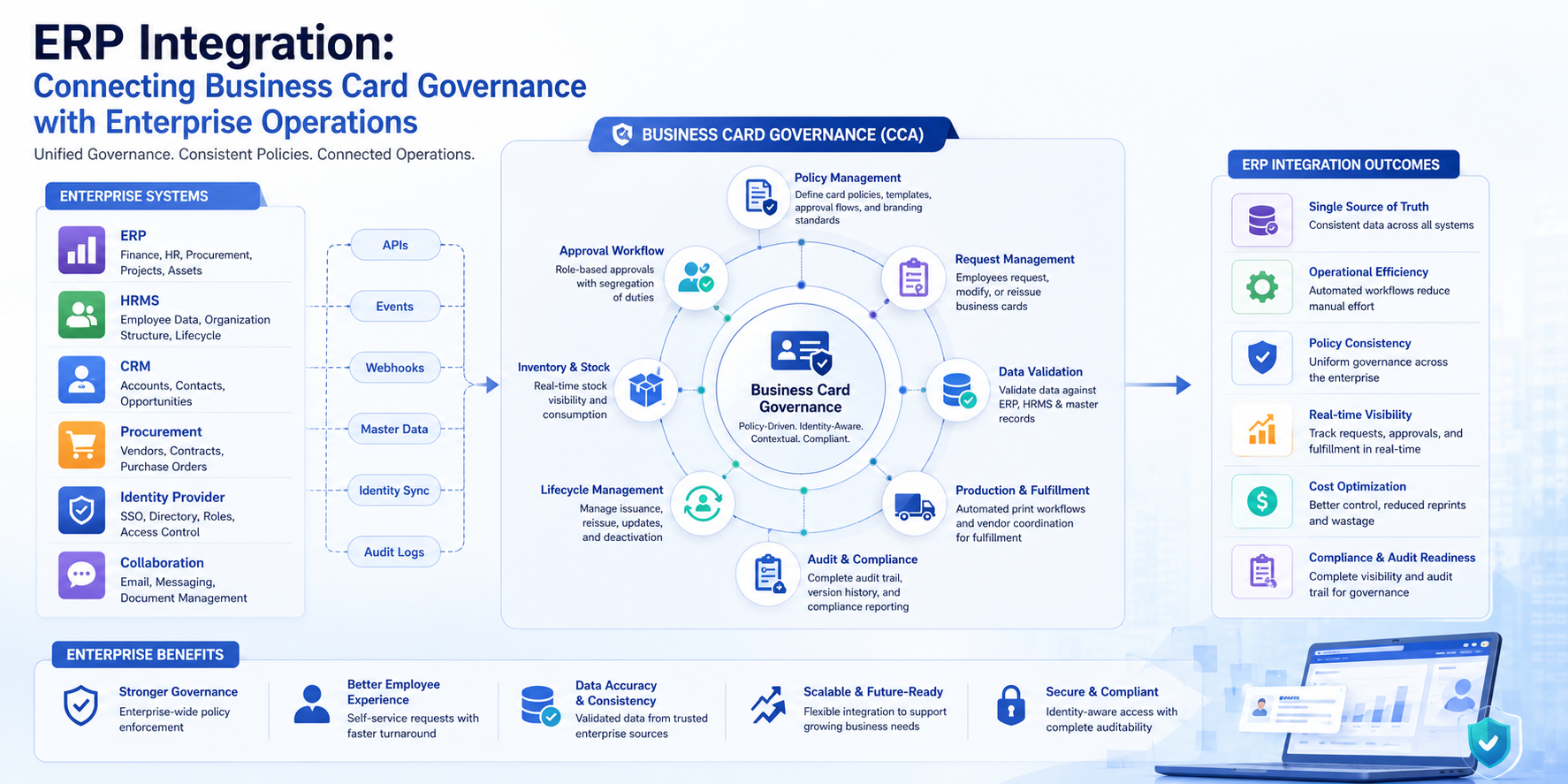
Enterprise Resource Planning (ERP) systems serve as the operational backbone of modern organizations. They manage financial processes, procurement, budgeting, inventory, vendor relationships, and organizational structures.
Business card management should not operate outside this environment.
Every business card request represents an operational event with financial and governance implications. Whether an organization issues hundreds or thousands of business cards annually, each request consumes organizational resources and must align with established procurement and financial controls.
By integrating BCM with ERP platforms, organizations can automatically:
- Associate requests with the correct cost center
- Apply departmental budgets
- Validate purchasing policies
- Track procurement expenditure
- Allocate costs across business units
- Maintain accurate financial reporting
This integration removes manual reconciliation while ensuring that business card management becomes part of enterprise operational governance rather than an isolated administrative activity.
API-First Integration Enables Enterprise Flexibility
Every enterprise has a unique technology landscape.
Some organizations rely heavily on Microsoft technologies.
Others standardize on Salesforce, SAP, Oracle, Workday, ServiceNow, Zoho, or custom enterprise applications.
A modern business card management platform must therefore support integration rather than dictate technology choices.
Business Card Manager adopts an API-first integration philosophy that allows organizations to connect BCM with existing enterprise applications without disrupting established workflows.
Typical integrations include:
- Human Resources systems
- Identity providers
- CRM platforms
- ERP applications
- Procurement solutions
- Workflow engines
- Business intelligence platforms
- Notification services
- Document management systems
This flexibility enables BCM to fit naturally into enterprise architecture while protecting previous technology investments.
Enterprise Reporting Across Connected Systems
When business card management becomes integrated with enterprise applications, organizations gain a significantly richer understanding of operational performance.
Rather than viewing business card requests in isolation, leadership can analyze trends across departments, regions, employee lifecycle events, procurement activities, and organizational growth.
Examples of enterprise reporting include:
Workforce Growth
Business card issuance by hiring period provides insight into organizational expansion and onboarding effectiveness.
Procurement Performance
Supplier utilization, production costs, and fulfillment timelines help procurement teams evaluate vendor performance and optimize purchasing strategies.
Brand Governance
Reporting highlights compliance with approved templates, branding standards, and identity policies across business units.
Operational Efficiency
Approval cycle times, workflow bottlenecks, and request volumes reveal opportunities to simplify administrative processes.
Executive Dashboards
Senior leadership gains a consolidated view of operational activity without relying on manual spreadsheets or departmental reports.
These insights transform BCM into a valuable source of operational intelligence that supports informed decision-making.
Security Must Extend Beyond Digital Identity
Enterprise security traditionally focuses on digital assets such as user accounts, application access, and confidential information.
However, physical identity assets also require governance.
Business cards communicate official organizational identity to customers, suppliers, regulators, and business partners.
Without proper controls, organizations risk:
- Unauthorized business card production
- Outdated employee information
- Inconsistent branding
- Incorrect legal entity representation
- Former employees continuing to represent the organization
BCM addresses these risks through centralized governance that ensures only authorized users, approved workflows, and validated information result in business card production.
Security therefore extends beyond protecting digital systems to protecting enterprise identity itself.
Supporting Global Governance Without Sacrificing Flexibility
Large enterprises often operate across multiple countries, languages, and regulatory environments.
Business card requirements may differ depending on:
- Local language preferences
- Regulatory disclosures
- Regional contact information
- Legal entity requirements
- Cultural formatting conventions
- Market-specific branding adaptations
Managing these variations manually often leads to inconsistency and governance challenges.
BCM enables organizations to maintain centralized governance while supporting approved regional flexibility.
Global policies remain consistent, while localized business requirements can be accommodated through configurable templates, approval workflows, and supplier assignments.
This balance between standardization and flexibility is essential for multinational enterprises.
BCM as a Connected Governance Platform
Business Card Manager should not be viewed simply as software for designing or printing business cards.
Its strategic value lies in connecting multiple governance disciplines into one controlled operational process.
Within an integrated enterprise environment, BCM connects:
- Employee identity
- Brand governance
- Procurement governance
- Workflow automation
- Financial accountability
- Supplier management
- Compliance reporting
- Executive analytics
Each integration strengthens the organization’s ability to manage identity consistently while reducing operational complexity.
Instead of isolated transactions, organizations establish a connected governance framework that supports long-term digital transformation.
BCM Within the Enterprise Governance Ecosystem
The strongest enterprise governance strategies rely on complementary platforms working together.
Within this governance ecosystem:
- Color Card Administrator (CCA) serves as the authority engine, governing identity standards, approval policies, organizational rules, and enterprise branding.
- Business Card Manager (BCM) functions as the conversion engine, transforming approved employee identity into governed customer-facing business card assets through automated workflows.
- Business Operations Center (BOC) provides operational oversight through workflow monitoring, analytics, executive dashboards, process optimization, and enterprise-wide governance visibility.
Together these platforms create an integrated architecture that supports operational excellence across the entire employee identity lifecycle.
Rather than managing identity, procurement, and workflow independently, organizations gain a unified governance framework capable of supporting enterprise growth.
The Future of Enterprise Integrations
Enterprise technology continues moving toward increasingly connected ecosystems.
Emerging trends include:
- AI-assisted workflow orchestration
- Event-driven automation
- Intelligent process recommendations
- Low-code integration platforms
- Enterprise digital assistants
- Predictive operational analytics
- Unified employee experience platforms
Business card management will evolve alongside these innovations.
Future organizations will expect identity updates to automatically trigger governed workflows without manual coordination between departments.
Organizations that invest in integrated governance today will be better prepared to adopt these technologies while maintaining compliance, operational consistency, and enterprise control.
BCM provides a scalable foundation for this future by emphasizing integration rather than isolation.
Conclusion
Enterprise integration is no longer optional.
Organizations seeking operational excellence must eliminate disconnected processes that create unnecessary administrative effort, inconsistent information, and governance risk.
Business card management represents one of those opportunities.
When integrated with HR, CRM, ERP, procurement, identity management, and workflow platforms, Business Card Manager becomes an integral component of enterprise digital transformation.
The result is:
- Improved employee experience
- Stronger brand governance
- Better procurement visibility
- Higher data accuracy
- Faster onboarding
- Increased operational efficiency
- Comprehensive reporting
- Scalable enterprise governance
Business card management should therefore be recognized not as a standalone printing process, but as a connected enterprise capability that strengthens the organization’s digital operating model.