

Enterprise Business Card Management Migration Guide
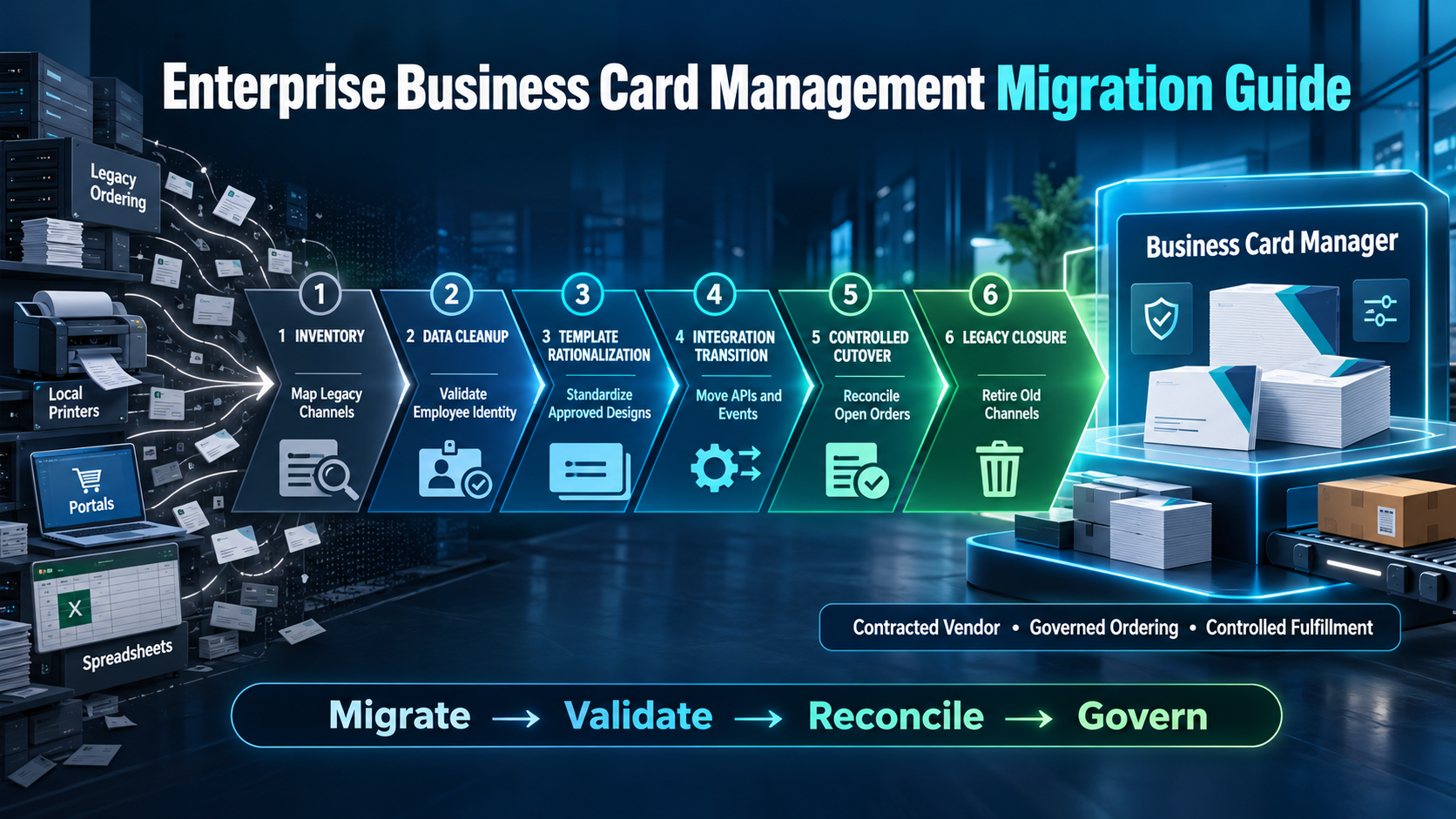
A controlled transition from fragmented ordering and legacy suppliers to governed BCM execution.
Executive Perspective
Business Card Manager (BCM) is the enterprise business-card ordering system, contracted business-card vendor, and execution platform that converts authorized employee identity specifications into controlled orders, production, delivery, and fulfillment evidence. Migrating to BCM is not merely a transfer of artwork or user accounts. It is a controlled transition from existing processes, portals, local printers, spreadsheets, shared mailboxes, and fragmented suppliers into a governed request-to-fulfillment operating model.
Migration creates an opportunity to remove obsolete templates, duplicate employee records, uncontrolled administrative access, inconsistent approvals, unclear purchasing rules, and incomplete order history. It also creates risk if the enterprise business card management moves inaccurate data, preserves unnecessary variants, leaves open orders unresolved, or allows legacy and new channels to operate without reconciliation.
A successful migration protects business continuity while changing the control model. It establishes the target authority structure, cleans and maps data, rationalizes templates and products, transitions integrations, validates production, pilots representative populations, controls cutover, reconciles transactions, and decommissions legacy channels only after evidence confirms readiness.
Migration Is a Business Transition
The migration plan should begin with the target operating model developed during implementation. Define eligibility, public identity authority, template ownership, roles, delegation, approvals, quantities, commercial controls, production release, delivery, support, evidence, and retention. Every migrated object should support this target model; historical objects should not be copied simply because they exist.
Create a migration governance team with an accountable business owner and leads for Brand, HR, IT, Security, Procurement, Finance, Operations, regional administration, and BCM. The team should maintain scope, decisions, risks, dependencies, exceptions, acceptance criteria, communications, and cutover authority.
Where Color Card Administrator (CCA) is deployed, CCA can govern identity, template, quantity policy, and exceptions before BCM executes the authorized specification. Workforce, directory, CRM, ERP, procurement, and service-management systems may supply facts or context. Their data should not bypass identity, approval, commercial, and production controls.
Inventory the Current Environment
The first migration deliverable is a verified inventory. Record each ordering channel, legacy portal, supplier, local printer, template repository, spreadsheet, email process, administrator group, approver list, integration, purchasing route, delivery region, report, support contact, contract, open order, and retained data set.
Classify every item as migrate, rebuild, consolidate, archive, or retire. A current template used by a defined population may migrate after validation. A duplicated regional variant may be consolidated. A historical order record may be archived for retention rather than loaded into the active BCM business card workflow. A local ordering link without an approved future use should be retired.
Baseline volumes, seasonality, employee populations, languages, card families, material specifications, production regions, delivery services, reprints, cancellations, open credits, invoice disputes, and service issues. These figures determine sequencing and help distinguish normal transition noise from a material control failure.
Migration Workstreams
| Workstream | Migration decisions | Required evidence |
|---|---|---|
| Governance | Target ownership, roles, delegation, approval authority, exceptions, retention, and cutover authority. | Approved responsibility map, role matrix, decision log |
| Employee and identity data | Source records, stable identifiers, public fields, effective dates, duplicates, corrections, and privacy. | Mapping, cleansing results, validation report, approved exceptions |
| Templates and products | Migrate, rebuild, consolidate, archive, or retire each template and specification. | Approved catalog, proof results, version and retirement record |
| Integrations | Source and target interfaces, event transition, credentials, retries, monitoring, and reconciliation. | Technical plan, test evidence, runbook, reconciliation results |
| Orders and commercial data | Open orders, purchasing references, budgets, invoices, credits, cancellations, and history. | Open-item register, conversion rules, finance signoff |
| Production and delivery | Samples, material specifications, regional capacity, status, tracking, failures, and reprints. | Sample approval, delivery matrix, operational acceptance |
| Cutover and decommission | Freeze, final extraction, activation, support, rollback, archive, access removal, and closure. | Cutover log, acceptance, archival proof, decommission signoff |
Design the Migration Data Model
Create a source-to-target mapping for employees, identities, templates, products, roles, delegations, approvers, cost centers, addresses, regions, orders, shipments, and retained evidence. For each field, record the source, target, stable identifier, format, transformation, validation, default, ownership, privacy purpose, and handling when the value is missing or conflicting.
Stable identifiers are essential. Names and email addresses may change; an employee or enterprise identifier should connect the workforce record, authorized identity, request, order, shipment, and evidence. Define how merged records, rehires, contingent workers, duplicate accounts, legal-entity transfers, and future-dated changes will be handled.
Do not migrate sensitive or irrelevant data. Payroll values, performance information, demographics, customer data, and historical notes usually have no purpose in a business-card ordering system. Data minimization reduces privacy risk, validation effort, and future support complexity.
Clean Employee and Identity Data
Profile the source data before transformation. Measure missing identifiers, duplicate records, invalid locations, inconsistent titles, unsupported characters, obsolete phone numbers, stale managers, conflicting legal entities, and inactive employees with active ordering access. Assign each issue to its authoritative owner rather than correcting it silently in a migration file.
Distinguish internal workforce attributes from public identity. Employment status, department, manager, and cost center may control eligibility or routing, while name, customer-facing title, credentials, company line, address, phone, email, and language appear on the card. The migration must preserve the authority decision behind public content.
Establish cleansing thresholds and exception rules. The goal is not to force every record into the target. A record that cannot be verified should be held for review or excluded until its owner resolves the issue. Keep a reconciliation report showing source count, transformed count, loaded count, rejected count, reason, and owner.
Rationalize Templates, Products, and Specifications
Template migration often reveals unnecessary complexity. Build a catalog that links each template to brand, legal entity, region, language, employee population, address, field rules, logo, legal lines, product, paper, finish, quantity, production route, and owner. Compare apparent variants to determine whether they reflect genuine policy or historical preference.
Rebuild templates within the BCM-controlled model and validate line length, wrapping, missing values, diacritics, translated content, credentials, typography, logo use, color expectations, trim, bleed, stock, finishing, and packaging. Approve both the digital proof behavior and physical production output.
Assign a version and effective date to every active template. Record how pending requests are treated when a template changes. Archive retired artwork with its ownership and retention context, but prevent it from being selected for new production.
Transition Integrations and API Traffic
Inventory every current file transfer, API, webhook, scheduled job, manual upload, and report. Identify data producer, consumer, frequency, authentication, fields, transformation, validation, monitoring, retry, support owner, and dependency. Shadow or replacement integrations should not reuse credentials or endpoints without an explicit security decision.
Plan how business events move from the legacy path to BCM. Employee hires, transfers, promotions, departures, identity updates, template changes, order releases, shipments, deliveries, cancellations, and reprints may require different transition dates. Avoid uncontrolled dual writing, in which two systems accept the same event without a single system of record.
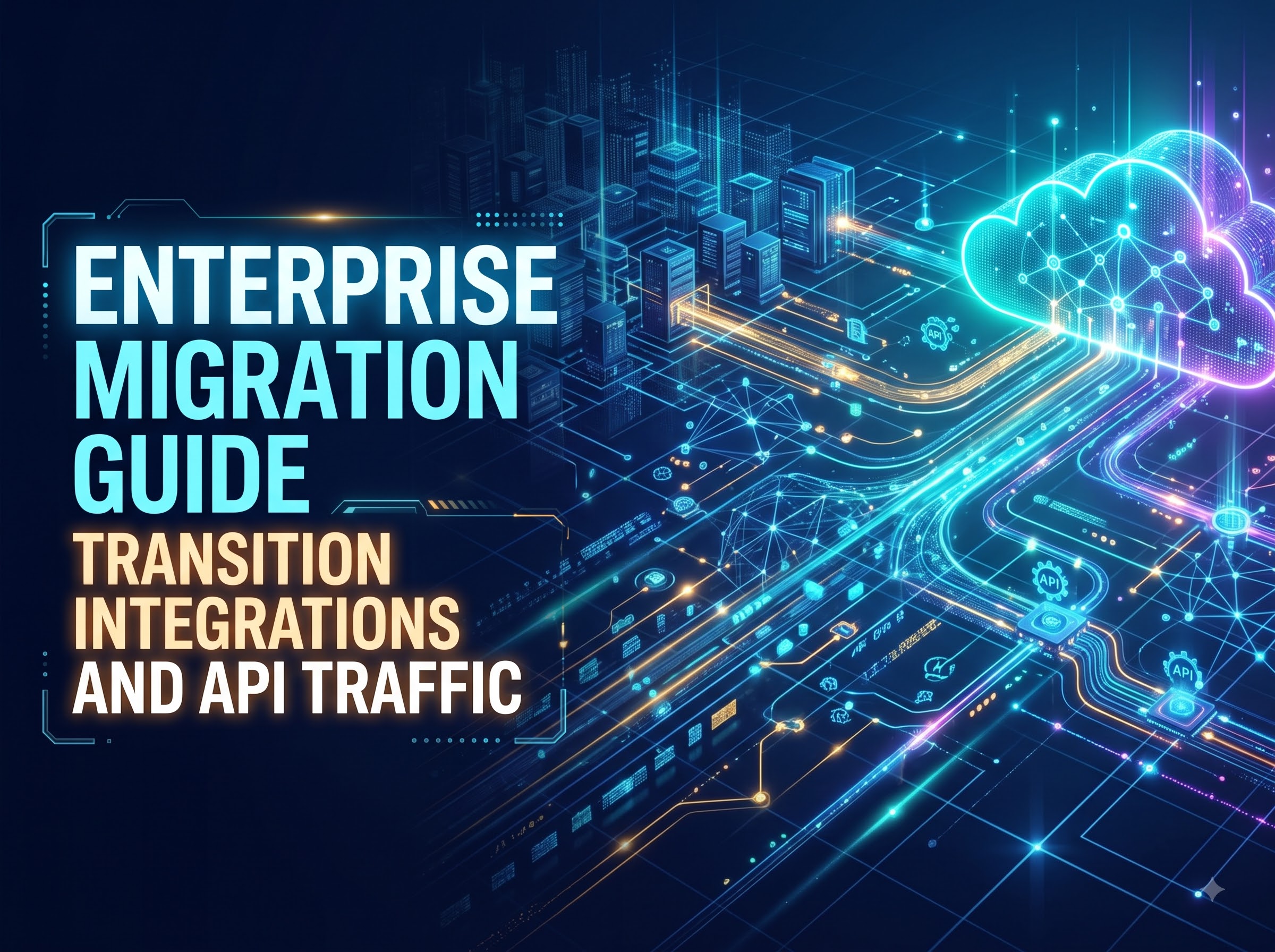
Test authentication, least privilege, schema, effective dates, idempotency, duplicate detection, out-of-order events, rate limits, retries, partial failures, monitoring, alerting, replay, and reconciliation. Establish a defined freeze or queue for events arriving during cutover, then confirm every queued event is processed exactly once or resolved through an approved exception.
Handle Open Orders and Financial Commitments
Open orders require item-level decisions. Record request status, approved version, quantity, cost center, purchase order, payment or invoice reference, production state, shipment, cancellation eligibility, expected delivery, exception, and accountable owner. Decide whether each order completes in the legacy service, transfers to BCM, is cancelled and recreated, or is closed.
Do not recreate an in-production order without duplicate prevention. A technically successful load can still create double production, double shipment, and double billing. Use a cross-reference between legacy and BCM identifiers and reconcile quantities, statuses, shipments, invoices, credits, and reprints.
Finance and enterprise procurement governance should approve the treatment of budgets, commitments, purchase orders, tax, currency, shipping charges, minimums, credits, and final invoices. Define the last invoice from each legacy provider, the first BCM invoice, and the evidence required to close outstanding disputes.
Use a Phased Migration
A phased transition reduces concentration of risk and allows the operating model to improve before wider rollout. The organization can organize waves by entity, brand, region, employee population, template family, integration, or delivery market. Each wave should be operationally meaningful and contain enough variation to test real controls.
Select a pilot with standard and exception orders, self-service and delegated ordering, a real integration, approval thresholds, commercial controls, representative production, and actual delivery conditions. A pilot limited to internal administrators and one simple card proves very little.
Define entry and exit criteria for every wave. Entry criteria may include approved data, templates, roles, integration, samples, communications, training, support, and rollback. Exit criteria may include transaction reconciliation, proof acceptance, production quality, delivery results, invoice match, exception closure, and stakeholder sign-off.
Migration Validation and Cutover
| Control point | Validation question | Cutover evidence |
|---|---|---|
| Population | Are active eligible employees loaded once with correct scope and inactive users blocked? | Source-to-target counts, duplicate and rejection report |
| Identity and templates | Does every eligible population receive the correct approved identity and template? | Scenario proofs, field and template reconciliation |
| Access and approval | Are roles, delegation, thresholds, absence coverage, and expiry correct? | Role tests, approval records, access review |
| Integration | Are events processed accurately, recoverably, and without uncontrolled duplication? | End-to-end tests, monitoring, retry and reconciliation evidence |
| Orders and finance | Are open items, quantities, purchasing references, invoices, credits, and status aligned? | Open-item reconciliation and Finance approval |
| Production and delivery | Are released specifications, materials, status, tracking, failure, and reprint controlled? | Physical samples, shipment tests, operational acceptance |
| Legacy closure | Are ordering access, integrations, credentials, links, data, contracts, and support paths closed safely? | Archive, access removal, redirect, retention, and sign-off. |
Create a detailed cutover runbook with timestamps, owners, prerequisites, decision points, communications, verification, rollback, and escalation. Typical steps include change freeze, final source extraction, data transformation, load, integration switch, access activation, legacy ordering restriction, smoke tests, first controlled order, transaction reconciliation, and go-live authorization.
Set explicit go or no-go criteria. Schedule pressure should not override unresolved identity, access, integration, production, or commercial defects. If the situation requires rollback, define which orders remain valid, how [the system] preserves queued events, how [the team] informs users, and how [the team] reconciles evidence.
Decommission Legacy Channels
Legacy decommissioning is part of migration, not an optional cleanup. Remove or redirect old ordering links, disable access, revoke integration credentials, stop scheduled files, close shared mailboxes, end local approval routes, collect unused inventory where applicable, and communicate the new support path.
Archive data according to legal, procurement, finance, privacy, and audit requirements. Preserve the records needed to explain historical orders, approvals, shipments, invoices, credits, and disputes. Delete data that no longer has a valid purpose when policy and law permit.
Close or amend legacy supplier contracts only after confirming open orders, invoices, credits, service claims, retained materials, artwork ownership, data return, data deletion, and transition obligations. BCM is the new contracted business-card vendor and execution platform; the migration should not leave an informal parallel supplier channel operating outside governance.
Stabilization and Continuous Improvement
Provide enhanced support during each migration wave. Review orders, approvals, controlled integration cutover exceptions, proofs, production, deliveries, invoices, and support contacts daily at first. Separate migration defects from training gaps, source-data problems, policy decisions, production issues, and carrier events so each root cause reaches the correct owner.
Measure source-to-target reconciliation, rejected records, duplicate prevention, first-pass proof acceptance, approval cycle time, exception rate, production lead time, on-time shipment, delivery performance, reprints, invoice match, integration recovery, access-review completion, and legacy-channel shutdown.
A formal stabilization exit should confirm that critical defects are closed, workarounds have owners and dates, metrics are within agreed thresholds, operational teams accept responsibility, documentation is current, and the next wave can proceed without repeating unresolved risk.
Buyer Intent Bridge
An enterprise needs a formal migration when business cards are ordered through several local printers, portals, spreadsheets, email channels, or disconnected systems and the organization wants a single governed service. The need becomes urgent when employee changes are frequent, templates are inconsistent, approvals are manual, invoices are fragmented, delivery status is unclear, or audit evidence is difficult to assemble.
Business Card Manager provides the contracted vendor and execution model for governed ordering, enterprise-system integration, controlled production, delivery coordination, exception handling, reporting, and fulfillment evidence. Migration to BCM should consolidate responsibility while preserving continuity and proving that every transferred population, template, integration, order, and financial commitment is controlled.
Frequently Asked Questions
Should every legacy record be migrated?
No. Active data needed for the target operating model may be migrated after validation. Historical records may be archived for retention, while duplicates, obsolete templates, inactive access, and unnecessary sensitive data should be excluded or retired under approved policy.
Can legacy and BCM ordering run in parallel?
A controlled parallel period may support validation, but it needs a defined purpose, population, duration, system of record, duplicate prevention, reconciliation, and exit date. Uncontrolled parallel ordering creates production, billing, and evidence risk.
How should open orders be handled?
Classify each open order to complete in the legacy service, transfer, cancel and recreate, or close. Preserve the approved version and commercial references, prevent duplicate production, and reconcile shipment, invoice, credit, and reprint status.
Is Business Card Manager the new vendor?
Yes. Business Card Manager is the contracted business-card vendor, ordering system, and execution platform. The organization should describe BCM as a tool that selects or routes work to an independently chosen business-card vendor.
What proves migration is complete?
Completion requires more than loaded data. The enterprise should reconcile populations, templates, roles, integrations, open orders, production, delivery, invoices, evidence, archived history, revoked access, disabled legacy channels, contracts, and operational ownership.
Plan a Controlled Migration to BCM
Inventory the current environment, design the target authority model, cleanse data, rationalize templates, transition integrations, reconcile open commitments, pilot representative populations, control cutover, and close legacy channels. Request a Business Card Manager migration and integration discussion at https://www.businesscardmanager.com/.