

ServiceNow Business Card Ordering BCM API Integration vs Custom Fulfillment
Keep ServiceNow as the employee request channel while evaluating which business card responsibilities to place in BCM and which to retain in a custom workflow.
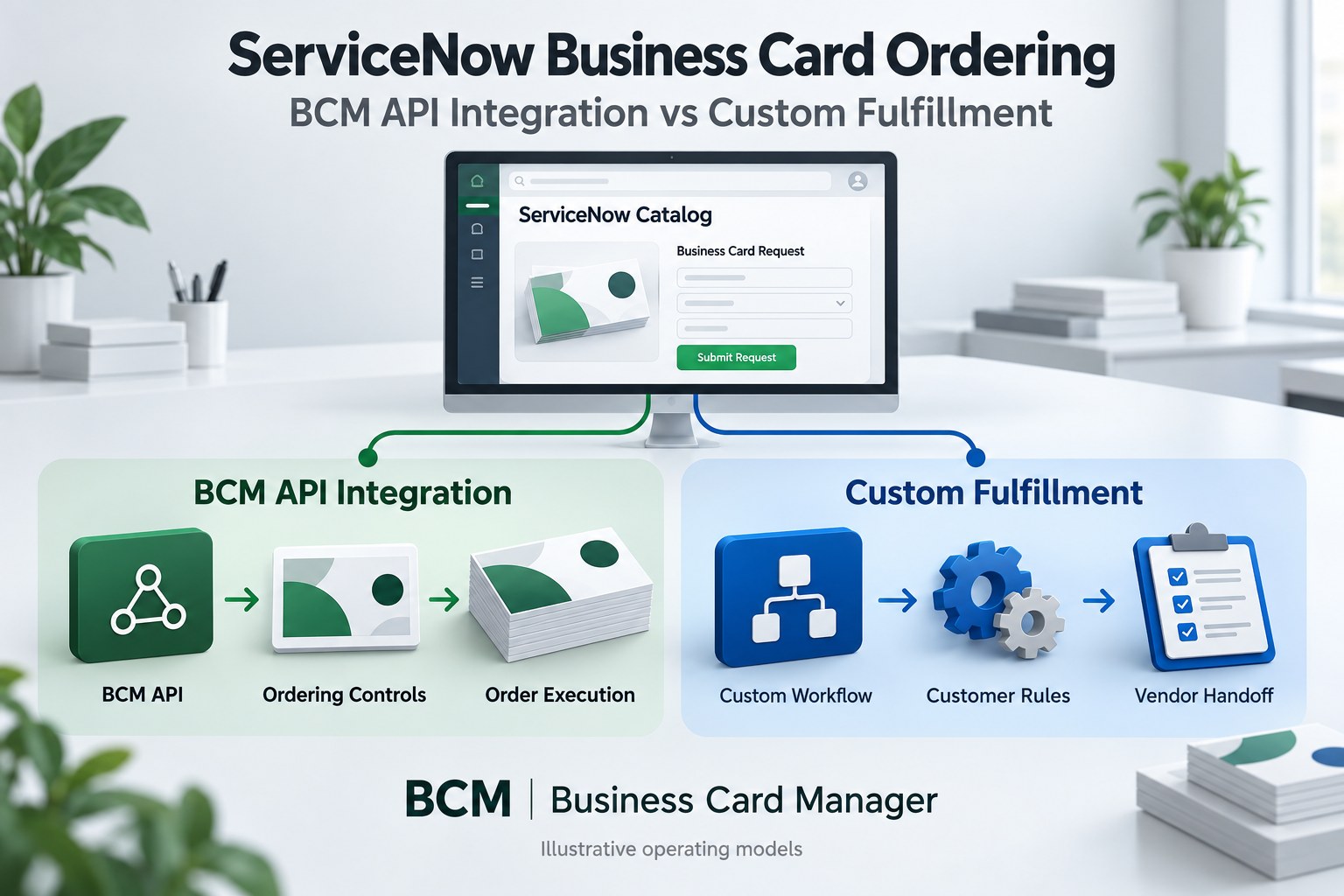
BCM (Business Card Manager) is business card ordering management software that enterprises can evaluate as the connected ordering service behind a ServiceNow request. The commercial decision is how much business card logic to maintain in a custom ServiceNow workflow and how much to place in BCM through a scoped API integration. A ServiceNow catalog item can remain the employee entry point in either design.
Choose the model by examining what happens after someone clicks Submit. The enterprise still needs an approved identity, the correct card template, purchase authorization, production instructions, and a dependable answer when an order needs attention. A successful catalog request does not establish that these obligations have been met.
This guide compares a BCM-connected operating model with a customer-managed fulfillment workflow. It focuses on ownership of card-specific rules, approval evidence, order handoffs, and ongoing maintenance. It does not assume that ServiceNow must be replaced or that every BCM action is available through an API. The intended result is a reviewable buying brief for the team responsible for both the employee request and the physical card outcome.
Define the two proposals fairly
In the BCM-connected model, ServiceNow provides the agreed request experience and service coordination. A configured connection transfers the authorized context to BCM, which performs the supported business card actions and applies the controls included in the contracted scope. The implementation must establish how request references, approvals, and supported order information cross that boundary.
In the custom fulfillment model, the customer maintains more of the card-specific process in ServiceNow and associated services. That work might include selecting card options, maintaining mappings, preparing production instructions, and coordinating with a contracted print service. The design may also use APIs. The distinction is therefore responsibility for the business card process, rather than API use versus no API use.
A hybrid can be appropriate: keep a tailored catalog form and customer approval rules in ServiceNow while using BCM for the agreed ordering controls and execution. Compare this option with the proposed custom build before deciding that an existing catalog investment makes a dedicated ordering platform unnecessary.
What the platforms establish and what the project must prove
ServiceNow documents that ordering a catalog item creates a request that follows a fulfillment process. That process can include approval steps and assigned fulfillment tasks. This provides a foundation for employee request management, but the customer still needs to define the business card service represented by those tasks.
ServiceNow also documents Integration Hub capabilities for calling external systems and using integration protocols such as REST. Confirm the applicable subscription, enabled capabilities, transaction treatment, and customer standards for the chosen implementation. An available outbound integration mechanism does not prove that a required BCM operation or packaged connector exists.
CCA’s integration directory lists ServiceNow as available for integration, subject to source access, APIs, permissions, data requirements, and workflow. Its ServiceNow page describes a configured request flow into controlled business card administration. Treat these as a basis for a fit discussion and demonstration; confirm the current interface contract and allocation of responsibilities for your environment.
Keep the catalog experience while clarifying the service boundary
Consider an employee ordering cards before a customer event. A well-designed request asks for the information the employee can legitimately supply and obtains the remaining context from approved sources. It should make clear which values are editable, who reviews exceptions, and when the request is ready to proceed.
The same employee-facing catalog item could lead to either fulfillment model. In one proposal, a fulfillment group manually assembles the specification and coordinates printing. In another, an approved request reaches BCM through a confirmed interface. A third may retain a deliberate administrator step for a small exception population. Ask the implementation team to show the whole journey rather than only the form.
Compare the number of handoffs, the decisions made at each point, and the information available to support staff. A request that looks simple to the employee may still depend on repeated administrative work. A connected model should demonstrate where that work is removed, where it remains, and how the enterprise retains control over the purchasing decision.
Compare ownership of business card work
The following matrix is a scope guide for evaluating proposals. It identifies responsibilities that must be assigned; it does not guarantee a particular endpoint or imply that a custom workflow cannot implement equivalent controls.
| Responsibility | BCM connected scope to confirm | Customer managed fulfillment scope |
|---|---|---|
| Employee request | ServiceNow catalog and agreed handoff to BCM | ServiceNow catalog and internal fulfillment route |
| Card templates | BCM template and rule administration in scope | Ownership of designs, permitted fields, and mappings |
| Authorization | Agreed ServiceNow and BCM approval boundary | Customer maintained approval and release logic |
| Ordering action | Supported BCM operation and acceptance evidence | Print instruction, vendor handoff, and acceptance check |
| Progress visibility | Confirmed status interface or owned service update | Customer maintained follow up and service record |
| Change support | Document customer and BCM configuration duties | Maintain catalog, card rules, and service interfaces |
Ask each team to identify its deliverable for every row. A general promise that the systems will be integrated is insufficient when nobody has agreed who maintains the template mapping or investigates an uncertain submission.
Avoid duplicate approval without weakening authorization
ServiceNow approval and business card approval can serve different purposes. A manager may authorize the expenditure while a brand administrator confirms the printable title and template. Requiring both can be appropriate when each reviewer makes a different decision. Repeating the same review in two systems adds delay without clarifying responsibility.
Define what the upstream approval establishes, what evidence accompanies the handoff, and which checks remain with BCM. If an approved ServiceNow request is meant to satisfy a downstream authorization requirement, BCM must confirm how that evidence is accepted and validated. Do not assume that an Approved label in one application automatically grants ordering authority in another.
Test a change after approval. If the employee edits the title, entity, quantity, or delivery destination, determine which changes invalidate the previous authorization. Preserve the approved version of the specification and link any replacement decision to it. The buying requirement is that the production instruction can be traced to the information actually approved.
Make the workforce source part of the scope
ServiceNow can coordinate the request without becoming the source of every employee fact. In a proposed design, Workday, SAP SuccessFactors, Oracle HCM, ADP, UKG, or Dayforce may supply approved workforce context through the customer’s authorized integration arrangements. Confirm source access, field coverage, timing, and mappings separately for the selected system.
Microsoft Entra ID may contribute access context, while HubSpot or Microsoft Dynamics may contribute sales-team context. Assign an owner to each value and decision. A CRM title, directory display name, and approved public title can differ. The workflow should resolve those differences according to policy instead of treating the most recently received field as authoritative.
Only transfer information required for the card process. A ServiceNow request does not need an entire HR profile to establish a permitted business name, title, office, and delivery route. Where Color Card Administrator is deployed, align the design with its governance role and the organization’s field-authority rules. BCM remains the business card ordering management software in that connected process.
Distinguish request progress from order progress
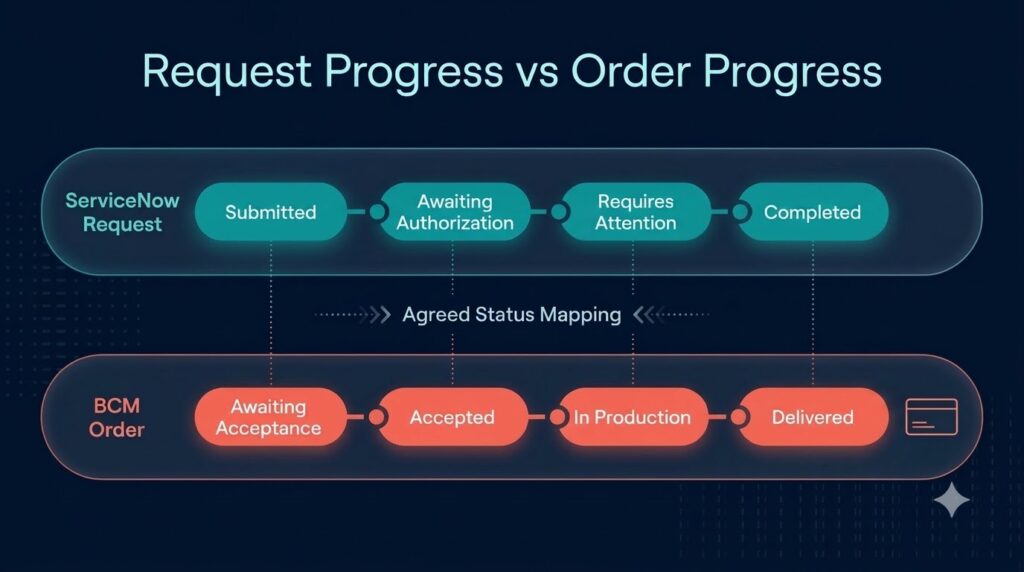
An employee service request and a business card order describe related but different work. Request approval may be complete while the specification still needs correction. BCM may have accepted an order while production or delivery remains outstanding. The customer should decide what constitutes completion of the employee service and which evidence supports that decision.
For the proposed integration, define a small, meaningful status mapping. For example, the service record might distinguish awaiting authorization, awaiting ordering acceptance, requiring attention, and completed according to an agreed rule. These are suggested business meanings, not a claim about available BCM status codes. Match them to demonstrated interface behavior or an owned service update process.
Establish which application employees consult and who communicates delays. Avoid closing the service request solely because an API call returned successfully. Equally, avoid promising detailed shipment updates in ServiceNow unless the implementation can obtain and maintain them reliably. A clear service record is more useful than a long list of states with ambiguous meanings.
Test retries and corrections as purchasing scenarios
Suppose the integration submits a request, but the connection fails before ServiceNow receives the outcome. The operator needs to determine whether BCM accepted the transaction before attempting another submission. Ask for the confirmed correlation, lookup, duplicate-protection, or managed reconciliation method. The proposal should explain the fallback when the preferred mechanism is unavailable.
A second scenario should correct an approved title after an order has entered the process. Demonstrate how the operator identifies the affected specification, determines whether a change is still possible, and communicates the result. An integration retry cannot resolve the commercial question of whether production can be altered or whether a replacement order is required.
Run equivalent scenarios for the custom fulfillment design. Identify the record used to check whether a print instruction was sent, the person permitted to resubmit, and the evidence retained after correction. Compare the work needed to reach a trustworthy answer, rather than assuming either architecture is inherently more reliable.
Include service ownership in the commercial proposal
The employee should not have to diagnose whether a problem belongs to ServiceNow, an integration service, BCM, or a production process. Give the request a first support owner, then document the escalation path behind that owner. Agree who gathers the evidence, communicates progress, and confirms resolution.
The customer’s ServiceNow team may own catalog configuration and service routing. An integration team may own credentials, mappings, and failed exchanges. BCM should identify its responsibilities for the contracted ordering service and the escalation route for order issues. Describe the actual arrangement in the proposal rather than assuming that one vendor owns every component.
For custom fulfillment, include ownership of card-specific rules and the print-service interface. Determine who maintains the process when a developer leaves, a template changes, or a business unit is added. Internal development capacity has an operating cost even when no additional software purchase is required.
Compare the next change as well as the first launch
Request an estimate for the initial use case and three representative changes: adding a legal entity, changing an approval rule, and introducing a second card family. Ask which changes require catalog work, integration work, BCM configuration, or print-service coordination. This exposes where responsibilities will accumulate over time.
Include testing and support in both estimates. For BCM integration, account for implementation, confirmed platform entitlements, integration operations, service charges, and any agreed development. For custom fulfillment, include the same service outcomes plus ongoing maintenance of the card-specific logic retained by the customer. Separate print and delivery costs so they do not obscure the workflow comparison.
Avoid a fixed saving assumption based only on request volume. A high-volume process with few exceptions may operate differently from a smaller program with many entities, templates, and approval variations. Measure administrator effort, correction work, and status inquiries during a pilot to establish which activities the chosen design actually changes.
Choose a bounded demonstration that resolves the buying decision
Begin with one catalog item, one eligible population, one card family, and an agreed approval route. Define the starting data and expected outcome for each test before the demonstration. Include a normal request, missing printable information, an unauthorized template choice, a post-approval edit, an interrupted submission, and an employee whose eligibility changes while a request is open.
The demonstration should show the employee experience and the operator’s recovery process. Record which activities are configured, which depend on supported BCM operations, which need development, and which remain manual. A deliberately retained manual step can be acceptable when it is owned, measured, and included in the service scope.
Ask the buying team to decide whether the result meets its required authorization, accuracy, visibility, and support conditions. Then compare implementation and operating cost. A working catalog form or a successful test message is useful evidence, but neither establishes a complete business card service.
When each model deserves consideration
Evaluate BCM integration when the enterprise wants a dedicated business card ordering service behind its existing request channel and the confirmed BCM scope addresses the controls it would otherwise maintain. The commercial value should follow from the actual division of work, including template administration, order handling, and support.
Retaining more custom fulfillment logic may suit a deliberately narrow process or an organization with a mature, supported internal implementation that already meets its requirements. Assess the cost of operating and changing that implementation before replacing it. There is no need to rebuild a successful employee request experience merely to connect the downstream service.
A hybrid deserves particular attention when ServiceNow is already the established service channel. Preserve its role in employee requests and coordination, then evaluate BCM for the business card responsibilities it can demonstrably take on. The best proposal identifies a maintainable boundary with evidence for each handoff.
Frequently asked questions
Does BCM replace the ServiceNow catalog?
It does not need to. A proposed design can retain the ServiceNow catalog item and service coordination while connecting to BCM for supported business card actions. Confirm the integration scope and any remaining user-interface steps.
Is there a native or certified BCM ServiceNow connector?
The cited CCA material establishes availability for integration, not a certified connector claim. Request current BCM documentation, supported operations, prerequisites, and implementation responsibilities for the customer environment.
Can ServiceNow approval release a BCM order?
That depends on the configured workflow and supported BCM interface. Define what the approval authorizes, how its evidence is passed, and whether further identity or purchasing review is required before production release.
Is Integration Hub included in the proposed cost?
Confirm the applicable ServiceNow entitlements and integration method with the customer’s platform team and the implementation provider. Include any required capacity, transaction, configuration, and support costs rather than assuming an existing subscription covers the project.
What should the buyer ask BCM to demonstrate?
Ask BCM to demonstrate the intended ordering action, validation behavior, returned reference, supported status information, and recovery from an uncertain submission. Include one approval change and one exception that requires operator intervention.
Request a ServiceNow to BCM workflow discussion
Bring BCM your current catalog item, request volumes, employee data sources, approval rules, card families, and fulfillment responsibilities. Ask the team to show where BCM can support the ordering process through its confirmed interface and which responsibilities remain with your ServiceNow and integration teams.
Request a scoped proposal comparing a BCM-connected workflow with the card-specific work your organization would retain in a custom implementation. Define acceptance evidence, support ownership, ongoing cost, and change responsibilities before selecting the operating model.
Discuss your ServiceNow business card ordering requirements with Business Card Manager