

ServiceNow Business Card Workflow Integration for Enterprise Request Management
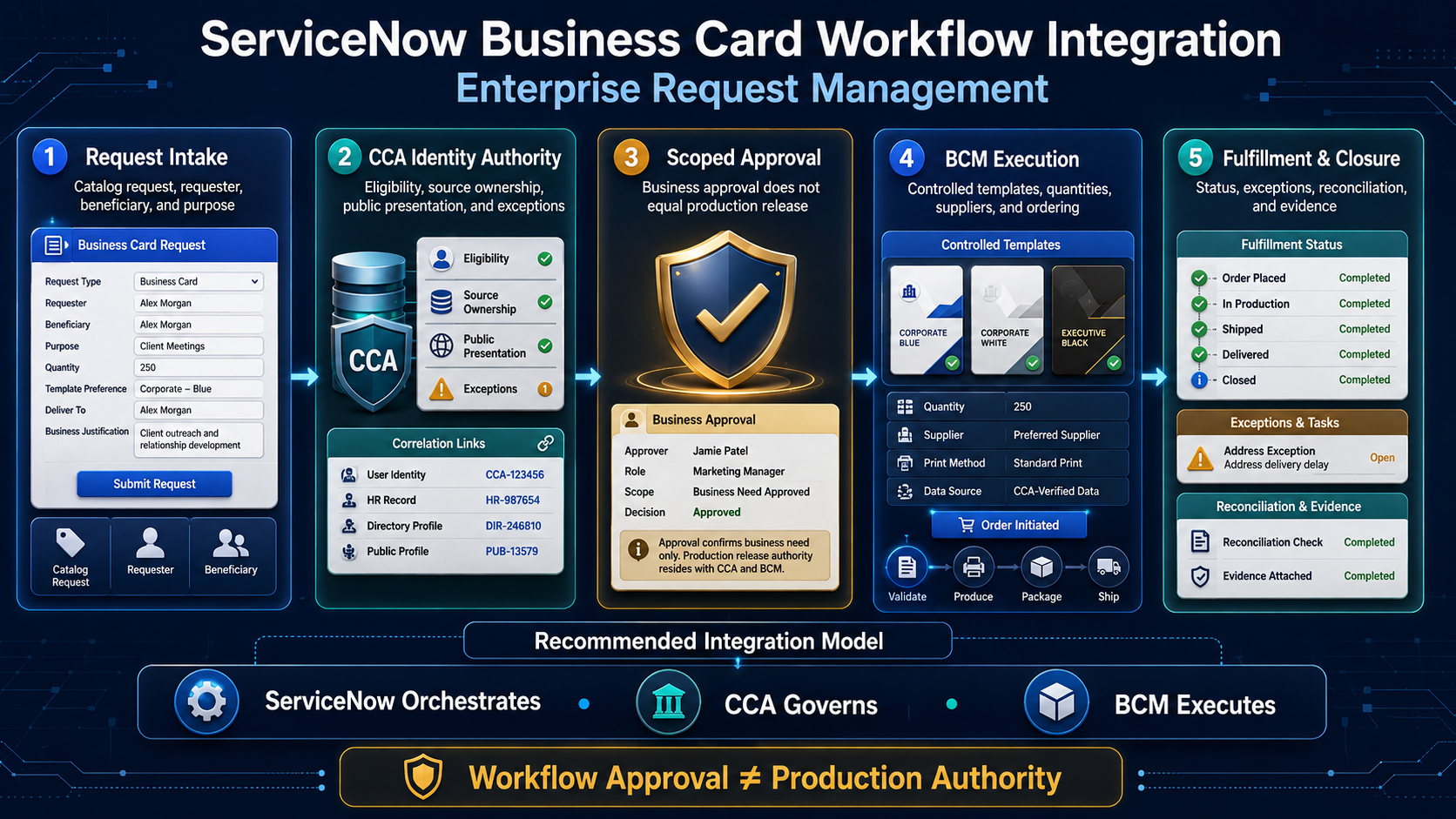
| EXECUTIVE PERSPECTIVE: A ServiceNow business card workflow integration can connect enterprise request intake, approvals, tasks, exceptions, and status visibility with governed ordering. But an approved catalog item or closed workflow task should not by itself authorize public identity or production. ServiceNow orchestrates the work; CCA governs identity authority and exceptions; BCM executes the controlled transaction. |
Request Orchestration Should Strengthen Control
ServiceNow can provide a governed front door for enterprise requests through service catalogs, forms, workflows, approvals, tasks, assignment groups, notifications, service-level expectations, exception queues, and status records. Connecting that operating layer to Business Card Manager (BCM) can give employees and authorized administrators a familiar request channel while preserving BCM controls for identity validation, template selection, ordering, supplier routing, shipping, and fulfillment.
The integration boundary matters. ServiceNow can record that a request was submitted, reviewed, approved, assigned, or completed, but those states do not automatically establish the correct public title, legal entity, brand, address, quantity, supplier, or production-ready identity. Those decisions depend on authoritative employee data, CCA policy, configured BCM controls, and accountable business owners.
BCM manages the controlled request, validation, approval, template, order, supplier, shipping, and fulfillment process. Color Card Administrator (CCA), where deployed as the enterprise business card governance authority layer, can evaluate source precedence, eligibility, public presentation, effective dates, delegated scope, material changes, and exceptions before releasing an approved identity specification to BCM.
Why ServiceNow Is a High-Value BCM Integration
ServiceNow is a top public-facing integration topic in the approved BCM title plan because enterprise buyers already use it to organize requests, approvals, tasks, incidents, service catalogs, and cross-functional work. Its value is not simply another order form. It is the governed policy orchestration of a request from intake through identity authority, approval, BCM execution, fulfillment, exception resolution, and closure.
- Offer a controlled service-catalog entry point for employee and request-on-behalf scenarios.
- Route work across HR, managers, brand, procurement, local administration, and operations.
- Keep request status synchronized without treating workflow completion as production authority.
- Create owned exception tasks for missing data, conflicts, rejected approvals, and supplier failures.
- Connect approvals, BCM orders, fulfillment events, and closure evidence for reporting.
- Apply reusable enterprise controls across business units, locations, brands, and request types.
ServiceNow should remain authoritative for the workflow facts it legitimately owns: request state, assignments, approvals, tasks, exceptions, and service-management evidence. It should not silently become the source of truth for employee identity, brand presentation, purchasing authority, supplier release, or fulfillment. Those responsibilities remain distributed across source systems, CCA, BCM, and accountable owners.
What a Governed ServiceNow-to-BCM Workflow Looks Like
A strong integration treats ServiceNow as the orchestration layer around a governed identity and ordering decision. Exact products, plugins, tables, APIs, IntegrationHub capabilities, catalog items, flow actions, events, webhooks, fields, roles, environments, and timing must be confirmed for the organization’s licensed services, architecture, configuration, CCA policies, and BCM setup.
- Capture the request. A controlled catalog item identifies the requester, beneficiary, purpose, account, location, urgency, and request-on-behalf context without collecting unnecessary identity data.
- Correlate the identity. Stable identifiers connect the request to the correct employee, CCA identity, and BCM account; names and email addresses alone are insufficient.
- Resolve authority. CCA or configured policy determines eligibility, source ownership, public presentation, delegated scope, material changes, and exceptions.
- Approve and release. ServiceNow can coordinate business approvals, but BCM validates the approved specification and applies template, quantity, supplier, and production-release controls.
- Return execution status. BCM sends order, supplier, shipment, delivery, cancellation, and failure outcomes back to the related ServiceNow work item.
- Reconcile and close. Closure requires an owned outcome: fulfilled, rejected, cancelled, replaced, or exception-resolved, with linked evidence across systems.
The Workflow and Authority Decisions That Matter
Integration quality depends on defining what every ServiceNow state is allowed to influence. Enterprise teams should separate request intake, source data, identity authority, business card approval workflow, production release, fulfillment status, and closure.
| Decision area | Enterprise question | Governed response |
|---|---|---|
| Request identity | Which ServiceNow item maps to which person and BCM request? | Use stable correlation identifiers and explicit requester/beneficiary context. |
| Authority | Who decides each printed value and eligibility rule? | Use source precedence, CCA policy, transformations, and owned exceptions. |
| Approval | What does a ServiceNow approval actually authorize? | Define approval scope; do not equate task approval with production release. |
| Execution | Which system creates and releases the order? | BCM freezes the approved specification and controls ordering and fulfillment. |
| Closure | When may the request be closed? | Require a reconciled outcome and link fulfillment or exception evidence. |
A Service Catalog Approval Is Not Production Authority
ServiceNow forms and catalog variables can make requests easy to submit, but convenience can create risk if free text, copied employee details, broad assignment-group access, or generic approval states are treated as authoritative. A manager may approve business need without owning brand presentation. Procurement may approve spend without validating identity. A service desk may complete a task without authority to release a supplier order.
A governed model defines the authoritative source, permitted requester, acting-on-behalf scope, field transformation, approval owner, production release rule, and exception path for every important decision. CCA resolves identity authority; BCM validates the approved specification and executes the transaction; ServiceNow coordinates the work and retains the service-management record.
Exceptions Must Become Owned Operational Work
Enterprise workflows encounter missing employee correlations, conflicting titles, ineligible populations, unavailable templates, rejected approvals, supplier failures, stale shipments, cancellations, and post-approval changes. A strong ServiceNow integration converts these conditions into owned tasks with priority, assignment, reason, evidence, escalation, and a defined recovery path instead of hiding them in integration logs.
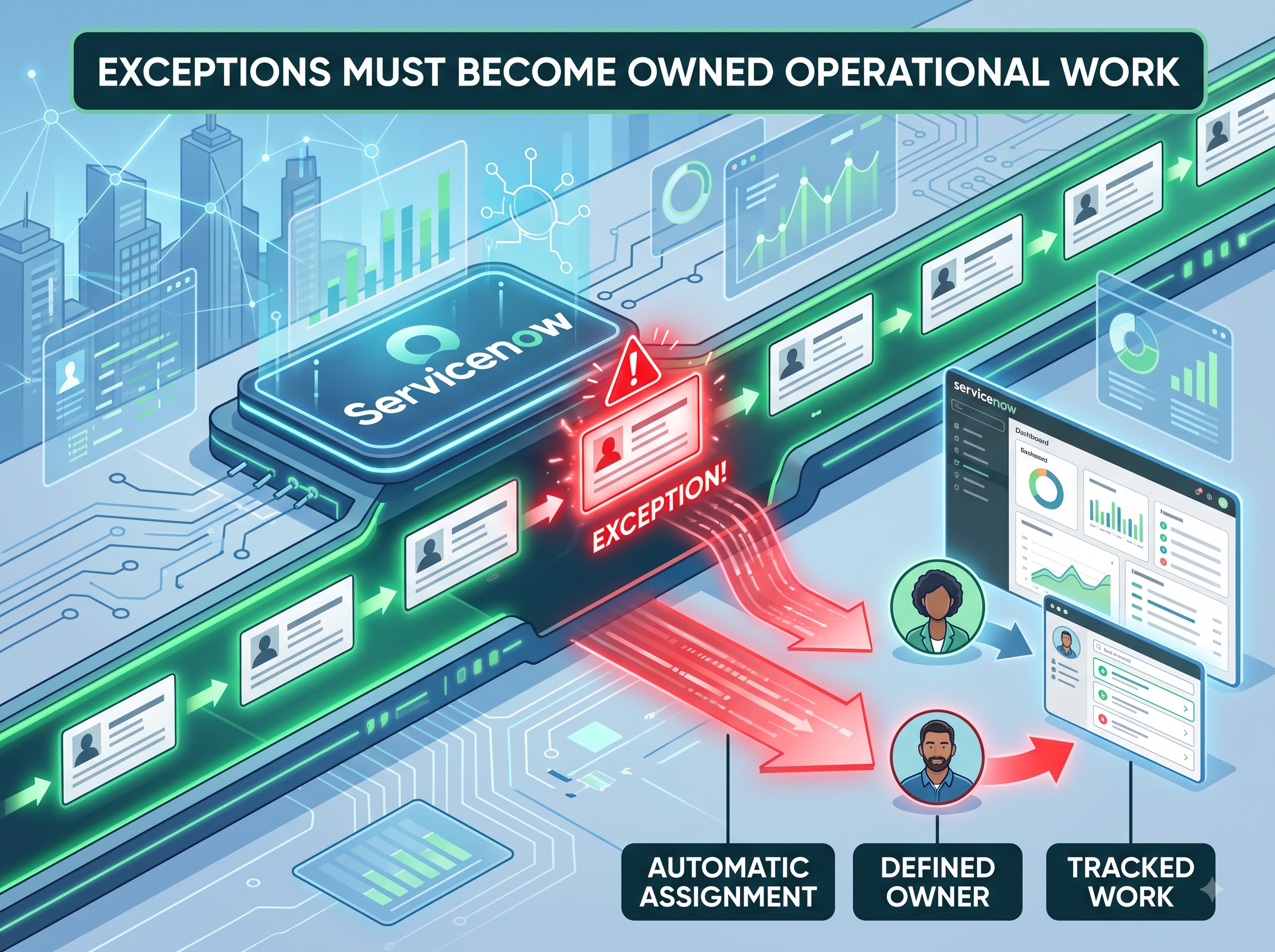
Retries must remain safe and idempotent. A reopened request should not create a duplicate order. A cancelled workflow should attempt to stop unreleased work and reconcile any order already in production. A post-approval identity change should trigger materiality evaluation, not silently rewrite the approved specification. Operational closure should reflect the real business outcome across ServiceNow, CCA, BCM, and the supplier.
Workflow Data Should Be Purpose-Limited
A business card request does not require broad incident history, HR cases, compensation, security incidents, device data, unrelated catalog activity, or unrestricted user profiles. Only fields needed for correlation, request context, identity governance, approval, ordering, cost allocation, fulfillment, and exception resolution should cross the integration boundary.
Field-level governance should define the owner, purpose, allowed use, retention rule, transformation, access boundary, and failure behavior for every element. Logs should avoid reproducing sensitive identity data, and assignment groups should see only the work and evidence required for their role. Data minimization reduces privacy exposure and makes monitoring, investigation, correction, and deletion more manageable.
Operational Benefits Across Service Management, HR, Brand, and Procurement
For service-management teams, the integration creates a visible request path with standardized intake, assignments, approvals, exception ownership, and status. HR and managers, it reduces informal handoffs while preserving source-system authority. For local administrators, controlled request-on-behalf workflows can replace email and shared credentials.
Marketing and brand teams, locked templates and governed public-presentation rules prevent catalog convenience from becoming uncontrolled identity. For IT and security, least-privilege integration identities, protected credentials, environment controls, monitoring, and owned failure queues create a governable interface. For procurement and finance, linked approvals, cost context, quantities, suppliers, orders, and fulfillment evidence improve spend visibility and reconciliation.
Buyer-Intent Bridge: From Ticketing to Governed Execution
Organizations evaluating business card vendors should ask more than whether ServiceNow can open a ticket or call an API. The higher-value questions are whether the platform can preserve authoritative employee data, distinguish workflow approval from production authority, control delegated requests, freeze the approved specification, prevent duplicate orders, route suppliers, synchronize fulfillment, govern exceptions, and retain linked evidence.
Business card printing is a transaction. Business card management is the workflow around that transaction. Governance is the control layer that determines who and what may proceed. API integration is the differentiator that connects those decisions to the systems the enterprise already operates. BCM is the conversion engine for controlled ordering and fulfillment; CCA is the authority engine for identity policy and exceptions.
Implementation Priorities for Enterprise Teams
Begin with one ServiceNow environment, one controlled catalog item, one BCM account, and a narrow use case such as employee self-service requests or authorized requests on behalf of new hires. Document requesters, beneficiaries, correlation identifiers, authoritative sources, catalog variables, eligible populations, approval scopes, CCA rules, templates, quantities, suppliers, status mappings, exceptions, and closure criteria before expanding automation.
Technical design should use least-privilege integration access, approved service identities, protected credentials, verified environment boundaries, data minimization, logging, monitoring, retry controls, idempotency, correlation identifiers, retention rules, and owned failure queues. Whether the organization uses APIs, events, extracts, or an integration platform, change processing should preserve effective dates and work relationships while preventing duplicate or out-of-order execution.
Testing should cover future-dated and rescinded hires, concurrent employment, contingent workers, duplicates, missing correlations, retroactive changes, transfers, promotions, leaves, terminations, stale managers, missing fields, unauthorized attributes, outages, expired credentials, throttling, retries, post-approval changes, supplier failures, and leavers with open orders. Useful measures include correction rate, request readiness, approval cycle time, exception volume, duplicate orders, avoidable reprints, cancellation success, and fulfillment visibility.
Frequently Asked Questions
Does BCM currently claim a native ServiceNow connector?
No. ServiceNow is identified as a recommended integration in the approved BCM roadmap. The appropriate interface, supported fields, events, permissions, timing, and production design must be confirmed for each organization.
Does a ServiceNow approval release production?
Not automatically. Approval scope must be explicit. ServiceNow may coordinate manager, brand, legal, procurement, or operational decisions, while CCA resolves identity authority and BCM applies the final template, quantity, supplier, and production-release controls.
What ServiceNow data should be excluded?
Unrelated incidents, HR cases, security records, device data, broad user-profile attributes, and other sensitive or unnecessary fields should remain outside the card workflow. Use only the minimum data required for the declared purpose.
From Enterprise Requests to Governed Identity Execution
ServiceNow can give BCM-connected enterprises a familiar front door and an operational record for requests, approvals, tasks, exceptions, and status. CCA turns approved source facts into governed eligibility, field authority, public presentation, access, and exception decisions. BCM converts the approved outcome into ordering and fulfillment.
The strategic advantage is not ticket-driven printing. It is governed orchestration: minimum-necessary data, stable correlation, clear authority, scoped approval, safe execution, owned exceptions, synchronized fulfillment, and evidence the organization can review. That is how a ServiceNow business card workflow integration becomes enterprise infrastructure rather than another form connected to a print portal.
| Connect Enterprise Requests to Governed Business Card Execution
Explore how Business Card Manager can connect controlled enterprise requests, identity decisions, approvals, templates, ordering, exceptions, fulfillment, and reporting. Request a BCM demonstration and ServiceNow integration-fit discussion at https://www.businesscardmanager.com/ |