

Business Card Ordering for New Hires
Evaluate BCM API and manual onboarding requests using complete and changed hires. Compare readiness, public details, approval timing, overlapping demand, and delivery follow up.
Business Card Ordering for New Hires | BCM API vs Manual Onboarding Workflow, Eligibility & Delivery
Getting business cards ready for new hires is hard when eligibility, details, and delivery are unclear. This video shows how Business Card Manager (BCM) helps you plan onboarding card orders, compare manual processes with an API workflow, and prepare requests without ordering too early. Fix missing details before production, separate requests from purchasing authority, and handle delayed starts and remote delivery.
BCM (Business Card Manager) is the enterprise business card ordering management system and contracted business card vendor for organizations connecting employee onboarding with approved physical cards. Business card ordering for new hires should begin early enough to support the employee’s work, while giving the enterprise a clear decision about eligibility, printed details, quantity, and delivery before an order is released.
For enterprise buyers, the useful comparison is between a scoped BCM API workflow and the manual onboarding process it would replace or supplement. A hire record can help prepare a request, but a future employee may still lack a confirmed public title, office assignment, or delivery destination. The workflow needs a way to distinguish preparation from purchase authorization.
This article focuses on that decision. It describes evaluation scenarios and proposed controls, subject to the actual customer environment and supported BCM operations. It does not assume that every HR platform has a packaged BCM connector or that a new-hire event should automatically trigger printing.
Define Readiness in Terms of the Employee Need
Decide what the onboarding program is trying to achieve. Some customer-facing employees need cards for an early external meeting. Others can receive them after their role and public contact details are confirmed. A single requirement to deliver cards on every employee’s first day may create unnecessary urgency or purchasing for people who do not need them.
Define the eligible population and the date by which cards are needed. Separate that date from the employment start date and from the expected delivery date. These dates may coincide, but each has a different meaning and owner. The request should make the business need visible without implying a delivery commitment before fulfillment arrangements are confirmed.
BCM’s HRIS ordering article describes employee data and lifecycle events feeding a controlled request, with integration scope dependent on the actual environment. For onboarding, translate that model into an agreed readiness decision. The buyer should see what information allows preparation, what authorizes release, and what happens when the remaining details arrive late.
Compare the Same Onboarding Cases
A manual process may rely on an HR notification followed by an administrator collecting approved details. That can work when hiring volume is limited and the team can maintain coverage. A configured API workflow may reduce repeated collection and entry when onboarding spans several regions or request coordinators.
Compare ordinary and changed hires using the same rules. Show an employee with complete details, a delayed start, a missing public title, and a withdrawn hire. The objective is to establish whether each process reaches the correct outcome with manageable work. A connection that transfers data successfully may still leave substantial manual coordination before purchasing.
| Decision area | Scoped BCM API workflow | Manual onboarding requests |
|---|---|---|
| Future hires | Confirm preparation and release conditions | Coordinator tracks readiness and approvals |
| Public details | Apply agreed source and review rules | Collect and verify approved presentation |
| Changed starts | Demonstrate reassessment and intervention | HR notifies an accountable request owner |
| Overlapping demand | Resolve related requests across covered channels | Check coordinator and employee requests |
| Delivery follow up | Return agreed verified statuses | Administrator checks BCM and updates HR |
| Operating effort | Include support and retained review | Include collection, correction, and coordination |
These are responsibilities to evaluate rather than universal claims about either approach. The proposal should identify the supported behavior, the configuration required, and the checks an operator must still perform. An explicit manual step is easier to assess than an undocumented assumption that the connection handles it.
Prepare Future Hires Without Releasing an Order Too Early
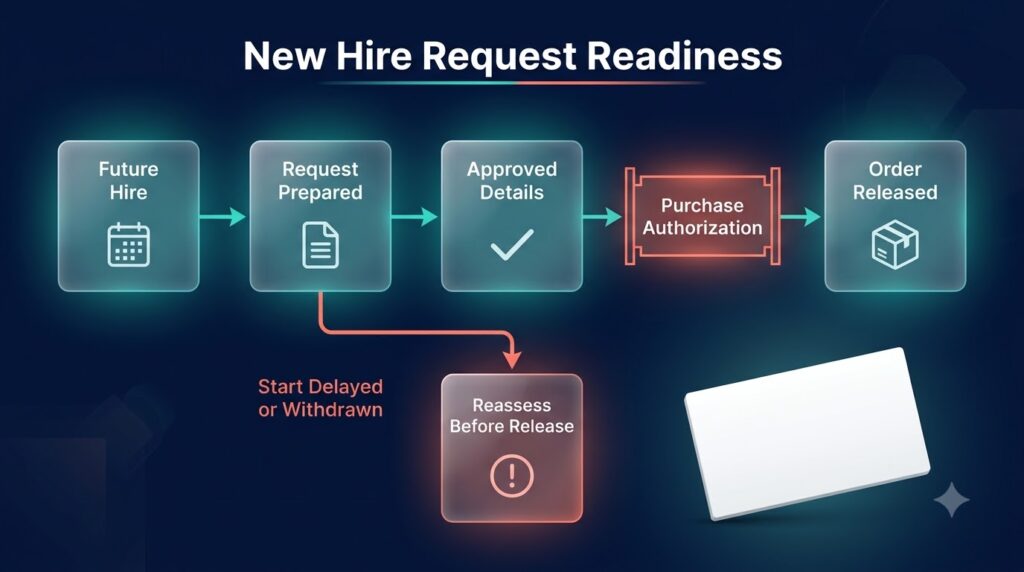
An enterprise may want to prepare requests before employees can access the ordering system. Confirm whether an authorized coordinator can act on their behalf and which populations that authority covers. The coordinator’s ability to prepare a request should remain distinguishable from permission to approve or purchase.
BCM’s Workday integration article describes candidate requests and preparation around workforce timing, subject to customer-specific mappings and approval paths. The same buying question applies regardless of the source platform: can the proposed workflow hold useful preparation while required decisions remain incomplete?
Use a future-dated hire in the demonstration. Ask which fields are available, which are provisional, and how the operator recognizes the request’s state. If the employee’s start is deferred, show how the pending work is reassessed. Confirm the actual mechanism for updating or holding a request, rather than assuming that changing the HR date changes every downstream action.
Explore the Workday business card integration model
Resolve Public Details Before Production
A job or position label used during recruitment may differ from the title approved for external use. A hiring manager may know the expected responsibility while brand or legal owners govern its public presentation. Establish the source and decision owner for the card’s public fields before configuring automated entry.
The same distinction applies to locations. An employee may join one office, attend orientation at another, and receive cards at a regional distribution point. The printed office address and the shipping destination should be reviewed as separate information. A convenient onboarding address should not silently become the public address on the card.
CCA, where deployed, can govern the identity approved for public use before BCM executes the order. If another authorized enterprise process performs that review, define how it supplies the approved result. Missing public details should lead to a clear review task. Staff should not invent temporary content simply to make the request appear complete.
Handle Missing Contact Information Explicitly
A future employee may not yet have an assigned telephone number or activated work email address. Decide whether the request can wait, whether an approved shared contact line is permitted, or whether the employee should receive cards after those details are confirmed. The right answer depends on the role and enterprise policy.
Keep a provisional value from being mistaken for an approved one. If a field is awaiting confirmation, identify its owner and the consequence for ordering. Avoid filling it with an assumed email format or a copied contact number just because the template requires content. A technically valid value can still be the wrong public representation.
For an integrated design, demonstrate what happens when the confirmed value arrives after an initial review. For the manual process, show how the administrator checks the final proof against the approved information. Both should preserve the relationship between the decision and the specification that is actually submitted.
Separate Hiring Approval from Card Purchase Authority
Approval to hire establishes a workforce decision. It should not be treated as blanket approval for any card design, quantity, or delivery service. The onboarding workflow needs the purchasing decisions applicable to the request, including who may authorize nonstandard quantities or urgent handling.
BCM’s approval workflow article distinguishes eligibility, public identity, commercial authorization, and production release. Apply those boundaries without adding unnecessary review. A standard new-hire request may follow a documented route, while a public-title exception or unusual delivery requirement needs a specific owner.
Ask the provider to demonstrate how changes affect previous decisions. An altered delivery service may require cost approval without repeating an unchanged public-title review. A new printed title may require content approval even when the quantity remains valid. Selective reapproval should follow the organization’s rules and the supported workflow, not an assumption that every edit resets everything or changes nothing.
Review business card approval workflow software
Respond to Delayed and Withdrawn Hires
A start-date change should cause an explicit reassessment of pending work. Determine whether the cards are still needed, whether their details remain current, and whether an order already exists. The appropriate response depends on both the workforce decision and the actual ordering state.
A withdrawn hire requires similar coordination. Closing the HR onboarding task does not prove that a previously accepted order has been cancelled. Confirm the supported route for identifying an open BCM order and requesting intervention. Record who follows the case when a change or cancellation is no longer available under the production or delivery conditions.
In the manual alternative, specify who notices the workforce update and checks the card request. In the integrated option, demonstrate the relevant update and its recovery procedure. The buyer should see the final outcome, including cases that close without purchasing and cases that require a documented service decision after acceptance.
Avoid Parallel Requests for the Same Employee
HR, a hiring manager, and a regional assistant may each believe they own onboarding cards. An employee may also start a request after gaining access. Without coordination, one hire can create multiple legitimate-looking requests for the same purpose.
Use a stable employee reference and enough request context to identify overlapping demand. A pre-hire reference may need reconciliation with a later worker identifier. The design should explain how that transition is handled and what happens when a match is uncertain. A familiar name alone should not merge requests or assign another employee’s order history.
Test a coordinator request followed by an employee request. Ask how the second requester learns that related work already exists and who decides whether additional quantity is justified. Then test an uncertain submission response. Confirm how the operating team establishes whether BCM accepted an order before another submission is attempted.
Confirm Delivery Ownership for Remote and Regional Hires
Onboarding teams may coordinate delivery to an office, distribution point, or an authorized remote destination. Establish who confirms the destination and who can view it. Collect only the information needed for the agreed ordering and delivery purpose, with appropriate access and retention responsibilities.
A change after approval should trigger the relevant review. Updating a profile does not establish that an accepted shipment can be redirected. Show the intervention procedure and the verified status available to the coordinator. Where direct delivery is unavailable or inappropriate, document the approved alternative and its effect on timing.
Keep the employee’s expectation aligned with evidence. Request prepared, purchase approved, order accepted, and shipped are different states. If the proposed integration returns only selected statuses, specify who handles the remaining follow-up. HR should be able to answer the readiness question without interpreting a successful data transfer as proof of delivery.
Review BCM ordering governance
Scope the Source Connection Around the Initial Population
Name the actual HR product and customer environment before requesting an integration proposal. Workday, SAP SuccessFactors, Oracle HCM, ADP, UKG, and Dayforce can describe different customer situations with different access requirements. Microsoft Entra ID may participate in access, while ServiceNow or a CRM application may coordinate requests. Confirm each proposed role rather than connecting every available application.
Begin with the minimum workforce context needed to identify the employee and assess the request. Payroll amounts, banking details, and unrelated personnel information should not be included simply because an extract is available. Add fields only when the enterprise can explain their purpose in the ordering decision.
The scoped proposal should identify source access, required mappings, supported BCM operations, and the team responsible for failed or ambiguous cases. A native connector, a direct API design, and a customer integration layer are different possibilities. Do not infer a particular implementation from a platform logo or a general integration article.
Measure Readiness and Handling Separately
Measure the current onboarding process before estimating improvement. Track active administrator handling, correction work, requests waiting for information, and whether cards arrive by the agreed need date. Use comparable populations and product assumptions when evaluating the integrated alternative.
Separate delays caused by missing enterprise decisions from those caused by ordering or delivery. An unconfirmed public title may hold a request before BCM receives it. A later delivery concern may belong to a different stage. This distinction makes the findings useful for improvement and avoids attributing every onboarding delay to the same team.
Include requests closed without an order, particularly deferred or withdrawn hires. These are valid outcomes when purchasing is no longer appropriate. Compare integration implementation and support effort with the handling removed or shortened. Do not assume that all source events become orders or that every minute released produces a cash saving.
Pilot a Complete Onboarding Cycle
Choose one employee population, a standard card design, and an agreed approval path. Include a customer-facing hire with complete details and a future hire with a pending contact field. Add a delayed start and a withdrawn hire so that the demonstration tests the decisions most likely to create rework.
Observe the request through its final business outcome. Confirm that the accepted order uses the authorized details and that a coordinator can explain its status. Include an overlapping request and an uncertain submission. The pilot should establish how the operating team recovers without depending on the implementation specialist to make undocumented decisions.
Review the results with HR, the relevant approval owners, and the people responsible for ongoing ordering support. Expand only after those teams can operate routine and changed cases consistently. The useful outcome is a repeatable readiness process, with clear ownership when the employee’s circumstances change before the cards are received.
Questions About Business Card Ordering for New Hires
Can a request be prepared before the employee starts?
That can be evaluated in the proposed workflow, subject to permissions and supported operations. Preparation should remain distinct from approval and order release. Confirm which future-hire information is available and what must be verified before purchasing.
Should the HR job title be copied directly onto the card?
Only if enterprise policy approves that use. An internal job label may differ from the permitted public title. Identify the decision owner and provide a review route when the approved representation is missing or disputed.
What happens if the hire is withdrawn after ordering?
Check the actual order state and follow the supported intervention route with BCM. A workforce update does not prove cancellation. Availability and commercial treatment depend on the order’s position and the agreed service conditions.
Does integration guarantee cards on the first day?
No guarantee is asserted here. Readiness depends on timely decisions, complete details, approvals, production, and delivery arrangements. Establish the required date and confirm the service expectations for the proposed deployment.
What should a BCM onboarding demonstration prove?
Ask to see a complete new-hire request, a late change, and a withdrawn hire. Verify approval evidence, the accepted specification, available status, and recovery ownership. Confirm which steps are supported, configured, or performed by an administrator.
Request a BCM Onboarding Workflow Assessment
Bring a representative new-hire request, a future start-date example, and a withdrawn-hire case to a BCM consultation. Ask for comparable API and manual workflow proposals using the same approval requirements and delivery expectations. The demonstration should establish what makes the request ready, what authorizes the purchase, and who follows changes through to a clear outcome.
Request pricing or schedule a demo with Business Card Manager to review your new hire onboarding integration scope.