

Business Card Workflow Infrastructure: The Missing Layer Between Printing, Governance, and Enterprise Operations
Introduction
Most organizations think about business cards as printed assets. Enterprise organizations increasingly understand that business cards are actually the output of a much larger operational workflow.
Before a business card is printed, employee information must be validated. Brand standards must be enforced. Approval policies must be followed. Procurement controls may need to be applied. Vendors must be coordinated. Reporting data must be captured. In many organizations, these activities span multiple departments and multiple systems.
Historically, organizations managed these activities through email, spreadsheets, local processes, shared folders, and disconnected print portals. While these approaches may appear manageable initially, they become increasingly difficult to govern as organizations grow.
This challenge is driving the emergence of a new concept: Business Card Workflow Infrastructure.
Rather than viewing business cards as isolated transactions, organizations are beginning to view them as operational workflows that require automation, visibility, governance, and integration.
What Is Business Card Workflow Infrastructure?
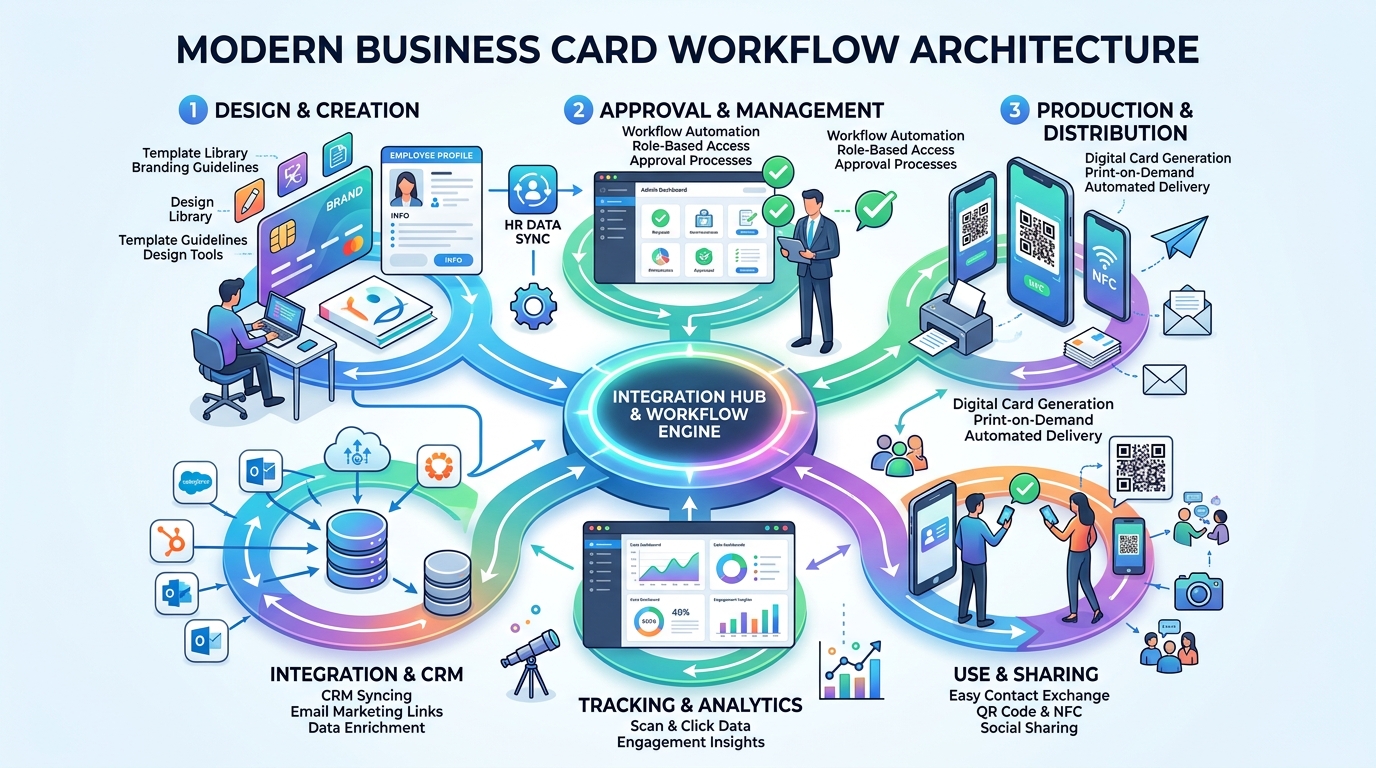
Business card workflow infrastructure is the operational layer that manages the processes surrounding business card programs.
It Coordinates:
- Employee ordering
- Approval routing
- Brand governance
- Procurement oversight
- Vendor coordination
- Production visibility
- Fulfillment tracking
- Reporting and analytics
- Enterprise system integration
The purpose is not simply to order business cards. The purpose is to manage the lifecycle of business card requests from initiation through fulfillment while maintaining visibility and control.
Why Traditional Approaches Break Down
Traditional ordering methods often develop organically.
An employee emails a request.
A manager approves it.
Marketing reviews the information.
A vendor produces the cards.
Someone tracks the order manually.
This process may work for a small team. However, it becomes increasingly problematic when organizations experience:
Common Growth Challenges
- Rapid growth
- Multiple locations
- High onboarding volumes
- Multiple approvers
- Procurement oversight requirements
- Brand governance mandates
Over time, manual processes create operational bottlenecks and visibility gaps.
The Operational Cost of Fragmentation
Fragmented workflows create challenges that are often difficult to measure initially.
Common Outcomes Include:
- Delayed onboarding
- Inconsistent approvals
- Duplicate orders
- Brand inconsistencies
- Limited audit visibility
- Procurement reporting challenges
- Vendor management complexity
- Increased administrative effort
These issues frequently affect multiple departments simultaneously.
The Relationship Between Printing and Workflow
One of the most important ideas within this category is understanding that printing and workflow are not the same thing.
Printing is a production activity.
Workflow is an operational activity.
Organizations can purchase business cards from many providers. However, managing the workflows surrounding business cards requires infrastructure that supports governance, visibility, and coordination.
This distinction becomes increasingly important as organizations scale.
How Workflow Infrastructure Supports HR Teams
Human Resources teams frequently interact with business card workflows during onboarding and employee lifecycle events.
Examples Include:
- New employee onboarding
- Promotions
- Department transfers
- Role changes
- Office relocations
Without structured workflows, HR teams often rely on manual coordination.
Workflow infrastructure helps standardize these processes while improving employee experience and operational consistency.
How Workflow Infrastructure Supports Procurement
Procurement teams need visibility into spending activity, vendor relationships, and purchasing patterns.
Workflow Infrastructure Enables Organizations to Track:
- Order volume
- Vendor utilization
- Department usage
- Approval history
- Budget allocation
- Regional demand
This visibility improves accountability and supports stronger governance practices.
How Workflow Infrastructure Supports Marketing
Marketing teams are responsible for protecting brand consistency.
Workflow Infrastructure Helps Enforce:
- Approved templates
- Logo standards
- Job title conventions
- Contact information formatting
- Brand governance policies
Rather than reviewing every request manually, marketing teams can rely on automated workflow controls.
Approval Workflow Software as Infrastructure
Approval workflows are a foundational component of business card workflow infrastructure.
Organizations Frequently Require:
- Manager approvals
- Department approvals
- Procurement validation
- Marketing review
- Executive authorization
Business card approval workflow software automates these requirements and ensures requests are routed consistently according to organizational policies.
The Importance of Operational Visibility
Enterprise organizations increasingly require visibility into every operational process.
Business Card Workflow Infrastructure Helps Organizations Understand:
- How requests move through workflows
- Where delays occur
- Which departments generate demand
- Which vendors are utilized
- How quickly fulfillment occurs
- How governance policies are enforced
Visibility enables continuous improvement and better decision-making.
API-Integrated Enterprise Business Card Printing and Management
Modern enterprises operate within connected technology ecosystems.
Business Card Workflows Increasingly Interact With:
- HRIS platforms
- ERP systems
- Procurement environments
- Identity management systems
- Reporting infrastructure
- Custom enterprise applications
API-integrated enterprise business card printing and management enables organizations to connect workflows with broader business operations.
Integration reduces manual effort while improving automation and consistency.
Buyer-Intent Bridge: When Organizations Need Workflow Infrastructure
Many organizations initially solve business card challenges through print providers, local vendors, or manual ordering methods.
As operational complexity increases, these approaches often become insufficient.
Organizations Typically Require Workflow Infrastructure When They Experience:
- Multi-location operations
- Complex approval requirements
- Procurement governance needs
- Reporting demands
- Brand consistency challenges
- Enterprise integration initiatives
At this stage, the challenge extends beyond printing and becomes a workflow management problem.
What Enterprise Buyers Should Evaluate
Organizations evaluating business card workflow infrastructure should assess:
- Centralized ordering capabilities
- Workflow automation
- Approval routing flexibility
- Governance controls
- Reporting visibility
- Procurement support
- Vendor coordination features
- API integration architecture
- Security and compliance
- Scalability
The goal should be to establish a long-term operational foundation rather than simply automate ordering.
How BCM Supports Business Card Workflow Infrastructure
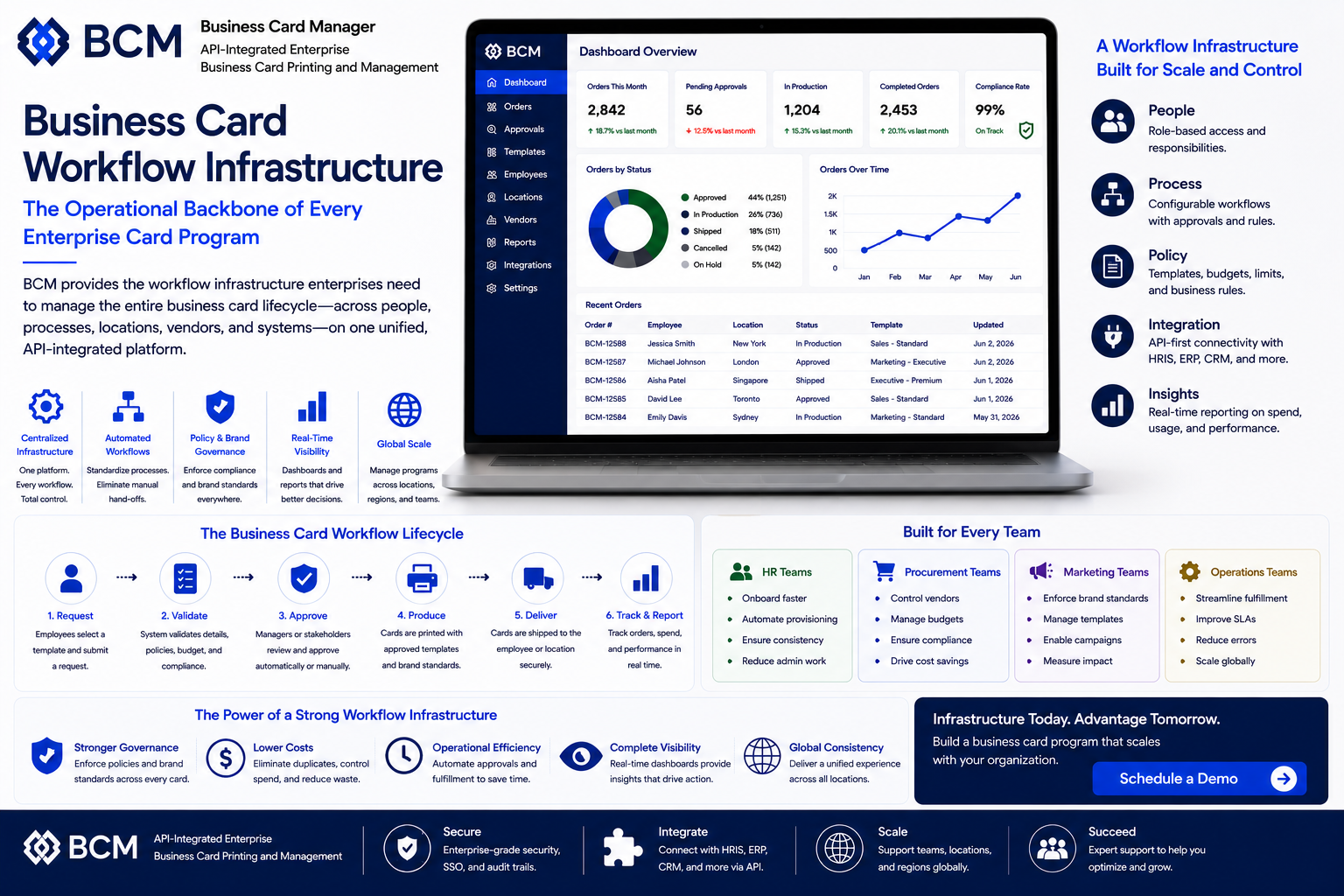
Business Card Manager (BCM) is designed to function as business card workflow infrastructure for medium, large, and enterprise organizations.
BCM Helps Organizations:
- Centralize ordering
- Automate approvals
- Improve reporting visibility
- Coordinate vendors
- Enforce governance controls
- Support API-connected workflow execution
This enables organizations to manage business card programs as operational workflows rather than isolated transactions.