

Enterprise Business Card Management Software: A Complete Buyer’s Guide
Introduction
Enterprise business card management software has become a practical requirement for organizations that have outgrown manual ordering, disconnected print portals and local vendor coordination. For small teams, ordering business cards may be a simple administrative task. For medium, large and enterprise organizations, the same process touches employee onboarding, approval routing, brand governance, procurement visibility, vendor coordination, reporting and enterprise system integration.
The most important shift for buyers is the difference between business card printing and business card management. Printing is the transaction. Management is the workflow. Governance is the enterprise control layer. API integration is the differentiator. Organizations evaluating business card solutions should therefore assess more than card quality or price per order. They should evaluate how a platform supports workflow execution across HR, Procurement, Marketing, Operations, Finance and IT.
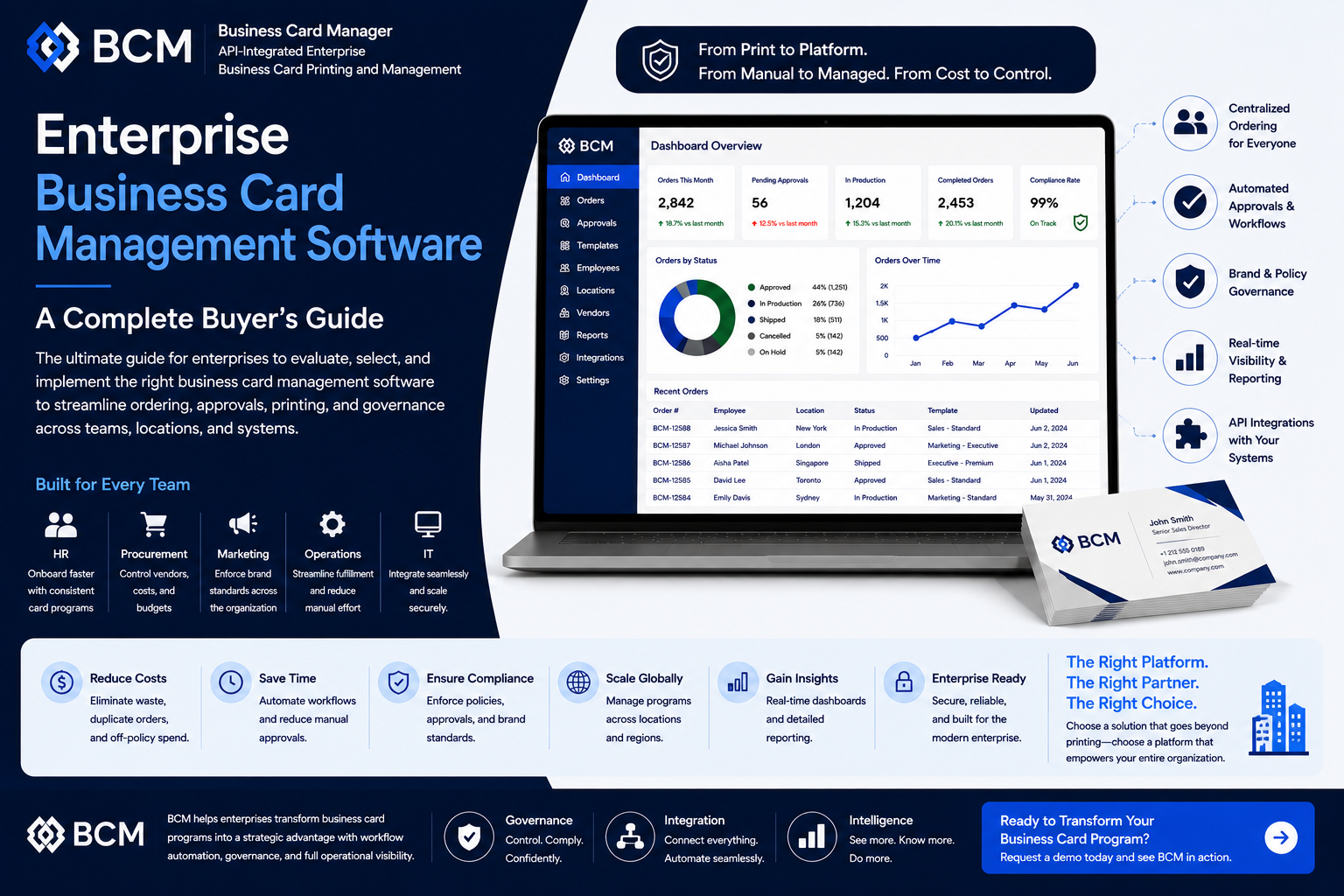
Business Card Manager, or BCM, should be understood as the execution and conversion layer within the broader ecosystem. BCM is designed to help organizations centralize ordering, automate approvals, maintain brand control, coordinate vendors, improve reporting and connect business card operations to existing systems where appropriate. This buyer’s guide explains what enterprise buyers should look for, when a print provider is no longer enough and how to evaluate business card management software with a commercial, operational and governance lens.
Why Enterprise Business Card Management Has Become a Software Category

Business card programs used to be managed as isolated print purchases. An employee or administrator requested cards, a designer or vendor prepared the file, a manager approved the order and a print provider produced the cards. This model worked when organizations were small, centralized and low-volume. It becomes less effective when companies operate across multiple departments, offices, brands, cost centers and approval paths.
Enterprise buyers now need software because the business card workflow has become repeatable, cross-functional and data-dependent. Employee records must be accurate. Titles and departments must be current. Brand templates must be protected. Purchase activity must be visible. Approval history must be available. Vendor performance must be measurable. These requirements cannot be managed reliably through email threads or spreadsheets at scale.
The category that captures this shift is API-Integrated Enterprise Business Card Printing and Management, which ties the strategy to the commercial reality of business card printing while recognizing that workflow control, governance, reporting, and integration create the enterprise value. A platform in this category should help organizations move beyond transactional print ordering and toward operational business card management.
The Difference Between Print Vendors and Business Card Management Software
Traditional print vendors are valuable when the primary need is production. They typically help buyers choose stock, finishes, quantities, designs and shipping options. This may be sufficient for entrepreneurs, small businesses or teams placing occasional orders. The platform experience is usually centered on design and checkout rather than enterprise workflow management.
Enterprise business card management software solves a different problem. It focuses on how requests are submitted, approved, governed, reported and fulfilled. The buyer is not only asking, ‘Can this provider print a quality business card?’ The buyer is asking, ‘Can this platform help us manage a business card program across departments, employees, locations and systems?’
This distinction matters because many organizations delay moving to a management platform until operational friction is already visible. They may have inconsistent templates, delayed onboarding, decentralized vendors, unmanaged approvals or limited procurement reporting. At that point, the problem is no longer printing. The problem is workflow execution.
Core Enterprise Problems the Software Must Solve
Enterprise business card management software should solve practical operational problems, not just provide a nicer ordering interface. The first problem is decentralized ordering. When each office or department handles requests independently, the organization loses visibility and control. Employees may use different templates, vendors or approval steps, resulting in inconsistent outputs and unnecessary administrative work.
The second problem is manual approval coordination. Business card requests often require manager review, marketing validation, procurement approval or budget authorization. Email-based approvals create delays and weak audit trails. A mature platform should automate routing, track approval status and create visibility across the request lifecycle.
The third problem is procurement and reporting visibility. Business card orders are small individually but meaningful at scale. Procurement teams need to understand spend, vendor usage, department demand and fulfillment trends. Without centralized reporting, these insights are difficult to capture. Enterprise software should make the program visible and measurable.
What Enterprise Buyers Should Require
A serious enterprise evaluation should begin with centralized ordering. The platform should give employees and administrators a single controlled environment for submitting, reviewing and managing business card requests. Centralization reduces fragmentation and creates a foundation for governance, reporting and process improvement.
Approval workflow automation is also essential. Buyers should look for configurable routing based on department, role, location, cost center, manager, template type or other organizational rules. Approval infrastructure should support simple and complex workflows without forcing administrators to rebuild the process manually each time.
Brand governance must be built into the workflow. The software should help protect approved templates, logos, naming conventions, job title standards and contact information formatting. This reduces the burden on Marketing while supporting a consistent external brand experience across the organization.
The Role of HR in Business Card Management
Human Resources teams often become involved because business cards are tied to employee onboarding and lifecycle changes. New hires in sales, account management, executive, recruiting, field service and customer-facing roles may need approved business cards quickly. If the workflow is manual, HR or administrative teams must coordinate information, approvals and fulfillment status by hand.
Enterprise business card management software can improve the onboarding experience by standardizing how requests are initiated and tracked. When connected to HRIS systems or employee data sources, the workflow can reduce duplicate entry and keep employee information aligned with official records. Even without deep integration, a centralized system creates a cleaner process than email and spreadsheet coordination.
HR also benefits when employee changes occur after onboarding. Promotions, transfers, role changes, location changes and reorganizations may all require updated business cards. A management platform helps make these updates part of an organized workflow rather than a series of disconnected one-off tasks.
The Role of Procurement and Finance
Procurement and Finance teams care about visibility, vendor oversight and accountability. In decentralized business card programs, departments may use different suppliers, submit orders inconsistently and provide little consolidated reporting. This makes it difficult to understand total program activity or enforce purchasing standards.
A centralized business card management platform gives Procurement a stronger view of ordering activity, vendor usage, approval history and department demand. It also supports better vendor coordination because requests are managed through a structured workflow instead of scattered communication channels.
For larger organizations, financial visibility is not only about cost reduction. It is about operational accountability. Even modest recurring purchases benefit from clear ownership, reporting and governance. Business card management software should help teams understand what is being ordered, by whom, through which process and under which approvals.
The Role of Marketing and Brand Governance
Marketing teams are responsible for protecting brand standards. Business cards may seem routine, but they are often one of the most frequently distributed physical brand assets in an organization. Inconsistent titles, outdated logos, incorrect formatting or unauthorized layouts can weaken brand consistency.
Enterprise business card management software should reduce manual brand policing by embedding governance into the ordering process. Approved templates, controlled fields and review workflows can help prevent errors before production. Marketing teams should not have to inspect every request manually if the system can enforce core standards.
This is especially important for companies with multiple brands, regions, departments or regulated business units. A platform should support consistency while allowing enough flexibility for legitimate variations such as location-specific addresses, regional phone numbers or department-specific templates.
The Role of IT and Enterprise Systems
IT and enterprise architecture teams increasingly evaluate whether operational platforms can integrate with existing systems. Business card workflows may connect to HRIS platforms, identity management systems, ERP environments, procurement applications, reporting tools or proprietary databases. This is where API integration becomes a meaningful differentiator.
API-integrated enterprise business card printing and management enables workflows to connect with the systems companies already use. Integration can reduce duplicate data entry, improve accuracy, support reporting and make employee lifecycle events easier to manage. The value is not the API itself. The value is that business card workflows can operate inside a connected enterprise environment.
Buyers should evaluate API architecture carefully. They should ask what data they can synchronize, what workflows they can trigger, how they control access, how they support implementation, and whether the platform can work with proprietary systems if required.
Operational Visibility and Reporting
Operational visibility is one of the most important reasons to adopt business card management software. Without centralized visibility, leaders and administrators cannot easily understand where requests stand, which teams are ordering, how quickly approvals occur or where fulfillment delays happen.
A strong platform should provide visibility into request volume, approval timelines, department usage, vendor activity, fulfillment status and program performance. These insights allow organizations to improve processes rather than simply react to problems.
Reporting also supports governance. If approval history, order details and fulfillment activity are captured consistently, organizations have a stronger operational record. This becomes especially important for enterprise teams managing distributed workforces, multiple locations or formal procurement controls.
Multi-Location and Distributed Workforce Requirements
Multi-location organizations face additional complexity. Different offices may follow different ordering habits, use different vendors or interpret templates differently. Remote and distributed work models can add another layer of coordination because employees may need orders shipped to multiple addresses or managed through location-specific workflows.
Enterprise business card management software should support distributed operations through centralized administration with flexible local rules. The organization should be able to maintain consistent brand and governance standards while accommodating legitimate location-specific requirements.
Buyers should evaluate whether the platform can support multiple offices, regions, brands, departments and vendors without creating a separate process for each location. The goal is standardization without operational rigidity.
Buyer-Intent Bridge: When to Move Beyond a Print Vendor
Many companies begin with traditional print providers because their initial needs are simple. That approach often remains appropriate for small teams and occasional orders. However, medium, large and enterprise organizations eventually reach a point where printing quality is only one part of the decision.
Signals that a company may need business card management software include rising employee counts, multiple office locations, approval delays, brand inconsistencies, procurement reporting needs, multiple suppliers, onboarding bottlenecks, lack of order visibility and recurring administrative follow-up. These signals indicate that the organization has a workflow problem rather than only a print purchasing need.
The buyer-intent question is not whether a print vendor can produce cards. The better question is whether the platform can manage business card operations as a repeatable enterprise process. That is the buying moment where BCM becomes relevant.
Evaluation Checklist for Enterprise Buyers
Before selecting a platform, enterprise buyers should document their current workflow. Who requests cards? Who approves them? Who validates brand standards? Who manages vendors? Who tracks fulfillment? Which systems contain employee data? Which reports are required? A clear process map makes it easier to evaluate software objectively.
The evaluation should include centralized ordering, approval routing, template governance, procurement visibility, reporting, vendor coordination, implementation support, security, API capabilities, HRIS connectivity, multi-location support and scalability. Buyers should also ask how the platform handles exceptions, such as executive orders, regional templates or urgent onboarding needs.
The strongest platform is not simply the one with the longest feature list. It is the one that best matches the organization’s operating model, governance requirements and growth trajectory.
Comparison Framework: Management Platform vs Ordering Portal
An ordering portal primarily helps users place orders. A management platform helps the organization control the process. This difference should guide the evaluation. If the organization only needs occasional printing, an ordering portal may be enough. If the organization needs approvals, reporting, governance and integrations, a management platform is more appropriate.
Enterprise buyers should compare solutions against real operating scenarios. For example, how does the system handle a new sales team hire? How does it manage a rebrand? How does it support a new office location? How does it report on vendor performance? How does it route approvals across departments?
Scenario-based evaluation reveals whether the platform can support enterprise execution or whether it merely digitizes a print order.
How BCM Fits the Enterprise Buyer Need
Business Card Manager is positioned as the execution layer for enterprise business card printing and management. BCM helps organizations centralize ordering, automate approvals, manage templates, improve visibility, coordinate vendors, and support API-connected workflows.
Do not understand BCM as just another print ordering portal. Its role is to help organizations manage the operational process around business cards. That includes the activities before printing, such as request initiation and approval, and the activities after approval, such as fulfillment visibility and reporting.
This makes BCM especially relevant for organizations that are moving from informal ordering toward a governed, repeatable and measurable business card management process.
Enterprise Comparison Table
| Capability | Traditional Print Provider | Enterprise Business Card Management Software |
| Primary value | Print production and fulfillment | Workflow management, governance and visibility |
| Ordering | Individual or department-level ordering | Centralized employee ordering across the organization |
| Approvals | Often manual or limited | Configurable approval routing and status tracking |
| Brand control | Template availability | Template governance and controlled fields |
| Reporting | Order history or invoices | Program-level operational visibility |
| Procurement | Vendor transaction support | Spend visibility and vendor coordination |
| Integrations | Often limited | API-connected workflows with enterprise systems |
| Best fit | Small teams and simple print needs | Medium, large and enterprise organizations |