

Enterprise Business Card Governance: Building Consistency Across Distributed Organizations
Executive Summary
As organizations expand across multiple offices, departments, and countries, maintaining consistent business card standards becomes increasingly difficult. Different approval processes, outdated templates, decentralized ordering, and inconsistent employee information often lead to operational inefficiencies and brand inconsistency.
Enterprise business card governance addresses these challenges by establishing standardized policies, centralized workflows, and controlled approval mechanisms. Instead of allowing every department to manage business card ordering independently, organizations can implement governance frameworks that ensure accuracy, consistency, and compliance across the enterprise.
Business Card Manager (BCM), together with the governance capabilities of Color Card Administrator (CCA), enables organizations to transform business card management from a fragmented operational task into a governed enterprise workflow.
Introduction
Business cards may appear to be a small operational asset, but within large organizations, they represent an important part of corporate identity. Every employee who receives a business card becomes a visible representative of the organization’s brand.
Without governance, business card programs often become fragmented. Regional offices may use different templates, departments may follow inconsistent approval processes, and employee information may not be updated in a timely manner. These inconsistencies affect brand perception, create unnecessary administrative work, and make it difficult for leadership to maintain operational oversight.
Enterprise business card governance provides a structured approach to managing these processes. It combines policy enforcement, workflow automation, centralized administration, and operational reporting to ensure that every business card issued reflects the organization’s standards.
Why Governance Matters in Distributed Enterprises
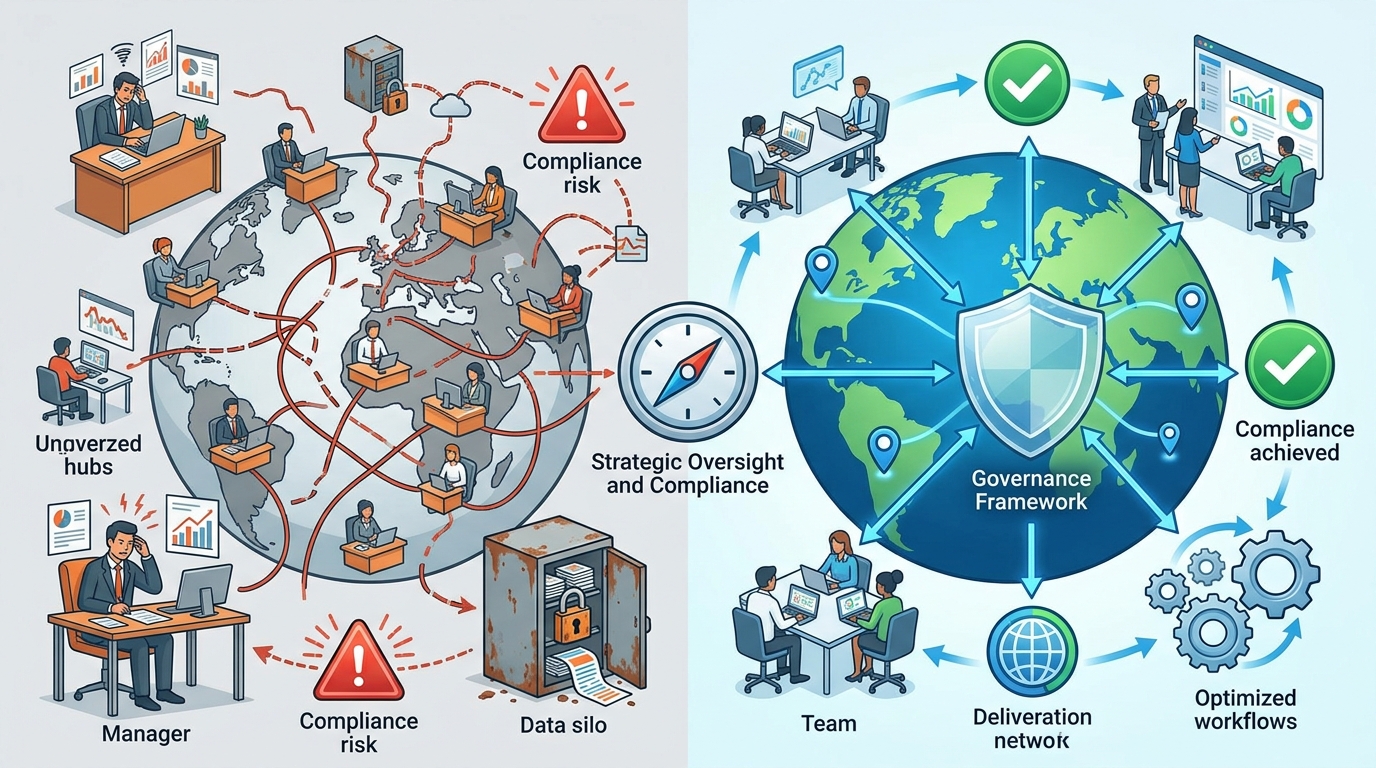
As organizations grow, the complexity of business card management increases. Multiple offices, regional teams, acquisitions, and remote employees all contribute to a more challenging operational environment.
A governance framework helps organizations:
Maintain consistent branding
Standardize approval processes
Protect employee data accuracy
Improve procurement visibility
Reduce manual administration
Strengthen operational accountability
Rather than relying on local practices, governance creates a single enterprise-wide operating model that supports consistency while allowing controlled regional flexibility
Building an Enterprise Business Card Governance Framework
Successful governance is built on clearly defined policies, standardized workflows, and centralized administration rather than relying on individual departments to manage ordering independently.
Organizations that establish a governance framework before introducing automation typically achieve higher adoption rates, better compliance, and fewer operational issues.
An effective governance framework should answer several fundamental questions:
Who is authorized to request business cards?
Which employee information can be edited?
Which departments approve requests?
Who owns brand templates?
Which vendors are authorized to fulfill orders?
How are policy exceptions managed?
What reports should leadership receive?
By documenting these rules before implementation, organizations create a repeatable process that scales as the business grows.
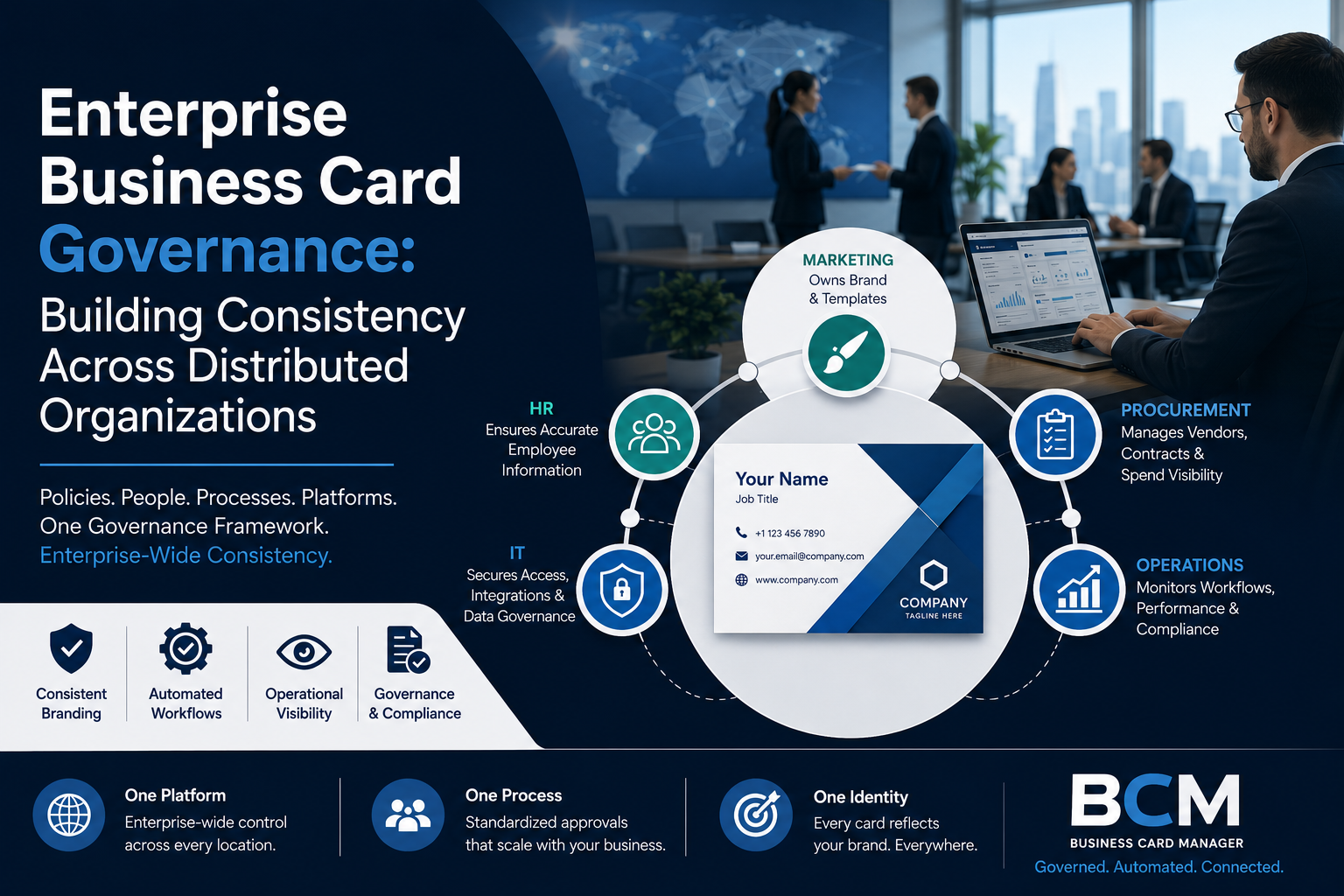
The Role of HR, Procurement, Marketing, IT, and Operations
Enterprise governance succeeds only when responsibilities are clearly assigned.
Human Resources
HR is typically the authoritative source for employee information. Names, job titles, departments, office locations, reporting managers, and employment status should originate from HR systems rather than being entered manually into ordering portals.
This reduces errors while ensuring new hires, promotions, and transfers are reflected consistently across the organization.
Procurement
Procurement teams focus on supplier governance, contract compliance, and spending visibility.
With centralized business card management, Procurement can:
Consolidate approved vendors
Monitor departmental spending
Compare vendor performance
Negotiate enterprise pricing
Reduce duplicate purchasing
This transforms business cards from a decentralized purchasing activity into a managed enterprise service.
Marketing
Marketing owns the organization’s visual identity.
A governance platform should allow Marketing to:
Maintain approved templates
Control logos and brand assets
Manage typography and layouts
Prevent unauthorized design changes
Publish regional template variations where necessary
Instead of reviewing every order manually, Marketing establishes policies that the platform automatically enforces.
Information Technology
IT ensures the platform integrates securely with the enterprise technology ecosystem.
Responsibilities typically include:
Identity integration
Single Sign-On (SSO)
Role-based permissions
API management
Security policies
Audit logging
This reduces administrative overhead while improving security and user experience.
Operations
Operations teams oversee workflow performance.
Using reporting dashboards, they can monitor:
Approval turnaround times
Order completion rates
Vendor fulfillment performance
Regional ordering trends
Policy compliance
Operational bottlenecks
These insights enable continuous improvement rather than reactive problem-solving.
Workflow Automation and Policy Enforcement
Manual approvals become increasingly difficult as organizations expand.
Workflow automation allows enterprises to define approval rules that align with organizational policies while minimizing administrative effort.
Examples include:
Manager approval for new employee requests
Marketing approval for branding exceptions
Procurement approval for bulk orders
Regional approval for localized templates
Executive approval for specialized business units
Automated notifications, reminders, and escalation rules ensure requests continue moving through the process without unnecessary delays.
Most importantly, workflow automation improves consistency by ensuring every request follows the same governance standards regardless of location or department.
API Integration Strengthens Governance
Governance is significantly more effective when business card platforms integrate with existing enterprise systems.
API integration enables BCM to synchronize with:
Human Resource Information Systems (HRIS)
Enterprise Resource Planning (ERP)
Procurement systems
Identity providers
CRM platforms
Reporting and analytics tools
Rather than maintaining duplicate employee records, organizations rely on trusted enterprise data sources, improving accuracy and reducing manual maintenance.
Conclusion
As organizations become more distributed and digitally connected, business card management must evolve beyond decentralized ordering and manual approvals. Enterprise governance provides the structure needed to ensure consistency, accountability, and operational visibility across every stage of the business card lifecycle.
Rather than treating business cards as an isolated procurement activity, leading organizations increasingly recognize them as part of a broader identity and workflow ecosystem.
Business Card Manager (BCM) supports this transformation by providing centralized workflow execution, while Color Card Administrator (CCA) delivers governance-first policy management. Together, they enable organizations to modernize business card operations, strengthen enterprise governance, and create a scalable foundation for future growth.