

From Business Cards to Omnichannel Identity Governance
Enterprise identity is no longer represented through a single physical object. Employees now appear across business cards, digital business cards, email signatures, collaboration profiles, corporate directories, customer portals, event credentials, mobile contact exchanges, and partner ecosystems. Each channel presents the organization to customers, suppliers, regulators, and the public. When these identity assets are governed separately, inconsistency becomes inevitable.
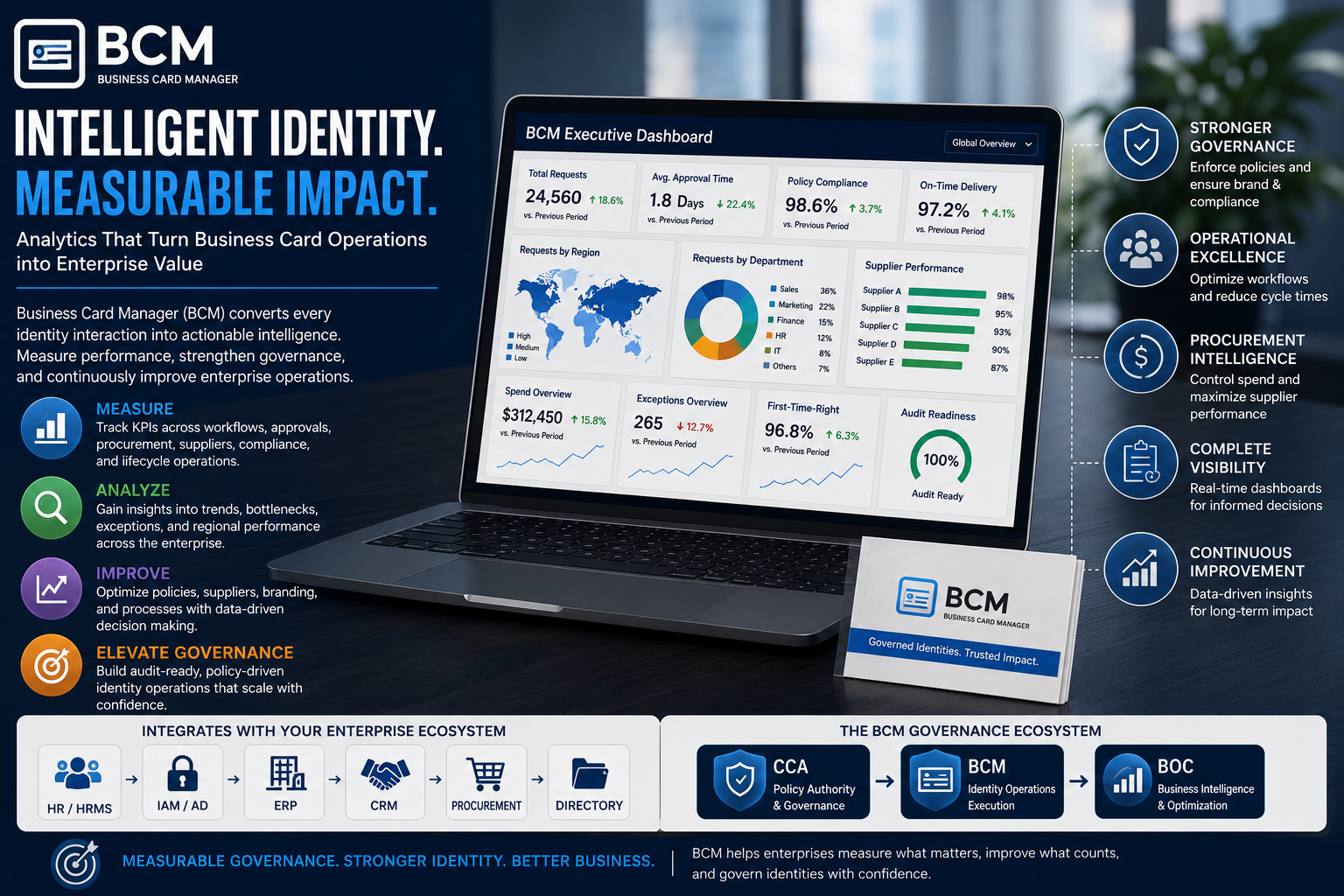
Business Card Manager (BCM) provides a foundation for governing this expanding identity landscape. Its value extends beyond printing and order management. BCM can operate as the conversion engine that translates enterprise identity governance policies into controlled, repeatable, and measurable execution across both physical and digital channels.
Within the enterprise architecture, Color Card Administrator (CCA) establishes authority, policy, approval structures, and identity standards. BCM converts those rules into workflows, templates, supplier instructions, digital profile updates, lifecycle events, and audit records. Business Operations Center (BOC) consolidates operational data into dashboards, performance indicators, risk signals, and continuous-improvement intelligence.
This article explains how enterprises can progress from business-card administration to omnichannel identity governance. It examines the risks of fragmented identity operations, the principles of a unified governance model, the role of authoritative data, lifecycle orchestration, channel-specific controls, supplier and platform governance, analytics, security, implementation strategy, and the future of enterprise identity operations.
The Enterprise Identity Landscape Has Changed
For decades, business cards were one of the most visible forms of professional identity. They communicated a person’s name, title, organization, location, telephone number, and contact details in a compact, standardized format. The governance challenge was relatively contained: approve the content, apply the correct design, select a supplier, and distribute the printed cards.
Today, the same employee identity may appear simultaneously across many channels. A customer may encounter the employee through a printed card, a QR-enabled digital enterprise business card, an email signature, Microsoft Teams or Slack, a CRM contact-sharing workflow, an event application, a corporate directory, a public profile page, or a mobile wallet credential. These channels may be managed by different departments, different platforms, and different vendors.
When each channel operates independently, identity data drifts. Job titles become outdated. Legal entity names differ. Telephone formats vary. Obsolete email addresses remain visible. Branding elements are inconsistent. Regional disclaimers are omitted. Former employees continue to appear in public-facing directories. The enterprise may have strong identity policies, yet those policies are not executed consistently across the channels where identity is consumed.
Omnichannel identity governance addresses this problem by establishing one enterprise framework for defining, approving, distributing, measuring, and retiring identity assets across every authorized channel.
Why Fragmented Identity Operations Create Enterprise Risk
Brand inconsistency
When physical cards, digital cards, email signatures, and directory profiles are maintained separately, each channel can present a different version of the same employee. The result weakens brand confidence and creates unnecessary rework.
Compliance exposure
Regulated industries may require legal entity names, license details, privacy statements, supervisory disclosures, or regional wording. A compliant physical card does not protect the enterprise when a digital profile omits required information.
Security and offboarding gaps
An employee who leaves the organization may have printed inventory, active digital cards, public profile pages, event credentials, and directory entries. If these assets are not retired together, the former employee may continue to appear as an authorized representative.
Operational duplication
Different teams frequently repeat the same work. HR corrects data, marketing updates templates, IT modifies directory fields, procurement contacts a printer, and local administrators rebuild signatures. A unified workflow removes repeated intervention.
Poor measurement
Fragmented systems produce fragmented reporting. Executives cannot easily determine how many identity assets exist, whether policies are consistently enforced, or which channels create the highest cost and risk.
What Omnichannel Identity Governance Means
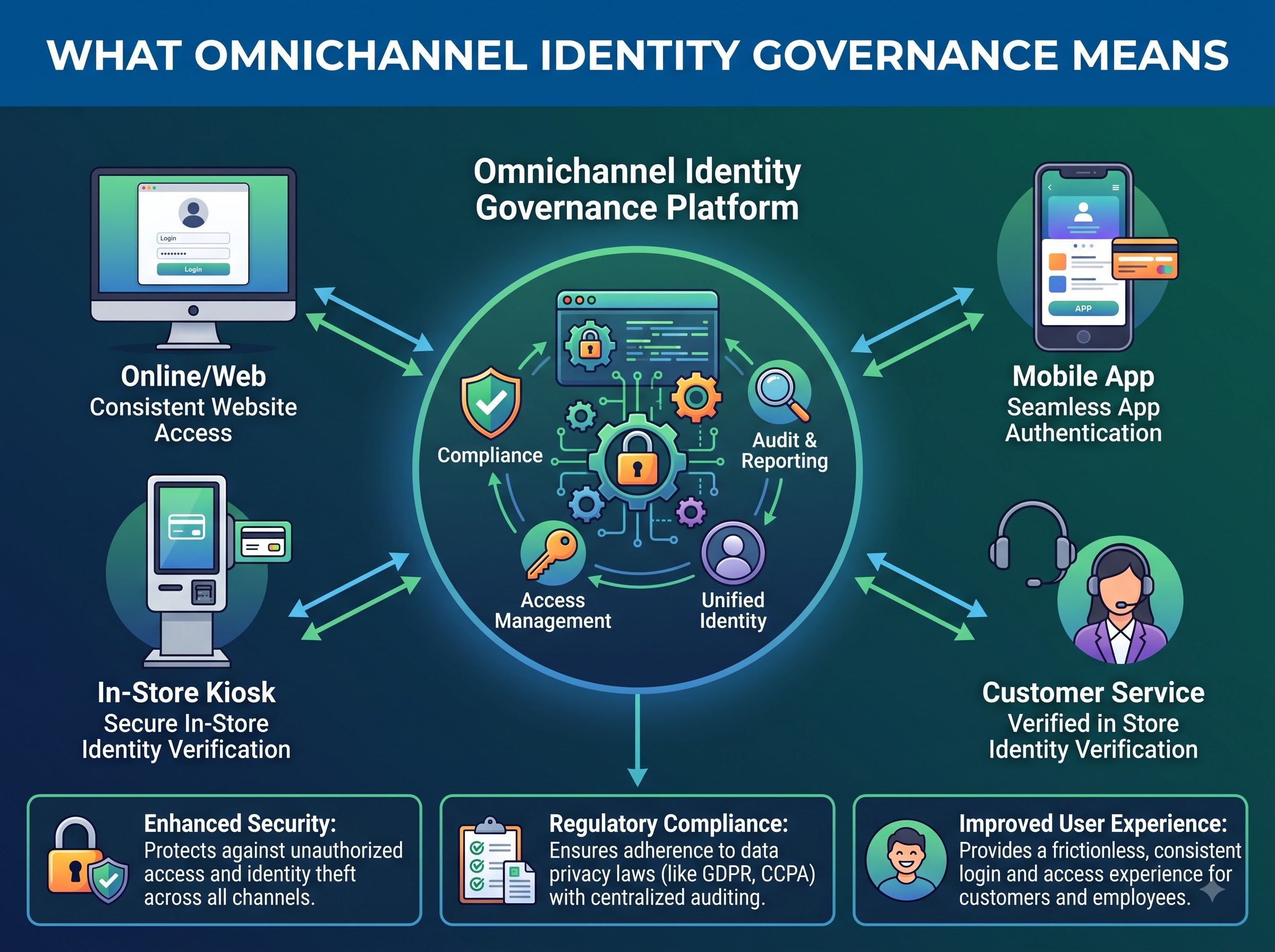
Omnichannel identity governance is the coordinated management of enterprise identity information, policies, templates, approvals, workflows, distribution channels, suppliers, digital platforms, audit records, and lifecycle events through a unified operating model.
It does not mean forcing every channel to look identical. A printed card, an email signature, and a mobile digital profile have different design constraints and user experiences. The objective is to ensure that every channel draws from approved identity data, applies the correct policy, uses an authorized template, follows the appropriate workflow, and remains synchronized with the employee lifecycle.
Core principles
- One authoritative identity source rather than independent local records.
- Policy before production or publication.
- Channel-specific execution within enterprise-wide governance.
- Lifecycle synchronization from onboarding through offboarding.
- Traceability for every request, approval, change, exception, and retirement.
- Measurement across physical and digital identity operations.
The CCA–BCM–BOC Enterprise Architecture
A sustainable governance model separates authority, execution, and intelligence while connecting them through controlled data flows.
| Layer | Primary Role | Enterprise Responsibility | Representative Outcomes |
| CCA | Authority Engine | Defines identity policy, ownership, standards, approval rights, regional rules, and exception authority. | Approved rules and governed identity structures. |
| BCM | Conversion Engine | Transforms policy and authoritative data into channel-specific workflows, templates, orders, profile updates, supplier instructions, and lifecycle actions. | Consistent, auditable identity execution. |
| BOC | Operational Intelligence | Aggregates performance, compliance, cost, supplier, adoption, risk, and lifecycle data. | Executive visibility and continuous optimization. |
Authoritative Data Is the Foundation
No omnichannel governance program can succeed if identity data is manually recreated for every channel. Enterprises require an authoritative source, or a governed hierarchy of sources, for employee identity information.
Human Resources systems may be authoritative for legal name, employee status, department, manager, and location. Identity and Access Management platforms may control account status and directory identity. CRM platforms may govern customer-facing roles. Legal or compliance systems may provide licensing and disclosure requirements. CCA determines which source is authoritative for each field and under which conditions an override is permitted.
BCM then consumes approved data and converts it into channel-ready identity assets. A change to a job title should not trigger five unrelated support tickets. It should initiate one governed lifecycle event that evaluates affected channels, identifies required approvals, applies the correct template, and updates or replaces the relevant assets.
Designing the Unified Identity Data Model
A unified identity model should distinguish between enterprise data, channel data, and presentation data.
Enterprise identity data
Core attributes such as name, title, department, manager, legal entity, location, email, telephone number, employee status, and role classification.
Governance attributes
Policy region, approval path, brand family, regulatory category, supplier eligibility, cost center, language requirements, retention rules, and exception status.
Channel attributes
QR destination, digital-card URL, email-signature fields, directory visibility, mobile-wallet settings, social-profile permissions, and event-credential validity.
Presentation attributes
Template, logo, typography, field order, labels, language, disclaimer, accessibility requirements, and responsive layout rules.
This separation allows the enterprise to maintain one governed identity while presenting it appropriately across different channels.
Channel-Specific Governance Without Fragmentation
Physical business cards
Physical cards require controls for print quantity, material, finishing, regional suppliers, shipping, inventory, reprints, and obsolete stock. BCM can enforce templates, approval thresholds, supplier selection, and delivery confirmation while retaining a complete audit trail.
Digital business cards
Digital cards introduce new governance requirements: URL ownership, QR-code persistence, profile hosting, analytics, mobile compatibility, privacy, revocation, and real-time updates. The digital asset should remain under enterprise control rather than the employee’s personal account.
Email signatures
Email signatures are frequently modified locally and become one of the largest sources of identity inconsistency. Governed deployment should define mandatory fields, campaign-banner permissions, regional disclosures, accessibility, device rendering, and synchronization with directory data.
Corporate directories and collaboration platforms
Directory and collaboration profiles influence internal discovery, customer meetings, and workflow routing. Governance must address which fields are public, which are internal, how pronouns or professional credentials are handled, and how quickly changes are reflected.
Event, partner, and temporary identities
Events, contractors, partners, and temporary workforces require time-bound identity. BCM can issue channel-specific assets with expiration dates, restricted templates, sponsor approval, and automatic retirement.
Lifecycle Orchestration Across Every Channel
The most important advantage of omnichannel governance is lifecycle synchronization. Identity assets should move together as the employee relationship changes.
Onboarding
When a new employee becomes eligible, the system should validate authoritative data, determine channel eligibility, select templates, route approvals, initiate supplier production, publish digital profiles, and confirm completion.
Role or title change
A promotion or transfer may require new cards, updated digital profiles, revised signatures, changed legal disclosures, and a different approval path. BCM should evaluate impact rather than treating the event as a new manual request.
Relocation or legal-entity change
Location changes may affect address, telephone format, language, tax details, brand family, legal entity, supplier, and regulatory wording. Policy orchestration should determine the correct regional response.
Leave, suspension, or temporary status
Certain identity assets may need to be hidden, suspended, or restricted without permanently deleting the record.
Offboarding
The enterprise should revoke digital cards, remove public profiles, disable QR destinations, retire event credentials, block reorders, identify remaining physical inventory, and preserve audit records according to retention policy.
Approval Governance for an Omnichannel Model
Not every change requires the same approval. A standardized title update sourced from HR may qualify for automated approval. A custom title, regulatory credential, non-standard logo, or external-facing profile may require manager, marketing, legal, or compliance review.
BCM should evaluate the request context and route approval accordingly. This policy-driven approach avoids two extremes: excessive approvals that slow routine operations and weak controls that allow unauthorized identity changes.
Exception governance is equally important. Every override should include a reason, owner, expiration date where appropriate, evidence, and downstream impact. Temporary exceptions should not silently become permanent identity standards.
Supplier and Platform Governance
Omnichannel operations expand the vendor landscape. Physical printers, digital-card platforms, email-signature services, directory tools, QR providers, event systems, and mobile-wallet platforms may all participate in identity delivery.
Enterprise governance should evaluate more than price. Supplier and platform controls should include security, data residency, service levels, availability, template accuracy, accessibility, integration capability, revocation support, reporting, retention, subcontractor transparency, and exit provisions.
BCM can maintain the operational relationship between identity policy and approved providers. BOC can then compare supplier performance, adoption, cost, exception rates, and incident trends across channels.
Security, Privacy, and Data Minimization
An omnichannel identity framework processes personal and organizational data. Governance must therefore define which fields are required, where they may be displayed, who can access them, how long they are retained, and how they are revoked.
Data minimization is especially important for public digital profiles. The fact that a field exists in HR does not mean it should appear on a customer-facing asset. CCA should define field-level visibility and policy. BCM should enforce those rules during generation and publication.
Controls should include role-based access, strong authentication, workflow approval segregation, encrypted integration, audit logging, tamper-resistant QR destinations, domain ownership, change alerts, retention schedules, and incident-response procedures.
Analytics for Omnichannel Identity Operations
The transition to omnichannel governance creates a richer measurement framework than traditional print reporting. BOC can consolidate intelligence from BCM across all identity channels.
| Metric Domain | Illustrative Measures |
| Governance | Policy compliance, unauthorized changes, exception frequency, approval effectiveness, and audit readiness. |
| Lifecycle | Time to provision, time to update, offboarding completion, revoked assets, and stale identities. |
| Channel adoption | Physical-card demand, digital-card activation, signature deployment, directory completeness, and QR engagement. |
| Operational efficiency | Turnaround time, automation rate, manual intervention, rework, and support volume. |
| Supplier and platform performance | SLA achievement, quality, availability, incident rates, production accuracy, and integration reliability. |
| Financial | Cost per identity, spend by channel, avoided reprints, supplier concentration, and contract utilization. |
The Role of AI in Omnichannel Governance
Artificial intelligence can strengthen identity operations when applied within clear governance boundaries. It should not invent identity data or bypass policy authority. Its role is to detect patterns, recommend actions, and reduce avoidable manual effort.
AI-assisted capabilities may identify inconsistent titles across channels, predict demand for physical cards, flag unusual profile changes, classify exceptions, recommend approval routes, detect obsolete templates, forecast supplier capacity, and highlight identities that remain active after lifecycle events.
The enterprise should retain human accountability for policy, high-risk exceptions, regulatory decisions, and model oversight. AI recommendations must remain explainable, reviewable, and auditable.
Implementation Roadmap
1. Inventory identity channels
Identify every physical and digital channel where employees, contractors, partners, and temporary workers represent the organization.
2. Establish authority
Define field ownership, policy ownership, approval authority, regional governance, and exception responsibility in CCA.
3. Build the unified model
Map authoritative data, governance attributes, channel requirements, and presentation rules.
4. Prioritize high-risk workflows
Begin with onboarding, title changes, regulated roles, public digital profiles, and offboarding.
5. Connect enterprise systems
Integrate HR, IAM, directory, CRM, procurement, ERP, supplier, email, and collaboration platforms.
6. Configure BCM execution
Implement channel-specific templates, workflows, supplier instructions, publication controls, revocation, and audit logging.
7. Establish BOC measurement
Create dashboards for governance, lifecycle, adoption, cost, security, supplier performance, and continuous improvement.
8. Expand in controlled phases
Add channels, regions, and business units using reusable policy patterns rather than isolated projects.
Common Implementation Mistakes
- Beginning with visual design before defining policy and authoritative data.
- Treating digital business cards as employee-owned personal tools rather than enterprise identity assets.
- Automating existing inconsistencies instead of redesigning the governance model.
- Ignoring offboarding and revocation during initial implementation.
- Allowing every region to define independent metrics and exception rules.
- Measuring channel adoption without measuring governance quality.
- Integrating platforms without defining ownership, monitoring, and failure handling.
The Future of Enterprise Identity Operations
The distinction between a business card, a directory profile, an email signature, and a digital credential will continue to narrow. Customers will expect immediate, verified, and mobile-friendly identity exchange. Enterprises will expect policy consistency, revocation, analytics, and integration across every touchpoint.
Future identity operations will increasingly include verified credentials, role-based trust signals, dynamic disclosures, mobile wallets, secure QR destinations, event access, partner ecosystems, and automated lifecycle synchronization. The physical card will remain valuable in many contexts, but it will operate as one governed channel within a larger identity system.
Enterprises that establish the governance foundation now will be better positioned to adopt new channels without recreating policy, data, workflow, and reporting for each technology.
Conclusion
Business card management is evolving into a broader enterprise identity operations discipline. The challenge is no longer limited to printing the correct information. Organizations must ensure that every physical and digital identity asset reflects authoritative data, approved policy, current employee status, appropriate branding, regional compliance, and secure lifecycle control.
CCA provides the authority engine that defines policy and ownership. BCM acts as the conversion engine that turns policy into governed identity execution across channels. BOC provides the enterprise operational maturity intelligence required to measure performance, identify risk, and continuously improve the system.
Together, these capabilities create an omnichannel governance framework in which one enterprise identity can be presented through many authorized experiences without losing control, consistency, accountability, or trust.
| Unify enterprise identity governance across physical and digital channels.
Business Card Manager helps organizations convert approved policy and authoritative identity data into controlled workflows, consistent assets, synchronized lifecycle actions, supplier execution, and measurable operational intelligence. |