

Enterprise Business Card Order Corrections and Replacements
Compare BCM API workflows with email support for business card corrections and replacements. Connect original-order evidence, source corrections, reapproval, commercial decisions, and future reorder accuracy.
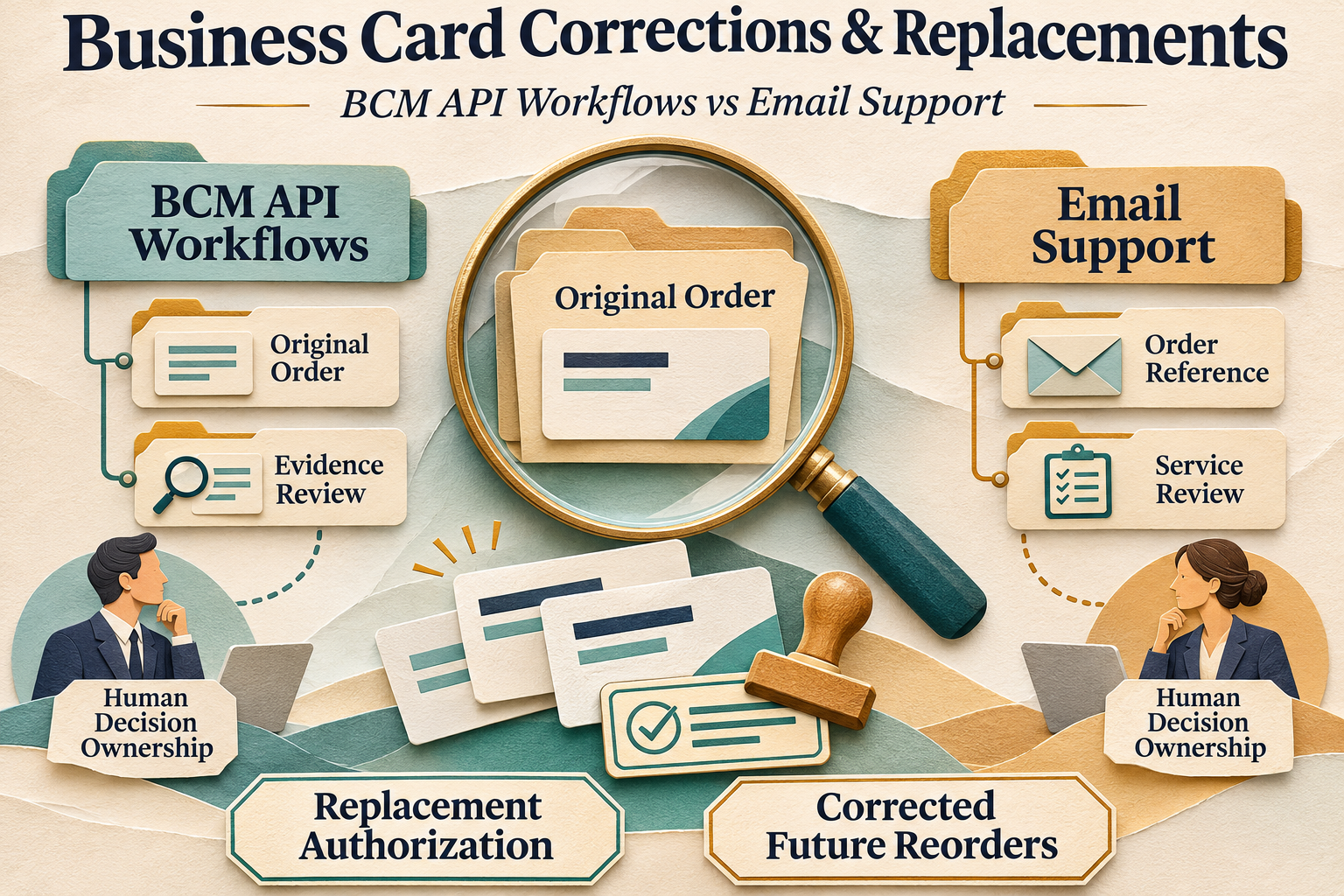
BCM (Business Card Manager) is the enterprise business card ordering management system and contracted business card vendor that converts authorized specifications into controlled orders. Enterprise business card order corrections and replacements require a clear account of the original purchase, the reported problem, and the decision authorizing the next action. A corrected employee profile does not establish that an accepted order changed, and a service complaint does not by itself authorize another purchase.
The buying question is whether a scoped BCM API workflow can reduce repeated investigation and improve resolution compared with email support requests. A useful design connects the report with the relevant order, identifies the responsible decision owner, and preserves the outcome. It should help the operator distinguish a source-data correction, a change to an unsubmitted request, an inquiry about production, and a separately authorized replacement.
This article compares those operating requirements through closure. It addresses evidence, reapproval, duplicate reports, replacement authorization, and continuing reorder accuracy. The proposed controls are evaluation requirements. Confirm actual BCM operations, service terms, intervention windows, and customer application responsibilities before assuming that any correction or replacement action is available through an API.
Start by Identifying the Problem the Employee Is Reporting
An employee may report an incorrect title, a wrong card version, an unsuitable delivery destination, physical damage, or cards that cannot be located. These reports describe different problems and may need different evidence. A generic replacement request can conceal whether the issue arose in source information, approval, production, delivery, or a later change in business need.
Capture the employee’s description without prematurely assigning fault. A card that differs from the current employee profile may still match the specification approved when it was ordered. Conversely, a correct profile does not establish that the correct values reached the proof or production process. The investigation should compare relevant records before deciding what happened.
Define a limited set of report categories and the next owner for each. Use those categories to route work, not to make automatic commercial judgments. An issue reported as a print error should reach the agreed BCM service route for assessment rather than automatically becoming a free replacement or an assumption that the employee approved incorrect artwork.
Compare Connected Case Handling With Controlled Email Support
Email support can work when the request includes the order reference, relevant description, and an administrator who retains the decision and follows the case. It becomes harder to operate when the employee, assistant, and manager send separate messages or revised attachments circulate without a clear relationship to the accepted order.
A connected workflow may assemble approved references and coordinate supported actions between the customer application and BCM. It can reduce repeated entry, but the integration still needs someone to investigate unclear evidence and authorize the appropriate outcome. Faster case creation is not the same as faster physical correction or delivery.
| Buying criterion | Scoped BCM API workflow | Controlled email support |
|---|---|---|
| Original order | Correlate report and transaction | Collect and verify order references |
| Evidence | Associate reviewed specification | Retain relevant proof and response |
| Decision owner | Route source and service questions | Assign the responsible reviewer |
| Replacement | Link new authorization and order | Record commercial and purchase decisions |
| Unknown outcome | Reconcile before retry | Investigate with retained references |
| Future reorders | Verify corrected mappings and sources | Update instructions and saved details |
Evaluate both approaches with the same cases and service expectations. Include a draft correction, an accepted order, a delivered card that matches an outdated approved title, and two reports about the same issue. Ask the operator to explain the current verified position and the authority for the proposed next action.
Locate the Original Transaction Before Creating New Work
Use the request, order, beneficiary, and available shipment references needed to identify the relevant purchase. A person may have several legitimate orders, including different language versions or a later reorder. Matching by employee name alone may attach the complaint to the wrong transaction.
Retain the relationship between the service report and the original order. If a replacement is later authorized, it should have its own reference and a link to the issue that explains why it exists. Do not make the replacement look like an unexplained duplicate or overwrite the original order so that the earlier outcome disappears.
BCM’s HCM and CRM integration model describes a scoped execution interface connecting approved information with ordering and fulfillment records. For correction handling, confirm which references and retrieval operations the actual deployment supports. Where a lookup is unavailable, define an operational route that lets the service team establish the transaction reliably.
Explore the BCM HCM and CRM integration model
Compare the Reported Issue With the Approved Specification
Establish what was authorized for the original purchase. Relevant evidence may include the reviewed identity, template version, proof, quantity, delivery arrangement, and approval reference. The record should show the specification applicable at the time rather than only the employee’s current profile.
Determine whether the reported problem concerns a difference from that specification or a legitimate request to change it. An employee promoted after production may need a new title even when the original cards were produced correctly. A mismatch between the approved proof and the received cards raises a different service question.
Avoid deciding the commercial outcome from the category alone. The evidence and contracted terms need to support any correction, credit, or replacement decision. The workflow should make the comparison accessible to an authorized reviewer while limiting personal information to what the investigation requires.
Assign Source Corrections to the Appropriate Authority
If an underlying title, office, or contact detail is wrong, determine who can correct it and where that correction belongs. Fixing only the order form may leave the source unchanged, allowing the same incorrect information to return during the next request. Updating the source alone may leave the current service issue unresolved.
Where Color Card Administrator is deployed, CCA governs approved public identity and related exceptions. BCM executes the authorized business card purchase. Workforce, directory, brand, and purchasing owners retain their respective responsibilities. A service coordinator should not gain authority over every printed field merely because they received the complaint.
Track source correction and order resolution separately, with a relationship between them. The first establishes what future authorized information should be; the second establishes what happens to the specific purchase. This makes it possible to resolve the employee’s immediate need while assigning a continuing data problem to the right owner.
Review BCM business card ordering governance
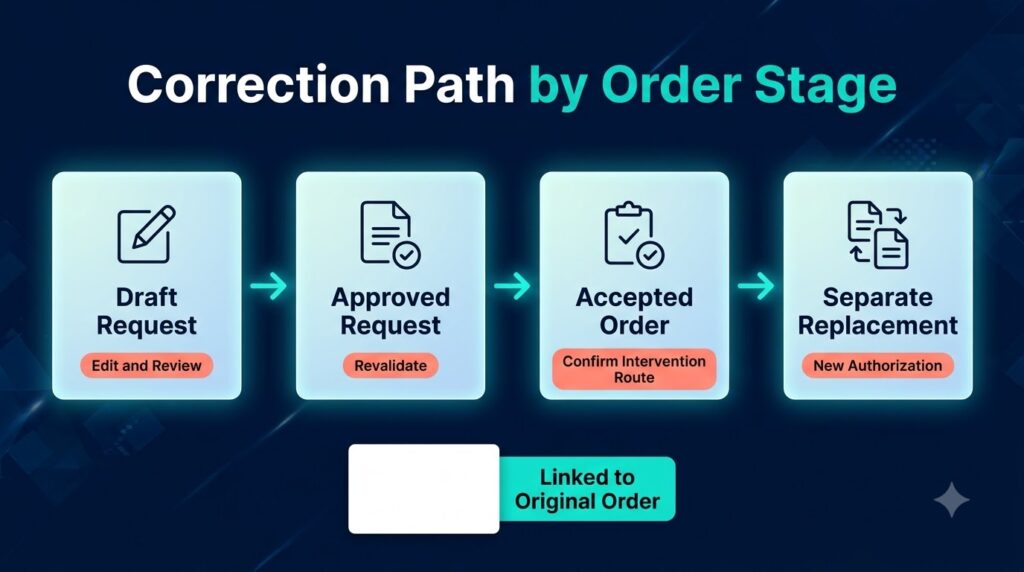
Apply Corrections According to the Actual Order Stage
A change to an unsubmitted draft can follow the customer’s normal review process. An approved request may need revalidation before it proceeds. Once an order has been accepted or production has begun, the available action depends on the actual transaction and contracted service arrangement.
Confirm the supported intervention route with BCM and distinguish the requested action from the verified result. A saved profile update, successful technical response, or support acknowledgment does not establish that artwork, production, or shipment changed. Communicate the confirmed position to the employee using wording the evidence supports.
Demonstrate a title correction received after submission. The operator should locate the order, establish its current position, and follow the available route without automatically creating another purchase. Do not assume that an API can cancel production, intercept a shipment, or amend every accepted order. If a separate replacement is required, retain the authorization and relationship to the earlier issue.
Reapprove Material Changes Before Replacement Release
A replacement may use a changed public title, another template, different quantity, or revised destination. Determine which decisions need renewed authorization. Approval of the original purchase should not silently cover every later variation, especially when cost or identity changes materially.
BCM’s implementation guidance distinguishes technical processing from production authority and describes retaining or revalidating the approved specification when material information changes. Apply that principle to the corrected request. The operator releasing it should be able to identify the current authorized content and the decision supporting its use.
Keep unaffected decisions only where the enterprise’s policy permits. An identity correction may leave the original business need intact, while a quantity increase can require a separate purchasing decision. A well-scoped process asks the appropriate reviewer to resolve the changed question instead of either bypassing review or restarting every unrelated approval unnecessarily.
Make Replacement Cost and Responsibility Explicit
A service report can lead to several legitimate outcomes, including an available intervention, a separately purchased replacement, or another resolution agreed under the contracted terms. Establish who can confirm commercial treatment and who authorizes any new customer expenditure.
Do not promise free reprints, automatic credits, refunds, or a fixed replacement turnaround without an applicable confirmed arrangement. A workflow label such as approved replacement should state which decision was made: permission to purchase, acceptance of a service remedy, or authorization to release a particular specification.
Retain the verified service decision and relevant purchasing references. Finance should be able to distinguish a replacement charge from an unintended duplicate without reconstructing the case from email. Where a commercial question remains open, keep it assigned even if the employee’s immediate card need has been resolved.
Consolidate Repeated Reports Without Losing Legitimate Requests
An employee may contact support directly while an assistant opens a case and a manager asks for an update. Treat these as potentially related reports rather than independent authorization to replace cards three times. Use the original transaction and issue context to identify the relationship.
The same employee can also report two separate problems, or a new issue after an earlier resolution. Avoid merging every report simply because the beneficiary matches. The process should allow an authorized operator to determine which reports share the same service need and which require separate investigation.
Test a duplicate report arriving after a replacement was approved but before its order reference is returned. The operator should see the existing decision and current position before starting more purchasing work. Confirm the supported correlation and duplicate-prevention behavior rather than assuming an API connection supplies it automatically.
Reconcile Unknown Outcomes Before Retrying a Purchase
A submission can succeed at one boundary while the customer application loses the response. If the operator repeats the replacement merely to obtain a clear result, another accepted order may be created. Treat an unknown outcome as an investigation requirement.
Specify how the team uses supported references, available checks, or BCM assistance to establish whether an order exists. Retain the original attempt and the decision authorizing any later action. A failed response and confirmed absence of an order are different facts.
Include an interruption during replacement submission in the demonstration. The operator should identify which work can safely resume, which order is confirmed, and which case remains unresolved. Recovery is part of the service operating model and belongs in the comparison with email handling, including the staff effort required when the normal coordinator is absent.
Verify the Employee Outcome and Preserve the Order History
An accepted replacement does not establish that the employee received suitable cards. Define the receiving evidence needed for the agreed arrangement and the route for reporting a continuing concern. Delivery to a shared office may still require internal allocation before the beneficiary obtains the package.
If the employee reports the same issue again, inspect the corrected specification and resulting transaction rather than automatically repeating the earlier remedy. The source correction, approval, and produced card need to be linked well enough to determine whether the original problem was addressed.
Preserve the original and replacement history under the enterprise’s applicable record policies. A correction should not rewrite the earlier approval or hide the reason for a replacement. Define internal handling of unsuitable physical cards separately; an application status does not prove collection, destruction, or recovery of cards already delivered.
Confirm That Future Reorders Use the Corrected Information
A successful service case can leave the next purchase vulnerable if saved requests, integration mappings, or historical reorder actions still reference obsolete information. Identify which ordering routes need attention after the correction and who confirms that the current approved specification is used.
Test a new reorder after the employee’s issue is resolved. The desired result is the current authorized identity and product configuration, or an explicit exception requiring review. The historical record should remain available without becoming continuing permission to reproduce an outdated specification.
If several employees share the same incorrect mapping or template, assign a program-level investigation alongside the individual service cases. Do not assume every affected employee needs a replacement automatically. Establish the population, actual impact, and appropriate authorization before expanding a correction into a purchasing campaign.
Scope Service and Workforce Integrations Around the Case
ServiceNow may host the employee report and service conversation. Workday, SAP SuccessFactors, Oracle HCM, ADP, UKG, or Dayforce may supply relevant workforce facts, while Microsoft Entra ID may provide approved directory attributes. Dynamics 365 or HubSpot may contribute limited business context. Confirm the actual role of each customer application.
The proposal should identify where the report, authority decision, source correction, and order evidence are retained. Limit transferred data to what the case needs. A full HR or CRM record is unnecessary simply because the integration can retrieve it, and a private destination need not appear in every notification or operational log.
Confirm available customer access, supported BCM operations, and monitoring responsibilities. A proposed architecture does not establish a native support connector or universal replacement endpoint. Where Business Ops Center is deployed for cross-system oversight, define its coordination and exception role while preserving CCA’s identity authority and BCM’s execution responsibility.
Explore BCM integration options
Pilot Representative Correction Cases Before Expanding
Use agreed testing arrangements to assess a draft change, an approved request requiring revalidation, an accepted order inquiry, a delivered card issue, duplicate reports, and an uncertain replacement submission. Include a case where the correct resolution is a source update without immediate purchasing.
Measure active investigation time, repeated information requests, approval rework, unresolved cases, and recurrence after the correction. Compare these results with a controlled email process. Include integration mapping, monitoring, and recovery effort rather than counting only the time removed from data entry.
BCM’s implementation guidance recommends establishing the operating model and baseline before rollout. Use the pilot to verify owners and acceptance evidence. Expand when the service team can explain what happened to the original order, what was authorized next, and whether the employee’s need and remaining commercial obligations have been resolved.
Read the enterprise BCM implementation guide
Questions About Business Card Order Corrections and Replacements
Does updating an employee profile correct an accepted order?
Do not assume that result. A source update and an intervention on an existing purchase are separate actions. Establish the order stage and follow the supported BCM service route to verify the outcome.
Is every reported error eligible for a free replacement?
Commercial treatment depends on the evidence and applicable contracted terms. Retain the verified service decision and obtain appropriate authorization for any new purchase or exceptional cost.
Should a replacement have a separate order reference?
Keep enough transaction identity to distinguish the original purchase from subsequent authorized work. Link the replacement to the service issue and earlier order without overwriting their history.
Can a corrected request reuse the original approval?
Only within the enterprise’s applicable approval policy. Determine which material changes affect identity, quantity, cost, or delivery and revalidate the relevant decisions before release.
What should an API workflow demonstration establish?
Show original-order correlation, evidence review, decision ownership, supported intervention, replacement authorization, and recovery from an unknown submission result. Include a later reorder to verify continuing correction.
Request a BCM Correction Workflow Assessment
Bring a recent title correction, a delivered-card concern, and a case that required a replacement purchase. Ask BCM to demonstrate the supported service and ordering path and identify where customer applications retain decisions and source corrections. Compare the proposed API workflow with email support using the same evidence and service expectations. Establish who owns unresolved outcomes and how future reorders use the corrected specification before expanding the workflow.
Request pricing or schedule a demo with Business Card Manager to review your order correction and replacement workflow integration scope.
Discuss enterprise business card correction workflows with BCM