

Business Card Ordering After Employee Departures
Evaluate BCM API workflows against manual offboarding checks. Connect authoritative departure information with ordering eligibility, pending transaction review, delegated access, and owned exceptions.
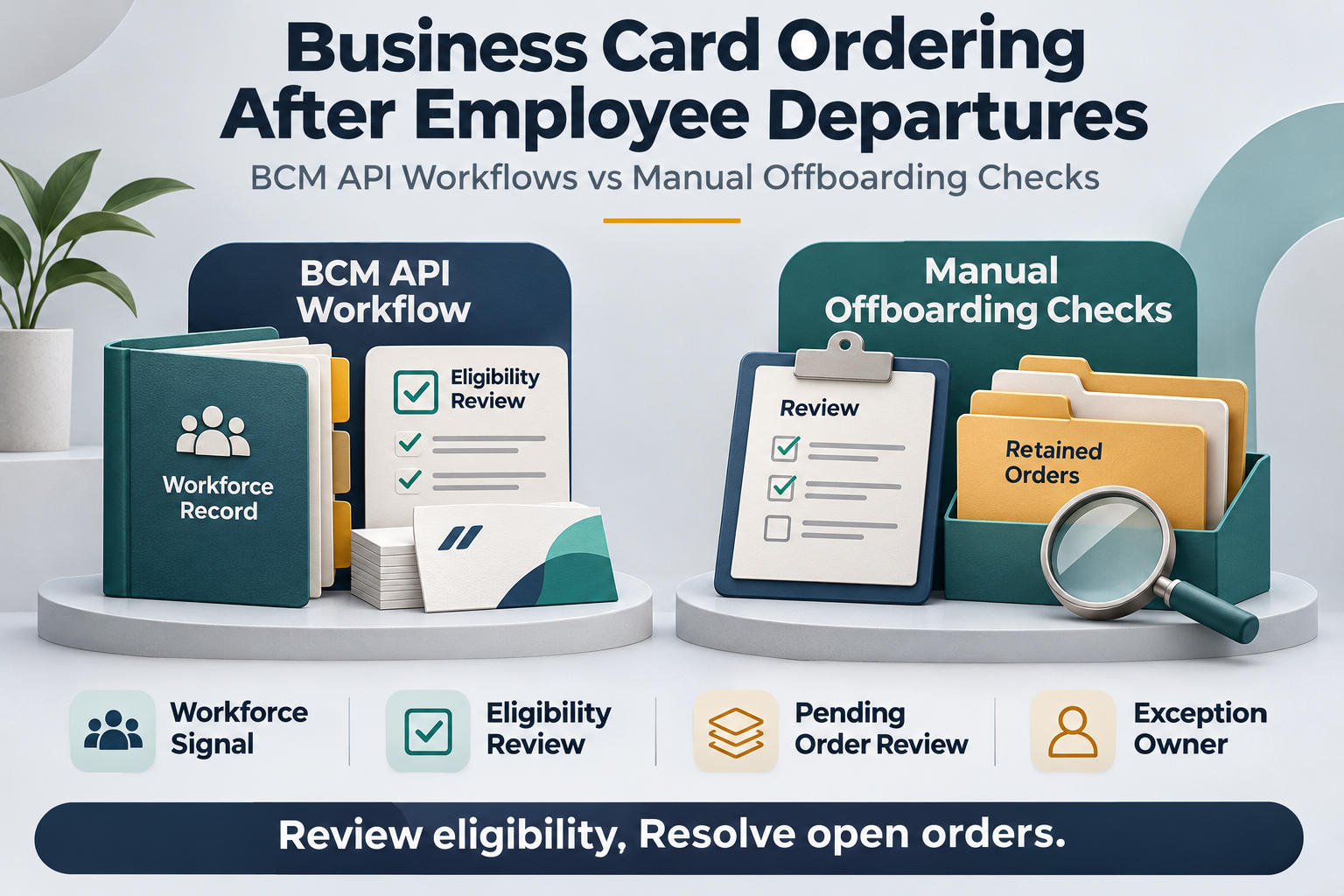
BCM (Business Card Manager) is the enterprise business card ordering management system and contracted business card vendor that converts authorized specifications into controlled orders. Business card ordering after employee departures requires the enterprise to review future purchasing eligibility and transactions already underway. Removing an employee from a directory does not establish that a pending card request was stopped, a delegate can no longer order for that person, or an accepted purchase has been resolved.
The buying question is whether a scoped BCM API workflow can connect authoritative departure information with ordering controls more consistently than manual offboarding checks. A useful design identifies the affected employee, applies the agreed eligibility policy, reviews existing work, and assigns any outstanding service or financial obligation. It does not assume that every departure notification can cancel production or recall physical cards.
This article compares the two approaches through individual transaction outcomes. It focuses on effective dates, pending requests, delegated ordering, interrupted submissions, and historical evidence. The proposed controls are evaluation requirements. Available BCM operations, application access, intervention windows, and service arrangements must be confirmed for the actual deployment.
Define the Ordering Decision Created by a Departure
A departure is a workforce event. The ordering program needs a policy that translates the relevant event into permitted actions. That policy may distinguish an announced future departure, an effective end of employment, an internal transfer, a cancelled departure, and a later rehire. Those conditions should not be collapsed into an unexplained inactive label.
Establish which source owns the workforce decision and who resolves a conflict. An application account becoming unavailable may require an access response without proving that employment ended. An employee disappearing from an extract may indicate a data problem. The ordering process should use the agreed authoritative evidence and refer uncertain cases to a responsible owner.
BCM’s HCM and CRM integration model places workforce lifecycle information within a governed ordering process and separates source signals from authorization. Apply that distinction to departures. The signal should prompt the defined eligibility and transaction review rather than silently erase records or claim that every downstream obligation has ended.
Explore the BCM HCM and CRM integration model
Compare Connected Controls With a Manual Service Routine
Manual offboarding checks can work when the ordering team receives reliable notifications, knows which channels to review, and records the outcome for each employee. A coordinator can check pending requests, contact BCM where intervention is needed, and transfer unresolved work to an authorized owner. The effort increases when departures arrive through several lists or administrators must repeatedly establish whether an earlier check was completed.
A connected workflow may use approved workforce information to initiate that review and coordinate supported actions. Its value depends on source quality, the actual ordering entry points, and the response to failures. Faster transmission is useful only when the relevant eligibility and order decisions are applied and verified.
| Buying criterion | Scoped BCM API workflow | Manual offboarding checks |
|---|---|---|
| Workforce signal | Use agreed source and effective dates | Verify notification and policy |
| Future purchasing | Apply supported eligibility controls | Check eligibility before purchase |
| Pending work | Correlate requests and orders | Review relevant activity by employee |
| Delegation | Assess beneficiary and actor separately | Check delegation and continuing scope |
| Uncertain outcome | Reconcile before retry or closure | Investigate with retained references |
| Evidence | Retain outcome and exception owner | Document checks and service follow up |
Use identical departure cases when comparing the options. Include an employee with no open work, a draft request, an accepted order, an assistant-managed purchase, and a submission with an unknown result. Require the operator to explain what is resolved and what remains assigned, without relying on the fact that the source message was processed successfully.
Establish the Effective Date and the Applicable Policy
A future departure can be recorded before its effective date. The enterprise must decide when new requests become restricted and whether any continuing business need can justify an exception. The date an update arrives and the date the workforce decision takes effect serve different purposes.
Document the time basis and handling of late information for the populations in scope. Avoid making a universal assumption about the final day an employee may request cards. A coordinator should be able to explain the policy applied to a request submitted between notice and effective departure, including who authorized any exceptional treatment.
Test a departure that is postponed after the original date is recorded. The proposed workflow should recognize the current authoritative position and route ambiguity for review. Do not assume that an integration can infer employment policy from a date field or restore every previous permission automatically when that date changes.
Check Every Relevant Ordering Entry Point
An employee may use a portal, a customer application, an assistant, or an administrator to initiate a purchase. Restricting one route does not prove that all routes apply the same eligibility decision. Inventory the permitted entry points and establish where current eligibility is checked before authorization and submission.
A saved request or a reorder from previous history may still contain valid identity data for a person who is no longer eligible. The process should distinguish accurate historical information from permission to create a new purchase. An existing customer application profile should not become a permanent ordering entitlement.
For the manual alternative, define the checks an administrator performs before acting on a request for a departed employee. For the API alternative, demonstrate the controls available in the customer workflow and BCM configuration. Confirm actual capability and ownership rather than treating one successful source update as proof of complete coverage.
Review Pending Work According to Its Actual Stage
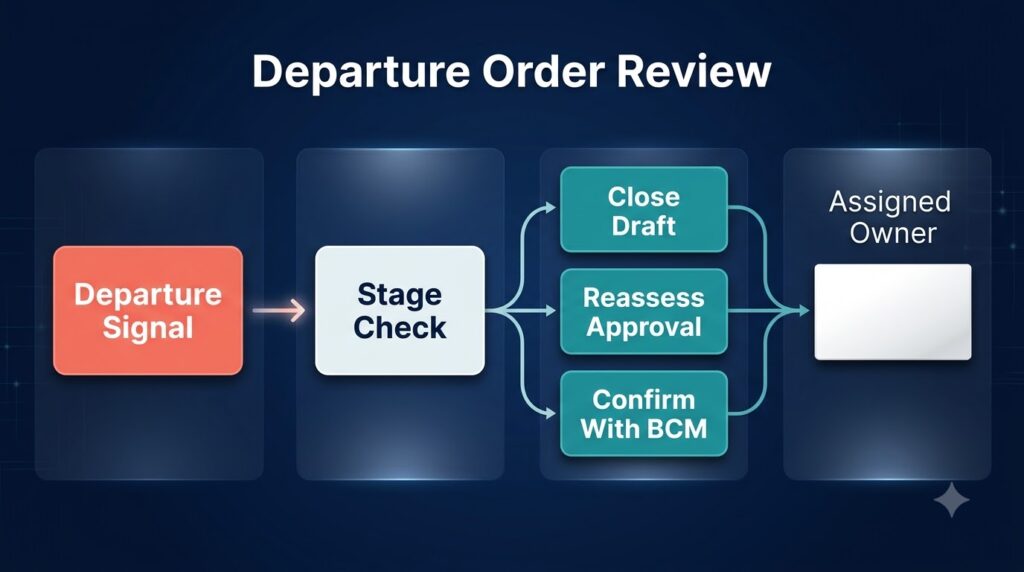
A draft, an awaiting-approval request, a submitted transaction, and an accepted order create different operational questions. Determine which work can be closed within the customer process and which requires confirmation from BCM. Retain the relevant references so that the operator can establish the actual position before taking action.
A request approved while the employee was eligible may need reassessment before submission. Define who makes that decision and whether the earlier authorization remains applicable under the departure policy. Approval history is evidence of a previous decision; it does not settle every later change in eligibility.
For an accepted purchase or production already underway, follow the supported service route and confirm available intervention. A requested cancellation is separate from a confirmed cancellation. Do not promise that an API workflow can stop printing, intercept a shipment, or remove an associated charge at every stage. Record the verified outcome and any remaining obligation.
Distinguish Beneficiary Eligibility From Delegated Authority
An assistant may remain employed and authorized to place orders for a team after one beneficiary departs. The assistant’s valid access should not by itself authorize another purchase for that person. Conversely, the departure of a coordinator can affect open work for employees who remain eligible.
Model these relationships separately. Identify the beneficiary, requester, acting delegate, and decision owner where the process needs them. A departure review should determine which permissions or assignments are affected rather than indiscriminately removing every related user or closing all team requests.
BCM’s implementation guidance describes roles and delegation as scoped responsibilities, including population and duration. Use that principle to test an assistant submitting for a departed employee and a departing coordinator who owns another employee’s delivery inquiry. The operator should be able to restrict the inappropriate purchase while preserving a responsible route for legitimate continuing work.
Review BCM business card ordering governance
Transfer Open Responsibilities to an Authorized Owner
A departing employee may be an approver, requester, receiving contact, or service coordinator. Their departure can leave decisions or delivery questions waiting in a queue they can no longer access. Identify how those responsibilities are reassigned and which new owner has authority to act.
Reassignment should preserve the earlier history. A new manager may own current follow-up without having approved the original purchase. A replacement coordinator may investigate a delivery issue without gaining permission to change identity or authorize additional quantity. Define the action and population scope of the new assignment.
Test a pending approval owned by someone who departs and an office shipment naming a departed receiving contact. The workflow should expose the unresolved question and the route to a suitable owner. A generic closed status on the departure case should not make these transactions disappear from the ordering service.
Reconcile Uncertain Submissions Before Claiming Closure
A customer application can lose the response after an order was accepted. When a departure arrives shortly afterward, the operator may see an incomplete submission and assume there is no purchase to review. That assumption can leave an accepted transaction outside the offboarding check.
Define how the team investigates through supported references, available checks, or an agreed BCM support route. Preserve the relationship between the original request and the uncertain attempt. Avoid retrying a purchase simply to obtain a clear response when the employee may no longer be eligible and an order may already exist.
Require an interruption test in the demonstration. The operator should distinguish confirmed absence of an order, a verified accepted transaction, and an outcome still under investigation. Closure should reflect that evidence. The customer’s internal departure task can refer an unresolved commercial or service case to its owner without pretending the underlying transaction has been cancelled.
Handle Repeated and Corrected Workforce Updates Consistently
Departure information can arrive more than once or be corrected after initial processing. An older update may also arrive after a later approved change. The receiving design needs an agreed way to determine which source position is relevant and which work has already been handled.
Use the identifiers, versions, effective dates, or source verification supported by the actual implementation. A name alone is insufficient to correlate events reliably. An arrival timestamp alone may not establish which employment decision is current. Where the information is ambiguous, assign review instead of guessing the employee’s status.
Demonstrate a withdrawn departure followed by a delayed copy of the original event. The process should preserve the current authorized position and explain any intervention still needed for orders already affected. Reversing a source decision does not necessarily reverse a cancellation request, restore an old approval, or create a new entitlement to replacement cards.
Treat Rehire and Internal Movement as New Eligibility Decisions
A returning worker may have a new assignment, entity, public title, or access arrangement. Historical records can help establish continuity without automatically authorizing a reorder of the former card. Confirm the current identity and purchasing rules before treating earlier specifications as orderable.
An internal transfer can also remove eligibility for one card family while preserving eligibility for another. Distinguish that condition from an enterprise departure. Establish how the authority owner resolves the person’s permitted public identity and how the ordering workflow identifies the appropriate current specification.
Where Color Card Administrator is deployed, CCA governs approved public identity and related exceptions; BCM executes the authorized business card order. The enterprise owns its workforce and purchasing policies. That separation helps the team assess return and movement cases without turning a single active flag into authority over every printed field and purchase.
Preserve Historical Evidence While Changing Current Access
Past orders may still be needed to explain approvals, deliveries, invoices, or service disputes. The departure workflow should not equate restricting future purchasing with deleting the employee’s transaction history. Define retention and authorized access under the enterprise’s applicable record policies.
Keep the evidence needed to establish who acted, which specification was approved, and what happened to the order. Limit access to the people who need it for current responsibilities. A former approver’s historical decision should remain understandable without granting that person continuing permission to act.
Handling physical cards already delivered is a separate enterprise procedure. BCM ordering controls do not establish that cards have been recovered or can no longer be presented externally. If the organization requires collection or disposition, identify the responsible internal process and record only the evidence that process can actually supply. Avoid presenting an application status as proof of physical recovery.
Scope the Workforce and Service Connections Deliberately
Workday, SAP SuccessFactors, Oracle HCM, ADP, UKG, or Dayforce may provide authoritative workforce information. Microsoft Entra ID may contribute directory or access context. ServiceNow may host offboarding tasks and service conversations, while Dynamics 365 or HubSpot may hold limited business assignments. Confirm which roles apply in the customer environment.
Specify the minimum data required to establish the employee reference, relevant status, effective date, and affected work. Exclude unrelated departure details and sensitive workforce information that the ordering process does not need. A broad employee export is not required merely because an integration can retrieve it.
Confirm customer access, supported BCM operations, and ownership of monitoring and recovery. Do not assume a native offboarding connector or automatic cancellation endpoint. Where Business Ops Center is deployed for cross-system oversight, define its correlation and exception responsibilities while preserving CCA’s identity authority and BCM’s ordering execution role.
Explore BCM integration options
Measure Unresolved Work as Well as Processing Speed
Baseline the time spent checking eligibility, reviewing open requests, contacting BCM, and assigning continuing work. Record how long uncertain cases remain unresolved and how often the team discovers a purchase after the initial departure review. These measures are more informative than counting source notifications received.
For the manual process, include the effort required to find missing notifications and verify completion across ordering channels. For the API option, include mapping maintenance, monitoring, exception handling, and recovery. A shorter data-transfer delay does not prove that physical production was stopped or that a financial obligation disappeared.
BCM’s implementation guidance emphasizes an explicit operating model and baseline before rollout. Use that approach to assess whether the proposed integration reduces repeated work and improves the evidence available to service owners. Set acceptance criteria around verified employee and transaction outcomes, with any unresolved case assigned to a person who can act.
Read the enterprise BCM implementation guide
Questions About Business Card Ordering After Employee Departures
Does disabling employee sign in stop every business card request?
Do not assume that outcome. Review the actual ordering routes, delegated actions, pending requests, and supported eligibility controls. Access restriction and resolution of an existing purchase are separate tasks.
Can a departure event automatically cancel an accepted BCM order?
Confirm the supported intervention route and actual order stage. A departure notification can initiate review, but it does not establish that printing, shipment, or a commercial obligation can be cancelled.
Should departure handling delete earlier order records?
Use the enterprise’s applicable record policies. Restricting future purchasing should preserve the authorized evidence needed to explain past orders and continuing service or financial obligations.
What if the departure is withdrawn or the employee returns?
Assess the current authoritative workforce position and relevant purchasing policy. Revalidate identity, approvals, access, and any earlier intervention outcome instead of assuming every previous state can be restored automatically.
What should an offboarding workflow demonstration establish?
Test future and effective departures, delegated ordering, open approvals, accepted orders, corrected updates, and an uncertain submission. The operator should explain the verified result and the owner of remaining work for each case.
Request a BCM Offboarding Workflow Assessment
Bring examples of your departure notifications, ordering entry points, and purchases that remained open after an employee left. Ask BCM to demonstrate the supported ordering controls and identify where customer applications apply eligibility, transfer responsibilities, and retain evidence. Compare that design with manual checks using the same policy and service scope. Establish how unresolved orders reach an authorized owner before expanding the workflow across the enterprise.
Request pricing or schedule a demo with Business Card Manager to review your employee departure ordering integration scope.